You hold a supercomputer in your hand that can instantly access the entirety of recorded human history, yet as an Ummah, we have rarely felt more spiritually confused. We scroll through hundreds of Islamic reminders a day, but how many of us actually know the foundational rulings of our own daily prayers? There is a massive difference between passively consuming Islamic content and actively seeking sacred knowledge. Let’s look at the heart of the issue through a defining statement of the Prophet ﷺ.
What Does “Talabul Ilmi Faridatun Ala Kulli Muslim” Actually Mean?
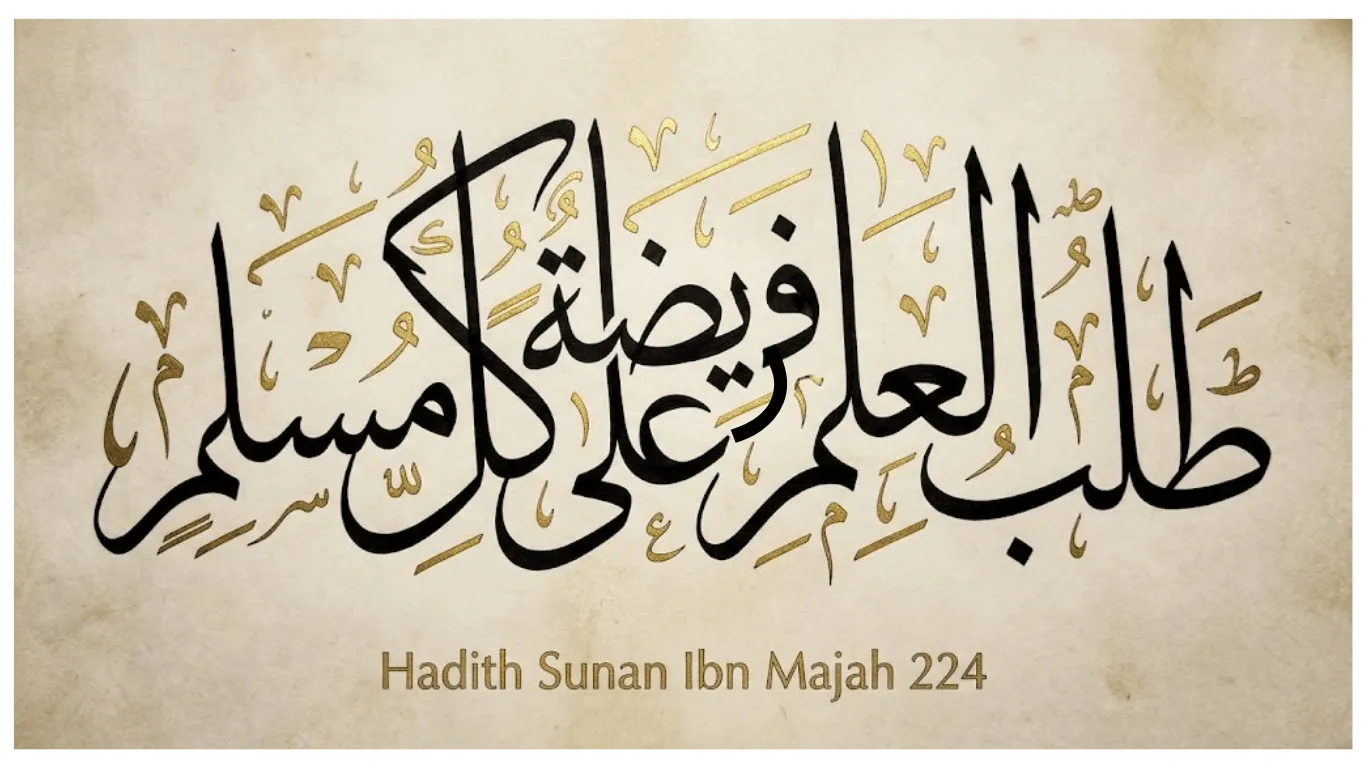
“Talabul ilmi faridatun ala kulli muslim” is an authentic hadith from Sunan Ibn Majah stating that seeking religious knowledge is a strict obligation upon every Muslim. This means learning the basics of faith, prayer, and daily halal and haram transactions is not optional; it is a fundamental duty.
To truly grasp the weight of this command, we have to look at the primary source and break down the specific vocabulary chosen by the Prophet ﷺ.
The Primary Proof: Sunan Ibn Majah 224
- Arabic: طَلَبُ الْعِلْمِ فَرِيضَةٌ عَلَى كُلِّ مُسْلِمٍ
- Transliteration: Talabu al-‘ilmi fariidatun ‘ala kulli muslim.
- English: “Seeking knowledge is an obligation upon every Muslim.” (Saheeh International styling).
- Urdu: علم دین حاصل کرنا ہر مسلمان پر فرض ہے۔ (Fateh Muhammad Jalandhari styling).
Word-by-Word NLP Breakdown
- Talab (طَلَبُ): This implies active pursuit. It requires effort, setting aside time, and seeking out qualified teachers. You cannot fulfill this by accidentally hearing a lecture; you must intend to learn.
- Al-Ilm (الْعِلْمِ): The definite article here points to a specific type of knowledge—the core tenets of Islam (Deen).
- Faridatun (فَرِيضَةٌ): This is the exact same legal weight as fasting in Ramadan or praying five times a day. Neglecting it is sinful.
- Ala Kulli Muslim (عَلَى كُلِّ مُسْلِمٍ): This phrasing is universally inclusive, binding this duty upon both men and women without exception.
The Digital Sunnah: Real Scholarship vs. Information Overload
In 2026, the digital sunnah requires us to separate infinite online information from authentic Islamic scholarship. Classical scholars divide knowledge into individual obligations, like knowing how to pray, and communal obligations, like advanced medical or legal sciences necessary for a functioning society.
Classical giants like Imam An-Nawawi and Al-Ghazali explicitly categorized this obligation so everyday Muslims wouldn’t feel paralyzed by the vastness of Islamic sciences. They divided knowledge into two branches:
- Fard al-Ayn (Individual Obligation): You do not need to be a Mufti, but you must know your Aqeedah (who Allah is), how to purify yourself (Taharah), how to pray correctly, and the specific rules related to your profession (e.g., a merchant must know the Fiqh of trading to avoid Riba).
- Fard al-Kifayah (Communal Obligation): This includes advanced Islamic jurisprudence, Tafsir, and worldly sciences like medicine, engineering, and digital security. If enough people in the community master these, the rest are absolved of the sin of neglecting them.
Today, algorithms feed us fragmented, out-of-context fatwas. The true “Digital Sunnah” is stepping back from the infinite scroll and committing to a structured, step-by-step study of Fard al-Ayn with a qualified teacher.
The Adab (Etiquette) of the Modern Student
Islamic tradition places the manners of a student before the memorization of facts. A true seeker of knowledge purifies their intentions, honors their teachers, and approaches sacred texts with deep humility and respect for the unbroken scholarly chain of transmission.
You cannot separate the knowledge from the manners used to acquire it. Just as we see in the Quran with Prophet Sulaiman’s letter starting with Bismillah, inaugurating every noble pursuit with the name of Allah transforms a mundane study session into a profound act of worship.
Furthermore, knowledge is meant to cultivate mercy and community, not arrogance and endless online debates. This is why the physical presence in a gathering of knowledge—and establishing the Islamic greeting of peace when you enter it—is historically how Muslims built bonds of brotherhood and sisterhood alongside their intellect.
People Also Ask:
Yes. The Arabic phrasing “kulli muslim” grammatically encompasses both male and female believers. Throughout Islamic history, female scholars (Muhaddithat) have played a critical role in preserving and teaching the Deen.
While religious basics are an individual obligation (Fard al-Ayn), studying worldly sciences like medicine, technology, and agriculture is a communal obligation (Fard al-Kifayah). The Muslim community sins collectively if it lacks experts in fields necessary for society’s survival and prosperity.
This specific wording is recorded in Sunan Ibn Majah, Hadith number 224. It has been authenticated by numerous Hadith masters, including Al-Albani, who graded it as Sahih.
The very first step is purifying your intention (Niyyah) to seek knowledge solely to please Allah and lift ignorance from yourself, followed by finding a credible, orthodox teacher to learn the foundational rules of prayer and purification.
Here’s why this matters for you today: your time is your most valuable asset, and dedicating even 15 minutes a day to structured Islamic learning fulfills a divine command.
