If you love seafood, you have likely paused at a restaurant menu or a coastal street food market and wondered: Is crab halal or haram in Islam?
Unlike chicken or beef, where the rules of Zabiha (Islamic slaughter) are universally understood, seafood introduces a layer of theological complexity. The answer to whether you can eat crab is not a simple “yes” or “no.” It depends entirely on the specific school of Islamic jurisprudence (Madhhab) you follow.
For some Muslims, crab is a perfectly permissible delicacy. For others, it is strictly forbidden.
To help you navigate this complex topic, here is a quick “At a Glance” summary of the rulings before we dive into the exact reasoning behind each perspective.
At a Glance: Rulings on Eating Crab
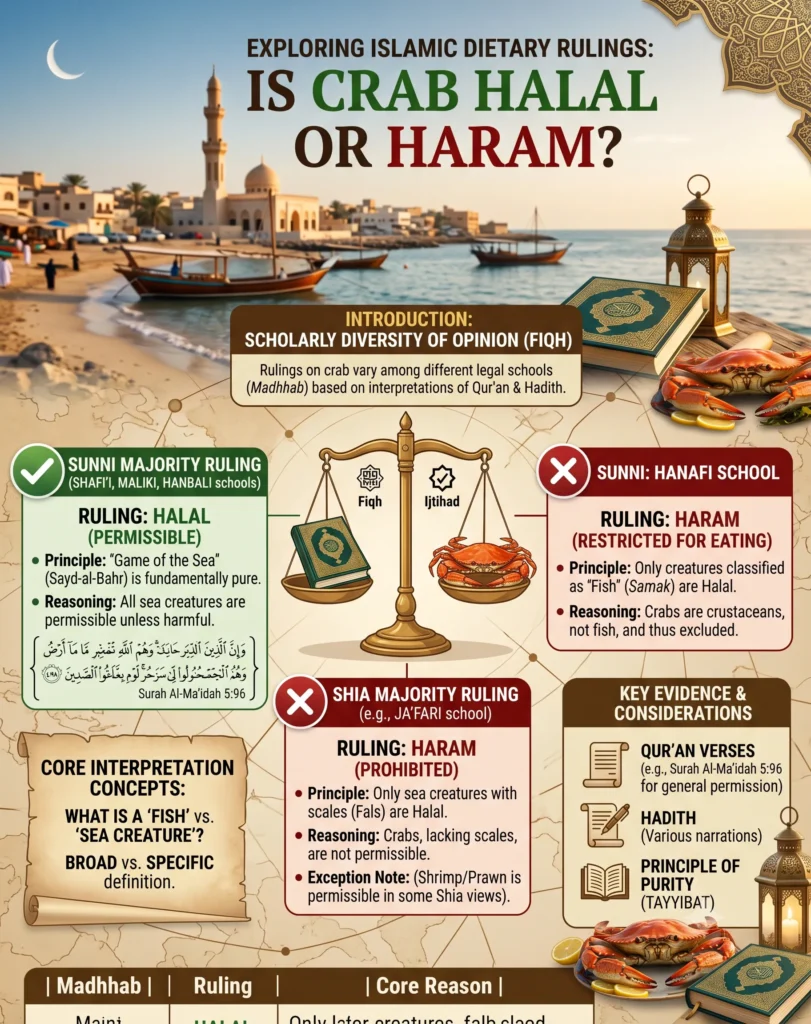
| School of Thought (Madhhab) | Ruling on Crab | Core Principle |
| Shafi’i | Halal | All sea creatures are permissible. |
| Maliki | Halal | All sea creatures are permissible. |
| Hanbali | Halal | All sea creatures are permissible. |
| Hanafi | Makruh Tahrimi | Only creatures classified as “fish” are permissible. |
| Shia (Ja’fari) | Haram | Only sea creatures with scales (and shrimp) are permissible. |
Question: Is Crab Halal or Haram in Islam?
The debate over crab stems from how different scholars interpret the Quranic verses and Hadith regarding water-dwelling creatures. While the Quran explicitly permits seafood, the interpretation of what exactly constitutes “seafood” varies.
The Rulings: Which Seafood is Halal or Haram in Islam?
To understand the specific ruling on crab, we first have to look at the foundational principles. In Islamic jurisprudence, scholars divide sea life into two broad categories based on interpretation:
- Samak: Strictly defined as “fish.”
- Sayd al-Bahr: Broadly defined as the “game of the sea” or any creature living in the water.
Schools of thought that permit only Samak will restrict the consumption of crustaceans. Schools that permit all Sayd al-Bahr will allow a much wider variety of seafood, including crab, lobster, and octopus.
Is Crab Halal or Haram in Fiqh Sunni and Hanafi?
Within Sunni Islam, there is a distinct split regarding crustaceans. The ruling you follow will depend on your specific tradition.
The Hanafi Ruling: Makruh Tahrimi
For followers of the Hanafi school of thought, eating crab is considered Makruh Tahrimi (prohibitively disliked), which in practical daily life means it should be strictly avoided.
The Hanafi fiqh relies on the interpretation that only creatures biologically and linguistically recognized as “fish” (samak) are Halal to consume from the water. Because a crab is a crustacean—and possesses physical traits vastly different from fish—it does not meet the criteria. Furthermore, many crabs are semi-amphibious and can survive on land for extended periods, which further removes them from the strict category of pure sea creatures.
The Shafi’i, Maliki, and Hanbali Ruling: Halal
In contrast, the Shafi’i, Maliki, and Hanbali schools of thought adopt a much broader interpretation of permissible seafood. According to these scholars, crab is completely Halal.
Their ruling is deeply rooted in the Quran, specifically Surah Al-Ma’idah:
“Lawful to you is game from the sea and its food as provision for you and the travelers…” — Quran (5:96)
Scholars from these three Madhhabs argue that the sea is inherently pure. Therefore, any creature that spends its life in the water—whether it is a fish, a crustacean like a crab, or a mollusk—is permissible to catch and eat. There is no requirement for the creature to have scales or fins.
The Shia (Ja’fari) Ruling on Eating Crab
In Shia Islam, particularly within the Ja’fari school of jurisprudence, dietary laws regarding seafood are highly specific and restrictive. According to Ja’fari scholars, eating crab is Haram.
The Shia ruling is based on teachings from the Ahl al-Bayt (the family of the Prophet Muhammad, PBUH). These teachings dictate that the only permissible seafood are creatures that possess scales.
Because crabs do not have scales, they fall into the prohibited category. The only exception made for scale-less sea creatures in the Ja’fari school is shrimp (prawns), which are specifically permitted through distinct Hadith. Crabs, lobsters, and shellfish do not share this exception.
Common Questions About Specific Seafood
Is Imitation Crab Halal?
Interestingly, imitation crab (often found in California sushi rolls) might be Halal even for Hanafis who cannot eat real crab.
Imitation crab is made from Surimi, a paste created from pulverized white fish (typically Alaskan Pollock). Because it is made from actual fish, the core ingredient is Halal. However, you must carefully check the packaging for two hidden ingredients:
- Food Coloring: Many brands use Carmine (E120) to give the stick its red color. Carmine is derived from crushed insects and is haram.
- Flavoring: Some artificial crab flavorings contain trace amounts of alcohol or are derived from actual crab extract.
If the imitation crab is certified Halal or uses plant-based coloring (like paprika extract), it is permissible.
Are Lobsters and Shrimp Halal?
- Shrimp: Universally accepted as Halal by the Shafi’i, Maliki, and Hanbali schools. It is also permitted in the Shia Ja’fari school. In the Hanafi school, shrimp is historically debated, but many modern Hanafi scholars permit it.
- Lobster: Lobster follows the exact same rulings as crab. It is Halal for Shafi’i, Maliki, and Hanbali followers, but Makruh Tahrimi for Hanafis and Haram for Shia Muslims.
Is Crab Makruh or Strictly Haram?
Terminology matters. You will often hear Hanafis say crab is “Makruh” rather than “Haram.”
In Hanafi fiqh, Haram is typically reserved for prohibitions explicitly detailed in the Quran (like pork or alcohol). Makruh Tahrimi refers to something highly discouraged based on scholarly deduction from Hadith. However, the practical outcome is the same: practicing Hanafis consider it sinful to consume Makruh Tahrimi items and will abstain from crab entirely.
Navigating Seafood Menus When Traveling
Understanding these rulings is crucial when stepping out of your local routine, especially for digital nomads or those exploring the globe.
Whether you are navigating coastal hidden gems on a Bali travel itinerary or wandering through bustling Southeast Asian street food markets, seafood is heavily integrated into local cultures. In places like Thailand, Indonesia, or the Maldives, crab and shellfish are staple dishes.
Tips for the Muslim Traveler:
- Communicate Clearly: In non-Muslim countries, chefs often assume that if you don’t eat pork, all seafood is fine. If you are Hanafi or Shia, clearly state that you only eat “fish with scales” rather than just asking for “Halal seafood.”
- Watch for Cross-Contamination: In busy street markets, crabs, shrimp, and fish are often fried in the same oil or grilled on the same grates.
- Sauces Matter: Even if you order a Halal fish, ensure the accompanying sauces (like Oyster sauce or Crab paste) align with your dietary restrictions.
Conclusion: Making an Informed Choice
The question of whether crab is halal or haram in Islam beautifully illustrates the depth and diversity of Islamic jurisprudence.
If you follow the Shafi’i, Maliki, or Hanbali schools, you can enjoy crab without hesitation. If you follow the Hanafi or Shia schools, you should avoid it. Ultimately, dietary laws in Islam are designed to promote mindfulness about what we consume. If you are ever in doubt about a specific dish or your school’s stance, the best approach is to consult with your local trusted scholar.
