You feel it somewhere inside:
That constant anxiety about sudden illness, unexplained tension in marriage, or your children’s sudden change in behavior. In such moments, many Muslims instinctively ask: “What is the best dua for black magic in Islam?” and “Which surah should I read daily to protect my family from evil eye?” The answer begins not in superstition, not in hidden rituals, but in the clear, Qur’an‑guided protection taught by the Prophet ﷺ and rooted in sound fiqh.
This guide is designed to be your complete reference on dua for protection from black magic and evil eye, with strong Qur’an + Sunnah proofs, repeatable daily routines, and scholarly commentary from classical scholars like Ibn Kathir, Ibn Taymiyyah, and Imam Nawawi. You will also see how to apply ruqyah for sihr and nazar in a halal way, without falling into taweez‑based or shirk‑laden practices.
What Is Black Magic (Sihr) and Evil Eye in Islam?
Black magic (sihr) and evil eye (nazar) are not myths. They are real, dangerous, and clearly addressed in the Qur’an and Sunnah. Yet at the same time, a believer is never to live in fear of people’s sihr or nazar, because Allah is more powerful than every form of harm. Sihr cannot change divine decree; it can only disturb and confuse—but Allah’s protection is always stronger than any magic.
Sihr in Islam is a form of major sin: it involves pact‑like dealings with the devils, distortion of reality, and, in some cases, separation between spouses or families. In Surah Al‑Baqarah 2:102, Allah explains that some people learned from the devils how to create discord, even to separate a man from his wife, but they were warned that learning sihr would bring them no benefit in the Hereafter. The scholars, including Ibn Kathir, emphasize that this verse establishes both the reality and the haram status of sihr. Practicing it is kufr‑level disbelief; visiting magicians or fortune‑tellers for “treatment” is also severely warned against.
On the other hand, the evil eye (nazar) is a subtle but real harm. The Prophet ﷺ said: “The evil eye is real,” and he allowed washing and ruqyah for it. The difference between sihr and nazar is that sihr is intentional, often ritual‑based, while nazar can affect even a loved one, consciously or unconsciously. Protection from witchcraft in Islam and protection from nazar must therefore be based only on Qur’an, Sunnah du’as, and lawful ruqyah, not on mysterious taweez or counter‑magic.
Best Quranic Duas for Protection (Surah Falaq, Surah Naas, Ayat al‑Kursi)
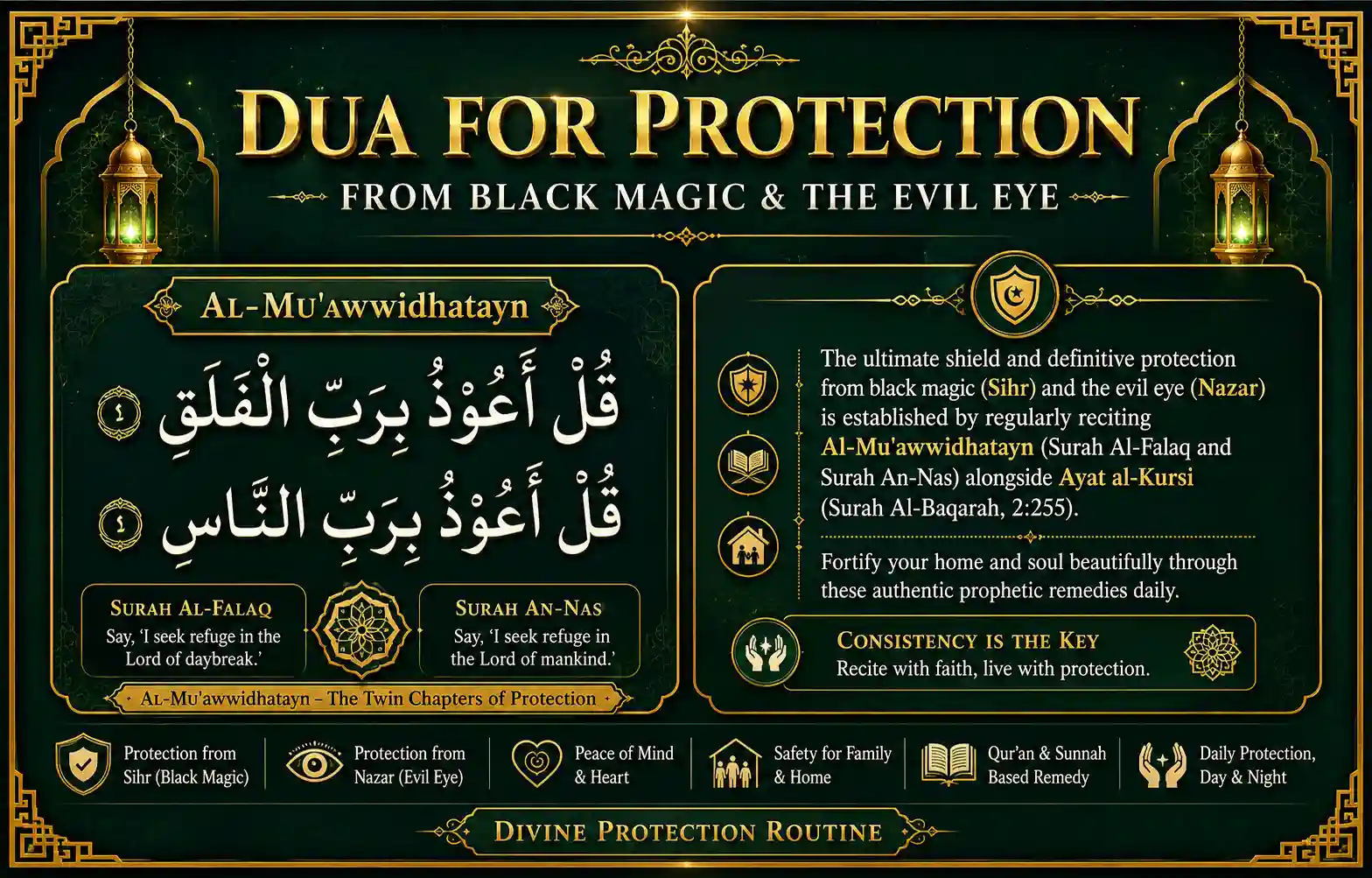
The first and strongest protection for any Muslim is to recite Surah Falaq, Surah Naas, and Ayat al‑Kursi regularly. These are not random “magic words”; they are revealed verses that place you under Allah’s direct protection. Many people ask, “How many times should I read Ayat al‑Kursi for protection?” and “Which surah should I read daily to protect my family?” — the answer is simple: include all three in your daily routine, especially in the morning, evening, and before sleep.
Surah Al‑Falaq
Surah Falaq is a prayer for protection from every hidden evil, from darkness, envy, and jinn. The Prophet ﷺ used it as a core part of his protection. A believer should read it morning, evening, and before sleep to seek Allah’s shield from sihr and nazar without fear or superstition.
Surah Al‑Falaq – Arabic, Transliteration, English, Urdu
Arabic text (Surah Falaq):
قُلْ أَعُوذُ بِرَبِّ الْفَلَقِ. مِنْ شَرِّ مَا خَلَقَ. وَمِنْ شَرِّ غَاسِقٍ إِذَا وَقَبَ. وَمِنْ شَرِّ النَّفَّاثَاتِ فِي الْعُقَدِ. وَمِن شَرِّ حَاسِدٍ إِذَا حَسَدَ.
Transliteration (Qul A’oothu bi Rabbil‑Falaq):
Qul a’oothu bi rabbil‑Falaq. Min sharri maa khalaq. Wa min sharri ghaseeqin idha waqab. Wa min sharri naffaathaat fil‑‘uqad. Wa min sharri haasidin idhaa hasad.
English meaning (Saheeh International translation):
“Say, ‘I seek refuge in the Lord of daybreak, from the evil of that which He created, from the evil of darkness when it settles, from the evil of the blowers in knots, and from the evil of the envier when he envies.’”
Urdu tafsir (Fateh Muhammad Jalandhari):
کہو کہ میں فجر کے پروردگار کی پناہ مانگتا ہوں، اس بدی سے جو کچھ اس نے پیدا کیا ہے، اس بُری رات کی بُرائی سے جب اندھیرا چھا جائے، اُن بُری لڑکیاں کی بُرائی سے جو رسیوں میں گاٹھیاں باندھتی ہیں، اور بُرے حسد کرنے والے کی بُرائی سے جب وہ حسد کرے۔
Tafsir note (Ibn Kathir / classical scholars):
Ibn Kathir explains that this surah seeks refuge in the Lord of light and dawn from all kinds of evil, including sihr and envy. The “blowers in knots” (naffaathaat fil‑‘uqad) refers to those who practice magic by tying knots and reciting spells over them, which is a clear description of black magic. The end of the surah warns against the envy of the envier, which is linked to the evil eye. This shows that Surah Falaq is a direct weapon against sihr and nazar.
How to use in ruqyah (how many times, when, intention):
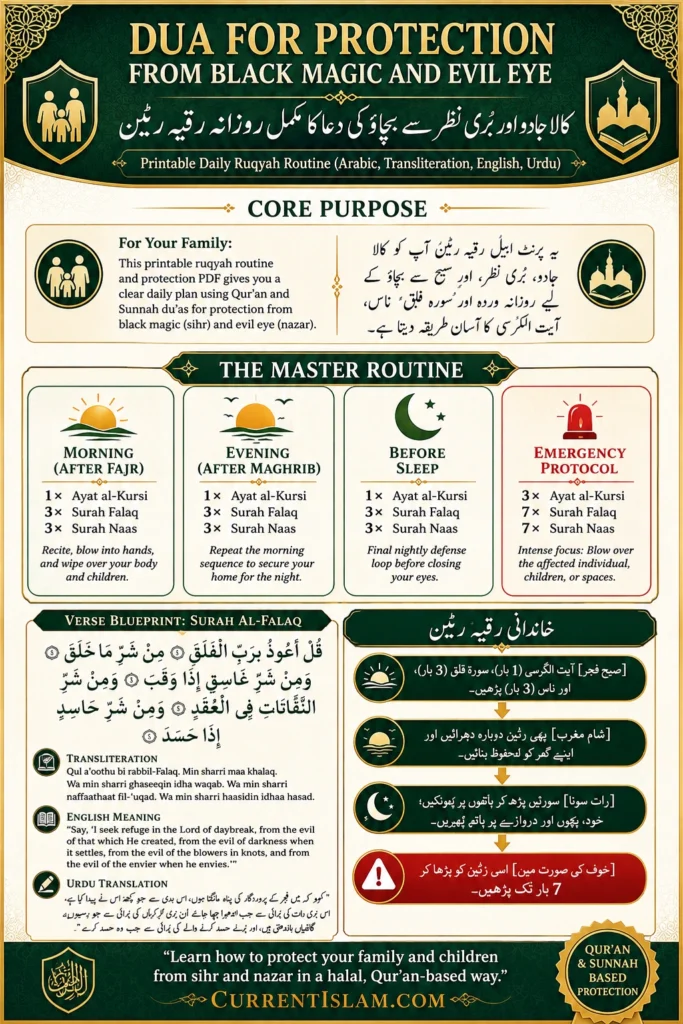
- Recommended: 3 times in the morning, 3 times in the evening, and 3 times before sleep.
- Intention: “O Allah, protect me and my family from sihr, nazar, and all hidden evils.”
- Method: Recite, then blow gently into your hands, pass them over your face, chest, and body. For children, do the same over their heads and bodies.
This is an authentic Sunnah practice; the Prophet ﷺ taught the Companions to seek refuge in these verses, not in amulets or unknown taweez.
Surah An‑Naas
Surah An‑Naas is the last refuge. It asks Allah for protection from the whisperings of evil people, jinn, and the inward whisperings of the nafs. When people ask for the best dua for protection from black magic and evil eye, this surah is always among the top answers, because it combats the hidden forces behind sihr and nazar.
Arabic text (Surah An‑Naas):
قُلْ أَعُوذُ بِرَبِّ النَّاسِ. مَلِكِ النَّاسِ. إِلَهِ النَّاسِ. مِنْ شَرِّ الْوَسْوَاسِ الْخَنَّاسِ. الَّذِي يُوَسْوِسُ فِي صُدُورِ النَّاسِ. مِنَ الْجِنَّةِ وَالنَّاسِ.
Transliteration (Qul A’oothu bi Rabbil‑Naas):
Qul a’oothu bi rabbil‑Naas. Malikil‑Naas. Ilahil‑Naas. Min sharri was‑waasil‑khannaas. Alladhee yuwas‑wisu fee sudooril‑Naas. Minal‑jinnati wan‑Naas.
English meaning (Saheeh International translation):
“Say, ‘I seek refuge in the Lord of mankind, the King of mankind, the God of mankind, from the evil of the retreating whisperer, who whispers [evil] into the breasts of mankind, from among the jinn and mankind.’”
Urdu translation (Fateh Muhammad Jalandhari):
کہو کہ میں انسانوں کے پروردگار کی پناہ مانگتا ہوں، انسانوں کے بادشاہ کی پناہ مانگتا ہوں، انسانوں کے معبود کی پناہ مانگتا ہوں، اس بُری سرگوشی کرنے والے کی بُرائی سے جو پیچھے ہٹتا ہے، وہ جو انسانوں کے سینوں میں سرگوشی کرتا ہے، جِنوں اور انسانوں میں سے۔
Tafsir note:
Scholars like Ibn Kathir and Imam Nawawi emphasize that this surah targets the whispering of Shaytan and wicked people. The “whisperer” (al‑was‑waas al‑khannaas) is the one who sows doubt, fear, and envy in the heart. This includes the psychological and spiritual effects of sihr and nazar. Calling Allah “Lord of mankind, King of mankind, God of mankind” zeroes the believer’s focus on Tawhid, which is the strongest defense against any kind of magic or envy.
How to use in ruqyah:
- 3 times morning, 3 times evening, 3 times before sleep.
- Combine with Falaq and Ayat al‑Kursi in a short set.
- Use the same method: blow into hands, wipe over yourself and your children.
Ayat al‑Kursi (Al‑Baqarah 2:255)
Ayat al‑Kursi is the throne verse of Allah. It explains His absolute power, knowledge, and life. When people ask, “How many times should I read Ayat al‑Kursi for protection?” the Sunnah is clear: it should be recited after every obligatory prayer and before sleep. It protects the home, the family, and the believer from all forms of harm, including sihr and nazar.
Arabic text (Ayat al‑Kursi, Al‑Baqarah 2:255):
اللَّهُ لَا إِلَهَ إِلَّا هُوَ الْحَيُّ الْقَيُّومُ لَا تَأْخُذُهُ سِنَةٌ وَلَا نَوْمٌ لَهُ مَا فِي السَّمَاوَاتِ وَمَا فِي الْأَرْضِ مَنْ ذَا الَّذِي يَشْفَعُ عِنْدَهُ إِلَّا بِإِذْنِهِ يَعْلَمُ مَا بَيْنَ أَيْدِيهِمْ وَمَا خَلْفَهُمْ وَلَا يُحِيطُونَ بِشَيْءٍ مِنْ عِلْمِهِ إِلَّا بِمَا شَاءَ وَسِعَ كُرْسِيُّهُ السَّمَاوَاتِ وَالْأَرْضَ وَلَا يَئُودُهُ حِفْظُهُمَا وَهُوَ الْعَلِيُّ الْعَظِيمُ.
Transliteration (Ayat al‑Kursi):
Allahu laa ilaaha illaa Huwa, al‑Hayyul‑Qayyoom, laa ta’khudhuhuu sinatuw wa laa nawm, lahu maa fis‑samawaati wa maa fil‑ard, man dhal‑ladhee yashfa’u ‘indahoo illaa bi‑idhnihi, ya’lamu maa baina aydeehim wa maa khalfahum, wa laa yuheetoona bi‑shay’in min ‘ilmihi illaa bimaa shaa’a, wa si’a kursiyyuhus‑samawaati wal‑ard, wa laa ya’uduhu hifdhuhumaa wa Huwal‑‘Aliyyul‑‘Adheem.
English meaning (Saheeh International translation):
“Allah—there is no deity except Him, the Ever‑Living, the Sustainer of existence. Neither drowsiness overtakes Him nor sleep. To Him belongs whatever is in the heavens and whatever is on the earth. Who is it that can intercede with Him except by His permission? He knows what is [presently] before them and what will be after them, and they encompass not a thing of His knowledge except for what He wills. His Kursi extends over the heavens and the earth, and their preservation tires Him not. And He is the Most High, the Most Great.”
Urdu translation (Fateh Muhammad Jalandhari):
اللہ! اس کے سوا کوئی معبود نہیں، وہ زندہ ہے، قیوم ہے، نہ نیند اس پر طاری ہوتی ہے نہ خواب، اس کے ہاتھ میں ہے جو کچھ آسمانوں میں اور جو کچھ زمین میں ہے، اس کے پاس کون ہے جو بغیر اس کی اجازت کے اس کے حضور سفارش کرے، وہ جانتا ہے جو کچھ ان کے سامنے ہے اور جو کچھ ان کے پیچھے ہے، اور وہ کسی بھی چیز سے اس کے علم کا احاطہ نہیں کرتے مگر جتنا چاہے، اور اس کا کرسی آسمانوں اور زمین کو گھیرے ہوئے ہے، اور ان دونوں کی حفاظت اسے کمزور نہیں کرتی، اور وہ بہت بلند ہے، بہت بڑا ہے۔
Tafsir and note:
Ibn Kathir explains that this verse establishes Allah’s absolute power and knowledge over all creation. No magic can reach a person under Allah’s protection, and no jinn or devil can overpower His will. The Prophet ﷺ promised that whoever recites this verse after every obligatory prayer will remain under Allah’s protection until the next prayer, and whoever recites it before sleep will have an angel guarding him. This is why it is the strongest protection from witchcraft in Islam and from spiritual attacks.
How to use in ruqyah:
- Recite once after every fard prayer.
- Recite once before sleep, with the intention of protection from sihr and nazar.
- You may also recite it over your home by blowing into your hands and passing them over doors and corners.
Surah Al‑Baqarah 2:102 (Sihr and the Reality of Magic)
This verse teaches that sihr is real, but also that it brings no benefit in the Hereafter. Allah explains how some people learned magic from the devils only to cause harm, even separating spouses. Yet this does not mean we should fear magic; it means we must seek protection in Qur’an and Sunnah and never learn or practice it ourselves.
Surah Al‑Baqarah 2:102 – Arabic Text with Context for Sihr (Black Magic)
Arabic text (Surah Al‑Baqarah 2:102 – sihr verse):
وَاتَّبَعُوا مَا تَتْلُو الشَّيَاطِينُ عَلَىٰ مُلْكِ سُلَيْمَانَ وَمَا كَفَرَ سُلَيْمَانُ وَلَـٰكِنَّ الشَّيَاطِينَ كَفَرُوا يُعَلِّمُونَ النَّاسَ السِّحْرَ وَمَا أُنْزِلَ عَلَى الْمَلَكَيْنِ بِبَابِلَ هَارُوتَ وَمَارُوتَ وَمَا يُعَلِّمَانِ مِنْ أَحَدٍ حَتَّىٰ يَقُولَا إِنَّمَا نَحْنُ فِتْنَةٌ فَلَا تَكْفُرْ فَيَتَعَلَّمُونَ مِنْهُمَا مَا يُفَرِّقُونَ بِهِ بَيْنَ الْمَرْءِ وَزَوْجِهِ وَمَا هُمْ بِضَارِّينَ بِهِ مِنْ أَحَدٍ إِلَّا بِإِذْنِ اللَّهِ وَيَتَعَلَّمُونَ مَا يَضُرُّهُمْ وَلَا يَنْفَعُهُمْ وَلَقَدْ عَلِمُوا لَمَنِ اشْتَرَاهُ مَا لَهُ فِي الْآخِرَةِ مِنْ خَلَاقٍ وَلَبِئْسَ مَا شَرَوْا بِهِ أَنْفُسَهُمْ لَوْ كَانُوا يَعْلَمُونَ.
Tafsir note (Ibn Kathir):
This verse explains that some people followed what the devils recited about the kingdom of Sulaiman. The devils taught people sihr, including the magic that creates separation between a man and his wife. Yet Sulaiman never learned or practiced this himself; the text clears his name and blames the devils. The verse ends by warning that those who buy sihr “have no share in the Hereafter,” showing that sihr is a trade in loss, not power. This is one of the clearest proofs in the Qur’an that sihr exists and is haram, and that it harms only by Allah’s permission.
Surah Yunus 10:81–82 (Allah Nullifies Magic)
In these verses, the magicians of Fir’awn challenge Musa, but when he throws his staff, Allah nullifies their magic and shows it is a lie. This teaches that no sorcery can stand before Allah’s truth. When dealing with kala jadu ka tor, the believer must rely on Allah’s word, not on fear or counter‑magic.
Arabic text (Surah Yunus 10:81–82 – magic and Allah’s power):
وَأَلْقَىٰ مُوسَىٰ عَصَاهُ فَإِذَا هِيَ تَلْقَفُ مَا يَأْفِكُونَ. فَأُلْقِيَ السَّحَرَةُ سُجَّدًا…
Scholars like Ibn Kathir and contemporary exegetes note that this shows the complete weakness of magic when confronted with Allah’s command. The magicians’ spells are “eaten” by Musa’s staff, symbolizing that Allah’s word and protection are higher than any sihr.
Daily Protection Routine (Morning, Evening, Before Sleep)
Here’s why this matters for you: you don’t need a long, mystical list of verses. You need a simple, repeatable Spiritual Habit Loop. After every Fajr and after every Maghrib/Asr, you have a clear trigger. Your routine is a short set of adhkar and specific verses. The reward is peace of heart and the feeling that you are under Allah’s protection.
Morning Routine
- Du’a for protection from witchcraft in Islam:
- Ayat al‑Kursi (1×)
- Surah Falaq (3×)
- Surah An‑Naas (3×)
- Any short prophetic du’a for protection (e.g., from the morning adhkar collection).
Evening Routine
Same as morning: Ayat al‑Kursi, Falaq, Naas, protection du’as.
Before Sleep
- Ayat al‑Kursi (1×)
- Falaq (3×)
- Naas (3×)
- A short du’a for protection of the family and home.
Emergency Routine (Fear of Sihr)
If you suddenly feel afraid or suspect sihr or strong nazar:
- Recite Falaq and Naas 7× each.
- Recite Ayat al‑Kursi 3×.
- Blow into hands and wipe over your body, children, and home.
This is the core of lawful ruqyah for sihr and nazar in Islam.
Dua for protection from black magic and evil eye (PDF)
Kala Jadu ka Tor According to Qur’an and Sunnah
When people say “kala jadu ka tor,” they often mean counter‑magic or some secret trick. But in Islam, there is no counter‑magic. The only true kala jadu ka tor is Qur’an, Sunnah, and lawful ruqyah. Practicing or learning sihr is forbidden; visiting magicians or fortune‑tellers is also forbidden. The believer protects himself and his family by reciting the verses above, using du’as, and trusting in Allah.
If you want to learn more about how to remove evil eye with authentic duas, you can read our step‑by‑step nazar ki dua guide on our detailed page.
For deeper understanding of how Allah nullified the magicians’ tricks, you can also read our explanation of wa alqi ma fi yameenika talqaf ma sanau.
People Also Ask:
There is no precise checklist. Unexplained marital problems, sudden hatred, or unexplained health issues may be signs, but only a qualified scholar or doctor should decide.
The best practice is to increase Qur’an recitation, ruqyah, and dhikr, and abandon visiting magicians.
Surah Falaq, Surah Naas, and Ayat al‑Kursi are the strongest daily choices.
Also add the morning and evening adhkar taught by the Prophet ﷺ.
If the taweez contains only Qur’an and clear, authentic du’as, some scholars allow it with caution.
Taweez with unknown script, images, or shirk‑based words are strictly forbidden.
The safest path is to rely on recitation, not objects.
If you want a simple, printable ruqyah routine and protection PDF with Arabic, transliteration, English, and Urdu for your daily routine, you can download it here. This will help you teach your family and children how to protect themselves from sihr and nazar in a halal, Qur’an‑based way.
Download Printable Routine PDF
1 thought on “Dua for Protection from black Magic and Evil eye”