Have you ever sat through an entire Jumu’ah khutbah, nodded along to every point—and then walked out and changed absolutely nothing?
That feeling right there—that quiet gap between hearing the truth and acting upon it—is exactly what this six-word verse is diagnosing. The Quran described it 1,400 years before modern psychology had a name for it.
Surah Al-Baqarah, Verse 18 is one of the shortest, sharpest spiritual verdicts in the entire Quran. While many search strictly for its wazifa and protective benefits, the true power of this verse lies in understanding why it works, and the profound warning it holds for our own hearts.
Let’s look at the heart of the issue.
Table of Contents
- What Is This Verse & Where Is It?
- Word-by-Word Meaning
- Four-Language Reference
- Tafseer — Ibn Kathir’s Deep Analysis
- The Spiritual Habit Loop
- Correct Pronunciation Guide
- Wazifa — Scholar-Backed Method & Rules
- Spiritual Benefits of Recitation
- People Also Ask
- Read More (Related Articles)
1. What Is This Verse & Where Is It?
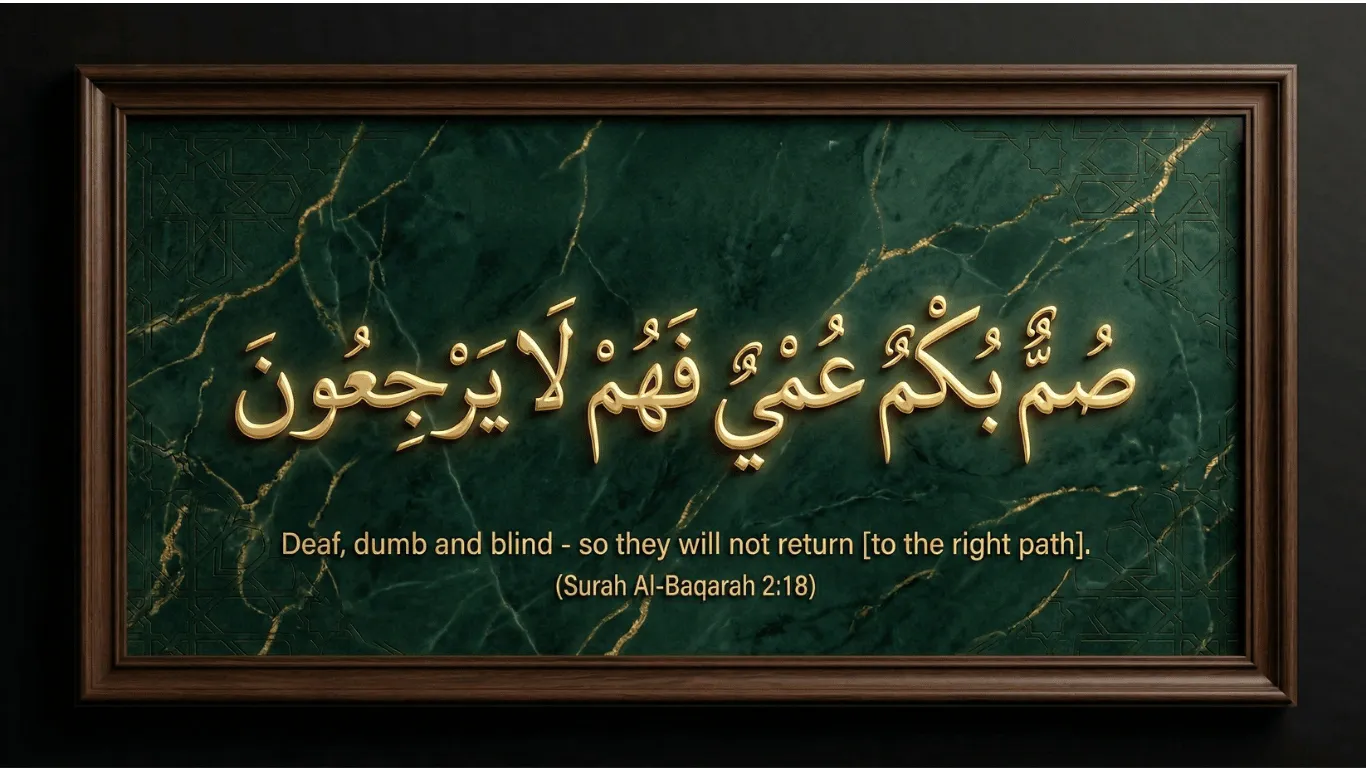
Summun Bukmun Umyun Fahum Layarjiun is Verse 18 of Surah Al-Baqarah. Located in Para (Juz) 1, its translation is: “Deaf, dumb, and blind — so they will not return to the right path.” It describes the sealed spiritual state of those who persistently reject truth.
- Surah: Al-Baqarah (The Cow) — Chapter 2
- Verse: 18
- Para (Juz): 1 — Juz Alif-Lam-Meem
- Page: 4 (Standard Uthmani Mushaf)
- Revelation Type: Madani
The Three-Verse Sequence
This verse does not stand alone. It is the final blow of a profound sequence:
- Verse 16: “These are the ones who purchased misguidance in exchange for guidance.”
- Verse 17: A parable of a man who lit a fire that illuminated his surroundings, only for Allah to take away his light, leaving him in total darkness.
- Verse 18: The verdict: Deaf. Dumb. Blind. They will not return.
The deafness, dumbness, and blindness in Verse 18 are not a punishment dropped randomly from the sky. They are the natural, self-earned consequences of repeatedly choosing darkness over light.
2. Word-by-Word Meaning
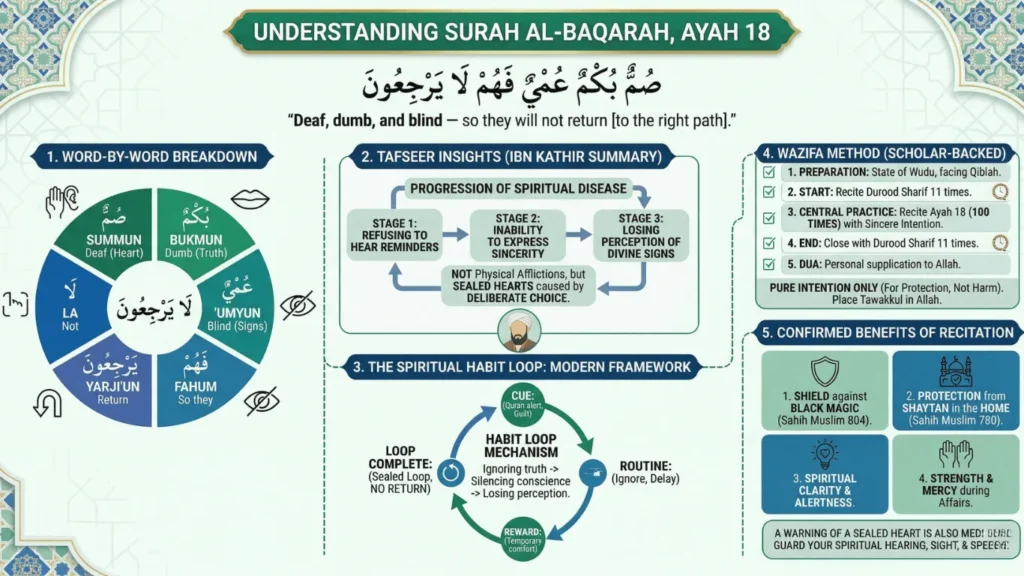
The verse contains six key words. Summun (spiritually deaf), Bukmun (unable to speak the truth), Umyun (heart-blind), Fahum (therefore they), La (never), and Yarjiun (return).
صُمٌّ (Summun)
- Literal meaning: Deaf; hard of hearing.
- Spiritual meaning: A person who hears the truth but refuses to let it enter the heart. The hypocrites were not physically deaf; they attended the Prophet’s ﷺ gatherings. They heard the words but deliberately let them bounce off.
بُكْمٌ (Bukmun)
- Literal meaning: Dumb; mute.
- Spiritual meaning: Unwilling to speak the truth. They could not bring themselves to admit faith, call out wrong, or whisper a sincere tawbah (repentance). When the heart is closed, the tongue of sincerity goes silent.
عُمْيٌ (‘Umyun)
- Literal meaning: Blind; sightless.
- Spiritual meaning: The most dangerous stage. The heart can no longer perceive Allah’s signs. They receive blessings and feel no gratitude. The faculty of spiritual sight is gone.
فَهُمْ (Fahum)
- Meaning: “Therefore they” / “So they”.
- The fa (فَ) signals a logical result. Because they chose to be deaf, dumb, and blind, therefore they cannot return.
لَا يَرْجِعُونَ (La Yarji’un)
- Meaning: “They will never return.”
- They will not return to the right path or the light they once had access to.
Linguistic Gem: Notice the absence of “and” (واو) between Summun, Bukmun, and Umyun. In Arabic rhetoric, this technique is called Asyndeton. Imam Al-Qurtubi explains this is deliberate: each condition is presented as a complete, independent, and total affliction.
3. Four-Language Reference
Arabic (Original):
صُمٌّ بُكْمٌ عُمْيٌ فَهُمْ لَا يَرْجِعُونَ
Transliteration:
Ṣummun Bukmun ʿUmyun Fahum Lā Yarjiʿūn
English — Saheeh International:
“Deaf, dumb and blind — so they will not return [to the right path].”
English — Yusuf Ali:
“Deaf, dumb, and blind, they will not return to the path.”
Urdu — Fateh Muhammad Jalandhari:
یہ بہرے ہیں، گونگے ہیں، اندھے ہیں۔ سو یہ نہیں پھریں گے۔
4. Tafseer — Ibn Kathir’s Deep Analysis
According to Imam Ibn Kathir (رحمه الله) in his landmark work Tafseer al-Quran al-Azeem, this verse explicitly describes the spiritual condition of the hypocrites (Al-Munafiqun).
He makes one point with crystal clarity: “This is not physical deafness or blindness. It is the deafness, dumbness, and blindness of the heart.”
The hypocrites lived among the Muslims, spoke the testimony of faith, and saw the miracles. But inside, they made a choice. With every repetition of that choice, their inner capacity to receive guidance diminished.
The Consequence
The Arabic word Yarji’un is from رجع (to come back). This implies they could have returned. The door was always open, but the habit of refusal became so ingrained that they stopped walking toward it.
Important Clarification: This verse warns against a deliberate, habitual rejection of guidance. It is not a verdict on ordinary forgetfulness or a Muslim struggling with their Deen. Allah’s mercy is vast, and sincere repentance is always accepted.
5. The Spiritual Habit Loop — A Modern Framework
Modern psychologists describe a “Habit Loop”—a cycle of cue, routine, and reward that carves deep neural pathways. The Quran mapped the spiritual version of this 1,400 years ago.
- LOOP STAGE 1 — SUMMUN (The Ignore): You feel guilt after a sin, or see a Quranic reminder. You scroll past it to avoid the discomfort of self-examination. Eventually, the cue stops registering.
- LOOP STAGE 2 — BUKMUN (The Silence): The inner voice of accountability goes quiet. You find you cannot genuinely make dua because the sincerity isn’t there.
- LOOP STAGE 3 — ‘UMYUN (The Unseeing): The heart is conditioned to filter out the Divine. You witness majestic signs in creation but feel nothing of Allah.
- LOOP COMPLETION — LA YARJI’UN (The Sealed Loop): The loop is self-sustaining. The habit of not returning to Allah has become who they are.
The good news? Habits can be broken. The very act of reading this article and feeling a pull in your heart means your spiritual hearing is still working. Guard it.
6. Correct Pronunciation Guide
| Word | Phonetic Guide | Common Mistake |
| Summun | SUAM-mun (Heavy ص from the back of the mouth) | Using a light English ‘S’ |
| Bukmun | BUK-mun (Ba + no-vowel Kaaf + Meem tanwin) | Adding a vowel after the Kaaf |
| ‘Umyun | ʿOOM-yun (Deep throat Ain, no-vowel Meem) | Skipping the Ain (ع) entirely |
| Fahum | FA-hum (Light Fa, Haa, no-vowel Meem) | Merging it into the next word |
| Lā | LAA (Long Alif, must be held) | Cutting it short |
| Yarji’un | yar-JI-ʿ-OON (Long Waw at the end) | Cutting the final vowel short |
7. Wazifa — Scholar-Backed Method & Rules
After Isha, with wudu, recite Durood Sharif 11 times, this verse 100 times with sincere intention, and close with Durood 11 times. Repeat for 7 days. Intention must be for protection, never harm.
The Foundation of Barakah
The Prophet Muhammad ﷺ said:
“Recite Surah Al-Baqarah, for taking it is a blessing, leaving it is regret, and the sorcerers cannot confront it.” (Sahih Muslim, 804)
The Method
- Perform Wudu and sit in a clean space facing the Qiblah.
- Recite Durood Ibrahim 11 times.
- Recite the verse 100 times (Ṣummun Bukmun ʿUmyun Fahum Lā Yarjiʿūn), holding your intention clearly (e.g., protection from harm, peace in the home).
- Recite Durood Ibrahim 11 times again.
- Make sincere du’a to Allah.
- Repeat for 7 consecutive nights.
Crucial Rules: * Pure Intention: This is never to be used to harm another out of revenge.
- Tawakkul: Trust in Allah, not the number 100.
- Seek Guidance: For severe spiritual distress or suspected sihr, consult an Imam.
8. Spiritual Benefits of Recitation
- Protection from Shaytan: “Shaytan flees from the house in which Surah Al-Baqarah is recited.” (Sahih Muslim, 780).
- Shield Against Black Magic: Sorcerers cannot confront the barakah of Al-Baqarah.
- Spiritual Clarity: Understanding this verse creates heightened spiritual alertness, preventing you from entering the “Summun” stage.
- Protection from Harmful People: The verse’s meaning repels those who persist in harmful opposition.
- General Barakah: Engaging with the “peak” of the Quran draws divine mercy into your affairs.
9. People Also Ask:
It means “Deaf, dumb, and blind — so they will not return to the right path.” It refers to the spiritual inability to receive, express, and perceive divine truth.
It is entirely about spiritual blindness. The hypocrites had full physical faculties but lacked the willingness to let those faculties serve the truth.
Both use the exact phrase. However, 2:18 addresses hypocrites who outwardly professed faith, while 2:171 addresses open disbelievers, comparing them to cattle that hear sounds without understanding. Same diagnosis; two different types of closed hearts.
10. Read More
- Surah Al-Baqarah Ayat 27 — Those Who Break the Covenant of Allah: A must-read companion piece that shows what the spiritually diseased heart does in the world.
- Safar Ki Dua — Complete Guide: Build your habit of Quranic du’as with this comprehensive guide to the travel supplication.
Final Reflection
Six words. Deaf. Dumb. Blind. So they will not return.
The sharpness of this verse is precisely because it is not describing a dramatic, sudden fall from faith. It is describing something quieter—the slow, incremental closing of doors. A reminder not heard. A truth not spoken. A sign not perceived. Again. And again.
The fact that you read this to the end means your hearing still works. Your conscience still speaks. Your eyes still see.
That is not nothing. That is everything. Guard it.
About the Author
Shahab Khan is an experienced Khateeb and Islamic scholar dedicated to making classical Tafseer accessible to the modern Muslim. Through his extensive work on Islamic web platforms, he bridges the gap between traditional scholarship and contemporary spiritual challenges. Reviewed for scholarly accuracy. Sources: Ibn Kathir (Tafseer al-Quran al-Azeem), Imam Al-Qurtubi, Sahih Muslim.
