Ever feel like your prayers are just physical movements, but your mind is still scrolling through a digital feed? You are not the only one. The disconnect between our outer acts of worship and our inner spiritual state is the modern believer’s greatest struggle. We are overwhelmed by digital distractions, constantly seeking mental clarity, yet struggling with consistency. But what if a single, 1,400-year-old verse held the exact, step-by-step formula for fixing this disconnect?
What is the Meaning of Qad Aflaha Man Tazakka?
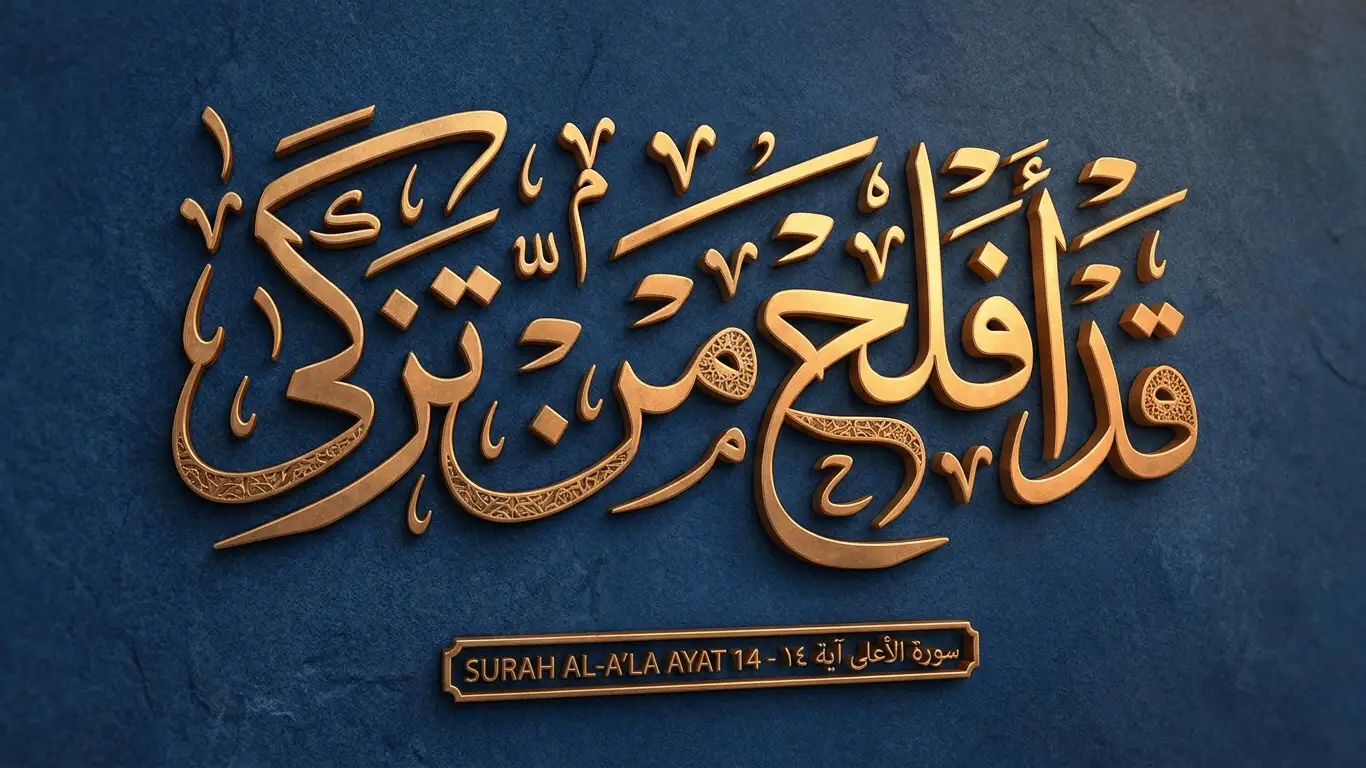
“Qad aflaha man tazakka” means “He has certainly succeeded who purifies himself.” Found in Surah Al-A’la, this verse promises guaranteed spiritual and ultimate success to any person who actively cleanses their heart from negative traits and builds consistent, righteous habits over time.
The Multilingual Quadrant: Surah Al-A’la Ayat 14
To truly grasp the weight of this verse, we must look at its original text and translations from trusted classical sources:
The Complete Translation
Original Arabic Script:
قَدْ أَفْلَحَ مَنْ تَزَكَّىٰ
Transliteration (Pronunciation):
Qad aflaha man tazakka.
English Translation (Saheeh International):
“He has certainly succeeded who purifies himself.”
Urdu Translation (Fateh Muhammad Jalandhari):
“بیشک وہ شخص فلاح پا گیا جس نے (اپنے آپ کو) پاک کر لیا۔”
Word-by-Word Translation and Surah Details
Understanding the individual words reveals the deep mechanics behind the verse.
- Surah Name: Al-A’la (The Most High)
- Surah Number: 87
- Verse (Ayat) Number: 14
- Qad (قَدْ): Certainly / Without a doubt. It removes all guesswork.
- Aflaha (أَفْلَحَ): Attained success. This root word shares the same origin as a “farmer” (fallah), meaning this is the success of someone who plants seeds and works hard for the harvest.
- Man (مَنْ): Whoever / The one who.
- Tazakka (تَزَكَّىٰ): Purifies himself / Cleanses and grows.
Qad aflaha man tazakka calligraphy | infographic

Deep Tafseer: Insights from Classical Scholars
To correctly interpret Quranic verses, we rely on the foundational explanations of classical scholars rather than personal assumptions.
What Ibn Kathir Says About Purification
Tafsir Ibn Kathir states that “Qad aflaha man tazakka” means purifying the soul from vile character traits and cleaning it from the filth of polytheism (shirk). True success is tied directly to the removal of bad character and the intentional planting of good character.
Imam Al-Ghazali takes this further in his teachings on the “diseases of the heart.” He explains that a heart cannot fully absorb the light of faith if it is clogged with arrogance, envy, or a love for the material world. Purification (Tazkiyah) is the act of treating these hidden spiritual illnesses.
The Spiritual Habit Loop: Modern Tazkiyah in 2026
Building spiritual consistency in an age of constant digital distraction requires a reliable system. Think of Tazkiyah not just as a one-time cleanse, but as “The Spiritual Habit Loop”—a daily, atomic habit of realigning your focus.
Every time you feel overwhelmed or distracted (the cue), the immediate routine should be a conscious moment of internal purification, such as seeking forgiveness (Istighfar). The reward is the return of mental clarity and spiritual presence.
Connecting Inner Purity to Outer Worship
Here is why this entire concept matters for your daily life: inner purification is the mandatory prerequisite for powerful external worship. Without a cleansed heart, the physical acts of Salah often remain hollow movements, disconnected from their true spiritual potential. Once the heart achieves this baseline of purity, the believer is truly ready to stand before Allah, fully grasping the weight of the call when meaning of establishing the prayer
is pronounced. You stop going through the motions and start praying with immense focus. A heart cleansed of arrogance naturally overflows with thankfulness, completely transforming how you experience the profound praise of expressing sincere gratitude in prayer after bowing.
Benefits, Hadith, and Practical Application
Implementing the reality of this verse brings immediate mental and spiritual benefits. It acts as a shield against anxiety and the spiritual fatigue caused by our fast-paced lives.
Core Benefits and Daily Action Steps
The Prophet Muhammad (ﷺ) constantly made dua for a purified soul. A foundational Sahih Muslim hadith records the Prophet (ﷺ) saying: “O Allah, grant my soul its piety and purify it, You are the Best to purify it, You are its Guardian and Master.”
While there is no specific numerical “wazifa” associated exclusively with repeating Surah Al-A’la Ayat 14, the practical application is to memorize the Prophet’s dua above and recite it daily. Use this verse as a personal audit: ask yourself every evening if your actions today helped purify your heart or clutter it further.
Qad Aflaha Man Tazakka Meaning: Free Bilingual PDF Guide (Urdu & English)
People Also Ask
Tazkiyah literally means to cleanse and to grow. In Islamic terminology, it refers to the ongoing process of purifying the human soul from sinful inclinations and nurturing it with positive virtues like patience and gratitude.
This powerful phrase is found in Surah Al-A’la, which is chapter 87 of the Holy Quran. It is specifically verse number 14.
You practice it by monitoring your intentions, performing daily prayers on time, seeking forgiveness (Istighfar) frequently, avoiding digital content that corrupts the mind, and constantly remembering Allah.
Take the Next Step in Your Spiritual Routine If you found this breakdown helpful and want to build unbreakable consistency in your daily worship, do not leave your progress to chance. Subscribe to our weekly newsletter below to receive practical, bite-sized strategies for protecting your spiritual focus in the digital age, sent straight to your inbox.

MashAllah beautiful article!
The very next verse explains how to purify the self. Which is by remembering the name of your Rabb (Allah) and praying Salah.
So the formulas for success = Doing the Zikr of Allah Allah Allah (if done from the heart its called Qalbi Zikr) + Praying Salah