
Ever felt trapped by bills piling up, tempted to cut corners just to get by, wondering if true peace comes with halal earnings? This dua changed everything for countless believers facing the same storm.
Full Dua Text
Allahumma akfini bihalalika an haramika wa aghnini bifadlika amman siwaka is a direct plea for Allah to provide enough lawful sustenance, shielding you from unlawful means and granting independence through His grace alone. Recite it daily for financial ease and spiritual strength.
اللَّهُمَّ اكْفِنِي بِحَلَالِكَ عَنْ حَرَامِكَ، وَأَغْنِنِي بِفَضْلِكَ عَمَّنْ سِوَاكَ
Transliteration: Allahumma akfini bihalalika ‘an haramika, wa aghnini bifadlika ‘amman siwaka.
English: O Allah, suffice me with what You have made lawful instead of what You have made unlawful, and enrich me by Your bounty so that I have no need of anyone besides You.
Urdu:
اے اللہ! مجھے تیرے حلال سے حرام کی طرف نہ جانے دے، اور تیرے فضل سے مجھے سب کے سوا بے نیاز کر دے۔
Word-by-Word Breakdown
This dua breaks down to a precise request for divine sufficiency in halal matters. Each word builds a shield against haram temptations while affirming total reliance on Allah.
- Allahumma: O Allah (direct address invoking the Provider).
- Akfini: Suffice me/protect me (root: k-f-y, to make enough).
- Bihalalika: With Your lawful (halal: pure, permitted sustenance).
- An haramika: From Your unlawful (haram: forbidden earnings like riba).
- Wa aghnini: And enrich/make independent.
- Bifadlika: By Your grace/favor.
- Amman siwaka: From anyone besides You.
Hadith Origin
Ali ibn Abi Talib taught this dua to a debtor slave unable to buy freedom; the Prophet (peace be upon him) shared it with Ali, promising Allah would settle even mountain-sized debts. Found in Tirmidhi (3563, hasan) and Riyad as-Salihin (1486). Imam Nawawi highlights its power in supplications for rizq.
Arabic:
حَدَّثَنَا قُتَيْبَةُ، حَدَّثَنَا اللَّيْثُ، عَنْ عُقَيْلٍ، عَنِ ابْنِ شِهَابٍ، قَالَ أَخْبَرَنِي عَبْدُ اللَّهِ بْنُ كَعْبِ بْنِ مَالِكٍ، أَنَّهَ سَمِعَ كَعْبَ بْنَ مَالِكٍ، يَقُولُ… (full chain in Tirmidhi).
Transliteration: Hadathana Qutaybah…
English: (Saheeh International style) Ali said: A man came to me unable to pay his debt…
Urdu:
حضرت علی بن ابی طالب رضی اللہ عنہ نے فرمایا: ایک غلام میرے پاس آیا جو اپنی آزادی کے لیے قرض ادا نہ کر سکتا تھا…
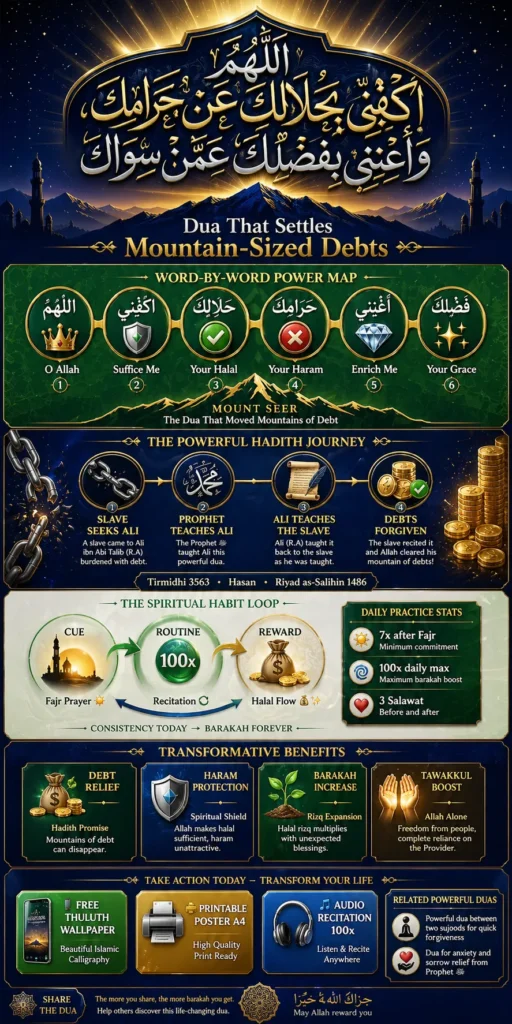
This infographic breaks down meaning, benefits, hadith story, and daily practice for halal rizq and barakah.
Benefits Explained
Reciting this dua brings barakah in income, repels haram influences, and fosters contentment amid trials. It purifies wealth, eases debts, and strengthens tawakkul, as seen in believers who escaped financial traps through persistent use.
Here’s why this matters for you: In a world pushing quick, shady gains, this dua realigns your rizq with purity, inviting unexpected provisions from Allah. Modern 2026 contexts like crypto temptations make it essential—Imam Nawawi notes it guards the heart from greed.
Wazifa and Recitation Times
Perform this wazifa after Fajr: Recite the full dua 100 times daily, or 7 times post-Fajr prayer, with 3 Salawat before and after. Combine with istighfar for faster acceptance—no fixed bid’ah, just sincerity. Many report rizq increase within weeks.
The Spiritual Habit Loop: Build it daily—Cue (Fajr prayer), Routine (100 recitations), Reward (inner peace, halal flow). Track in a journal; this digital-age Sunnah turns dua into autopilot barakah.
Tafseer Insights
Ibn Kathir on related rizq verses (e.g., Surah Talaq 65:2-3) stresses taqwa yields sufficiency; this dua embodies that by prioritizing halal. It echoes “Whoever fears Allah—He will make for him a way out and provide for him from where he does not expect.” Fiqh-wise, it counters unlawful jobs, promoting ethical hustles.
The Prophetic Protocol for Rizq: A Sunnah for Debt Relief (PDF)
People Also Ask:
Up to 100 times daily or 7 after Fajr—consistency over quantity matters most.
Yes, the hadith promises relief even for huge debts; pair with halal effort.
اے اللہ! مجھے تیرے حلال سے حرام کی ضرورت نہ ہو، تیرے فضل سے سب کے سوا بے نیاز کر دے۔
Related duas for forgiveness in sujood?
Try powerful dua between two sujoods for quick forgiveness and ease.
Dua for stress from haram worries?
Recite Allahumma inni auzubika min al-hammi wal-hazan for anxiety relief.
Share this in your next quiet moment—watch Allah unfold halal paths you never saw. Start today for tomorrow’s barakah.

1 thought on “Dua for rizq – Allahumma akfini bihalalika an haramika”