How many times have you rushed to the prayer mat, body physically present but mind miles away, still scrolling through the day’s anxieties or running through your to-do list? We live in an age of fragmented attention. Yet, five times a day, a profound, rapid-fire declaration echoes through the masjid or our homes, designed to sever our ties with the noise of the world. That declaration is the Iqamah, and its core message—Qad qamatis salah—is the ultimate anchor for the wandering heart.
What Does Qad Qamatis Salah Mean?
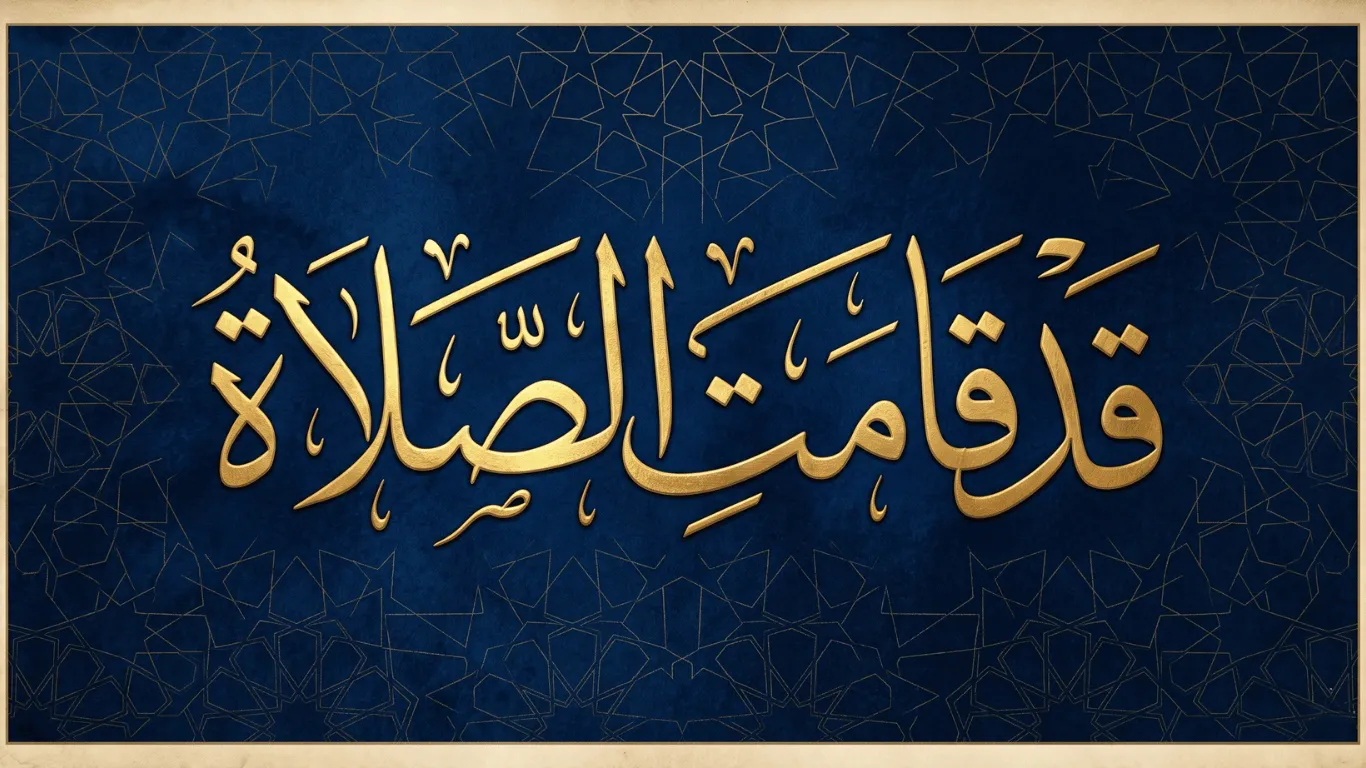
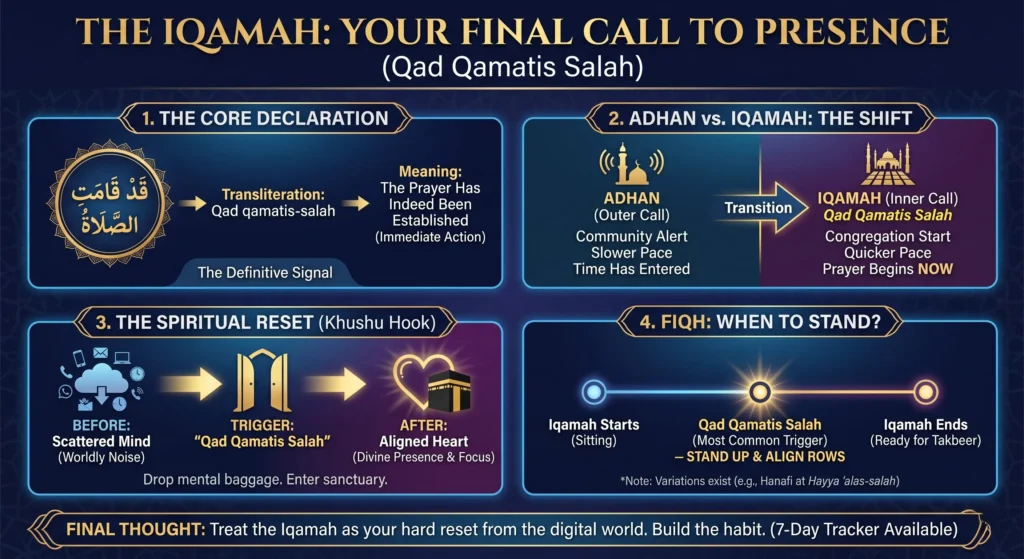
Qad qamatis salah translates directly to “the prayer has indeed been established.” It is the central, defining phrase of the Iqamah, serving as the final and immediate call for Muslims to align their rows and shift their complete focus to worshipping Allah.
To truly grasp the weight of these words, we need to look at the phrasing. The Arabic word qamat implies standing upright, establishing, and bringing something into tangible reality. It is a direct fulfillment of the Quranic command seen throughout the text, such as in Surah Taha (20:14), where Allah instructs Musa (AS): “and establish prayer for My remembrance.” When the Mu’adhdhin reaches this exact phrase, the theoretical time for prayer ends, and the physical, spiritual reality of standing before the Creator begins.
Primary Source Breakdown
- Arabic: قَدْ قَامَتِ الصَّلَاةُ
- Transliteration: Qad qamatis-salah
- English Translation (Saheeh International): “The prayer has been established.”
- Urdu Translation (Fateh Muhammad Jalandhari): نماز کھڑی ہو گئی ہے۔
The Fiqh: Adhan vs. Iqamah
The Adhan is the public announcement that the time for prayer has entered, while the Iqamah is the internal call for the congregation to stand. The Iqamah is recited in a quicker, softer tone directly before the opening takbeer.
While the initial call serves to alert the community, including specific additions for the Fajr prayer, the Iqamat is the definitive signal that the congregation is immediately commencing.
Classical scholarship emphasizes the distinct nature of these two calls. Imam an-Nawawi, in his monumental work Al-Majmu’, highlights the Sunnah of delivering the Iqamah rapidly (Hadr), as opposed to the deliberate, paused rhythm (Tarteel) of the Adhan. The Adhan is meant to reach those far away; the Iqamah is an urgent rally for those already present.
But when exactly do you stand? The scholars differ slightly based on the Madhahib. The Hanafi school suggests standing when the Mu’adhdhin reaches Hayya ‘alas-salah, while the Shafi’i and Hanbali schools often recommend standing once the Iqamah is fully completed. Regardless of the slight technical variations, the unifying purpose is absolute readiness.
The Digital Sunnah: Reclaiming Khushu
True khushu begins before the prayer starts. By treating the Iqamah as a psychological trigger, Muslims can build a spiritual habit loop that immediately transitions the mind from worldly distractions into a state of divine presence.
Here’s why this matters for you today. We are constantly tethered to screens, navigating an endless stream of notifications. This creates a scattered mind. The concept of Khushu (deep reverence and focus) isn’t something you can magically switch on the second you raise your hands for the Takbeer.
Think of the Iqamah as the ultimate “Spiritual Habit Loop.” In habit formation, you need a cue. Let the rapid cadence of Qad qamatis salah be your cue to drop the mental baggage. Ibn Kathir, when explaining the verses of successful believers in Surah Al-Mu’minun (“They who are during their prayer humbly submissive”), notes that Khushu requires the heart to be completely emptied of everything except the prayer.
The physical act of standing establishes the rows, preparing the heart for the opening takbeer and the profound declaration of absolute reliance on Allah that follows. It is the bridge between the chaotic world and the peaceful sanctuary of Salah.
Building a consistent spiritual routine means recognizing the prophetic cues designed to guide our daily transitions. Just as we pause to recite the safar ki dua to seek mindfulness and protection before embarking on a physical journey, we must treat the Iqamah as the ultimate anchor for our internal journey. Letting the final call of Qad qamatis salah wash over you is the daily habit that successfully transitions your heart from the chaos of the outside world into the absolute peace of the prayer mat.
People Also Ask
Yes, it is considered a highly recommended Sunnah (Sunnah Muakkadah) to recite both the Adhan and the Iqamah even when praying alone at home, as it establishes a complete atmosphere of worship.
The Adhan alerts people that the prayer time has started and is called slowly and loudly. The Iqamah is called quickly and quietly inside the mosque to signal that the prayer is starting right now.
While opinions vary slightly among the schools of thought, a common and accepted practice is to stand when the person calling the Iqamah reaches the phrase “Qad qamatis salah.”
To help you build this focus into a concrete routine and track your consistency with congregational prayer, you can download the 7-day protocol tracking sheet. Use it as a physical reminder to treat the Iqamah as your hard reset.
The Digital Sunnah: 7-Day Iqamah & Congregational Prayer Tracker (PDF)
Put it into Practice: Reclaim Your Focus with the 7-Day Tracker
To help you build this focus into a concrete routine and track your consistency with congregational prayer, download the protocol sheet below. Use it as a physical reminder to treat the Iqamah as your hard reset.
Download the 7-Day Protocol Free PDF Guide & Tracker