
Have you ever felt a sudden drop in your stomach right as the plane takes off, or a flash of panic on a busy, unpredictable highway? We spend hundreds of hours a year moving at unnatural speeds, entirely out of our own physical control. But what if those exact moments of vulnerability are actually the perfect time to reset your heart and recognize who is truly in the driver’s seat?
What is the Safar Ki Dua?
The Safar ki dua, or the dua for traveling, is a profound supplication from Surah Az-Zukhruf, verses 13 and 14. Muslims recite this prayer when boarding a vehicle to seek Allah’s protection, acknowledge human limitations, and remember the ultimate journey back to the Creator.
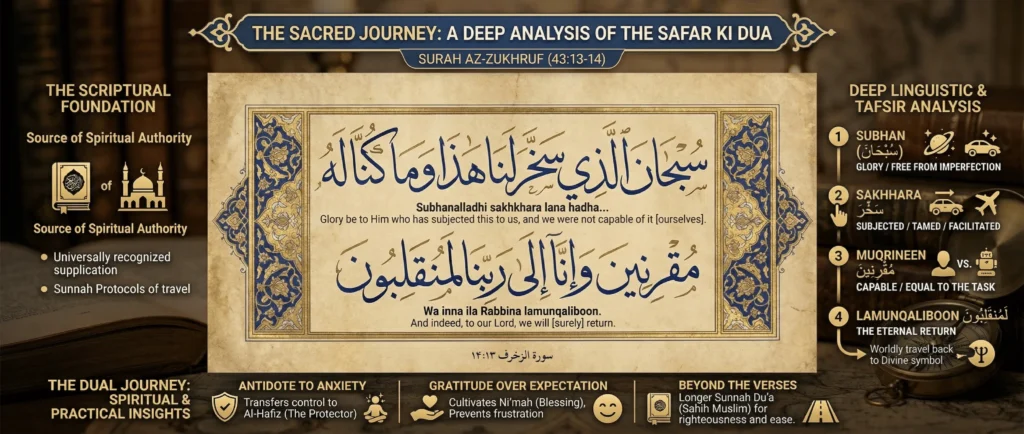
The Multilingual Quadrant: Surah Az-Zukhruf 43:13-14
Arabic (Original Script):
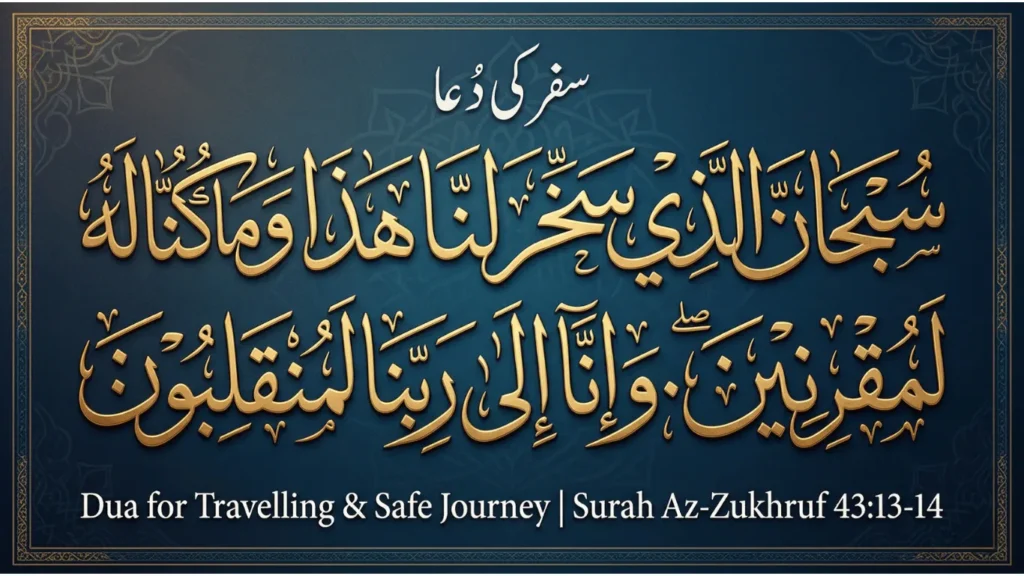
سُبْحَانَ الَّذِي سَخَّرَ لَنَا هَذَا وَمَا كُنَّا لَهُ مُقْرِنِينَ وَإِنَّا إِلَى رَبِّنَا لَمُنقَلِبُونَ
Transliteration (For Accessibility): Subhanallazi sakhara lana haaza wama kunna lahu muqrineen. Wa inna ila Rabbina lamunqaliboon.
English Translation (Saheeh International): “Glory to Him who has subjected this to us, and we could not have [otherwise] subdued it. And indeed we, to our Lord, will [surely] return.”
Urdu Translation (Fateh Muhammad Jalandhari):
پاک ہے وہ ذات جس نے اس (سواری) کو ہمارے تابع کر دیا حالانکہ ہم اسے قابو میں لانے والے نہ تھے۔ اور بلاشبہ ہم اپنے رب کی طرف ہی لوٹ کر جانے والے ہیں۔
Word-by-Word Analysis
Understanding the dua for a safe journey word-by-word transforms a simple recitation into a mindful conversation with Allah. It shifts your focus from the physical vehicle to the divine power that makes the journey possible, deepening your overall spiritual connection.
- Subhanallazi (سُبْحَانَ الَّذِي): Glory be to the One who.
- Sakhara (سَخَّرَ): Subjected / made subservient.
- Lana (لَنَا): For us.
- Haaza (هَذَا): This (vehicle/mode of transport).
- Wama kunna (وَمَا كُنَّا): And we were not.
- Lahu (لَهُ): To it.
- Muqrineen (مُقْرِنِينَ): Capable of controlling / equal to the task.
- Wa inna (وَإِنَّا): And indeed we.
- Ila (إِلَى): To.
- Rabbina (رَبِّنَا): Our Lord.
- Lamunqaliboon (لَمُنقَلِبُونَ): Will surely return.
The Spiritual Habit Loop: Modern Travel Meets the Sunnah
Building a habit of reading the travel dua requires a trigger and a reward. When you buckle your seatbelt or step onto a train, use that physical action as your trigger to recite the dua, resulting in the reward of immediate inner peace.
Often, the anxiety of commuting, long-haul flights, or dangerous roads clouds our minds. We worry about traffic, delays, or accidents. Reciting this dua is not just an empty ritual; it is the ultimate psychological transition of placing complete tawakkul in Allah before stepping out of your home, recognizing Him as the ultimate Disposer of Affairs. By applying this simple framework, your daily commute transforms from a stressful chore into a daily act of dedicated worship.
Tafseer and Classical Scholarship Depth
Classical Islamic scholars emphasized that the dua for travelling is a deeply humbling admission of our weakness. Imam Ibn Kathir noted that reminding ourselves of the worldly vehicle naturally points the believer toward the ultimate vehicle of death, returning us directly to Allah.
When we utter the words “we could not have subdued it,” we actively strip away our ego. You might be driving a technologically advanced, modern car or flying in a highly engineered jet, but the raw laws of aerodynamics and physics were created and sustained entirely by Allah. Recognizing this brings immense humility to the traveler.
Beyond the Basics: The Full Sunnah Dua from Hadith
While the Quranic verses form the core, Prophet Muhammad (ﷺ) expanded on this when embarking on long journeys. The full travel dua found in Sahih Muslim includes powerful pleas for righteousness, ease, and the protection of one’s family left behind.
The Prophet (ﷺ) would ask Allah to fold the physical distance and make the journey easy to bear. When the sheer unpredictability of travel causes distress, combining your journey supplication with the powerful act of seeking Allah’s ultimate mercy during moments of distress can instantly anchor a restless heart.
People Also Ask:
The primary dua for a safe journey is “Subhanallazi sakhara lana haaza wama kunna lahu muqrineen, wa inna ila Rabbina lamunqaliboon,” which asks Allah for protection and acknowledges His supreme control over our travels.
You should recite the safar ki dua as soon as you settle into your vehicle—whether it is a car, plane, train, or bus—right before the physical movement of the journey actually begins.
Reading the travel dua protects you from the sudden hardships of the journey, places the family and property you left behind under Allah’s guardianship, and grants you immense reward for reviving a Sunnah of Prophet Muhammad (ﷺ).
Here is why this matters for you: the next time you turn the key in the ignition or wait for the train doors to close, pause for just five seconds. Let the profound words of Surah Az-Zukhruf wash over you. Make it a non-negotiable part of your routine. Share this deep dive with a family member who travels often, and keep exploring our other Quranic guides to elevate your daily life.
👉 “Before you travel, don’t forget this powerful dua for protection and blessings ✨”
