Have you ever felt a sudden weight on your chest that no amount of deep breathing can fix? The kind of modern anxiety that keeps your mind racing long after you’ve closed your eyes? You are not alone. Millions of Muslims experience this quiet daily struggle, often searching for an anchor in a sea of overwhelming thoughts.
Here’s why this matters. Before we look at therapy and self-help, our tradition offers an incredibly profound, rhythmic remedy. Darood Taj (The Prayer of the Crown) is not just a historical litany; it is a spiritual shield designed to calm the heart, realign our focus, and connect us to the majestic reality of Prophet Muhammad ﷺ.
Let’s understand the real meaning of this beautiful prayer and how you can build it into a daily habit for lasting peace.
What is Darood Taj?
Darood Taj is a beautifully composed Islamic prayer of blessing upon Prophet Muhammad ﷺ. Originally written by the revered Yemeni scholar Shaykh Abu Bakr bin Salim, it serves as a daily spiritual anchor to seek divine peace, alleviate anxiety, and express profound love for the Prophet ﷺ.
This specific Salawat (prayer of blessing) goes beyond standard requests for peace. It paints a vivid picture of the Prophet’s ﷺ cosmic rank—calling him the bearer of the Crown and the repeller of worldly afflictions by the permission of Allah.
The Quranic Foundation of Salawat
Muslims recite Darood because it is a direct, enduring command from Allah in the Quran. Sending peace upon the Prophet ﷺ brings immediate tranquility to the heart, facilitates the forgiveness of sins, and draws immense spiritual rewards from the Divine.
The foundation for all forms of sending blessings is rooted deeply in Surah Al-Ahzab.
Arabic: إِنَّ اللَّهَ وَمَلَائِكَتَهُ يُصَلُّونَ عَلَى النَّبِيِّ ۚ يَا أَيُّهَا الَّذِينَ آمَنُوا صَلُّوا عَلَيْهِ وَسَلِّمُوا تَسْلِيمًا
Transliteration: Innallaha wa mala’ikatahu yusalloona ‘alan-nabiyy, ya ayyuha allatheena amanoo salloo ‘alayhi wa sallimoo tasleema.
English: “Indeed, Allah confers blessing upon the Prophet, and His angels [ask Him to do so]. O you who have believed, ask [Allah to confer] blessing upon him and ask [Allah to grant him] peace.”
Urdu: بیشک اللہ اور اس کے فرشتے نبی پر درود بھیجتے ہیں۔ اے ایمان والو! تم بھی ان پر درود اور خوب سلام بھیجا کرو۔
Hindi: बेशक अल्लाह और उसके फ़रिश्ते नबी पर दरूद भेजते हैं। ऐ ईमान वालों! तुम भी उन पर दरूद और खूब सलाम भेजा करो।
While the Durood Shareef (Allahumma Salli Ala Muhammadin) is the standard foundational practice taught by the Prophet ﷺ himself, beautifully expanded compositions like Darood Taj are celebrated by scholars for their poetic expression of deep, yearning love (Ishq).
Breaking Anxiety
We live in an era of constant notifications, endless scrolling, and overwhelming stress. Our minds are perpetually stuck in a loop of worry. Implementing a daily wazifa (spiritual routine) acts as an emotional circuit breaker.
When you feel panic setting in, your brain is actively looking for a narrative. Reciting Darood Taj replaces those chaotic internal thoughts with rhythmic, beautiful praises of the Prophet ﷺ. This is the essence of the Spiritual Habit Loop. Instead of spiraling downward into stress, you redirect your mental energy upward toward divine gratitude and protection.
Many scholars of the heart note that making Salawat your primary response to hardship is one of the most powerful forms of dua for anxiety and depression. It shifts your psychological focus from your temporary problems to the eternal mercy sent to the worlds.
Multilingual Translation and Pronunciation
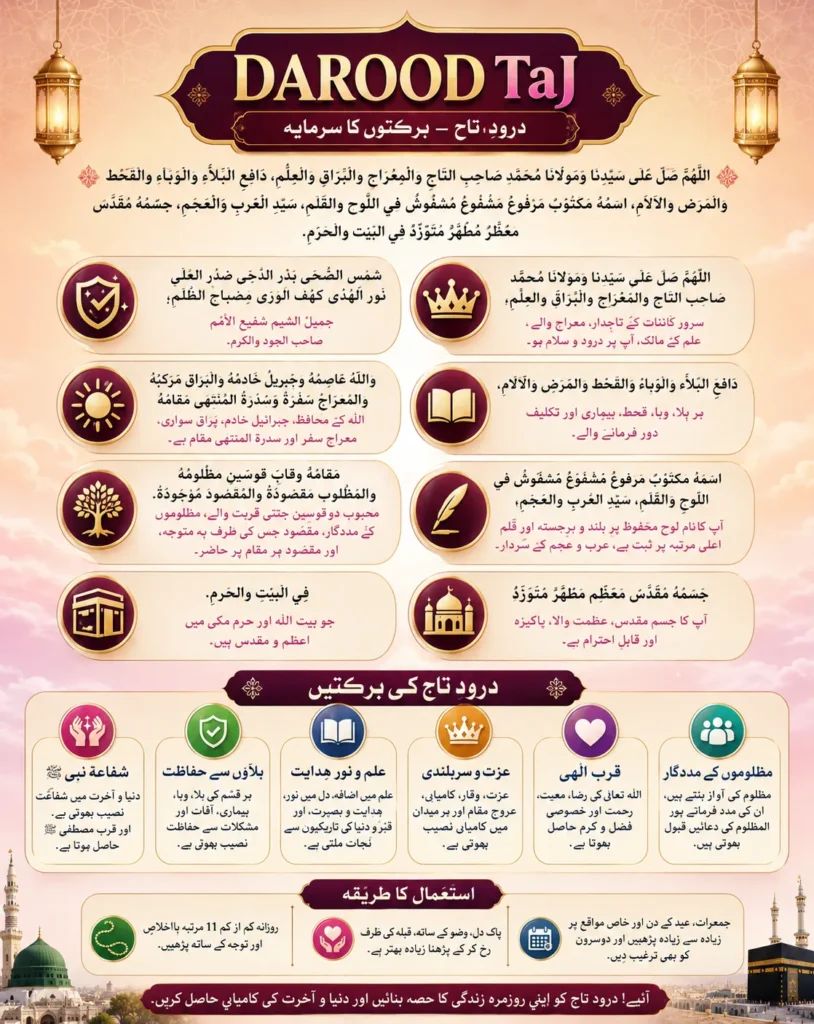
Reciting Darood Taj correctly is essential for fully experiencing its spiritual cadence. Below are the foundational opening verses with accurate, side-by-side English, Urdu, and Hindi translations to ensure perfect pronunciation and deep comprehension.
Arabic Text
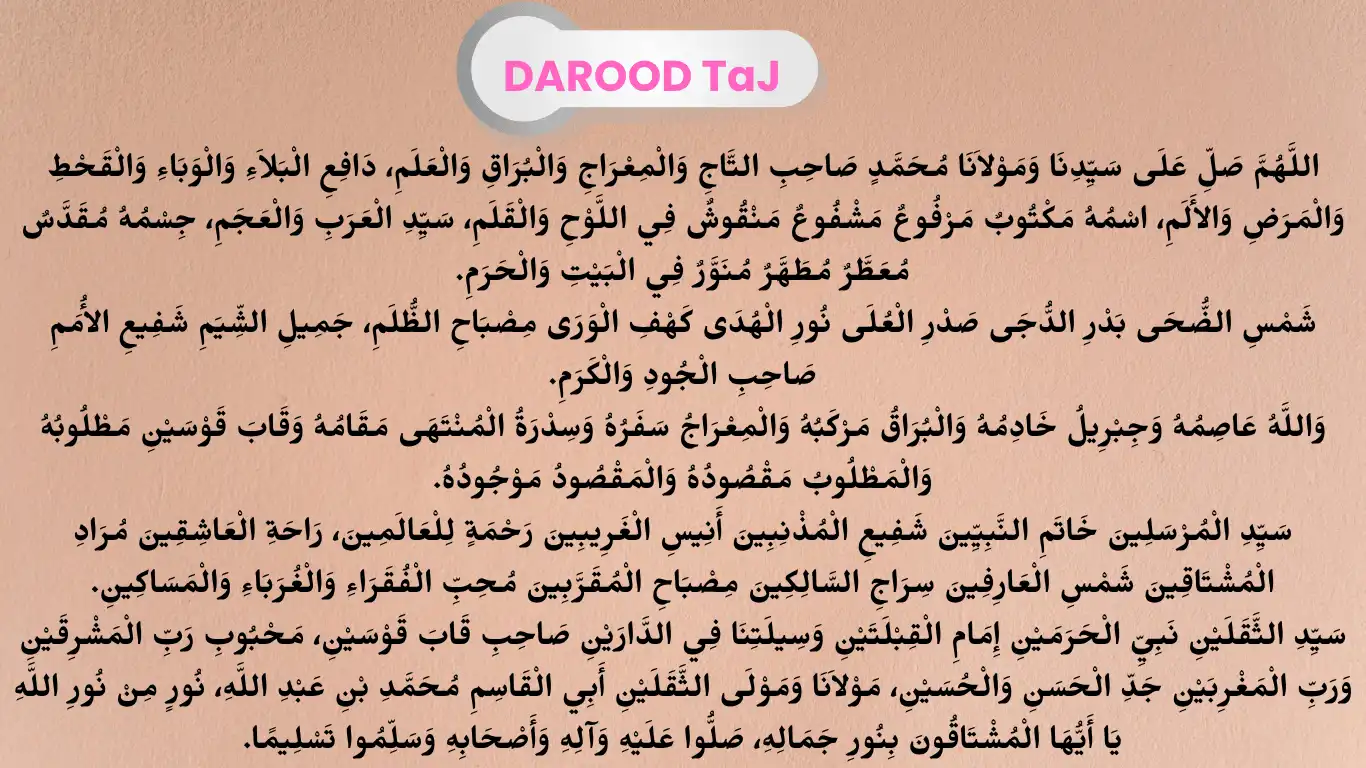
اللَّهُمَّ صَلِّ عَلَى سَيِّدِنَا وَمَوْلاَنَا مُحَمَّدٍ صَاحِبِ التَّاجِ وَالْمِعْرَاجِ وَالْبُرَاقِ وَالْعَلَمِ، دَافِعِ الْبَلاَءِ وَالْوَبَاءِ وَالْقَحْطِ وَالْمَرَضِ وَالأَلَمِ، اسْمُهُ مَكْتُوبٌ مَرْفُوعٌ مَشْفُوعٌ مَنْقُوشٌ فِي اللَّوْحِ وَالْقَلَمِ، سَيِّدِ الْعَرَبِ وَالْعَجَمِ، جِسْمُهُ مُقَدَّسٌ مُعَطَّرٌ مُطَهَّرٌ مُنَوَّرٌ فِي الْبَيْتِ وَالْحَرَمِ
شَمْسِ الضُّحَى بَدْرِ الدُّجَى صَدْرِ الْعُلَى نُورِ الْهُدَى كَهْفِ الْوَرَى مِصْبَاحِ الظُّلَمِ، جَمِيلِ الشِّيَمِ شَفِيعِ الأُمَمِ صَاحِبِ الْجُودِ وَالْكَرَمِ
وَاللَّهُ عَاصِمُهُ وَجِبْرِيلُ خَادِمُهُ وَالْبُرَاقُ مَرْكَبُهُ وَالْمِعْرَاجُ سَفَرُهُ وَسِدْرَةُ الْمُنْتَهَى مَقَامُهُ وَقَابَ قَوْسَيْنِ مَطْلُوبُهُ وَالْمَطْلُوبُ مَقْصُودُهُ وَالْمَقْصُودُ مَوْجُودُهُ.
سَيِّدِ الْمُرْسَلِينَ خَاتَمِ النَّبِيِّينَ شَفِيعِ الْمُذْنِبِينَ أَنِيسِ الْغَرِيبِينَ رَحْمَةٍ لِلْعَالَمِينَ، رَاحَةِ الْعَاشِقِينَ مُرَادِ الْمُشْتَاقِينَ شَمْسِ الْعَارِفِينَ سِرَاجِ السَّالِكِينَ مِصْبَاحِ الْمُقَرَّبِينَ مُحِبِّ الْفُقَرَاءِ وَالْغُرَبَاءِ وَالْمَسَاكِينِ
سَيِّدِ الثَّقَلَيْنِ نَبِيِّ الْحَرَمَيْنِ إِمَامِ الْقِبْلَتَيْنِ وَسِيلَتِنَا فِي الدَّارَيْنِ صَاحِبِ قَابَ قَوْسَيْنِ، مَحْبُوبِ رَبِّ الْمَشْرِقَيْنِ وَرَبِّ الْمَغْرِبَيْنِ جَدِّ الْحَسَنِ وَالْحُسَيْنِ، مَوْلاَنَا وَمَوْلَى الثَّقَلَيْنِ أَبِي الْقَاسِمِ مُحَمَّدِ بْنِ عَبْدِ اللَّهِ، نُورٍ مِنْ نُورِ اللَّهِ
يَا أَيُّهَا الْمُشْتَاقُونَ بِنُورِ جَمَالِهِ، صَلُّوا عَلَيْهِ وَآلِهِ وَأَصْحَابِهِ وَسَلِّمُوا تَسْلِيمًا
Transliteration
Allahumma salli ‘ala Sayyidina wa Mawlana Muhammadin sahib it-taji wal-mi’raji wal-buraqi wal-‘alam. Dafi’ il-bala’i wal-waba’i wal-qahti wal-maradhi wal-alam. Ismuhu maktubun marfu’un mashfu’un manqushun fil lawhi wal-qalam. Sayyid il-‘arabi wal-‘ajam. Jismuhu muqaddasun mu’attarun mutahharun munawwarun fil-bayti wal-haram. Shams id-dhuha, badr id-duja, sadr il-‘ula, nur il-huda, kahf il-wara, misbah iz-zulam. Jamil ish-shiyam, shafi’ il-umam, sahib il-judi wal-karam. Wallahu ‘asimuhu, wa Jibrilu khadimuhu, wal-buraqu markabuhu, wal-mi’raju safaruhu, wa sidrat ul-muntaha maqamuhu. Wa qaba qawsayni matlubuhu, wal-matlubu maqsuduhu, wal-maqsudu mawjuduhu. Sayyid il-mursalina, khatam in-nabiyyina, shafi’ il-mudhnibina, anis il-gharibina, rahmatan lil-‘alamin. Rahat il-‘ashiqina, murad il-mushtaqina, shams il-‘arifina, siraj is-salikina, misbah il-muqarrabina. Muhibb il-fuqara’i wal-ghuraba’i wal-masakin. Sayyid ith-thaqalayni, nabiyy il-haramayni, imam il-qiblatayni. Wasilatina fid-darayni, sahib i-qaba qawsayni. Mahbubi rabb il-mashriqayni wa rabb il-maghribayni. Jadd il-Hasani wal-Husayn. Mawlana wa mawlath-thaqalayn, Abil Qasimi Muhammad ibni ‘Abdillah. Nurin min nurillah. Ya ayyuhal mushtaquna binuri jamalihi, Sallu ‘alayhi wa alihi wa ashabihi wa sallimu taslima.
English Translation
O Allah, send blessings upon our Master and Patron Muhammad, the bearer of the Crown, the Ascent (Mi’raj), the Heavenly Mount (Buraq), and the Banner. The repeller of affliction, epidemics, drought, illness, and pain. His name is written, exalted, interceding, and engraved upon the Preserved Tablet and the Pen. The master of the Arabs and the non-Arabs. His body is sanctified, perfumed, purified, and illumined within the Sacred House and the Sanctuary.
He is the Sun of the morning light, the Full Moon of the dark night, the Foremost in high-rank, the Light of guidance, the Cave of refuge for creation, the Lamp in the darkness. Possessor of beautiful character, the intercessor of the nations, the owner of bounty and generosity.
Allah is his Protector, Gabriel is his servant, the Buraq is his mount, the Mi’raj is his journey, and the Lote Tree of the Utmost Boundary (Sidrat al-Muntaha) is his station. “Two bow-lengths or nearer” (Qaba Qawsayn) is his desire, his desire is his goal, and his goal is what he has found.
The Master of the Messengers, the Seal of the Prophets, the intercessor for sinners, the companion of strangers, the mercy to the worlds. The comfort of the lovers, the desire of the yearning, the sun of the gnostics, the guiding lamp for the travelers, the light of those drawn near to Allah. The lover of the poor, the strangers, and the destitute.
The master of the two realms (jinn and mankind), the Prophet of the two sanctuaries (Mecca and Medina), the Imam of the two Qiblas. Our means of salvation in both domains, the one who attained “two bow-lengths.” The beloved of the Lord of the two Easts and the Lord of the two Wests. The grandfather of Hasan and Husayn. Our Master and the Master of the two realms, Abu al-Qasim, Muhammad, son of Abdullah. A light from the Light of Allah.
O you who yearn for the light of his beauty, Send blessings upon him, his family, and his companions, and salute him with a worthy salutation.
Full Urdu Translation
اے اللہ! ہمارے سردار اور ہمارے آقا حضرت محمد ﷺ پر درود نازل فرما، جو تاج، معراج، براق اور جھنڈے والے ہیں۔ جو بلاؤں، وباؤں، قحط، بیماری اور درد کو دور کرنے والے ہیں۔ جن کا نام لوح و قلم میں لکھا ہوا، بلند کیا ہوا، شفاعت کیا ہوا اور نقش ہے۔ جو عرب اور عجم کے سردار ہیں۔ جن کا جسم کعبہ اور حرم میں مقدس، معطر، پاکیزہ اور منور ہے۔
جو چاشت کے سورج، اندھیری رات کے چودھویں کے چاند، بلندیوں کے صدر، ہدایت کے نور، مخلوق کی پناہ گاہ اور تاریکیوں کے چراغ ہیں۔ جو خوبصورت خصلتوں والے، امتوں کی شفاعت کرنے والے اور جود و کرم کے مالک ہیں۔
اور اللہ ان کا نگہبان ہے، اور جبرائیل ان کے خادم ہیں، اور براق ان کی سواری ہے، اور معراج ان کا سفر ہے، اور سدرۃ المنتہیٰ ان کا مقام ہے، اور قاب قوسین (دو کمانوں کے فاصلے کے برابر یا اس سے کم) ان کا مطلوب ہے، اور مطلوب ہی ان کا مقصود ہے، اور مقصود ان کو حاصل ہے۔
جو رسولوں کے سردار، نبیوں کے خاتم، گناہگاروں کی شفاعت کرنے والے، مسافروں کے غم خوار، اور تمام جہانوں کے لیے رحمت ہیں۔ جو عاشقوں کا سکون، مشتاقوں کی مراد، عارفوں کے سورج، سالکوں کے چراغ، اور مقربین کی روشنی ہیں۔ جو فقیروں، غریبوں اور مسکینوں سے محبت کرنے والے ہیں۔
جو جن و انس کے سردار، حرمین کے نبی، دونوں قبلوں کے امام، اور دونوں جہانوں میں ہمارا وسیلہ ہیں، جو قاب قوسین کے مقام والے ہیں۔ جو دونوں مشرقوں اور دونوں مغربوں کے رب کے محبوب ہیں، جو حسن اور حسین کے نانا ہیں۔ جو ہمارے اور جن و انس کے آقا ہیں، ابوالقاسم، محمد بن عبداللہ، جو اللہ کے نور میں سے ایک نور ہیں۔
اے ان کے نورِ جمال کے مشتاقو! ان پر، ان کی آل اور اصحاب پر درود بھیجو اور خوب سلام بھیجو۔
Full Hindi Translation
ऐ अल्लाह! हमारे सरदार और हमारे आक़ा हज़रत मुहम्मद ﷺ पर दरूद नाज़िल फ़रमा, जो ताज, मेराज, बुराक़ और झंडे वाले हैं। जो बलाओं, वबाओं, अकाल, बीमारी और दर्द को दूर करने वाले हैं। जिनका नाम लौह-ओ-क़लम में लिखा हुआ, बुलंद किया हुआ, शिफ़ाअत किया हुआ और नक़्श है। जो अरब और अजम के सरदार हैं। जिनका जिस्म काबा और हरम में मुक़द्दस, मुअत्तर, पाकीज़ा और मुनव्वर है।
जो चाश्त (सुबह) के सूरज, अँधेरी रात के चौदहवीं के चाँद, बुलंदियों के सदर, हिदायत के नूर, मख़्लूक़ की पनाहगाह और तारिक़ियों के चराग़ हैं। जो ख़ूबसूरत ख़स्लतों वाले, उम्मतों की शिफ़ाअत करने वाले और जूद-ओ-करम के मालिक हैं।
और अल्लाह उनके निगहबान (रक्षक) हैं, और जिब्रील उनके खादिम हैं, और बुराक़ उनकी सवारी है, और मेराज उनका सफ़र है, और सिदरत-उल-मुंतहा उनका मक़ाम है, और क़ाब-ए-क़ौसैन (दो कमानों के फ़ासले के बराबर या उससे कम) उनका मतलूब (चाहत) है, और मतलूब ही उनका मक़सूद है, और मक़सूद उनको हासिल है।
जो रसूलों के सरदार, नबियों के ख़ातम, गुनहगारों की शिफ़ाअत करने वाले, मुसाफ़िरों के ग़मख़्वार, और तमाम जहानों के लिए रहमत हैं। जो आशिक़ों का सुकून, मुश्ताक़ों (चाहने वालों) की मुराद, आरिफ़ों के सूरज, सालिकों के चराग़, और मुक़र्रबीन की रौशनी हैं। जो फ़क़ीरों, ग़रीबों और मिस्कीनों से मुहब्बत करने वाले हैं।
जो जिन्न-ओ-इंस के सरदार, हरमैन के नबी, दोनों क़िब्लों के इमाम, और दोनों जहानों में हमारा वसीला हैं, जो क़ाब-ए-क़ौसैन के मक़ाम वाले हैं। जो दोनों मशरिक़ों (पूरब) और दोनों मग़रिबों (पश्चिम) के रब के महबूब हैं, जो हसन और हुसैन के नाना हैं। जो हमारे और जिन्न-ओ-इंस के आक़ा हैं, अबुल क़ासिम, मुहम्मद बिन अब्दुल्लाह, जो अल्लाह के नूर में से एक नूर हैं।
ऐ उनके नूर-ए-जमाल के मुश्ताक़ों (चाहने वालों)! उन पर, उनकी आल और असहाब पर दरूद भेजो और ख़ूब सलाम भेजो।
How Darood Taj Relieves Anxiety
Why Recite Darood Taj Today?
Darood Taj offers profound spiritual healing for the modern Muslim. It helps shift our psychological focus from daily worries to the magnificent reality of the Prophet ﷺ, acting as a shield against physical and emotional distress by the will of Allah.
This becomes important when you look at how much we try to control our own lives. We often rely purely on our own planning, forgetting the spiritual dimension of Barakah (divine blessing). Classical scholars remind us that while our personal supplications might be flawed, any prayer that carries Salawat upon the Prophet ﷺ is inherently accepted by Allah. Darood Taj leverages this beautifully. By calling upon the Prophet as a means of approach (Wasilah), we acknowledge our own weakness and rely on his ultimate standing before God.
People Also Ask
For general peace of mind and spiritual connection, reciting it once after the Fajr or Isha prayer is an excellent daily habit. For overcoming severe distress or seeking specific relief, classical scholars often recommend reciting it 3, 7, or 11 times. Consistency is always more important than a high number.
The primary benefits include immense inner peace, protection from sudden calamities, relief from anxiety and depression, and cultivating a deep, loving bond with Prophet Muhammad ﷺ. It is widely regarded as a spiritual remedy for both a heavy heart and physical illness.
Yes, you can recite any Salawat, including Darood Taj, from memory without having Wudu (ablution). However, if you are reading directly from a physical book or script that contains Quranic verses, Wudu is highly recommended out of respect and adab (etiquette).
Darood Taj is an authentic spiritual composition by a respected Islamic scholar, Shaykh Abu Bakr bin Salim. While it is not a direct Hadith (like Darood Ibrahimi), it is a completely valid and highly celebrated expression of poetic love and veneration for the Prophet ﷺ, firmly rooted in orthodox Islamic principles.
Next Steps: Build Your Daily Wazifa
Now let’s connect this to daily life. Building a new habit requires removing friction. You shouldn’t have to struggle with pronunciation, lose your place on a screen, or search for meanings every morning.
To help you establish this beautiful practice consistently, we have prepared a perfectly formatted, easy-to-read document that you can keep on your phone or print for your prayer mat.
