
Have you ever felt completely overwhelmed by the demands of your workplace, the sting of someone’s harsh words, or the heavy burden of sudden personal grief? When life pushes you to the edge of your emotional limits, the natural human reaction is to panic, lash out, or entirely shut down. Yet, embedded within the advice of a wise father to his son lies a profound blueprint for surviving the chaos of modern life without losing your inner peace.
The Exact Meaning of Wasbir Ala Ma Asabaka
“Wasbir ala ma asabaka” simply translates to “be patient over what befalls you.” Found in Surah Luqman (31:17), this phrase is not just spiritual encouragement; it is a direct divine command to maintain emotional resilience when hardship strikes. The concluding phrase, “inna zalika min azmil umoor,” confirms that choosing this restraint is a matter of great resolve, requiring immense psychological strength.
To fully grasp its weight, we must look at the linguistic and multilingual roots of this beautiful advice.
Arabic Text:
وَاصْبِرْ عَلَىٰ مَا أَصَابَكَ ۖ إِنَّ ذَٰلِكَ مِنْ عَزْمِ الْأُمُورِ
Transliteration: Wasbir ‘ala ma asabaka inna dhalika min ‘azmi al-umur.
English Translation: “And be patient over what befalls you. Indeed, [all] that is of the matters [requiring] resolve.”
Urdu Translation:
اور جو مصیبت تجھے پہنچے اس پر صبر کر، بیشک یہ بڑی ہمت کے کام ہیں۔
Hindi Translation: और जो मुसीबत तुम पर पड़े उस पर सब्र करो, बेशक यह बड़ी हिम्मत के कामों में से है।
Here is why this matters. The Arabic root for asabaka (أَصَابَكَ) is the same root used for an arrow hitting its target dead-center. The verse implies that the adversity you are facing was perfectly aimed at you by divine decree, meaning you have the exact capacity required to withstand it.
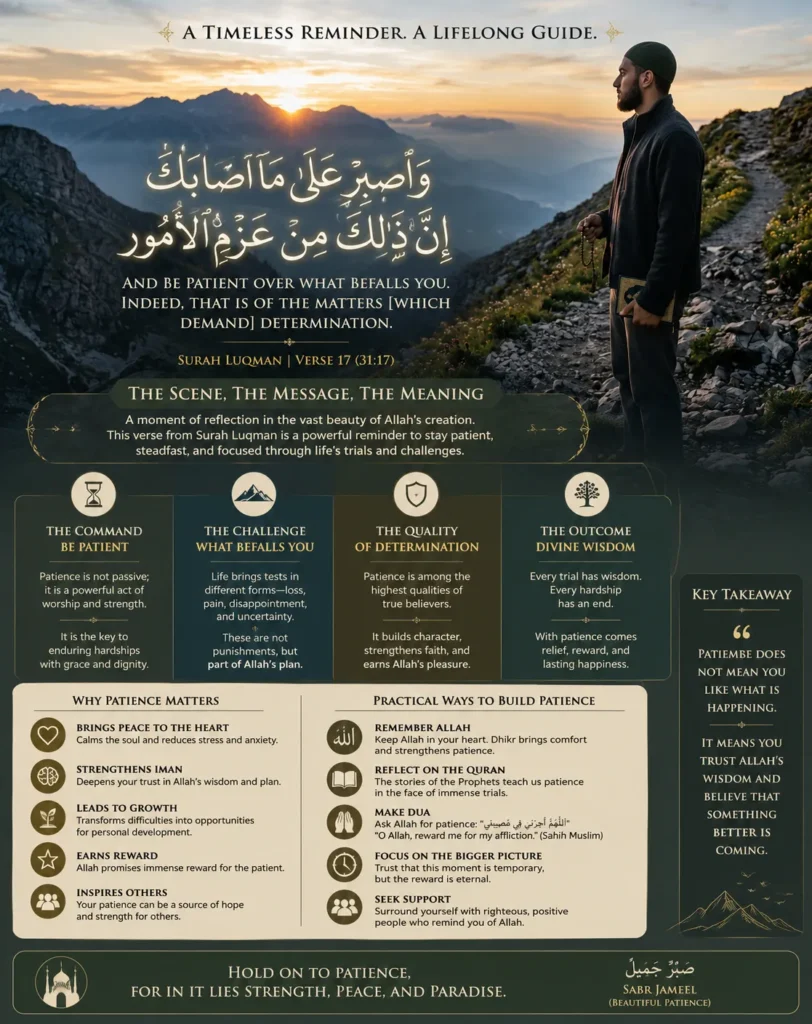
A Modern Resilience Framework from Classical Tafseer
True Sabr is an active psychological endurance framework, not passive suffering. Classical scholars like Ibn Kathir and Al-Qurtubi emphasize that this specific verse addresses the social friction and pushback we inevitably face when trying to live an ethical, upright life.
When you stand up for what is right in a toxic corporate environment, or when you face the social pressures of university life, friction is guaranteed. Imam Ibn Kathir, in his renowned Tafseer, highlights that Luqman told his son to enjoin good and forbid evil, and immediately followed it with the command to be patient. Ibn Kathir explains that this sequence exists because anyone who tries to correct society or hold onto their values will face harm and annoyance from people.
We can map this classical wisdom directly onto a modern resilience framework. When a young professional experiences a stressful project failure or a student faces unjust criticism, the brain’s threat-response system triggers anxiety. Surah Luqman 31:17 offers a “Spiritual Habit Loop”:
- The Trigger: A stressful event, grief, or workplace conflict (ma asabaka).
- The Routine: Actively pausing and binding the soul to restraint (wasbir).
- The Reward: Developing high character and unshakeable resolve (azmil umoor).
Prophetic Hadith on Patience and Social Friction
The Prophet Muhammad (PBUH) taught that a believer who actively interacts with society and endures their harm possesses higher spiritual strength than one who isolates to avoid conflict. Social friction is an unavoidable reality of human existence.
This becomes important when you look at the daily realities of modern life. We are constantly exposed to digital noise, workplace politics, and complex social dynamics. A famous Hadith recorded in Sunan Ibn Majah states: “The believer who mixes with people and bears their annoyance with patience is better than the believer who does not mix with people and does not bear their annoyance with patience.”
This tradition aligns perfectly with Luqman’s advice. You are not meant to hide from the world to protect your peace. You are meant to build an internal shock absorber—Sabr—that allows you to navigate toxic environments, demanding bosses, and interpersonal grief while maintaining your Islamic integrity.
Navigating Daily Life and Complete Islamic Guidance
Part of maintaining resilience and reducing stress is having clear, actionable guidance on the daily matters of faith. Uncertainty breeds anxiety, while knowledge brings peace.
Living a holistic Islamic lifestyle means seeking clarity on all aspects of jurisprudence (Fiqh) and daily living, ensuring our actions align with divine boundaries. Whether a student is navigating dietary restrictions in a new city or a young professional is seeking clarity on marital life, knowing the rulings removes a significant mental burden. For example, understanding dietary specifics, such as whether crab is halal or haram in Islam, or seeking knowledge regarding sensitive familial and private matters like can I kiss my wife private parts in Islam, allows a believer to live with confidence rather than doubt. Seeking this knowledge proactively is a form of resilience in itself.
Wazifa, Benefits, and Practical Application
While there is no rigid Sunnah prescribing a specific number of times to recite this verse, making it a personal daily Wazifa (spiritual litany) acts as a powerful cognitive reset.
Repeating “Wasbir ala ma asabaka” during moments of acute stress, anger, or deep grief serves as a mindfulness trigger. It stops the psychological spiral of “Why is this happening to me?” and replaces it with the grounding reality of “This is meant for me, and I have the resolve to handle it.”
Benefits of Reciting This Verse During Hardship:
- Emotional Regulation: It actively lowers your heart rate by shifting your focus from the external problem to internal reliance on Allah.
- Perspective Shift: It reminds you that enduring hardship is not a sign of weakness, but a trait of elite spiritual resilience (azmil umoor).
- Protection from Reactivity: It prevents you from saying or doing things in anger that you might later regret, preserving your relationships and professionalism.
Now let’s connect this to daily life. The next time you receive a frustrating email, face an unfair critique, or feel the heavy wave of personal loss, pause. Breathe. Recite this verse internally. Acknowledge that the arrow has landed exactly where it was supposed to, and stand firm in your resolve.
People Also Ask:
This phrase means “Indeed, that is of the matters requiring resolve.” It highlights that practicing patience during hardship is not easy; it requires immense courage, determination, and high moral character. It is the hallmark of a strong believer.
This profound advice is found in Surah Luqman, Chapter 31 of the Quran, specifically in verse 17. It is part of the wisdom imparted by the sage Luqman to his son regarding how to navigate life and society.
When facing difficult colleagues or high-pressure situations, use this verse as a mental anchor. Instead of reacting emotionally to the stress, recognize the friction as the ma asabaka (what has befallen you) and apply sabr (active restraint). This allows you to respond with professionalism and spiritual dignity.
Build Your Daily Spiritual Resilience If you are struggling with anxiety, grief, or the heavy pressures of modern life, anchoring your heart with specific Quranic verses can change your reality. To help you integrate this resilience framework into your daily routine, we have compiled a step-by-step spiritual action plan. Download our specific Wazifa Guide for Emotional Resilience today, and start transforming your daily stress into spiritual strength.

2 thoughts on “Surah Luqman (31:17) — Wasbir ala ma asabaka inna zalika min”