
Five times a day, the world demands your absolute attention with deadlines, notifications, and endless responsibilities. Yet, five times a day, a voice from the minaret calls you back to your ultimate purpose. When the adhan finishes, what is your immediate response? That brief moment of silence before the prayer begins is not just a pause; it is one of the most powerful opportunities for spiritual elevation and connection in a believer’s day.
What is the Dua After Adhan?
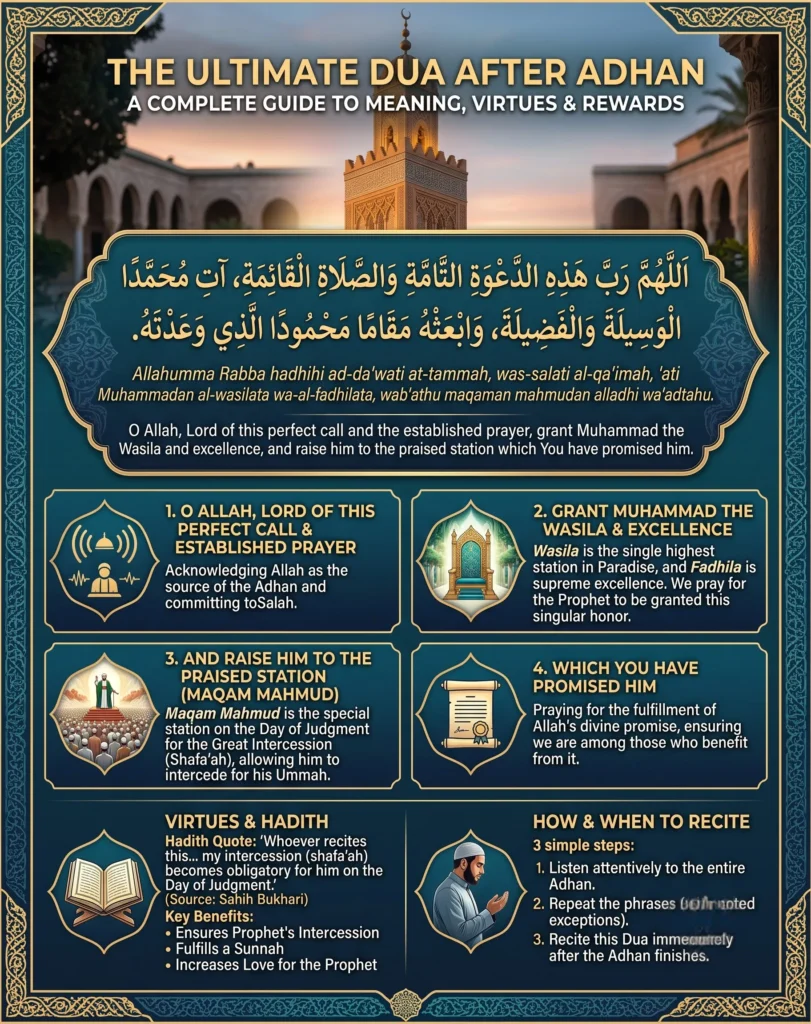
The dua after adhan is a prophetic supplication asking Allah to grant Prophet Muhammad (PBUH) the highest rank in Paradise. Reciting it faithfully guarantees his intercession on the Day of Judgment. The most authentic and widely practiced version begins with the phrase “Allahumma Rabba hadhihi-d-da’wati-t-tammah.”
Arabic:
اللَّهُمَّ رَبَّ هَذِهِ الدَّعْوَةِ التَّامَّةِ، وَالصَّلاَةِ الْقَائِمَةِ، آتِ مُحَمَّدًا الْوَسِيلَةَ وَالْفَضِيلَةَ، وَابْعَثْهُ مَقَامًا مَحْمُودًا الَّذِي وَعَدْتَهُ
Transliteration:
Allahumma Rabba hadhihi-d-da’wati-t-tammah, was-salati-l-qa’imah, ati Muhammadan al-wasilata wal-fadilah, wab’ath-hu maqaman mahmudan-illadhi wa’adtah.
English:
O Allah, Lord of this perfect call and established prayer. Grant Muhammad the intercession and favor, and raise him to the Praiseworthy Station You have promised him.
Urdu:
اے اللہ! اس مکمل پکار اور قائم ہونے والی نماز کے رب، محمد صلی اللہ علیہ وسلم کو وسیلہ اور فضیلت عطا فرما، اور انہیں اس مقام محمود پر فائز فرما جس کا تو نے ان سے وعدہ کیا ہے۔
Hindi Translation:
ऐ अल्लाह! इस पूर्ण (मुकम्मल) पुकार और कायम होने वाली नमाज़ के रब, मुहम्मद (ﷺ) को वसीला और फ़ज़ीलत अता फ़रमा, और उन्हें उस मक़ामे महमूद (प्रशंसनीय स्थान) पर पहुँचा जिसका तूने उनसे वादा किया है।
Mastering the Correct Pronunciation
Perfecting the pronunciation of the dua after adhan requires careful attention to the Arabic makharij (articulation points). For new Muslims and parents teaching children, breaking the supplication into smaller, manageable phonetic blocks makes memorization, accuracy, and confident recitation much easier.
Here is why this matters. Many non-native Arabic speakers struggle to differentiate between similar-sounding letters, which can alter the profound meaning of the supplication. When teaching this to children or learning it yourself as a new Muslim, focus on these distinct phonetic sections:
- Dha and Zaa: In the word hadhihi (هَذِهِ), the letter ‘dhal’ (ذ) is pronounced by placing the tip of the tongue against the edge of the upper front teeth. It sounds softer than a sharp ‘Z’.
- Ayn and Hamza: The word da’wati (الدَّعْوَةِ) contains the letter ‘ayn’ (ع), which comes from the middle of the throat. It is distinct from the regular ‘A’ sound.
- Saad and Seen: In was-salati (وَالصَّلاَةِ), the ‘saad’ (ص) is a heavy, full-mouth sound, entirely different from the lighter ‘seen’ (س) found in al-wasilata (الْوَسِيلَةَ).
By practicing these specific articulation points, you ensure that the words are spoken exactly as the Prophet (PBUH) taught them, preserving both the beauty and the theological accuracy of the prayer.
A Catalyst for Daily Islamic Transformation
Reciting this dua transforms a routine pause into an active spiritual habit loop. It shifts a young professional’s mindset from worldly stress to eternal purpose, grounding the believer five times daily in the reality of the Hereafter and the Prophet’s living legacy.
Let’s understand the real meaning behind this daily reset. In the modern era, our days are fragmented by meetings, commutes, and digital noise. The adhan serves as a divine pattern interrupt, halting our worldly momentum. However, merely hearing the adhan is only the first step. The proactive recitation of the dua is where the true transformation occurs. It takes the core testimony of our faith—the profound weight and meaning found in the declaration of La ilaha illallah Muhammadur Rasulullah—and puts it into daily, repetitive practice.
For parents, modeling this behavior creates a lasting impression on children. When a busy parent stops everything, listens attentively, and softly murmurs this dua, it teaches children that connection with Allah and love for His Messenger supersede whatever worldly task is at hand.
Scholarly Depth: Hadith and Quranic Context
Classical Islamic scholarship highlights this dua as a definitive guarantee for prophetic intercession. Authentic traditions in Sahih Bukhari and detailed commentaries by classical scholars like Ibn Hajar and Imam Nawawi emphasize that this specific prayer directly fulfills a divine promise mentioned in the Quran.
This becomes important when you look at the exact texts that form our understanding. The foundation of this practice is found in Sahih al-Bukhari, where Jabir bin Abdullah narrated that Allah’s Messenger (PBUH) said:
“Whoever says when he hears the call to prayer, ‘O Allah, Lord of this perfect call and established prayer…’, my intercession for him will be permitted on the Day of Resurrection.”
To grasp the magnitude of this reward, we turn to the classical scholars. Imam al-Nawawi, in his commentary on Sahih Muslim, explains the concept of Al-Wasilah. He clarifies that it is the most exalted and singular station in Jannah, reserved exclusively for one servant of Allah. When we recite this dua, we are collectively praying for Prophet Muhammad (PBUH) to attain that apex position.
Furthermore, Ibn Hajar al-Asqalani, in his monumental work Fath al-Bari, connects this dua directly to the Quran. He explains that the phrase Maqam Mahmud (the Praiseworthy Station) is a direct realization of Surah Al-Isra (17:79):
“And from [part of] the night, pray with it as additional [worship] for you; it is expected that your Lord will resurrect you to a praised station.”
Ibn Hajar notes that this station represents the Great Intercession (Shafa’at al-Kubra) on the Day of Judgment, when the Prophet (PBUH) will advocate for humanity when all other prophets remain silent.
Applying the Sunnah During the Morning Call
The adhan experience requires distinct mindfulness at dawn. When listening to the morning call, believers hear an extra phrase emphasizing that prayer is better than sleep, requiring a conscious spiritual effort to wake up and respond with the prophetic dua.
Now let’s connect this to daily life, particularly during the most challenging part of the day: the early morning. Waking up for Fajr requires immense discipline. When the mu’adhin’s voice breaks the silence of the night, proclaiming As-salatu khayrun minan-nawm (prayer is better than sleep), the believer’s spiritual resilience is tested. Replying to these exact words and finalizing the call with the dua of Allahumma Rabba hadhihi-d-da’wati-t-tammah seals your morning with prophetic blessings, setting a productive and barakah-filled tone for the rest of your workday.
Dua after Azan PDF
People Also Ask
You should recite this dua once immediately after the mu’adhin finishes the complete adhan. Doing this five times a day after each call to prayer ensures continuous spiritual reward and guarantees intercession on the Last Day.
Yes, you can recite the dua after adhan without being in a state of wudu (ablution). Supplications and the remembrance (dhikr) of Allah are permissible and encouraged at any time, even without ritual purity.
While raising hands is a general etiquette of making dua, it is not explicitly mandatory for this specific supplication. Scholars state you can recite it quietly to yourself while walking, sitting, or preparing for the upcoming prayer.
Maqam Mahmud translates directly to the “Praiseworthy Station.” Islamic scholars explain this refers exclusively to the right of the Great Intercession granted to Prophet Muhammad (PBUH) to initiate the reckoning on the Day of Judgment.
Take the Next Step in Your Spiritual Journey Want to perfect your daily prayers, master the correct Arabic pronunciation, and understand the deep meanings behind what you recite every day? Download our full informational PDF guide below. It includes easy-to-read phonetic breakdowns, printable dua cards for your home or office, and a comprehensive checklist for building a lasting daily Islamic transformation.

Great content! Keep up the good work!