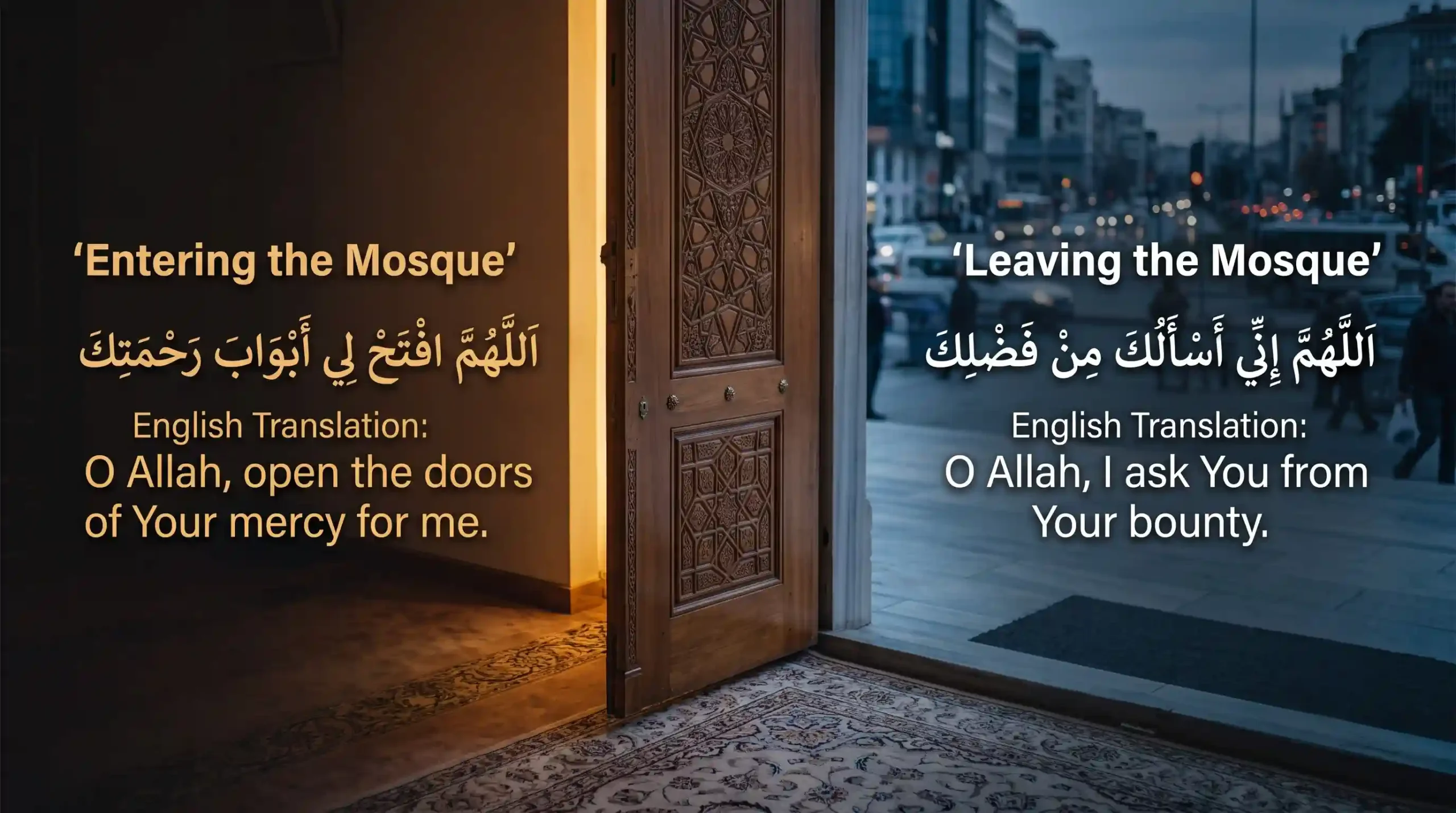
When you are stepping off the London Underground at 9 AM GMT or rushing through a busy New York street to catch the 1:15 PM EST Friday prayer, your mind is usually racing. You carry the stress of emails, commute traffic, and modern city life right up to the doors of the masjid. Before you cross that physical threshold, this ancient dua from Prophet Muhammad (PBUH) serves as your ultimate mental reset, shifting your heart from worldly chaos into a divine sanctuary.
What Is the Dua Before Entering the Mosque in English?
The authentic dua before entering the mosque is a short prayer asking Allah to open the doors of His mercy. You recite it while stepping into the masjid with your right foot. This practice immediately shifts your mindset from worldly stress to spiritual readiness.
Hadith Reference: Sahih Muslim (Book 4, Hadith 152)
1. Arabic Text:
بِسْمِ اللَّهِ وَالصَّلَاةُ وَالسَّلَامُ عَلَى رَسُولِ اللَّهِ، اللَّهُمَّ افْتَحْ لِي أَبْوَابَ رَحْمَتِكَ
2. Transliteration: “Bismillahi was-salatu was-salamu ‘ala Rasulillah, Allahumma iftah li abwaba rahmatik.”
3. English Translation: “In the name of Allah, and prayers and peace be upon the Messenger of Allah. O Allah, open the doors of Your mercy for me.”
4. Urdu Translation: “
اللہ کے نام سے، اور درود و سلام ہو اللہ کے رسول پر۔ اے اللہ! میرے لیے اپنی رحمت کے دروازے کھول دے۔”
Here is why this matters for you. As an American or British Muslim, your days are divided by strict secular schedules. Saying this simple invocation is an act of letting go. By specifically asking for the “doors of mercy” to open, you acknowledge that true peace cannot be found in a salary or a status symbol; it is a spiritual gift granted by Allah when you sincerely seek it.
The Dua for Leaving the Mosque
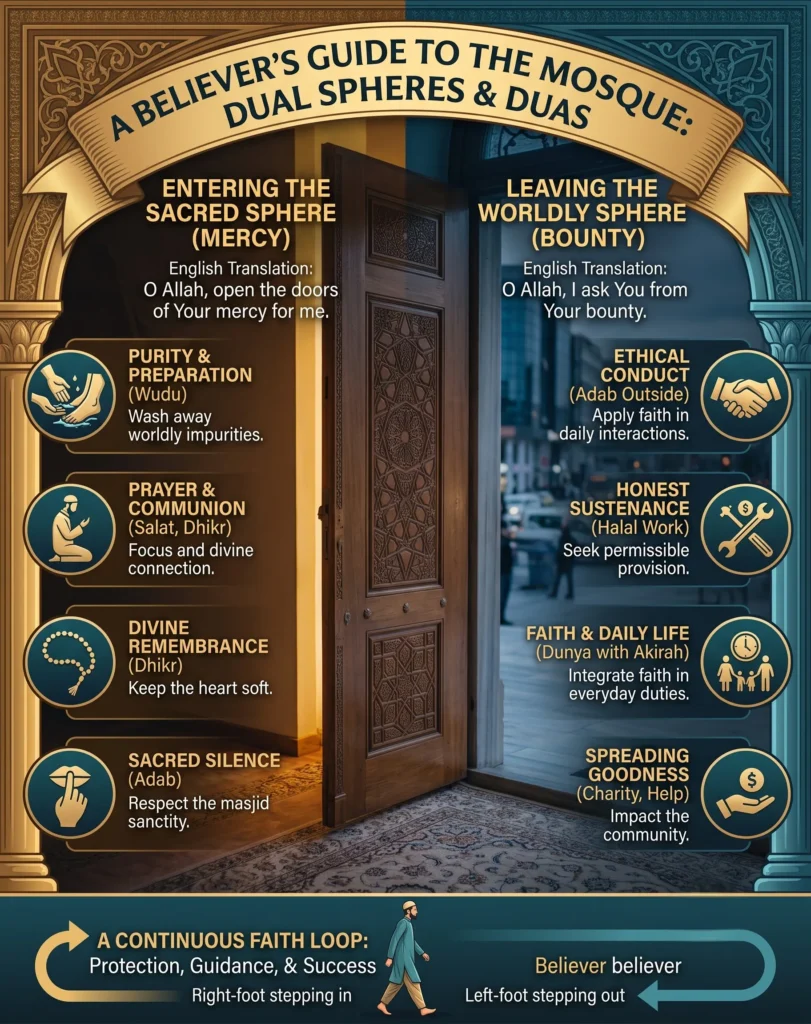
When leaving the mosque, you step out with your left foot and ask Allah from His bounty. While entering focuses on receiving spiritual mercy, exiting prepares you to seek ethical provision and success in your daily worldly life outside the sanctuary.
Hadith Reference: Sahih Muslim (Book 4, Hadith 152)
1. Arabic Text:
بِسْمِ اللَّهِ وَالصَّلَاةُ وَالسَّلَامُ عَلَى رَسُولِ اللَّهِ، اللَّهُمَّ إِنِّي أََسْأَلُكَ مِنْ فَضْلِكَ
2. Transliteration: “Bismillahi was-salatu was-salamu ‘ala Rasulillah, Allahumma inni as’aluka min fadlik.”
3. English Translation: “In the name of Allah, and prayers and peace be upon the Messenger of Allah. O Allah, I ask You from Your bounty.”
4. Urdu Translation: “
اللہ کے نام سے، اور درود و سلام ہو اللہ کے رسول پر۔ اے اللہ! میں تجھ سے تیرا فضل مانگتا ہوں۔”
Let’s understand the real meaning of this Arabic phrasing. Notice the profound linguistic shift. Inside the mosque, you ask for Rahmah (mercy) to heal your soul. When you step back outside, you ask for Fadl (bounty or provision) to sustain your physical life. Islam does not ask you to abandon the world; it teaches you how to compartmentalize it.
Bridging the Commute and Spiritual Focus
Practicing faith in American and British life requires intentional habits. Reciting the entering dua creates a definitive boundary between secular responsibilities and spiritual worship. It allows Muslims to pause the anxieties of modern urban living and fully focus on sincere prayer.
Whether you are navigating traffic on the I-405 in Los Angeles at 1 PM Pacific Time or taking a quick lunch break from a corporate office in Manchester, the transition from work mode to prayer mode is challenging. The diaspora community often feels a sharp disconnect between the demands of the modern workplace and the quiet submission required in the prayer hall.
This becomes important when you look at your morning routine in New York or London. You cannot carry the boardroom into the prayer room and expect to find peace. By consciously pausing to ask for divine mercy at the threshold, you instruct your brain to leave the commute behind. The physical act of stepping with the right foot, combined with the verbal recitation, acts as a psychological anchor. It bridges the gap between a chaotic commute and pure spiritual focus, serving as a vital coping mechanism against daily anxiety.
Quranic Context and the Houses of Allah
The Quran elevates the status of the mosque as a place of pure remembrance and light. Understanding the Quranic view of these sacred spaces helps recent converts and lifelong Muslims appreciate why asking for divine mercy at the door is so essential.
Quranic Reference: Surah An-Nur (Chapter 24, Verse 36)
1. Arabic Text:
فِي بُيُوتٍ أَذِنَ اللَّهُ أَنْ تُرْفَعَ وَيُذْكَرَ فِيهَا اسْمُهُ يُسَبِّحُ لَهُ فِيهَا بِالْغُدُوِّ وَالْآصَالِ
2. Transliteration: “Fee buyootin adhina Allahu an turfa’a wayudhkara feeha ismuhu yusabbihu lahu feeha bilghuduwwi wal-asal.”
3. English Translation: “In houses [mosques] which Allah has ordered to be raised and that His name be mentioned therein; exalting Him within them in the morning and the evenings.”
4. Urdu Translation: “
ان گھروں میں جن کے بلند کرنے اور جن میں اپنے نام کی یاد کا اللہ نے حکم دیا ہے، ان میں صبح و شام اس کی تسبیح کرتے ہیں۔”
Classical Tafseer (Ibn Kathir):
The renowned classical scholar Ibn Kathir explains in his tafseer that these “houses” are the mosques, which are the most beloved places to Allah on earth. He emphasizes that they must be purified from idle talk and worldly distractions. Because the mosque holds such an elevated status, an individual must spiritually cleanse themselves before participating in its tranquility. The dua before entering acts as this spiritual purification, aligning your internal state with the external sanctity of the space.
How to Build This Spiritual Habit Loop
You can integrate this sunnah into your daily life by linking it to physical actions like taking off your shoes. This psychological association ensures you remember the invocation consistently, even when you are stressed or distracted by a heavy schedule.
For recent converts, diaspora youth, and busy professionals, memorizing Arabic can sometimes feel intimidating. The key is to start small and build a spiritual habit loop. Every time you reach for the door handle of the mosque, let that physical touch be the trigger that reminds your brain to recite the dua.
As your heart settles into this daily practice, building a foundational understanding of core Islamic concepts will further anchor your identity in a Western environment. To deepen your connection to the core tenets of faith, read our full guide on La Ilaha Illallah Muhammadur Rasulullah: Benefits, Meaning, and Wazifa. Additionally, if you are looking to protect your spiritual energy and understand profound Quranic blessings at home or work, you can learn more about What is Lohe Qurani.
Dua before entering and leaving the Mosque (PDF)
People Also Ask:
The direct English meaning is: “O Allah, open the doors of Your mercy for me.” It is a humble request to receive spiritual peace and forgiveness before you begin your formal prayer.
Following the established Sunnah of Prophet Muhammad (PBUH), you should always step into the mosque with your right foot first. Conversely, when leaving the mosque, you exit with your left foot first.
You only need to recite this specific invocation once right as you are crossing the threshold into the masjid.
While there is not a specific “before work” prayer, the dua for leaving the mosque—”O Allah, I ask You from Your bounty”—is highly recommended to recite when heading to your office, as it actively seeks ethical provision, sustenance, and success in your career.
Surah Ar-Ra’d (13:28), which states, “Verily, in the remembrance of Allah do hearts find rest,” is a powerful verse to recall when trying to calm commuter anxiety before stepping into the mosque.
Establish Your Daily Spiritual Routine
Consistently reciting your daily prayers protects your mental peace and anchors your faith in a demanding environment. To help you maintain this spiritual habit, we have created a comprehensive, free resource designed specifically for your lifestyle.
Now let’s connect this to daily life at your office or school. Whether you are navigating a stressful morning commute in Washington DC or managing a busy household in London, having your daily remembrances easily accessible is vital for spiritual consistency. We want to help you seamlessly bridge the gap between your worldly duties and your faith. Please download a daily dua PDF guide to keep these essential prayers, complete with clear transliteration and English meanings, right on your phone for immediate access wherever your day takes you.
