Does it ever feel like the world is moving too fast for your soul to keep up? You aren’t alone, and more importantly, your faith has a specific vocabulary for that tightness in your chest.
What does Anxiety (Bechaini) actually mean?
Anxiety is often a state of Bechaini or Iztrab—a lack of internal rest. In an Islamic context, it is seen as a signal from the heart seeking its natural state of Sakina (tranquility). It is a human experience, not a sign of weak faith.
Urdu Summary: Anxiety ya bechaini aik aisi kefiyat hai jis mein insaan ka dil aur dimagh sakoon kho detay hain. Islam ise imaan ki kamzori nahi balkay insani fitrat ka hissa qaraar deta hai.
The Ultimate Anxiety Dua and Wazifa
To find relief from anxiety, the most effective Prophetic Dua is “Allahumma inni a’udhu bika minal-hammi wal-hazan.” This prayer specifically targets both future worries and past regrets, providing a comprehensive spiritual shield for the mind and heart.
Arabic:
اللَّهُمَّ إِنِّي أَعُوذُ بِكَ مِنَ الْهَمِّ وَالْحَزَنِ
Transliteration: Allahumma inni a’udhu bika minal-hammi wal-hazan.
English: O Allah, I seek refuge in You from anxiety and sorrow.
Urdu:
اے اللہ! میں فکر اور غم سے تیری پناہ مانگتا ہوں۔
Where is Anxiety Mentioned in the Quran?
The Quran addresses anxiety through the concept of Deeq-as-Sadr (tightness of the chest). In Surah Taha and Surah Al-Hijr, Allah acknowledges this feeling in the Prophets, offering “Dhikir” (remembrance) and “Sajdah” (prostration) as the primary spiritual cures for a constricted heart.
The Cure from the Quran
In Surah Ar-Ra’d (13:28), Allah provides the foundational formula for mental health:
Arabic:
أَلَا بِذِكْرِ اللَّهِ تَطْمَئِنُّ الْقُلُوبُ
Transliteration: Ala bidhikrillahi tatma’innul-qulub.
English: Unquestionably, by the remembrance of Allah hearts are assured.
Urdu:
خبردار! اللہ کے ذکر سے ہی دلوں کو اطمینان نصیب ہوتا ہے۔
Scholarship Insight: Imam Ibn Kathir notes that this “assurance” isn’t just a temporary feeling; it is the removal of doubt and the settling of the soul’s agitation through its connection to the Creator.
Hadith About Worry and Stress
The Prophet Muhammad (peace be upon him) taught that every hardship, even the prick of a thorn or a moment of anxiety, serves as an expiation for sins. This recontextualizes suffering from “meaningless pain” into “purposeful purification,” which significantly lowers psychological distress.
The Prophetic Guidance: The Prophet (PBUH) said: “No fatigue, nor disease, nor sorrow, nor sadness, nor hurt, nor distress befalls a Muslim… but that Allah expiates some of his sins for it” (Sahih Bukhari).
The “Digital Sunnah: Your Modern Habit Loop
Here’s why this matters for you right now: We live in an era of “Continuous Partial Attention.” Our brains are over-stimulated, which the classical scholar Imam Al-Ghazali might have described as a “scattered heart.”
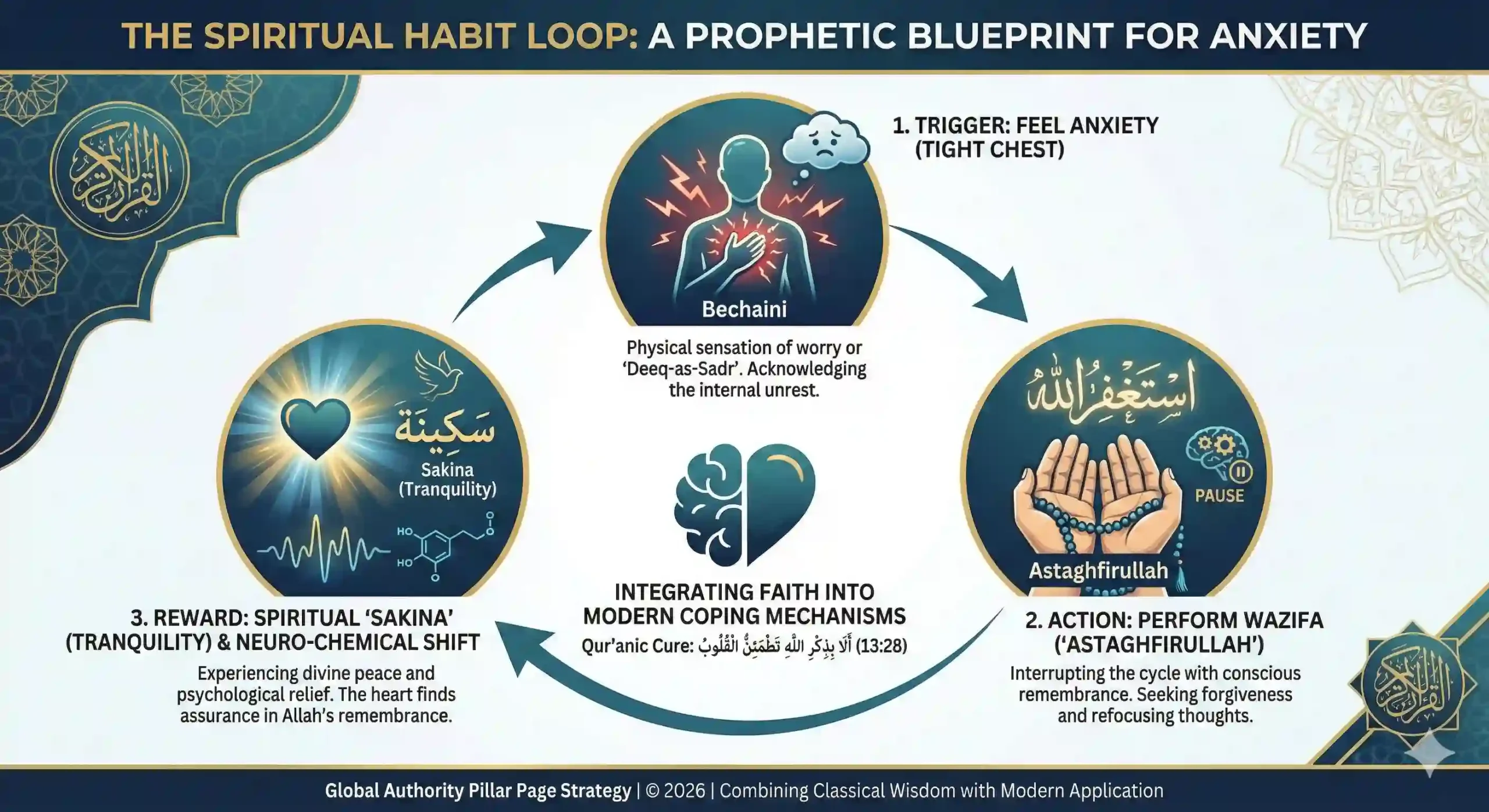
To fix this, we implement the Spiritual Habit Loop:
- The Trigger: Feel the chest tighten (Anxiety).
- The Action: Instead of scrolling, perform the Wazifa of “Astaghfirullah” (seeking forgiveness).
- The Reward: The neuro-chemical shift of deep breathing combined with the spiritual “Sakina” promised by Allah.
People Also Ask:
Surah Ad-Duha is often cited by scholars as the “Healing Surah” for those feeling abandoned or low, as it was revealed to comfort the Prophet (PBUH) during a time of emotional distress.
Seek refuge from Waswasa (whispers) by saying “A’udhu billahi minash-shaytanir-rajim” and immediately redirecting your focus to a physical task, a method supported by both Hadith and modern Cognitive Behavioral Therapy.
Yes. In the Islamic framework, every challenge is a means to draw closer to Allah. It is not a punishment, but an invitation to seek the “Al-Shafi” (The Healer).
Complete Anxiety Relief Kit (Urdu)
بے چینی کا روحانی علاج: مسنون دعائیں اور وظائف کی پی ڈی ایف حاصل کریں۔
Download PDF Guide ↓
1 thought on “What is Anxiety? An Islamic Guide for Cure”