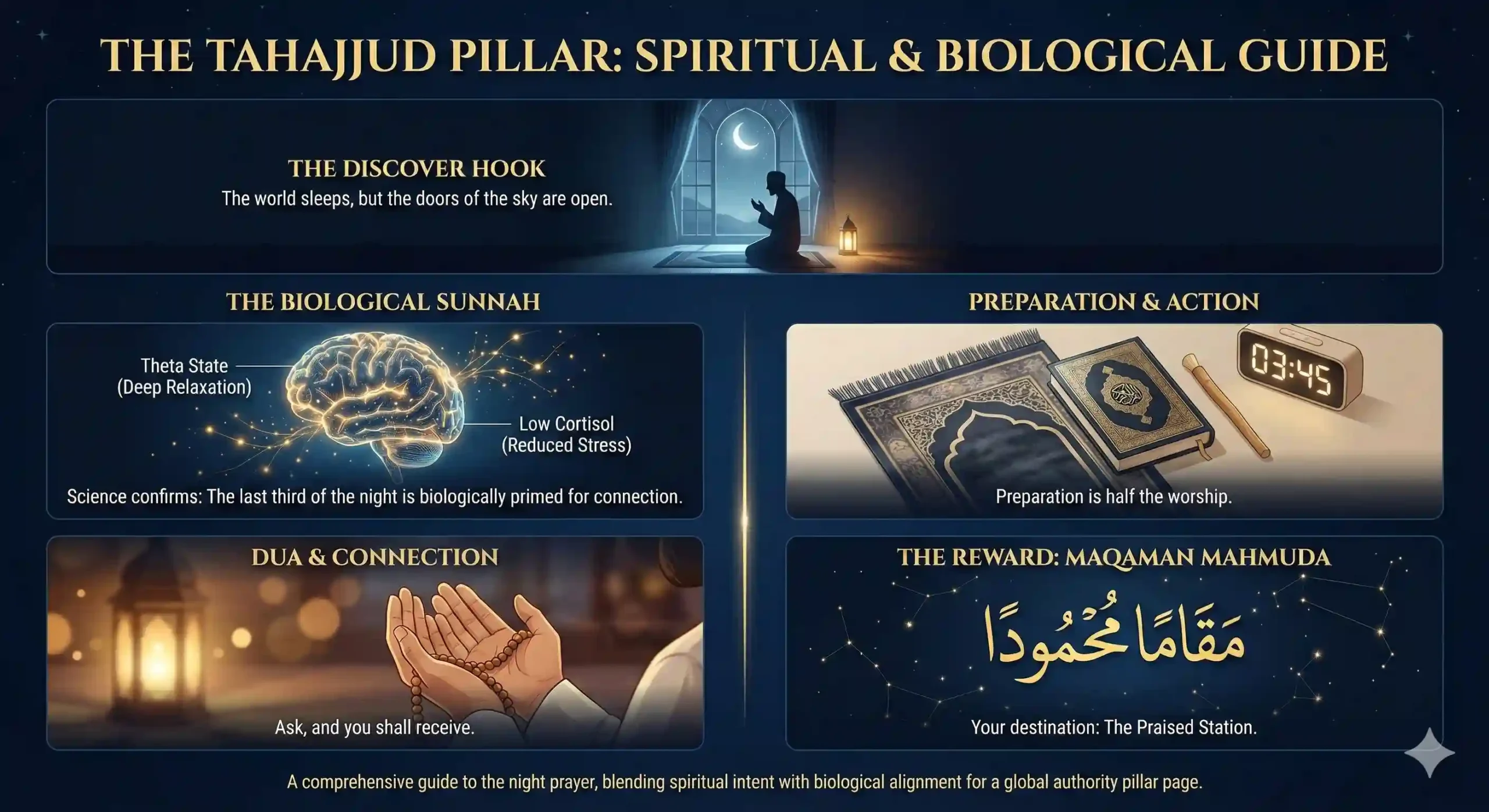
The world is noisy. Your notifications are endless, your anxiety is high, and your heart feels scattered. But there is a specific time—usually around 3:00 AM—when the world goes silent. This isn’t just “quiet time.” It is a VIP invitation.
While the rest of the world sleeps, the Creator of the Heavens descends to the lowest sky to ask, “Is there anyone asking of Me, that I may give to him?” This is Tahajjud. It is the spiritual hack that changes destiny (Qadr). If you are reading this, you haven’t just stumbled upon an article; you’ve been invited.
What is Tahajjud Prayer?
Tahajjud is a voluntary (Sunnah) night prayer performed after sleeping and waking up, before the Fajr prayer begins. It is considered the most virtuous prayer after the obligatory (Fard) prayers. It consists of a minimum of two Rakats (units) and serves as a direct, private line to Allah SWT during the “Third of the Night.”
The Evidence (The Multilingual Quadrant)
Primary Source: Surah Al-Isra (17:79)
| Language | Text |
| Arabic | وَمِنَ اللَّيْلِ فَتَهَجَّدْ بِهِ نَافِلَةً لَّكَ عَسَىٰ أَن يَبْعَثَكَ رَبُّكَ مَقَامًا مَّحْمُودًا |
| Transliteration | Wa minal-layli fatahajjad bihi nāfilatan laka ‘asā an yab’athaka Rabbuka Maqāman Maḥmūdā. |
| English (Saheeh Intl) | “And from [part of] the night, pray with it as additional [worship] for you; it is expected that your Lord will resurrect you to a praised station.” |
| Urdu (Jalandhari) | “اور رات کے کچھ حصے میں تہجد پڑھا کرو یہ تمہارے لئے نفل ہے قریب ہے کہ تمہارا پروردگار تمہیں مقام محمود پر فائز کرے۔” |
Tahajjud Ka Time: When Should You Pray?
The time for Tahajjud begins after the Isha prayer and after one has slept, extending until the entrance of Fajr time. While you can pray it in the early or middle part of the night, the most powerful time—the “Golden Hour”—is the last third of the night.
The “Biological Sunnah”
Why is the last third of the night so emphasized? Modern science in 2026 aligns perfectly with this Sunnah.
- Melatonin Peak: Your brain is in a theta-state (deep relaxation) around 3 AM.
- Cortisol Drop: Stress hormones are at their lowest.
When you wake up for tahajjud ka time, your brain is chemically primed for focus and emotional vulnerability. You aren’t fighting distractions; you are biologically wired to connect. This is the “Spiritual Habit Loop”: Wake (Trigger) → Wudu & Salah (Action) → Peace/Maqam Mahmud (Reward).
How to Perform Tahajjud (Step-by-Step)
To perform Tahajjud, wake up before Fajr, perform Wudu, and make the intention (Niyat) to pray. Offer the prayer in sets of two Rakats—just like the morning Fajr Sunnah—reciting Surah Al-Fatiha and any other Surah. You can pray as many pairs as you wish (2, 4, 8, etc.), ending with the Witr prayer if you haven’t prayed it yet.
1. The Intention
You do not need to say the Niyat out loud; the heart’s intention is sufficient. However, for those who prefer verbalizing to focus:
- Arabic: Nawaytu an usalliya lillahi ta’ala raka’atay salat at-Tahajjud Sunnatan lillahi ta’ala.
- English: “I intend to offer two Rakats of the Tahajjud prayer, voluntary for the sake of Allah.”
- Urdu: “Niyat karta hun main do rakat namaz tahajjud, waqt raat ka, waste Allah Ta’ala ke, muh mera Kaaba Sharif ki taraf.”
2. The Prayer Structure
- Takbir: Say Allahu Akbar.
- Recitation: Surah Al-Fatiha + Any Surah (Longer Surahs are recommended if you know them, but short ones are fine).
- Ruku & Sujood: Prolong your prostration (Sajdah). This is the closest you are to Allah.
- Salam: Finish every two Rakats with Assalamu Alaikum wa Rahmatullah.
Scholar’s Note: Ibn Kathir (RA) mentions that the Prophet (PBUH) would sometimes lengthen his recitation significantly. However, consistancy beats intensity. Two short Rakats done every night are better than 8 Rakats done once a month.
Dua After Tahajjud Prayer & The “Descent”
The best Dua after Tahajjud is asking for forgiveness (Istighfar) and your specific worldly or spiritual needs. Since this is the time of “Divine Descent,” specific supplications are highly recommended, especially those reported from the Prophet (PBUH).
The “Descent” Hadith (The Multilingual Quadrant)
Primary Source: Sahih Al-Bukhari 1145
| Language | Text |
| Arabic | يَنْزِلُ رَبُّنَا تَبَارَكَ وَتَعَالَى كُلَّ لَيْلَةٍ إِلَى السَّمَاءِ الدُّنْيَا |
| Transliteration | Yanzilu Rabbuna Tabaraka wa Ta’ala kulla laylatin ila as-sama’i ad-dunya… |
| English (Saheeh Intl) | “Our Lord, the Blessed and the Exalted, descends every night to the lowest heaven when one-third of the night remains and says: ‘Who will call upon Me, that I may answer him?'” |
| Urdu (Jalandhari) | “ہمارا پروردگار تبارک و تعالیٰ ہر رات آسمان دنیا پر نزول فرماتا ہے (جیسا کہ اس کی شان کے لائق ہے) جب رات کا آخری تہائی حصہ باقی رہ جاتا ہے۔..” |
Connection to Dua for Fasting
Many of you wake up for Tahajjud during Ramadan or for voluntary fasts. This is the perfect time to make your intention for fasting (Suhoor).
- Dua for Fasting (Sehri): Wa bisawmi ghadinn nawaiytu min shahri ramadan (I intend to keep the fast for tomorrow in the month of Ramadan).
After the Night comes the Morning Light: Chasht Namaz Time & Benefits
Don’t stop at Tahajjud. Learn the secrets of Salatul Duha (The Prayer of the Repentant).
→Unlock the Promise: “Warafana Laka Zikrak” Explained
How this powerful verse from Surah Alam Nashrah can elevate your status in this world and the next.
→People Also Ask :
To pray Tahajjud, wake up from sleep in the last third of the night, perform Wudu, and offer a minimum of two Rakats. Recite the Quran as you would in normal prayer, but try to lengthen the Ruku and Sujood for deeper reflection.
The minimum is 2 Rakats. The Prophet Muhammad (PBUH) often prayed 8 Rakats, followed by 3 Rakats of Witr, totaling 11. However, you can pray 2, 4, 6, 8, or even more, depending on your energy and time.
Technically, “Tahajjud” implies waking up after sleep. If you pray without sleeping, it is called Qiyam-ul-Layl (Standing of the Night). It is still highly rewarding, but the specific reward of “Tahajjud” comes after the struggle of waking up.
Offer Tahajjud by making a specific intention (Niyat) for the night prayer. Pray in sets of two units (Rakats). After every two Rakats, say the Tasleem (Salam). Repeat this cycle until you are satisfied, then close with Witr if needed.
Perform Tahajjud in a clean, quiet space. Ensure you are in a state of Wudu. Face the Qibla, establish your focus (Khushu), and pray slowly. This is a private conversation with Allah, so there is no need to rush.
Tahajjud parhne ka tariqa yeh hai ke aap Isha ke baad so jayen aur Fajr se pehle uthen. Wudu karein aur kam az kam 2 rakat namaz parhein. Har 2 rakat ke baad salam pheren. Dil mein niyat karein ke aap Allah ki raza ke liye tahajjud parh rahe hain.
Tahajjud Prayer: A Private Audience with The King (PDF)
Your Next Step: The 3 AM Protocol
Reading about the water won’t quench your thirst; you have to drink. The feeling of distance from Allah won’t be fixed by scrolling, but by one Sajdah in the dark.
Here is your immediate action plan:
- Set your alarm for 45 minutes before Fajr.
- Download our “21-Day Tahajjud Tracker & Dua List” (Link above) to keep yourself accountable.
- Make the Niyat right now: “O Allah, wake me up to meet You.”
May your name be called among those who stand while the world sleeps.

2 thoughts on “What is Tahajjud Namaz & How to Pray It?”