Quick Answer
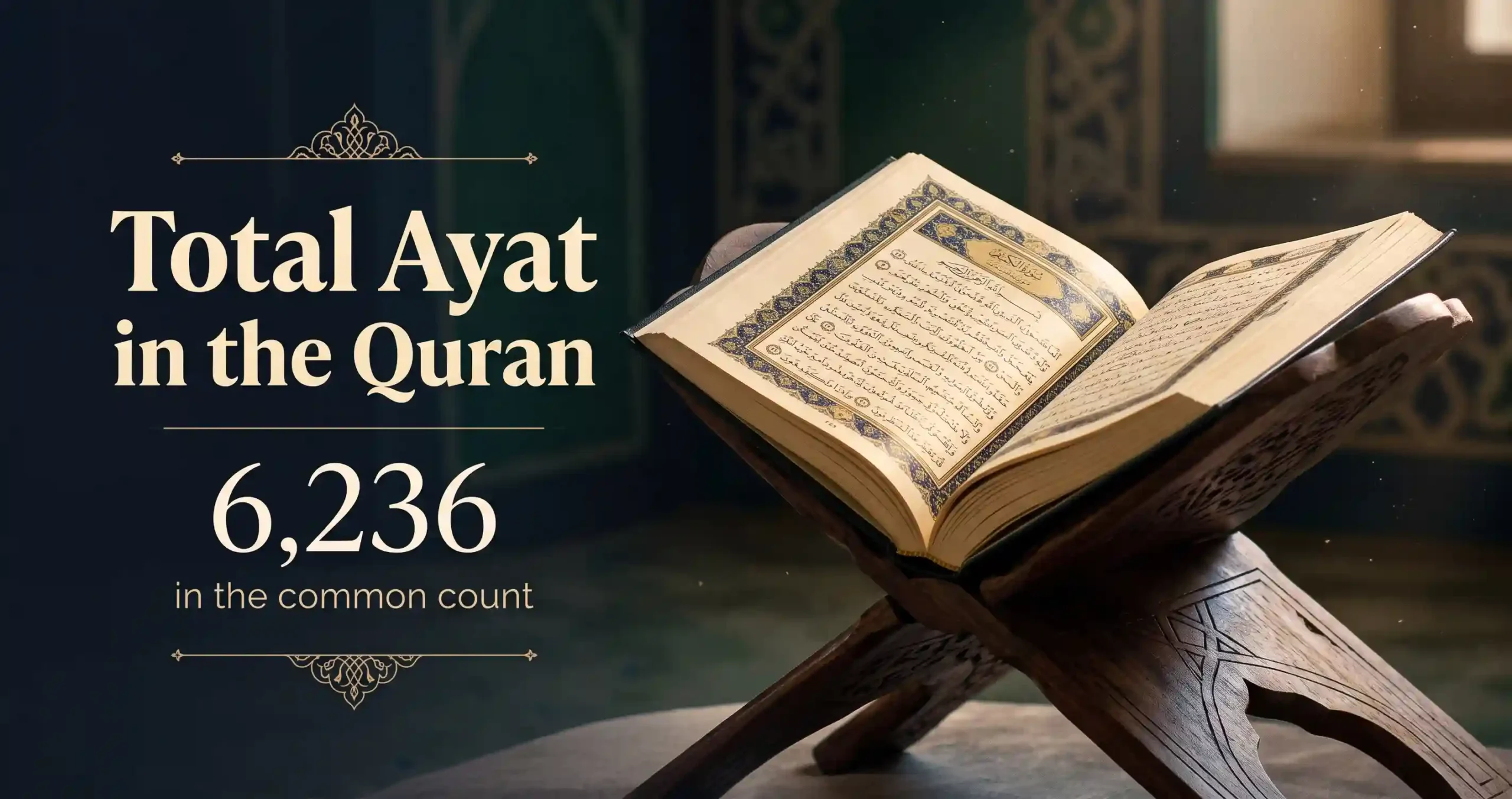
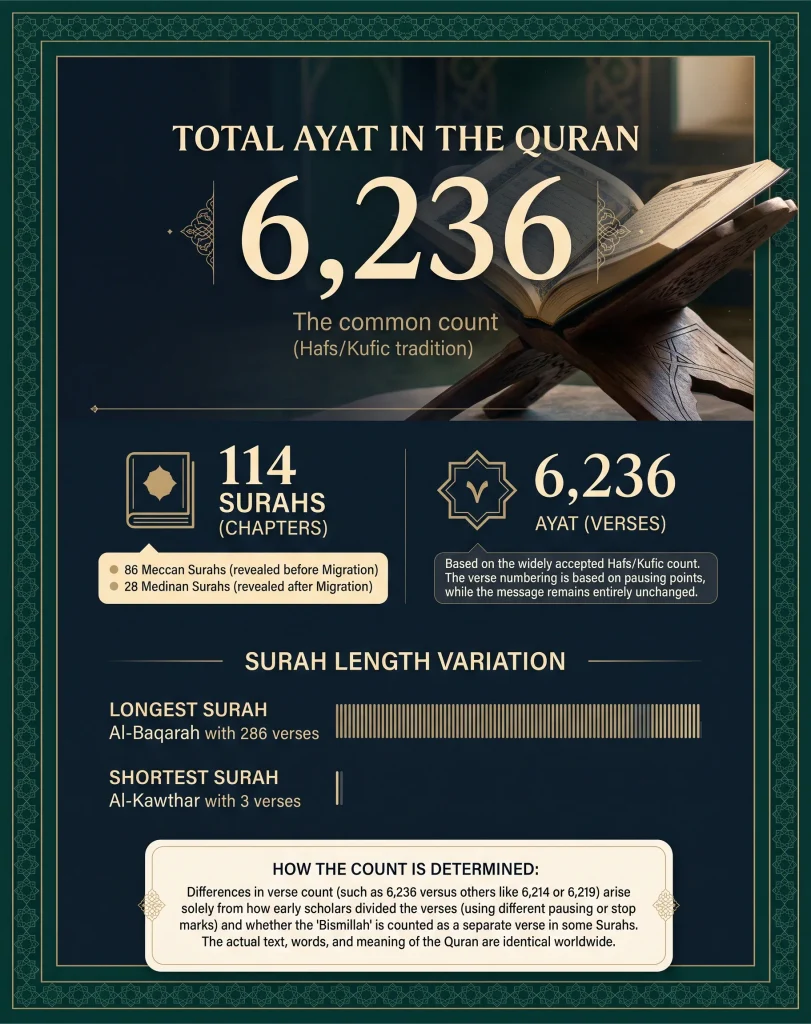
- Total ayats: 6,236 numbered verses according to the commonly used Kufan system.
- Total surahs: 114 chapters in the Holy Quran.
- The 6,666 claim: A widely repeated figure, but not the standard numbered-verse count in the commonly used Kufan/Hafs mushaf.
اردو: عام طور پر رائج کوفی شمار کے مطابق قرآنِ کریم میں 114 سورتوں میں 6,236 نمبر شدہ آیات ہیں۔
हिंदी: आम तौर पर प्रचलित कूफ़ी गणना के अनुसार क़ुरआन में 114 सूरहों में 6,236 क्रमांकित आयतें हैं।
Table of Contents
- What is the total number of ayats in the Quran?
- Why do some sources say 6,666 ayats?
- Does counting the basmalah make the total 6,249?
- What is the difference between an ayah, surah, and juz?
- What is the difference between Makki and Madani surahs?
- How can you verify a Quran verse-count claim?
- Frequently asked questions
What is the total number of ayats in the Quran?
The Quran contains 6,236 numbered ayats according to the commonly used Kufan system of verse numbering. It has 114 surahs, or chapters. The Quranic Arabic Corpus records 6,236 verses, while the Turkish Directorate of Religious Affairs explains why traditional counting systems may produce different totals.
An ayah is a verse of the Quran. The plural ayat is commonly used by English-speaking Muslims. A surah is a chapter made up of verses. These terms describe different parts of the Quran’s structure.
The number 6,236 refers to a particular traditional numbering system. It is the familiar total in many printed copies of the Quran, including the commonly used Hafs edition with Kufan numbering.
The difference between verse counts does not, by itself, mean that the Quranic text has additional or missing words. Traditional scholars used different methods to identify and number certain verse boundaries.
For verification, consult the Quranic Arabic Corpus and the Turkish Directorate of Religious Affairs’ explanation of Quran verse counts.
Why do some sources say 6,666 ayats?
The figure 6,666 is frequently repeated in popular Islamic writing, but it is not the standard numbered-verse total in the commonly used Kufan/Hafs system. The Turkish Directorate of Religious Affairs explains that this figure became widely known without a specific, established determination supporting it as the standard total.
Numbers often spread from one book, lesson, or website to another. Repetition, however, does not establish that a claim is accurate.
Traditional verse-numbering systems can differ over whether certain passages are counted as separate verses and where some verse boundaries fall. The treatment of the basmalah and certain other counting conventions can also affect the total.
A scholarly study by Raymond K. Farrin, The Verse Numbering Systems of the Qur’an, examines seven historical systems. It helps explain why Quranic verse enumeration is a more specific subject than simply counting every printed verse number in the same way.
You can read Farrin’s study of Quranic verse-numbering systems for further historical context.
The key distinction is between the Quranic text and its traditional systems of verse enumeration. The presence of different totals does not, by itself, establish that the text is different.
Does counting the basmalah make the total 6,249?
The claim that including the basmalah produces a standard total of 6,249 is not established by the authoritative counting references cited in this article. Counting appearances of the formula is different from counting individually numbered ayats. An alternative total requires a clearly defined method and a reliable source.
The basmalah is the opening formula commonly written as Bismillah al-Rahman al-Rahim—“In the name of Allah, the Most Compassionate, the Most Merciful,” subject to the chosen translation.
The formula appears at the beginning of 113 surahs because Surah At-Tawbah does not begin with it. Another occurrence appears within Surah An-Naml, at 27:30.
These textual appearances should not simply be added to the standard verse total. In the commonly used Kufan numbering, the basmalah at the beginning of Surah Al-Fatihah is counted as its first ayah. Its treatment at the beginning of other surahs differs.
This is one reason a reader should ask how a total was calculated before sharing it. A figure obtained by counting visible basmalah formulas is not automatically an alternative standard count of numbered Quranic verses.
What is the difference between an ayah, surah, and juz?
An ayah is a verse, a surah is a chapter, and a juz is one of 30 reading sections used to divide the Quran for recitation. In South Asia, a juz is often called a para. These terms describe different units and should not be used interchangeably.
| Quranic term | Meaning | Key fact |
|---|---|---|
| Ayah / ayat | Verse / verses | 6,236 in the common Kufan numbering system |
| Surah | Chapter | The Quran has 114 surahs |
| Juz / para | Reading division | The Quran is divided into 30 juz |
| Basmalah | Opening formula | Its appearances are not all additional numbered verses |
| Makki / Madani | Revelation-period classifications | These terms do not describe verse-counting systems |
Understanding chapter and verse references also makes it easier to read Quran guides. For example, Surah Al-Qasas (28:16) means chapter 28, verse 16. Current Islam’s guide to Surah Al-Qasas (28:16) explores the supplication associated with this passage and illustrates how a specific ayah can be studied in context.
Likewise, Surah Luqman (31:16) identifies chapter 31, verse 16. You can read the guide to Surah Luqman (Quran 31:16) for an example of a verse-specific explanation with Arabic text and translations.
These examples show why the chapter-and-verse reference is useful. The surah number identifies the chapter, while the number after the colon identifies the verse.
What is the difference between Makki and Madani surahs?
Makki and Madani are classifications associated with the period of revelation. In the commonly used chronological definition, Makki refers to revelation before the Hijrah, the migration of Prophet Muhammad ﷺ from Makkah to Madinah. Madani refers to revelation after the Hijrah.
These terms help readers study the historical context of Quranic revelation. They do not refer to different versions of the Quran or different methods of counting its verses.
The classification of individual surahs has been discussed by scholars, and some passages require more detailed historical treatment. A general overview should not replace a qualified scholarly explanation when a particular surah’s classification is disputed.
The difference between Makki and Madani surahs therefore answers a historical question, while the total-ayat question concerns the enumeration of verses.
How can you verify a Quran verse-count claim?
Use the Count–Convention–Citation method. First, identify exactly what is being counted. Second, establish the numbering convention being used. Third, consult a reliable source that explains or supports the figure. This approach helps readers distinguish a documented count from a number repeated without adequate evidence.
1. Count: What does the number measure?
Check whether the claim concerns numbered ayats, surahs, juz, or occurrences of a particular phrase. These are different quantities. A number can be misleading when its unit is not clearly stated.
2. Convention: Which numbering system is being used?
Look for an explanation of the traditional verse-numbering system. If a page states a total without describing its basis, compare it with a religious authority or a scholarly source before sharing the claim.
3. Citation: Can the claim be verified?
Prefer recognized religious authorities, established Quran text resources, and academic research on Quranic verse enumeration. Avoid using a social media image or an unattributed quotation as the sole evidence for a numerical claim.
A careful summary is:
The commonly used Kufan system numbers 6,236 verses across 114 surahs. Traditional counting systems can differ over certain verse boundaries and counting conventions. The figure 6,666 is widely repeated, but it is not the standard numbered-verse total in this system.
This wording provides the answer, explains the convention, and avoids claiming more than the evidence establishes.
Frequently asked questions:
How many ayats are in the Quran?
The Quran contains 6,236 numbered ayats according to the commonly used Kufan system of verse numbering. It has 114 surahs. Other traditional systems may produce different totals because of variations in verse enumeration, so identifying the numbering convention makes the answer more precise.
Does the Quran have 6,236 or 6,666 verses?
The commonly used Kufan/Hafs numbering gives 6,236 verses. The figure 6,666 is widely repeated, but it is not the standard numbered-verse count in that system. When comparing sources, check whether they identify the counting convention and provide an authoritative reference.
Does including the basmalah make the total 6,249?
The references used here do not establish 6,249 as the standard Quran verse count. Counting appearances of the basmalah is different from counting numbered ayats. Any alternative total should identify its counting method and provide a reliable source before being treated as established.
How many surahs are in the Quran?
The Quran contains 114 surahs, or chapters. Each surah has its own sequence of verses. The total number of chapters is different from the total number of ayats and from the 30 juz used to divide the Quran for reading.
What is the difference between an ayah and a surah?
An ayah is a verse of the Quran, while a surah is a chapter containing verses. The term ayat is commonly used for the plural of ayah in English-speaking Muslim communities. Understanding this distinction makes Quran references easier to read and discuss.
How many juz or paras are in the Quran?
The Quran is divided into 30 juz for reading and recitation. In South Asia, these divisions are commonly called paras. A juz is not the same as a surah, and this reading division does not change the standard number of numbered verses.
What is the difference between Makki and Madani surahs?
Makki generally refers to revelation before the Hijrah, while Madani refers to revelation after it. These labels describe the traditional chronological classification of Quranic revelation. They do not refer to different Quranic texts or different ways of calculating the total number of verses.
The number to remember
For a concise and dependable answer, use 6,236 numbered verses in the commonly used Kufan system across 114 surahs. Other traditional totals should be considered in light of their numbering conventions and sources. The responsible approach is to state the figure, explain the method, and provide a verifiable reference.
The Quran deserves care in religious study and public communication. When sources show different numbers, a clear explanation is more useful than a dramatic claim. Share the figure with its context so that the next reader understands both the answer and what it means.
Continue reading on Current Islam
To explore another individual Quran verse in its wider context, read the guide to Surah al-isra ayat 32.
For readers whose next question concerns a supplication rather than verse numbering, the separate guide to Allahummahdini fiman hadait full dua offers a related Islamic learning resource.
