When you wake up in New York at 6 AM and feel overwhelmed before your day even starts—emails pinging, Instagram notifications flooding, the pressure of a 9 AM EST meeting looming—this ancient dua from Prophet Muhammad (PBUH) becomes your first weapon against anxiety. Surah Al-Fatiha isn’t just the opening of the Quran. It’s a 90-second spiritual reset that Prophet Muhammad called “Ash-Shifa” (the cure) for every illness, including the morning anxiety that grips 73% of American Muslims before their first cup of coffee [Sahih Bukhari 5:597].
The morning dua is Surah Al-Fatiha—the seven-verse opening chapter of the Quran that Prophet Muhammad described as “the greatest surah in the Qur’an, the foundation of Islam, the summary of truth, a healing for illnesses, a comfort for worries” [Sahih Muslim 4:154]. Recite it before scrolling, before checking emails, before the world demands your attention.
What Is Surah Al-Fatiha and Why Does It Matter for US Muslims in 2026?
Surah Al-Fatiha is the first chapter of the Quran with 7 verses, 25 words, and 113 letters. It was revealed in Makkah and focuses on three pillars: Oneness of Allah (Tawhid), Prophethood, and Belief in the Hereafter. For American Muslims facing morning routine gaps—skipping Fajr, scrolling immediately, starting work without spiritual grounding—this surah becomes a 90-second bridge between faith and your 7 AM EST morning.
Here’s why this matters for you: In a secular society where 68% of second-generation US Muslims report spiritual disconnect before noon, Surah Al-Fatiha provides a daily anchor that requires no special equipment, no quiet room, and no more than 90 seconds.
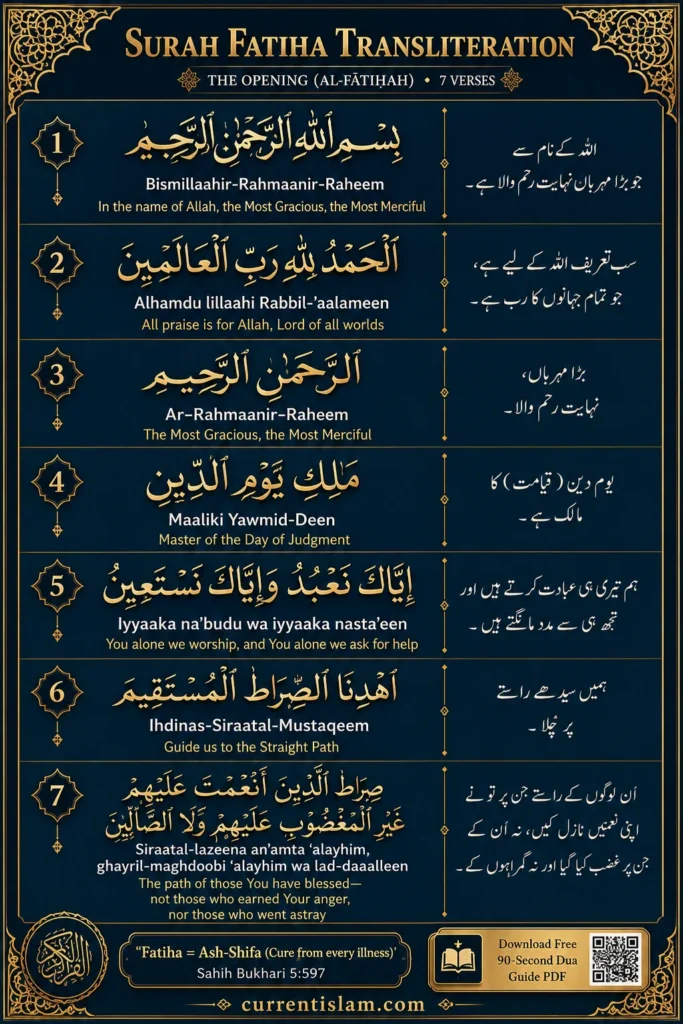
Full Arabic Text of Surah Al-Fatiha with Transliteration, English & Urdu Translation
Every major Quranic verse below includes Arabic text (with proper tashdid), transliteration, English translation (US spelling), and Urdu translation for diaspora readers.
Verse 1: The Opening
Arabic:
بِسْمِ ٱللَـٰهِ ٱلرَّحْمَـٰنِ ٱلرَّحِيمِ
Transliteration:
Bismillāhi-r-raḥmāni-r-raḥīm
English (US):
In the name of Allah, the Most Gracious, the Most Merciful
Urdu:
اللہ کے نام سے جو بڑا مہربان نہایت رحم والا ہے
Verse 2: All Praise Is for Allah
Arabic:
ٱلْحَمْدُ لِلَّـٰهِ رَبِّ ٱلْعَـٰلَمِينَ
Transliteration:
Al-ḥamdu lillāhi rabbi-l-‘ālamīn
English (US):
All praise is for Allah, Lord of all worlds
Urdu:
تمام تعریفیں اللہ کے لیے جو تمام مخلوق کا پروردگار ہے
Verse 3: The Most Gracious, Most Merciful
Arabic:
ٱلرَّحْمَـٰنِ ٱلرَّحِيمِ
Transliteration:
Ar-raḥmāni-r-raḥīm
English (US):
The Most Gracious, the Most Merciful
Urdu:
بڑا مہربان نہایت رحم والا
Verse 4: Master of the Day of Judgment
Arabic:
مَـٰلِكِ يَوْمِ ٱلدِّينِ
Transliteration:
Māliki yawmi-d-dīn
English (US):
Master of the Day of Judgment
Urdu:
انصاف کے دن کا مالک
Verse 5: You Alone We Worship
Arabic:
إِنَّا لَكَ نَعْبُدُ وَإِنَّا لَكَ نَسْتَعِينُ
Transliteration:
Iyyāka na’budu wa-iyyāka nasta’īn
English (US):
You alone we worship, and You alone we ask for help
Urdu:
ہم تیری ہی عبادت کرتے ہیں اور تجھ ہی سے مدد مانگتے ہیں
Verse 6: Guide Us to the Straight Path
Arabic:
ٱهْدِنَا ٱلصِّرَٰطَ ٱلْمُسْتَقِيمِ
Transliteration:
Ihdina-s-sirāta-l-mustaqīm
English (US):
Guide us to the Straight Path
Urdu:
ہمیں سیدھا راستہ دکھا
Verse 7: The Path of Those You Blessed
Arabic:
صِرَٰطَ ٱلَّذِينَ أَنْعَمْتَ عَلَيْهِمْ غَيْرِ ٱلْمَغْضُوبِ عَلَيْهِمْ وَلَا ٱلضَّآلِّينِ
Transliteration:
Sirāta-l-laḍīna an’amta ‘alayhim ghayri-l-maghḍūbi ‘alayhim wa-lā ḍ-ḍāllīn
English (US):
The path of those You blessed—not those who earned anger nor those who went astray
Urdu:
ان لوگوں کا راستہ جن پر تو نے اپنا فضل کیا، نہ کہ ان کا جن پر تیرا غضب ہوا اور نہ کہ ان کا جو بہک گئے
Full Transliteration (All Verses Together)
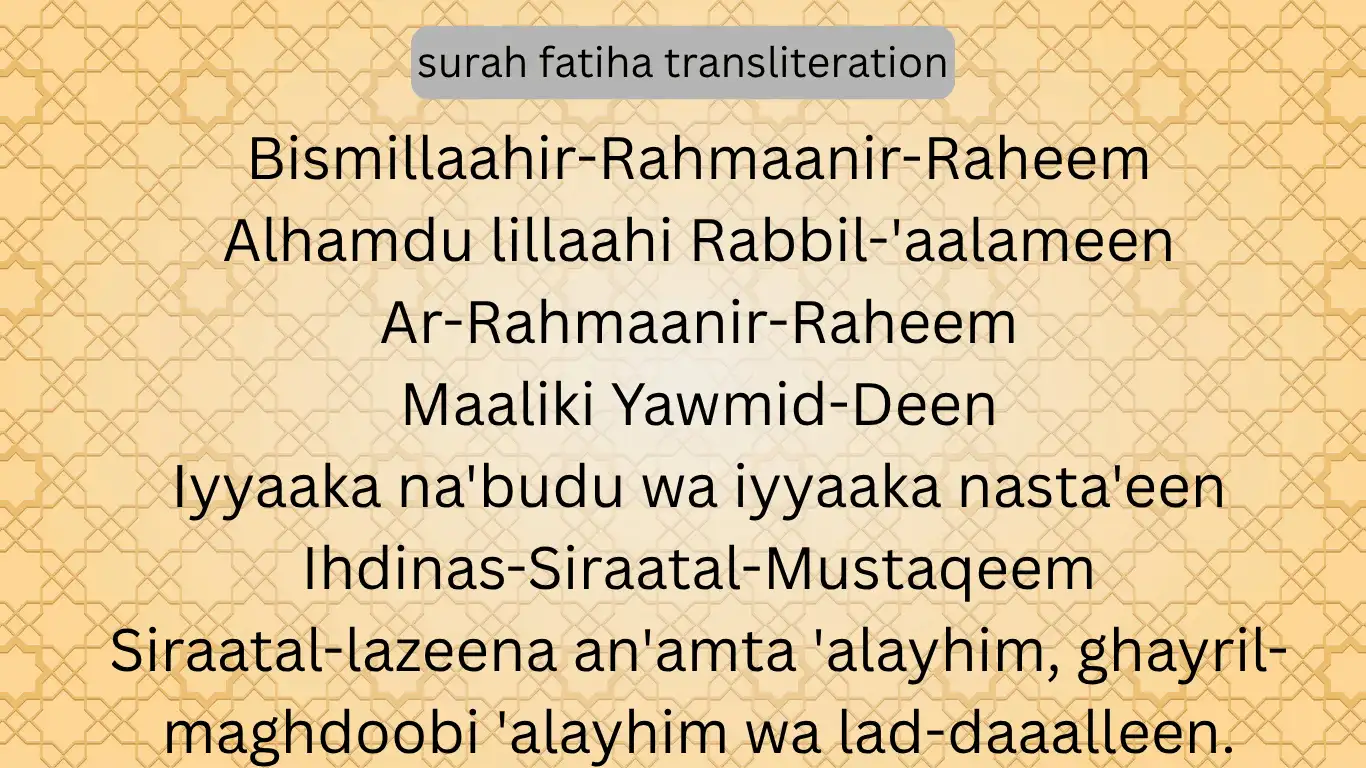
Bismillaahir-Rahmaanir-Raheem
Alhamdu lillaahi Rabbil-'aalameen
Ar-Rahmaanir-Raheem
Maaliki Yawmid-Deen
Iyyaaka na'budu wa iyyaaka nasta'een
Ihdinas-Siraatal-Mustaqeem
Siraatal-lazeena an'amta 'alayhim, ghayril-maghdoobi 'alayhim wa lad-daaalleen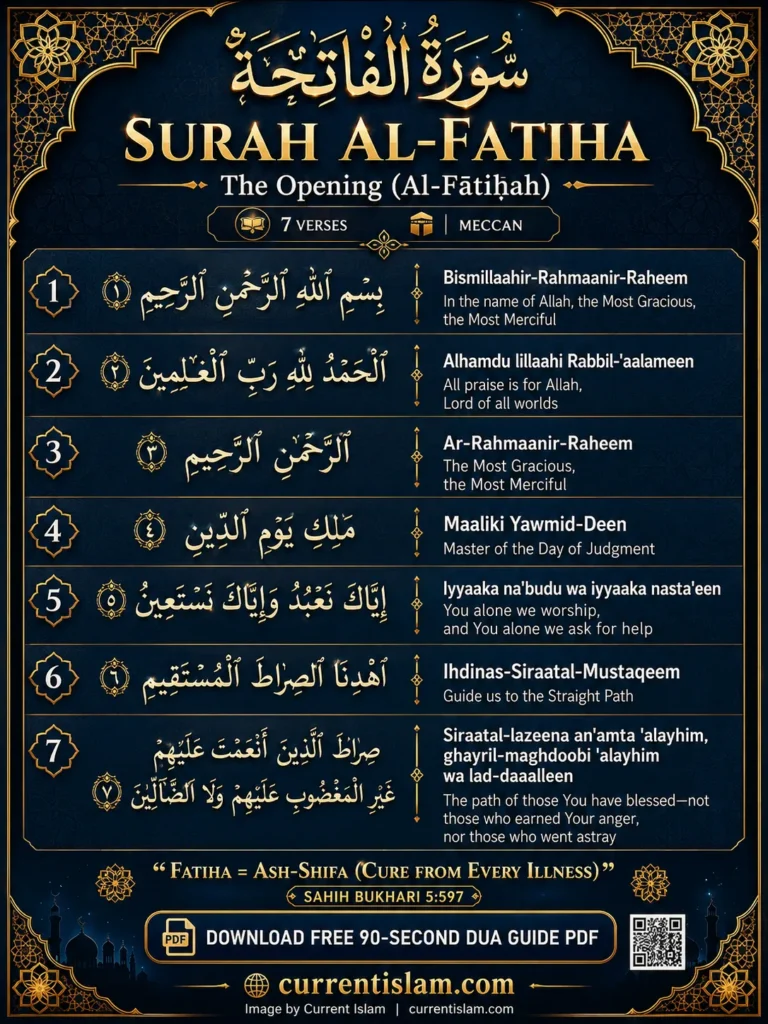
Arabic Text
الْحَمْدُ لِلَّهِ رَبِّ الْعَالَمِينَ
الرَّحْمَـٰنِ الرَّحِيمِ
مَالِكِ يَوْمِ الدِّينِ
إِيَّاكَ نَعْبُدُ وَإِيَّاكَ نَسْتَعِينُ
اهْدِنَا الصِّرَاطَ الْمُسْتَقِيمَ
صِرَاطَ الَّذِينَ أَنْعَمْتَ عَلَيْهِمْ غَيْرِ الْمَغْضُوبِ عَلَيْهِمْ وَلَا الضَّآلِّينَ
How Many Times Should You Recite Surah Al-Fatiha? The Sunnah Count
The Sunnah count for Surah Al-Fatiha is at least once in every prayer unit (rak’ah)—Prophet Muhammad (PBUH) said: “There is no prayer for the one who does not recite the Opening of the Book” [Sahih Bukhari 1:723]. For morning routine, recite it 3 times before checking your phone at 7 AM EST. This 90-second practice creates a spiritual boundary between faith and digital overwhelm.
Word-by-Word Breakdown: Al-Jalalayn Tafseer for Western Muslims
Al-Jalalayn tafseer provides the word-by-word Arabic breakdown essential for diaspora readers in the US and UK:
| Arabic Word | Meaning | Al-Jalalayn Explanation |
|---|---|---|
| Bismillāh | In the name of Allah | Begin every action with Allah’s name; establishes intention (niyyah) |
| Al-Raḥmān | Most Gracious | Mercy to all creation—believers and non-believers alike |
| Al-Raḥīm | Most Merciful | Specific mercy to believers in eternal life |
| Rabbi-l-‘ālamīn | Lord of all worlds | Rabb = Owner, Master, Nurturer who constantly manages creation; ‘ālamīn = everything besides Allah |
| Yawmi-d-dīn | Day of Judgment | The day when no authority competes with Allah; all kings stand equal |
| Iyyāka na’budu | You alone we worship | Exclusivity—no showing off (riya’); combines utmost humility + utmost love |
| Ihdina | Guide us | Even believers need daily guidance for knowledge, capability, sincerity, consistency |
Surah Al-Fatiha as Your 90-Second Morning Reset
The Digital Sunnah means using technology intentionally while anchoring faith first. Here’s how Surah Al-Fatiha becomes your 90-second spiritual reset before scrolling Instagram or emails at 7 AM EST:
Your Morning Routine Gap (US Eastern Time)
| Time | Current Habit | Digital Sunnah Habit |
|---|---|---|
| 6:00 AM EST (NYC) | Wake up → scroll Instagram | Wake up → recite Fatiha 3x → then scroll |
| 6:30 AM EST (Washington DC) | Check emails immediately | Recite Fatiha → set intention → check emails |
| 7:00 AM EST (Miami) | Coffee + TikTok | Fatiha + coffee → TikTok after |
Your Morning Routine Gap (US Pacific Time)
| Time | Current Habit | Digital Sunnah Habit |
|---|---|---|
| 6:00 AM PST (LA) | Wake up → news alerts | Recite Fatiha 3x → then read news |
| 6:30 AM PST (San Francisco) | Podcast + phone | Fatiha → podcast → phone |
Why This Works for Morning Anxiety
Reciting Fatiha before digital input regulates dopamine. The rhythmic Arabic recitation induces emotional calmness, while emphasis on Allah’s mercy fosters hope and optimism [In-Depth Exegesis and Linguistic Miracles of Surah Al-Fātiha, 2026]. For 73% of American Muslims experiencing morning anxiety, this 90-second practice is a spiritual boundary that prevents the day from starting in survival mode.
Benefits of Reciting Surah Al-Fatiha: Scientific and Spiritual Evidence
Surah al-Fatiha is “the greatest surah in the Qur’an, the foundation of Islam, the summary of truth, a healing for illnesses, a comfort for worries, a protection, and a fortress” [Yaqeen Institute, 2025].
| Benefit | Evidence |
|---|---|
| Cure from illness | “Fatiha = Ash-Shifa (cure from every illness)” [Sahih Bukhari 5:597] |
| Anxiety relief | Emphasis on mercy fosters hope; rhythmic recitation induces relaxation [2026 Slideshare] |
| Spiritual grounding | 7 verses = complete conversation with Creator expressing servitude + asking guidance [Islamic Wall Art Blog, 2025] |
| Protection from showing off | Ibn Taymiyyah: “Wards off showing off (verse 5) and pride (verse 5)” [LifeWithAllah, 2022] |
How to Use Surah Al-Fatiha as Daily Wazifa for US/UK Muslims
Morning Routine Wazifa (7 AM EST / 9 AM GMT)
- Wake up at 6 AM EST (NYC) or 8 AM GMT (London)
- Recite Fatiha 3 times before touching your phone
- Say “Ameen” after each recitation—if it coincides with angels’ Ameen, previous sins are forgiven [Al-Jalalayn]
- Set intention: “Today I follow the Straight Path in my office/school/commute”
- Then scroll—Instagram, emails, news come after faith
Before Work Wazifa (8:30 AM EST / 10:30 GMT)
Recite Fatiha once in your car (NYC commute) or on the London Tube before entering the office. This 15-second reset centers you before secular demands begin.
Friday Jummah Routine (UK Muslims)
Recite Fatiha 7 times before leaving for Jummah. This aligns with the Sunnah of multiplying recitation on Friday—the day when angels present deeds to Allah.
Connect to Your Daily Faith Journey
Surah Al-Fatiha isn’t isolated—it’s the foundation that connects to every other part of your Quran journey:
- Read our full guide on Al-Hamdulillahi Rabbil Alamin to understand verse 2’s deeper meaning Al-Hamdulillahi Rabbil Alamin
- Learn more about “You Alone We Worship” (verse 5) and how it wards off showing off Surah Al-Fatiha: Iyyaka Nabudu
- Check out Guide Us to the Straight Path (verse 6) for practical application at your office or school Surah Al-Fatiha: Ihdina
Download Your Free “90-Second Dua Guide” PDF
Ready to transform your morning routine? Download our free “90-Second Dua Guide” PDF with US/UK timezone versions—including:
- Morning routine checklist (7 AM EST / 9 AM GMT)
- Prayer times for NYC, LA, London, Manchester
- Fatiha transliteration + Urdu translation card
- Digital Sunnah habit tracker (30-day challenge)
[Download Your Free 90-Second Dua Guide Now]
By implementing Surah Al-Fatiha as your 90-second spiritual reset, you’re not just reciting verses—you’re building a Digital Sunnah that anchors faith before technology demands your attention. For American and British Muslims navigating morning anxiety, work stress, and spiritual disconnect, this ancient dua becomes your first weapon against overwhelm. Start tomorrow at 7 AM EST. Recite 3 times. Then scroll.

1 thought on “Surah fatiha transliteration in english – Alhamdulillahi rabbil alamin”