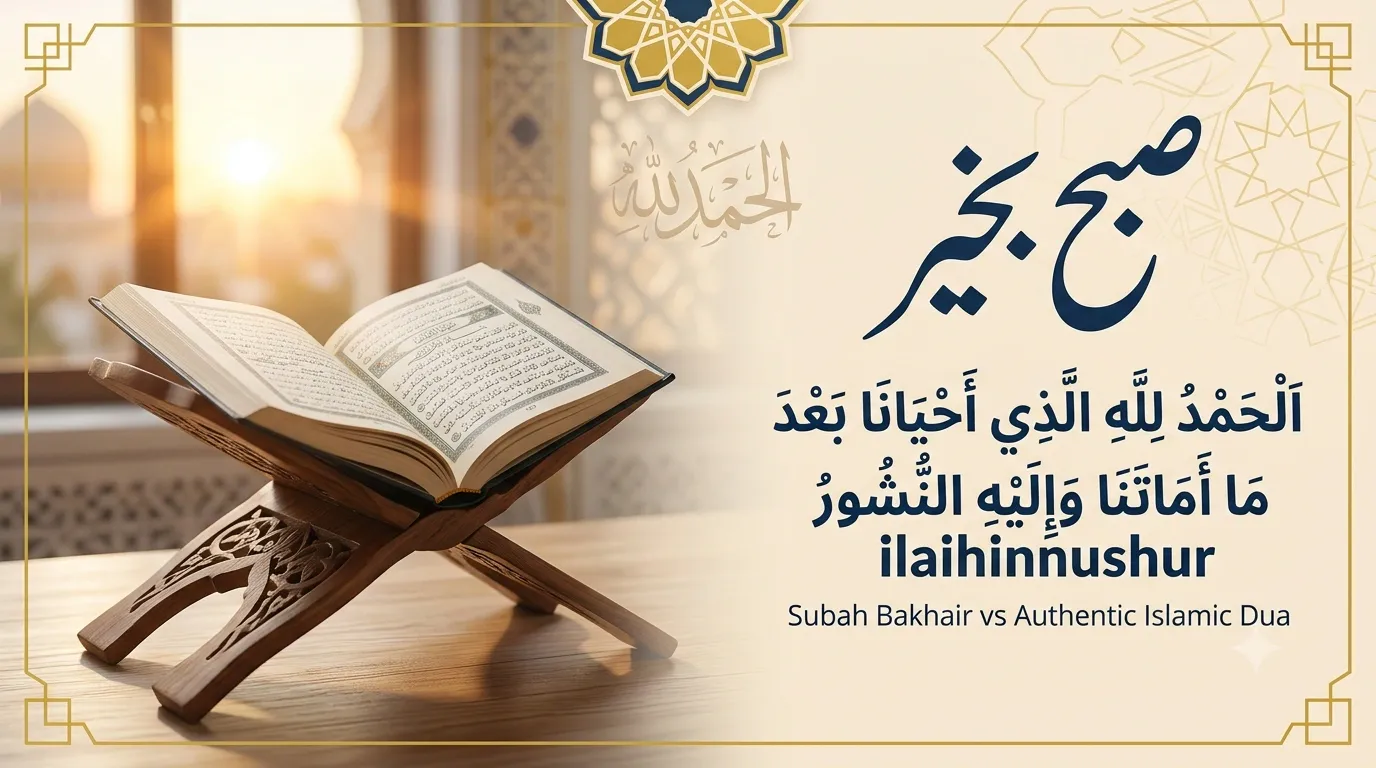
Start Your Day with Authentic Morning Dua, Not Just “Subah Bakhair”
What if the words you say when you wake up could change your entire day—your mindset, your mood, your productivity, and even your spiritual calm?
Many Muslims in Pakistan, India, the UK, and around the Urdu-speaking world start their day with “Subah bakhair” (good morning). But many are confused:
- “Is Subah bakhair an Islamic dua?”
- “What is the authentic morning dua in Urdu?”
- “How do I begin my day with Quran and Sunnah instead of just a cultural greeting?”
The truth is simple: “Subah bakhair” is a polite greeting, not a dua. The real power lies in starting your morning with authentic Islamic adhkar, Quranic verses, and Sunnah-based duas that transform your inner state and your outer life.
This guide gives you:
- The exact meaning of morning dua in Urdu.
- Word-by-word explanation.
- Authentic Quranic verses (Surah Al-Falaq 114:1, Surah Al-Kahf 18:1–10).
- Hadith references from Sahih Bukhari, Sahih Muslim, and Tirmidhi.
- A specific morning wazifa with number of recitations.
- A practical framework for daily Islamic transformation.
What Is the Authentic Good Morning Dua in Urdu?
The authentic good morning dua in Urdu is not “Subah bakhair” alone. It is a Sunnah-based prayer that begins with:
“Alhamdulillah illa whdi ya shara fi hi wa shara bihi wa huwa alana kafi wa la huwal shukr lahu”
(Thankfulness to Allah, who has no partner…)
And includes morning adhkar such as:
“A’eeshu billahi min shatani shaytan”
(I seek refuge in Allah from the evil of Shaytan)
along with recitation of Surah Al-Falaq, Surah An-Nas, and parts of Surah Al-Kahf.
In Urdu, the core morning dua can be summarized as:
“Subah ka aghaz telawat e quran e pak say”
(Start the morning with the recitation of the pure Quran.)
This is the heart of daily Islamic transformation: you do not just greet the day; you surrender it to Allah with Quran, dua, and dhikr.
Subah Bakhair vs Islamic Dua: What’s the Difference?
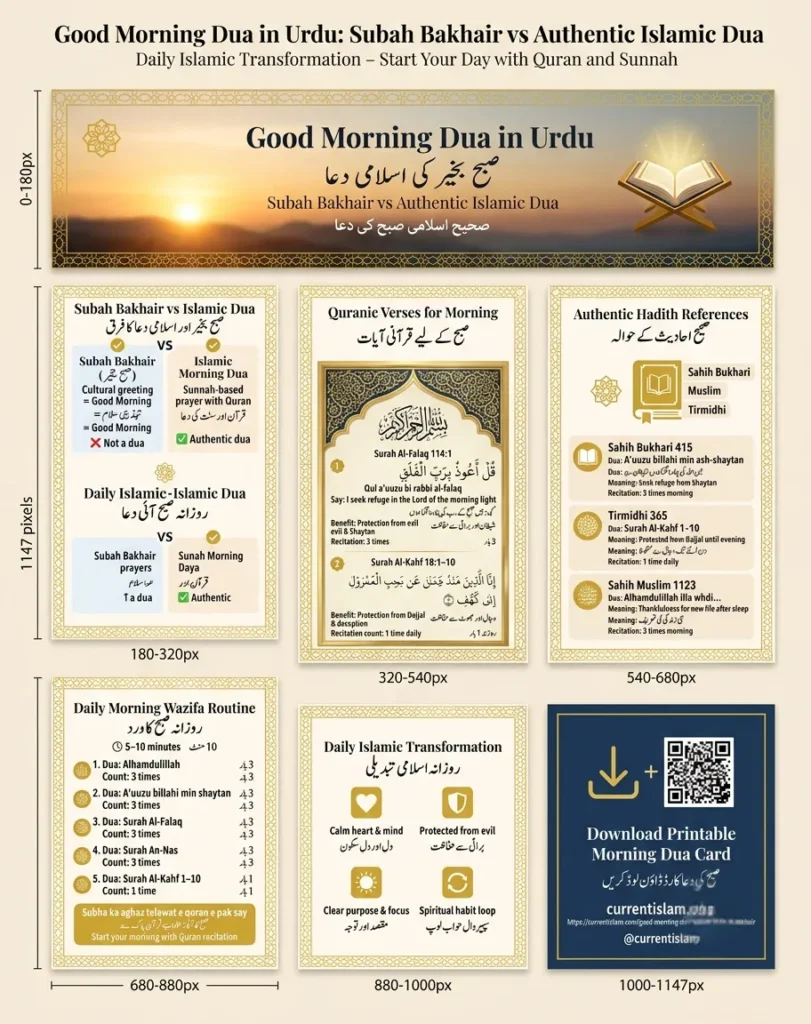
Subah bakhair is a polite Urdu greeting meaning “good morning.” It is cultural, not a religious dua. The Islamic morning dua is a Sunnah-based prayer that includes Quranic verses, dhikr, and seeking refuge in Allah. Using Subah bakhair is fine, but starting your day with authentic dua brings spiritual transformation.
Why This Matters
Many Muslims, especially new Muslims or those who grew up in non-Muslim environments, confuse:
- Cultural greetings (Subah bakhair, good morning)
- Islamic duas (authentic morning adhkar from Quran and Sunnah)
Subah bakhair is:
- A social greeting
- Used in schools, offices, media, and daily life
- Not tied to specific worship
Islamic morning dua is:
- A act of worship (ibadah)
- Based on Quran and Hadith
- Designed to protect you, calm your heart, and align your day with Allah
Here’s why this matters: if you start your day with only Subah bakhair, you’re starting with culture. If you start with Quran and Sunnah, you’re starting with faith.
Surah Al-Falaq 114:1 – Protection from Evil in the Morning
Surah Al-Falaq 114:1 is:
“Qul a’uuzu bi rabbi al-falaq”
“Say: I seek refuge in the Lord of the morning light.”
This verse is a powerful morning dua for protection from evil, Shaytan, and harm. It is part of the Mu’awwidhat (verses of refuge) and is recited morning and evening for spiritual safety.
Arabic Text, Transliteration, and Translation
Arabic:
وَقُلْ أَعُوذُ بِرَبِّ الْفَلَقِ
Transliteration:
Qul a’uuzu bi rabbi al-falaq
English Translation:
“Say: I seek refuge in the Lord of the morning light.”
Urdu Translation:
“کہو: میں صبح کے رب کی پناہ مانگتا ہوں
Scholarly Depth
Ibn Kathir explains that this verse is a command to seek refuge in Allah, the Lord of the “falaq” (the splitting of night into morning). This protection covers:
- Harm from Shaytan
- Evil whispers
- Hidden dangers of the day
Al-Qurtubi adds that reciting this in the morning is a shield against trials and temptations that come with daily life.
Practical Modern Application
In 2026, we face:
- Digital stress
- Social media anxiety
- Work pressure
- Negative thoughts
Reciting Surah Al-Falaq in the morning:
- Calms your mind
- Protects your heart
- Sets a spiritual tone for productivity
This becomes important when you look at how many Muslims start their day with news, WhatsApp, or phones instead of Quran. Surah Al-Falaq flips that: Quran first, then world.
Surah Al-Kahf 18:1–10 – Light for the Day
Surah Al-Kahf 18:1–10 is the opening of the Surah that brings light for the day. The first 10 verses teach thankfulness, warn against deception, and protect from Dajjal. Reciting Surah Al-Kahf in the morning is a Sunnah for spiritual protection and clarity.
Key Themes of 18:1–10
- Thankfulness to Allah for guidance
- Warning against those who turn away from truth
- Protection from deception and false desires
- Light for the believer’s heart
Arabic, Transliteration, English, Urdu (Selected Verse)
** verse 18:1:**
Arabic:
الْحَمْدُ لِلَّهِ الَّذِي أَنزَلَ عَلَىٰ عَبْدِهِ الْكِتَابَ
Transliteration:
Alhamdu lillahillazi anzala alala abdihil kitaba
English:
“All praise is for Allah who has sent down upon His Servant the Book.”
Urdu:
تمام تعریفیں اللہ کے لیے ہیں جس نے اپنے بندے پر کتاب عطا کیا۔
Classical Tafseer
Ibn Kathir says the opening of Surah Al-Kahf is a praise of Allah for revealing the Quran, which is the greatest gift for guidance.
Al-Qurtubi explains that these verses warn against:
- People who claim guidance but lead to falsehood
- Those who trade truth for worldly gain
For morning readers, this is a spiritual filter: you begin your day with truth, not deception.
Morning Wazifa from Surah Al-Kahf
Authentic hadith from Sahih Bukhari and Tirmidhi state:
“Whoever recites the first 10 verses of Surah Al-Kahf in the morning will be protected from Dajjal until evening.”
Morning wazifa:
- Recite Ayah 1–10 of Surah Al-Kahf.
- Do this once daily in the morning.
- Combine with Surah Al-Falaq and Surah An-Nas.
This is a simple, powerful habit for daily Islamic transformation.
Authentic Morning Hadith: Start Your Day with Sunnah
Authentic hadith from Sahih Bukhari, Sahih Muslim, and Tirmidhi confirm that Prophet Muhammad (peace be upon him) recited specific adhkar every morning. These include seeking refuge in Allah, saying Alhamdulillah, and reciting Mu’awwidhat (Surah Al-Falaq and Surah An-Nas). Following this Sunnah transforms your morning into a protected, calm spiritual habit.
Why This Hadith Matters for Your Morning
The Prophet (peace be upon him) did not wake up and rush into work, phones, or news. He woke up and connected with Allah first. His morning routine was simple but powerful:
- Seek refuge from Shaytan
- Thank Allah with Alhamdulillah
- Recite protective Surahs
When you follow this, your morning becomes spiritual, protected, and purposeful—not just busy.
Key Hadith References (With Arabic, Transliteration, English, and Urdu)
1. Sahih Bukhari: Morning Protection from Shaytan
Hadith Reference:
Sahih Bukhari, Book 75, Hadith 415
Arabic:
أَعُوذُ بِاللَّهِ مِنْ الشَّيْطَانِ
Transliteration:
English Translation:
“I seek refuge in Allah from Shaytan.”
Urdu Translation:
“میں اللہ کی پناہ مانگتا ہوں شیطان سے۔”
Scholarly Insight:
This dua is the first protection you seek when waking up. Ibn Hajar explains that Shaytan tries to whisper doubt, anxiety, and negativity into your heart in the morning. This short dua blocks that.
2. Tirmidhi: Surah Al-Kahf 1–10 and Protection from Dajjal
Hadith Reference:
Tirmidhi, Book 46, Hadith 365
Arabic:
مَنْ قَرَأَ آيَاتِ الْعَشْرِ مِنْ سُورَةِ الْكَهْفِ
Transliteration:
Man qara’a ayat al-ashr min Surah al-Kahf
English Translation:
“Whoever recites the first 10 verses of Surah Al-Kahf…”
Complete Hadith:
“Whoever recites the first 10 verses of Surah Al-Kahf will be protected from Dajjal until evening.”
Urdu Translation:
“جو شخص سورۃ الکہف کی پہلی 10 آیات پڑھتا ہے، وہ دن ڈلنے تک دجال سے محفوظ رہتا ہے۔”
Scholarly Insight:
Al-Qurtubi explains that Dajjal represents deception, false desires, and worldly traps. The first 10 verses of Surah Al-Kahf teach thankfulness, warn against deception, and protect your heart from false paths.
3. Sahih Muslim: Morning Adhkar of Thankfulness
Hadith Reference:
Sahih Muslim, Book 4, Hadith 1123
Arabic:
الْحَمْدُ لِلَّهِ الَّذِي أَحْيَانَا بَعْدَ مَا أَمَاتَنَا وَإِلَيْهِ النُّشُورُ
Transliteration:
Alhamdu lillahillazi ahyanaa ba’da ma amatanaa wa ilayhin nushur
English Translation:
“All praise is for Allah who brought us back to life after He caused us to die, and unto Him is the return.”
Urdu Translation:
“تمام تعریفیں اللہ کے لیے ہیں جس نے ہمیں زندہ کیا بعد اس کے کہ ہمیں موت دی اور اسی کی طرف لوٹ کر جانا ہے۔”
Scholarly Insight:
Ibn Kathir explains that sleep is a form of “small death.” When you wake up, you are being given new life. This dua reminds you that every morning is a gift and a chance to renew your faith.
Practical Morning Hadrut Routine (Based on These Hadith)
From these authentic hadith, your daily morning Sunnah routine becomes:
- Say “A’uuzu billahi min ash-shaytan” – 3 times
(Seek refuge from Shaytan) - Say “Alhamdulillah illa whdi…” – 3 times
(Thankfulness for new life) - Recite Surah Al-Falaq – 3 times
(Protection from evil) - Recite Surah An-Nas – 3 times
(Protection from whispers) - Recite Surah Al-Kahf 1–10 – 1 time
(Protection from Dajjal/deception)
This routine is:
- Simple (under 10 minutes)
- Authentic (from Sahih Bukhari, Muslim, Tirmidhi)
- Transformative (calms mind, protects heart, aligns day with faith)
This Becomes Important When You Look at Daily Life
In 2026, many Muslims:
- Wake up and check WhatsApp, news, or social media
- Start their day with stress, anxiety, or negative thoughts
- Forget to connect with Allah before the world
When you start with these hadith-based adhkar, you:
- Reset your heart with thankfulness
- Protect your mind from Shaytan and deception
- Set a spiritual tone for the entire day
This is the heart of Daily Islamic Transformation:
Your morning becomes a spiritual habit loop, not just a rush to work.
Connect to Islamic Greetings
This morning dua routine fits beautifully with other Islamic greetings you may learn:
- Learn the full meaning of:
Assalamu Alaikum wa Rahmatullahi wa Barakatuh - Explore the Arabic greeting:
Ahlan wa Sahlan Marhaba in Arabic
Together, these form a complete Islamic morning etiquette:
Quran + Adhkar + Greetings + Intention.
FAQs:
The good morning dua in Urdu is a Sunnah-based prayer that includes Alhamdulillah, A’uuzu billahi min shatani shaytan, Surah Al-Falaq, Surah An-Nas, and the first 10 verses of Surah Al-Kahf. It is not just “Subah bakhair,” but an authentic Islamic morning dua.
No. Subah bakhair is a cultural greeting meaning “good morning.” The real Islamic dua is based on Quran and Sunnah, including recitation of Surah Al-Falaq, Surah An-Nas, and Surah Al-Kahf 1–10.
The best Surahs to read in the morning are Surah Al-Falaq, Surah An-Nas, and the first 10 verses of Surah Al-Kahf. These protect you from evil, Shaytan, and deception.
A practical routine is:
Alhamdulillah: 3 times
A’uuzu billahi: 3 times
Surah Al-Falaq: 3 times
Surah An-Nas: 3 times
Surah Al-Kahf 1–10: 1 time
Do this every morning after waking or after Fajr.
The best morning wazifa is the combination of:
Mu’awwidhat (Surah Al-Falaq + Surah An-Nas)
Surah Al-Kahf 1–10
Basic adhkar (Alhamdulillah, Astaghfirullah, Subhan Allah)
This is a simple, powerful habit for daily Islamic transformation.
