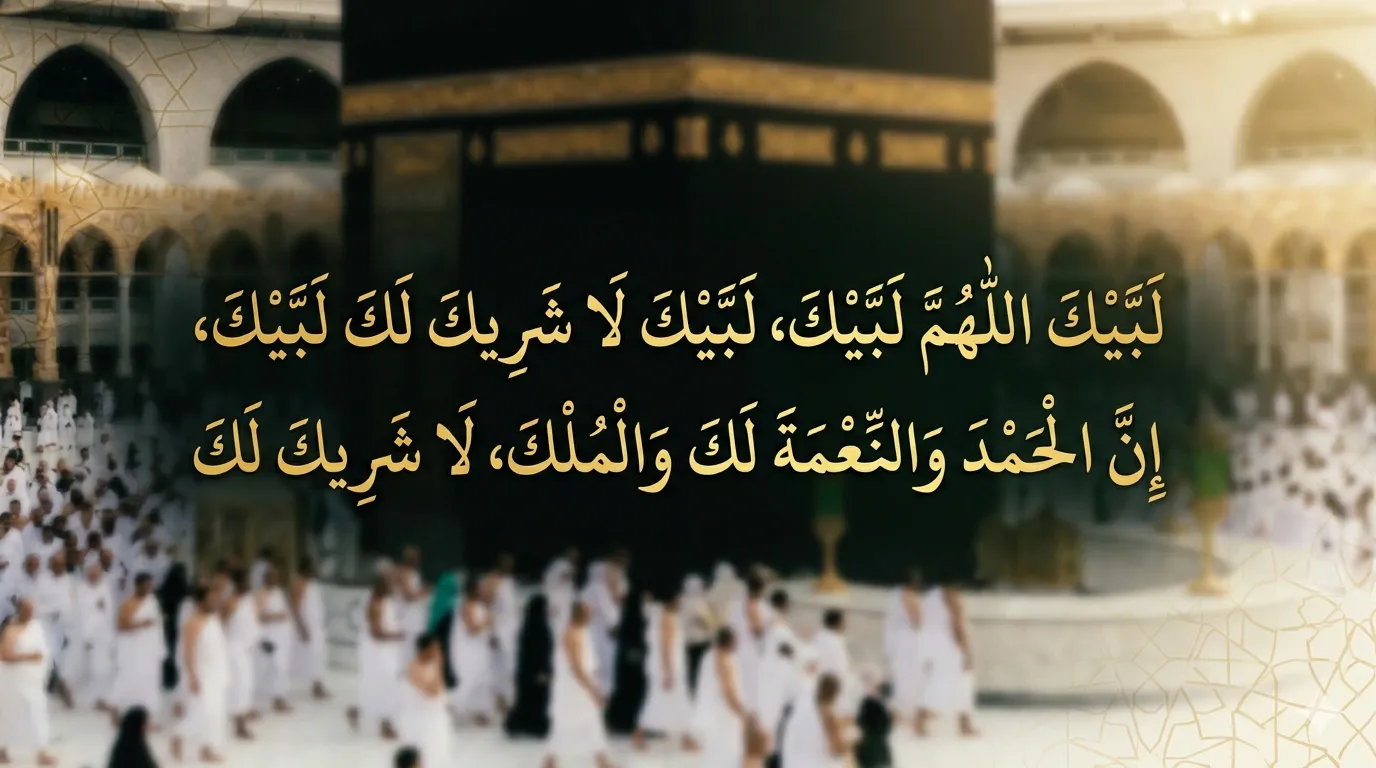
Hajj and Umrah ki dua is not just a phrase to memorize; it is a living response to Allah’s call, especially when the body is tired, the crowd is overwhelming, and the heat feels unbearable. For first-time pilgrims and everyday Muslims alike, the real question is not only “what should I read?” but “what should I understand so I can recite with presence and confidence?”
Why this dua matters
The core dua of pilgrimage is the talbiyah, because it expresses surrender, devotion, and readiness to obey Allah during Hajj and Umrah. The Qur’an also roots pilgrimage in the legacy of Ibrahim عليه السلام, showing that this journey is not a random ritual but a divinely established act of worship.
If you are searching for hajj and umrah ki dua, the main Sunnah recitation is the talbiyah: “Labbaik Allahumma labbaik”. It is the most authentic and most repeated dua of the pilgrimage, and it should be understood, not only repeated mechanically.
Quranic foundation
The Qur’an frames Hajj as a call from Allah that people answer with action, movement, and devotion. Surah Al-Hajj connects Ibrahim’s mission with the purification of the House and the proclamation of pilgrimage to all people.
Qur’an 22:26
Arabic:
وَإِذْ بَوَّأْنَا لِإِبْرَاهِيمَ مَكَانَ الْبَيْتِ أَنْ لَا تُشْرِكْ بِي شَيْئًا وَطَهِّرْ بَيْتِيَ لِلطَّائِفِينَ وَالْقَائِمِينَ وَالرُّكَّعِ السُّجُودِ
Transliteration:
Wa idh bawwa’nā li-Ibrāhīma makāna al-bayti an lā tushrik bī shay’an wa ṭahhir baytiya liṭ-ṭā’ifīna wal-qā’imīna war-rukka’is-sujūd
English meaning:
“And ˹remember˺ when We assigned to Abraham the site of the House, ˹saying,˺ ‘Do not associate anything with Me in worship and purify My House for those who circle the Ka‘bah, stand in prayer, and bow and prostrate themselves.’”
Urdu meaning:
“اور یاد کرو جب ہم نے ابراہیم کو بیت اللہ کی جگہ بتائی کہ میرے ساتھ کسی کو شریک نہ ٹھہرانا اور میرے گھر کو طواف کرنے والوں، قیام کرنے والوں، رکوع اور سجدہ کرنے والوں کے لیے پاک رکھنا۔”
Qur’an 22:27
Arabic:
وَأَذِّنْ فِي النَّاسِ بِالْحَجِّ يَأْتُوكَ رِجَالًا وَعَلَىٰ كُلِّ ضَامِرٍ يَأْتِينَ مِنْ كُلِّ فَجٍّ عَمِيقٍ
Transliteration:
Wa adh-dhin fī an-nāsi bil-ḥajj ya’tūka rijālan wa ‘alā kulli ḍāmir ya’tīna min kulli fajjin ‘amīq
English meaning:
“Call all people to the pilgrimage. They will come to you on foot and on every lean camel from every distant path.”
Urdu meaning:
“اور لوگوں میں حج کا اعلان کر دو، وہ تمہارے پاس پیدل بھی آئیں گے اور ہر دبلے اونٹ پر بھی، دور دراز راستوں سے۔”
Why these verses matter today
These verses make pilgrimage feel purposeful, not routine. They also speak directly to modern pilgrims who struggle with tiredness, long travel, and logistical strain, because the Qur’an already describes Hajj as a journey of endurance and response.
The main talbiyah
The most important pilgrimage dua is the talbiyah, which the Prophet ﷺ used during Hajj and which is strongly connected to the spiritual identity of the pilgrim. It is short, powerful, and easy to remember, making it ideal for voice-search, memorization, and practical use during travel.
Talbiyah text
Arabic:
لَبَّيْكَ اللَّهُمَّ لَبَّيْكَ، لَبَّيْكَ لَا شَرِيكَ لَكَ لَبَّيْكَ، إِنَّ الْحَمْدَ وَالنِّعْمَةَ لَكَ وَالْمُلْكَ، لَا شَرِيكَ لَكَ
Transliteration:
Labbaik Allahumma labbaik, labbaika la sharika laka labbaik, innal-hamda wan-ni‘mata laka wal-mulk, la sharika lak
English meaning:
“I respond to Your call, O Allah, I respond to Your call. You have no partner. I respond to Your call. All praise, blessing, and sovereignty are Yours. You have no partner.”
Urdu meaning:
“حاضرم، اے اللہ! میں حاضر ہوں، میں حاضر ہوں، تیرا کوئی شریک نہیں، میں حاضر ہوں۔ بے شک تمام تعریف، نعمت اور بادشاہی تیرے لیے ہے، تیرا کوئی شریک نہیں۔”
How many times to recite
There is no fixed “magic number” for this dua in the sense of a special count that makes it valid. The prophetic practice is to keep reciting it frequently during the relevant stages of pilgrimage, especially after entering ihram and while moving through the rites.
Other important duas
Hajj and Umrah also include other authentic remembrances, especially at key ritual moments. These are not replacements for the talbiyah, but they enrich the pilgrimage and help the pilgrim stay spiritually focused.
Delegation of Allah
The Prophet ﷺ said that the pilgrim performing Hajj and Umrah is a delegation to Allah, meaning a guest who comes seeking mercy, forgiveness, and acceptance.
Arabic:
الْغَازِي فِي سَبِيلِ اللَّهِ، وَالْحَاجُّ وَالْمُعْتَمِرُ وَفْدُ اللَّهِ، دَعَاهُمْ فَأَجَابُوهُ، وَسَأَلُوهُ فَأَعْطَاهُمْ
Transliteration:
Al-ghāzī fī sabīlillāh, wal-ḥājj wal-mu‘tamir wafdu Allāh, da‘āhum fa-ajābūh, wa sa’alūhu fa-a‘ṭāhum
English meaning:
“The one who fights in the cause of Allah, and the pilgrim performing Hajj and Umrah are a delegation to Allah. He invited them, so they responded to Him, and they ask Him and He gives to them.”
Urdu meaning:
“اللہ کی راہ میں جہاد کرنے والا، حج کرنے والا اور عمرہ کرنے والا اللہ تعالیٰ کا وفد ہے۔ اللہ نے انہیں بلایا تو انہوں نے لبیک کہا، اور انہوں نے مانگا تو اللہ نے عطا فرمایا۔”
Why this matters
This hadith changes the emotional tone of pilgrimage. It tells the pilgrim that exhaustion, crowd pressure, and delays are not signs of failure; they are part of answering Allah’s invitation with patience and devotion.
Umrah ki niyat
Umrah ki niyat is often misunderstood as a fixed sentence that must be read in one exact wording. In reality, intention is made in the heart, while the tongue helps with remembrance and preparation through talbiyah and related du’as.
The intention for Umrah is not a single required phrase for validity; what matters is entering the state of ihram with sincere purpose, then reciting the talbiyah as the Sunnah practice. This is why many scholars and guides focus on meaning, not just wording.
Umrah ka tariqa
Umrah ka tariqa becomes easier when it is presented step by step with the dua attached to each stage. This approach helps first-time pilgrims avoid confusion, especially when fatigue, heat, and crowded movement make memory harder.
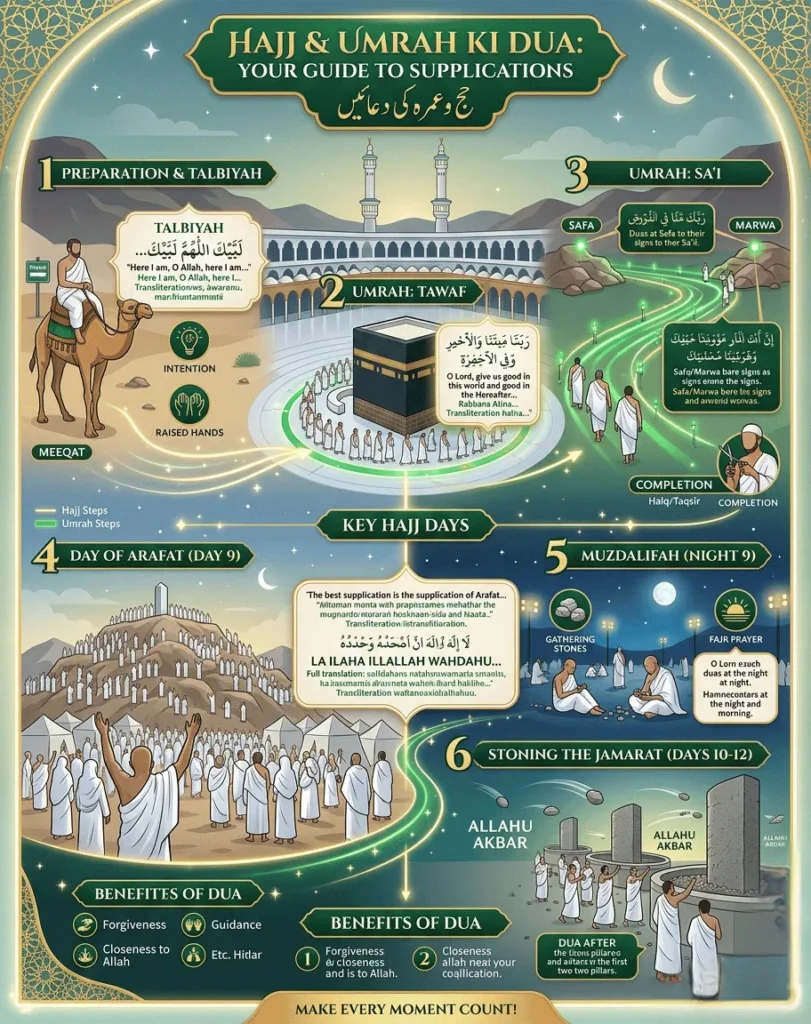
Step-by-step flow
- Enter ihram with intention.
- Begin the talbiyah.
- Perform tawaf.
- Pray and make personal dua.
- Perform sa’i between Safa and Marwah.
- End with shaving or trimming the hair.
The step-by-step method matters because a tired pilgrim needs a simple map, not a dense lecture. The dua becomes easier to remember when it is tied to a sequence of actions, not studied as isolated text.
Difference between Hajj and Umrah
Hajj and Umrah are similar in spirit, but they are not identical in obligation, timing, and ritual scope. Hajj is performed at a specific time in the Islamic lunar year, while Umrah can be performed throughout the year.
The easiest distinction is this: Hajj is the larger and more time-bound pilgrimage, while Umrah is the shorter pilgrimage with fewer rites. Both share the same spiritual foundation of responding to Allah’s call.
Tafseer and meaning
Classical tafseer traditions commonly read Surah Al-Hajj as a reminder that pilgrimage is rooted in monotheism, purification, and obedience. The command to proclaim Hajj shows that the journey is not only physical movement but also a public sign of faith and submission.
The deeper meaning of hajj and umrah ki dua is surrender, not repetition alone. Talbiyah means “I am present,” so the pilgrim is not just speaking words; he or she is answering Allah with the whole self.
Practical modern relevance
Pilgrims today face severe heat, crowded routes, intense walking, and logistical pressure. In that setting, a short and powerful dua like the talbiyah is especially useful because it can be repeated easily while walking, waiting, or traveling between rites.
The modern value of this dua is that it keeps the heart steady when the body is under strain. In a crowded pilgrimage environment, the talbiyah becomes both remembrance and emotional support.
To understand the full meaning and pronunciation of the talbiyah, read our detailed guide:
For the core pilgrimage chant, see our guide to Labbaik Allahumma Labbaik, including its meaning, transliteration, and when to recite it.
For a related supplication that reflects deep repentance, read What is the meaning of Rabbana Zalamna Anfusana Dua?, and understand why it matters in Islamic spirituality.
For practical, step-by-step preparation, explore Umrah 2026: A Complete Guide for First-Time Pilgrims, especially if you are learning the pilgrimage for the first time.
People also ask:
What is the dua for Hajj and Umrah?
The main dua is the talbiyah: “Labbaik Allahumma labbaik.” It is the central Sunnah remembrance for pilgrims and the clearest answer to this query.
Is there a special dua for Umrah?
There is no single compulsory special dua for Umrah beyond the Sunnah remembrances and personal supplication. The intention is in the heart, and the talbiyah is recited after entering ihram.
How many times should I say Labbaik Allahumma Labbaik?
It should be recited repeatedly during the pilgrimage stages, especially after ihram and while moving through the rites. The sources emphasize repetition, not a fixed number.
What does the pilgrim ask Allah for?
The hadith of Ibn Majah shows that pilgrims ask, and Allah gives them, highlighting forgiveness, mercy, and acceptance as the central meanings of pilgrimage supplication.
Umrah Ki Dua PDF
FAQs:
Yes. The Sunnah allows personal dua, and pilgrims are encouraged to ask Allah in their own words along with the authentic recitations.
The talbiyah is strongly associated with Hajj, and pilgrimage guides also discuss it in the context of Umrah because it marks entry into the sacred state and the response to Allah’s call.
Because it expresses the essence of pilgrimage: “I respond to Your call.” It turns a difficult journey into a conscious act of worship.
Start with the talbiyah, then learn the basic sequence of Umrah, and then add the dua for each stage. That order reduces stress and improves confidence.
