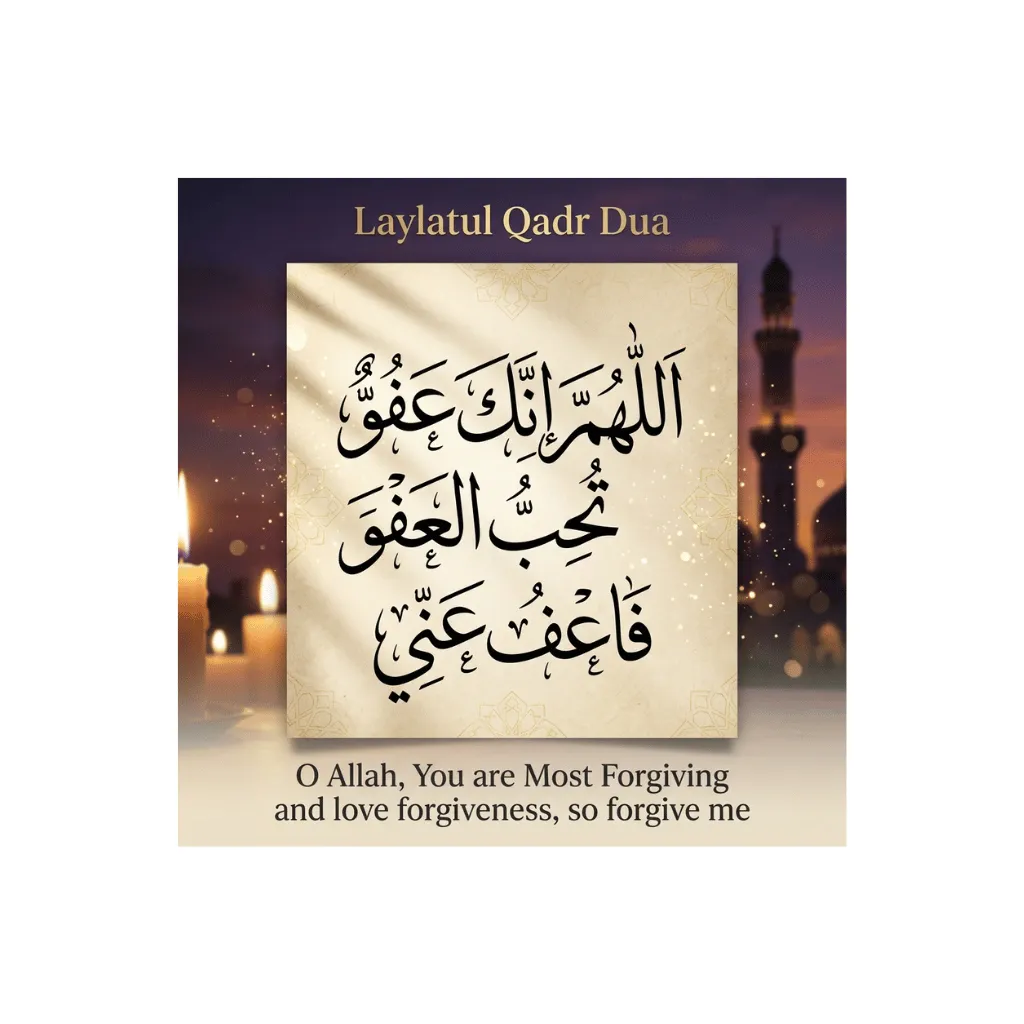
What is the Allahumma Innaka Afuwwun dua? This powerful supplication means “O Allah, You are Most Forgiving and love forgiveness, so forgive me.” Prophet Muhammad (ﷺ) taught it specifically for Laylatul Qadr (Night of Decree), making it the essential prayer for complete sin erasure during Ramadan’s last ten nights.
The Night That Changes Everything
What if one simple sentence could erase years of mistakes? What if there was a specific prayer Prophet Muhammad (ﷺ) personally taught his wife for the most blessed night of the year? For millions of Muslims approaching Ramadan’s final nights, this question isn’t theoretical—it’s urgent. The Allahumma innaka afuwwun dua isn’t just another supplication. It’s your direct gateway to ‘afw (complete erasure), not just surface-level forgiveness.
Here’s what most articles miss: Understanding the difference between being covered for your sins and having them erased completely. This distinction changes everything about how you approach Laylatul Qadr.
What Does Allahumma Innaka Afuwwun Mean?
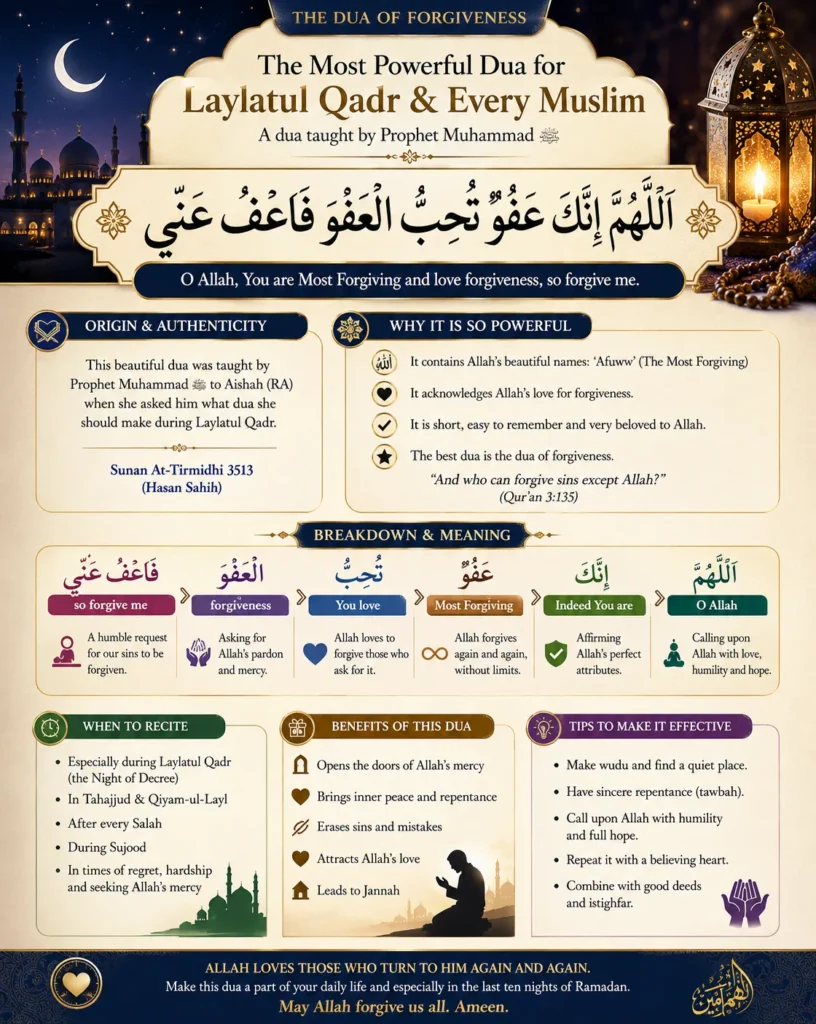
The complete translation is: “O Allah, You are Most Forgiving and love forgiveness, so forgive me.” This dua combines divine praise with personal plea, acknowledging Allah’s nature as Al-‘Afuw (The Pardoner) before asking for mercy.
Word-by-Word Breakdown
| Arabic Word | Transliteration | Literal Meaning |
|---|---|---|
| اللَّهُمَّ | Allahumma | O Allah |
| إِنَّكَ | Innaka | Indeed, You are |
| عَفُوٌّ | ‘Afuwwun | Most Forgiving/Pardoner |
| تُحِبُّ | Tuhibbu | You love |
| الْعَفْوَ | Al-‘Afw | Forgiveness/Pardon |
| فَاعْفُ عَنِّي | Fa’fu ‘annee | So forgive me |
The full Arabic text is:
اللَّهُمَّ إِنَّكَ عَفُوٌّ تُحِبُّ الْعَفْوَ فَاعْفُ عَنِّي
Urdu Translation
“اے اللہ! بے شک آپ معاف کرنے والا ہے اور معافی پسند کرتا ہے، تو مجھے معاف فرما دے
Hindi Translation
“हे अल्लाह, बेशक आप बहुत माफ़ करने वाले हैं और माफ़ी पसंद करते हैं, तो मुझे माफ़ कर दे”
The Authentic Hadith: Why This Dua Matters
Prophet Muhammad (ﷺ) taught this dua specifically to Aisha (RA) for Laylatul Qadr. The authentic narration comes from Sunan Ibn Majah 3850 and *Jami` at-Tirmidhi 3513*, both graded *hasan* (good) by Hadith scholars
Complete Arabic Text with Transliteration
Arabic:
قُلْتُ يَا رَسُولَ اللَّهِ أَرَأَيْتَ إِنْ وَافَيْتُ لَيْلَةَ الْقَدْرِ مَا أَقُولُ قَالَ قُولِي
اللَّهُمَّ إِنَّكَ عَفُوٌّ تُحِبُّ الْعَفْوَ فَاعْفُ عَنِّي
Transliteration:
Qultu: Ya Rasool Allah, ara’ayta in waafaytu Laylat al-Qadr ma aqool?
Qala: Qooli:
Allahumma innaka ‘afuwwun tuhibbul-‘afwa fa’fu ‘annee
English Translation:
I (Aisha RA) asked: “O Messenger of Allah, if I know which night is Laylatul Qadr, what should I say?” He (ﷺ) said: “Say: ‘O Allah, You are Most Forgiving and love forgiveness, so forgive me’“.
Why These References Are Approved
Both Sunan Ibn Majah and *Jami` at-Tirmidhi* are among the six canonical Hadith collections (*Sihah Sittah*) accepted by Sunni scholars worldwide. Imam at-Tirmidhi specifically graded this narration as *hasan sahih* (good and authentic), making it reliable for religious practice
The Critical Difference: ‘Afw vs. Maghfirah
‘Afw means complete erasure of sins as if they never occurred, while Maghfirah means Allah covers sins but they remain recorded. This is the theological foundation that makes this dua superior for Laylatul Qadr.
Maghfirah (Regular Forgiveness)
- Allah covers your sin and spares you punishment
- The sin remains recorded in your book of deeds
- You may still be questioned about it on Judgment Day
‘Afw (Complete Pardon)
- Allah erases the sin completely
- The sin is obliterated from your record
- You will not be questioned about it at all
When you recite Allahumma innaka afuwwun, you’re asking for the higher level—‘afw—not just maghfirah. This is why scholars emphasize this dua specifically for Laylatul Qadr: the night’s blessing makes complete erasure possible.
When to Recite: Laylatul Qadr Timing
Recite this dua during the last ten odd nights of Ramadan (21, 23, 25, 27, 29), with special focus on Night 27. While ideal for Laylatul Qadr, you can recite it anytime for forgiveness.
How Many Times to Recite?
There’s no specific number mandated in Hadith. Scholars recommend:
- Minimum: Once with full presence of heart
- Recommended: 100 times across the night
- Maximum: As many times as possible with sincerity
The key is ikhlas (sincerity) and khushu’ (focus), not mechanical repetition.
Best Times Within the Night
- After Tahajjud prayer (late night)
- During sujud (prostration)
- In the final third of the night when Allah descends
- While prostrating in Taraweeh
Quranic Foundations of Forgiveness
Three Quranic verses support the theology behind this dua:
Quran 3:135 – The Believers’ Character
“And those who, when they commit an immorality or wrong themselves [by transgression], remember Allah and seek forgiveness for their sins…”
This verse establishes that seeking forgiveness is a defining trait of true believers (muttaqun).
Quran 42:25 – Allah’s Love for Forgiveness
“And it is He who accepts repentance from his servants and pardons misdeeds, and He knows what you do.”
This confirms Allah’s attribute as Al-‘Afuw—He doesn’t just accept repentance; He actively pardons.
Quran 110:3 – Seek Forgiveness After Success
“So exalt [Allah] with praise of your Lord and ask for His forgiveness; indeed, He is ever acceptor of repentance.”
This verse was revealed near the end of Prophet’s life, emphasizing continuous repentance even after spiritual achievement.
Classical Tafseer Insights
Ibn Kathir’s Commentary
Ibn Kathir explains that ‘afw means “removing the trace of sin completely.” He notes that Allah’s love for forgiveness (tuhibbul-‘afwa) demonstrates His mercy outweighs His wrath.
Al-Qurtubi’s Perspective
Al-Qurtubi emphasizes that asking for ‘afw specifically (not just maghfirah) shows deeper understanding of Allah’s names. He writes that Laylatul Qadr’s unique blessing makes complete erasure achievable.
Al-Jalalayn’s Simplification
Al-Jalalayn simplifies: “Allah is the One who pardons greatly, so pardon you from your servant’s sins.” This emphasizes the direct relationship between recognizing Allah’s attribute and receiving mercy.
Practical Modern Application: The Digital Sunnah
Here’s why this matters today: In an age of digital distractions, this dua becomes a spiritual anchor. You don’t need perfect conditions—just presence of heart.
How to Integrate Into Daily Life
- Set a Ramadan reminder for the last 10 nights (phones often auto-suggest Laylatul Qadr dates)
- Pair with existing habits: After Fajr, before bed, or during commute
- Create a physical space: A clean corner with a prayer mat signals “forgiveness time”
- Write it down: Keep the Arabic text visible for memorization
- Share with family: Teach children this dua early
For New Muslims
If Islam feels new and overwhelming, start here: This dua is simple, authentic, and powerful. You don’t need years of study to benefit. Just sincerity. The Prophet (ﷺ) designed it for everyone.
For South Asian Diaspora
The Urdu and Hindi translations make this accessible across generations. Use the multilingual format to teach children while maintaining Arabic authenticity.
Benefits of Reciting This Dua
Scholars and reliable sources confirm these benefits:
Common Mistakes to Avoid
Here’s what reduces the dua’s impact:
- Mechanical recitation without understanding: Know what you’re saying
- Rushing through it slowly: Take time for khushu’
- Skipping Arabic entirely: Keep Arabic as primary, translations as aid
- Only reciting once: Repetition with sincerity multiplies reward
- Ignoring repentance conditions: True tawbah requires stopping the sin and resolving not to return
Related Forgiveness Duas for Complete Spiritual Protection
For comprehensive spiritual cleansing, combine this with Sayyid al-Istighfar (the Chief of Forgiveness Prayers). This comprehensive dua encompasses acknowledging God’s lordship, admitting shortcomings, and seeking absolute forgiveness.
Most Powerful Duas for Forgiveness: Sayyidul Istighfar
Additionally, recite Dua Rabbana Innana Amanna Faghfir Lana for collective forgiveness and protection from punishment.
Dua for Forgiveness: Rabbana Innana Amanna Faghfir Lana
People Also Ask:
Allahumma innaka afuwwun is the Prophet’s specifically taught dua for Laylatul Qadr, asking for complete sin erasure (‘afw).
There’s no fixed number. Recite once with full focus or up to 100 times across the night. Sincerity matters more than quantity.
Yes. While ideal for Laylatul Qadr, it’s a general forgiveness dua valid anytime.
Al-‘Afuw means complete erasure (removing the sin entirely). Al-Ghaffar means frequent forgiver (covering sins repeatedly).
No, it’s from Hadith. Prophet Muhammad (ﷺ) taught it to Aisha (RA) for Laylatul Qadr.
Wazifa means a regular spiritual practice or dhikr recited consistently for specific purposes.
Your Laylatul Qadr Action Plan
Download our printable Laylatul Qadr Supplication Guide to carry this dua with you throughout Ramadan’s final nights. This guide includes:
- Complete Arabic text with transliteration
- Urdu and Hindi translations
- Timing schedule for last 10 nights
- Space for personal notes and reflections
- Companion duas for comprehensive spiritual protection
Start tonight. Even if you’re unsure which night is Laylatul Qadr, every odd night in the last ten is a potential opportunity. The Prophet (ﷺ) didn’t want us to miss this chance.
Final Thought: The Erasure You’re Seeking
This isn’t about perfect pronunciation or memorizing 100 duas. It’s about one simple truth: Allah loves to forgive you more than you can imagine. When He says tuhibbul-‘afwa (You love forgiveness), He’s telling you that your return is His joy, not His burden.
The night is coming. The opportunity is real. The dua is ready. All that remains is your sincerity.
Allahumma innaka ‘afuwwun tuhibbul-‘afwa fa’fu ‘annee.
O Allah, You are Most Forgiving and love forgiveness. So forgive me.
