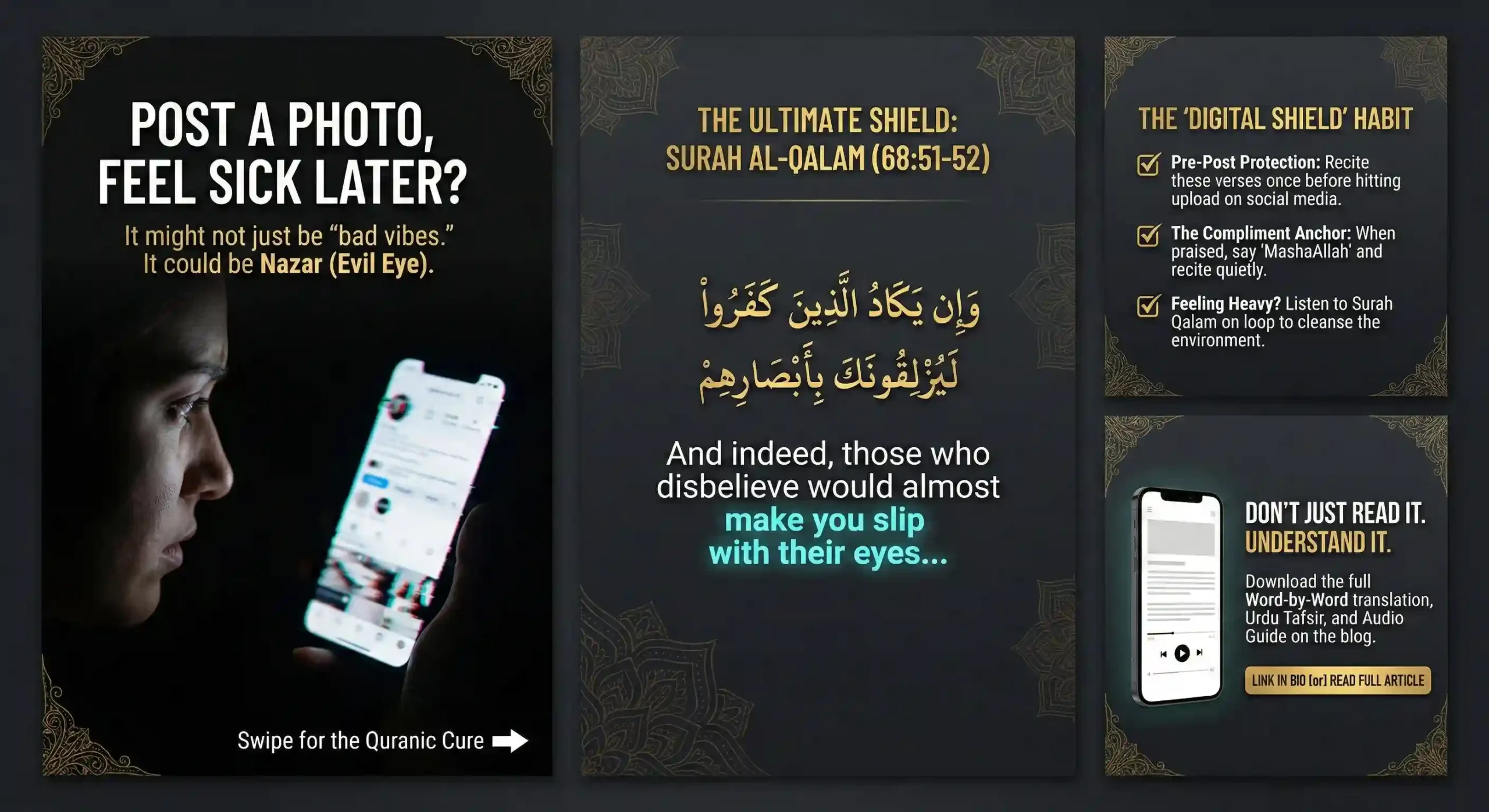
Have you ever shared a moment of joy—a new job, a beautiful family photo, or a personal achievement—only to feel a sudden, unexplained heaviness or chaos immediately after? It’s a feeling many of us know too well. In the Quran, Allah validates this reality. It isn’t just “bad vibes”; it is the spiritual reality of Nazar (Evil Eye).
But Allah did not leave us defenseless. He revealed a specific set of verses that acted as a shield for the Prophet Muhammad (PBUH) against the intense jealousy of his enemies. Let’s explore the power, meaning, and protective armor of the last two verses of Surah Al-Qalam.
Which Surah Contains the Ayat for Nazar?
The specific verses known as the “Ayat for Nazar” (Verses for Evil Eye) are the final two verses of Surah Al-Qalam (Chapter 68), specifically verses 51 and 52. They are located in the 29th Juz (Para) of the Holy Quran and are widely recited to repel jealousy and spiritual harm.
Many people scramble through the Quran looking for protection. It is essential to know exactly where to look. Surah Al-Qalam (The Pen) is a Makki Surah, revealed when the opposition against the Prophet (PBUH) was fierce. The disbelievers weren’t just attacking him with words; they were attacking him with their eyes—intense, hateful glares meant to psychologically and spiritually destabilize him.
These two verses were the divine response to that specific type of aggression.
The Text: Arabic, English, and Urdu Translation
The last two verses of Surah Qalam (68:51-52) describe how the disbelievers tried to make the Prophet slip with their eyes. Below is the complete Arabic text alongside the Saheeh International English translation and Fateh Muhammad Jalandhari’s Urdu translation for complete understanding.
To truly benefit from these verses, you must connect with them in a language you understand. Here is the breakdown:
| Language | Text / Translation |
| Arabic | وَإِن يَكَادُ ٱلَّذِينَ كَفَرُواْ لَيُزۡلِقُونَكَ بِأَبۡصَٰرِهِمۡ لَمَّا سَمِعُواْ ٱلذِّكۡرَ وَيَقُولُونَ إِنَّهُۥ لَمَجۡنُونٌ وَمَا هُوَ إِلَّا ذِكۡرٌ لِّلۡعَٰلَمِينَ |
| Transliteration | Wa in yakadul lazina kafaru layuzliqoonaka bi ab saarihim lamma sami’uz zikra wa yaquluna innahu lamajnun. Wa ma huwa illa zikrul lil aalamin. |
| English (Saheeh Int.) | “And indeed, those who disbelieve would almost make you slip with their eyes when they hear the message, and they say, ‘Indeed, he is mad.’ But it is not except a reminder to the worlds.” |
| Urdu (Jalandhari) | “اور کافر جب قرآن سنتے ہیں تو معلوم ہوتا ہے کہ (مارے حسد کے) تم کو اپنی نگاہوں سے پھسلا دیں گے اور کہتے ہیں یہ تو دیوانہ ہے۔ حالانکہ یہ (قرآن) اہل عالم کے لیے نصیحت ہے۔” |
Tafsir & Benefits: How Does It Cure Evil Eye?
Scholars state that these verses are effective because they mention the specific act of “striking with the eyes.” By reciting the very words that describe the disbelievers’ attempt to harm the Prophet via their gaze, the believer invokes Allah’s protection to neutralize similar jealous glares directed at them today.
The Wisdom of the Salaf
The connection between these verses and the cure for Nazar isn’t a modern invention; it is rooted in classical scholarship.
Imam Ibn Kathir, in his famous Tafsir, mentions that the phrase “make you slip with their eyes” refers to the intent of the disbelievers to destroy the Prophet (PBUH) with the Evil Eye. They were envious of his eloquence and the Quran.
Furthermore, the great Tabi’i scholar Al-Hasan Al-Basri was reported to have said regarding a person afflicted by the Evil Eye:
“The cure lies in reciting the verse: Wa in yakadul lazina kafaru…”
Surah Qalam Last 2 Ayat (68:51-52) (PDF) : The Powerful Dua for Nazer (Evil Eye) & Benefits
2026 The “Digital Shield” Habit
The “Digital Shield” strategy involves reciting these two verses immediately before posting personal achievements on social media or right after receiving a compliment. This connects ancient spiritual protection with modern digital behavior, ensuring you are guarded where you are most visible.
We live in an era where we are constantly “perceived.” Millions of eyes can see your vacation photos or your LinkedIn update in seconds. This increases the surface area for Nazar.
Here is how to apply the Surah Qalam Protocol in your daily life:
- The “Pre-Post” Pause: Before you hit “Upload” on Instagram or TikTok, recite verses 51-52. Intend that Allah protects the blessing you are about to show the world.
- The Compliment Anchor: When someone praises your children or your home, say MashaAllah, and then quietly recite Wa in yakadul lazina… This acts as an immediate spiritual cleanser.
- The Home Entrance: Many scholars recommend placing this artwork near the entrance of the home. However, remember that the recitation holds the power, not just the hanging wall art.
Word-by-Word Analysis for Deep Reflection
Understanding the individual words of Surah Qalam verse 51 helps increase Khushoo (focus). Key terms include Yakadul (almost/verging on), Layuzliqoonaka (to make you slip or stumble), and Bi-absarihim (with their eyes/vision).
- Wa In (وَإِن): And indeed.
- Yakadul (يَكَادُ): They almost / are near to.
- Layuzliqoonaka (لَيُزۡلِقُونَكَ): To make you slip/stumble. (This implies a gaze so heavy it physically unbalances you).
- Bi-absarihim (بِأَبۡصَٰرِهِمۡ): With their eyes/glances.
- Lamajnun (لَمَجۡنُونٌ): Surely a madman. (An insult they used to discredit the Prophet).
Common Questions:
The last two ayats of Surah Al-Qalam are found in the 29th Para (Juz Tabarakalladhi). The Surah itself is the 68th chapter of the Quran.
Yes, along with the “4 Quls” (Surah Al-Falaq, An-Nas, Al-Ikhlas, and Al-Kafirun) and Ayatul Kursi, the ending of Surah Qalam is considered one of the most potent specific remedies for protection against the Evil Eye.
A common method mentioned by spiritual teachers is to recite these verses seven times after Fajar and Maghrib prayers, blowing on your hands and wiping them over your body or your children to create a protective aura.

Ma Sha Allah
Can I copy paste the information please and learn spread the information