Imagine trying to fast the entire month of Ramadan without eating, drinking, or experiencing the warmth of marital intimacy from the moment you fall asleep at night until the next sunset. For the earliest Muslims, this grueling, relentless routine was a physical reality. It led to sheer exhaustion, private guilt, and a profound realization of human frailty.
Then came a single verse that transformed the spiritual landscape of Islam forever.
What is Surah Baqarah Ayat 187 About?
Surah Baqarah Ayat 187 establishes the fundamental, balanced rules of fasting in Ramadan. It explicitly permits eating, drinking, and marital intimacy during the night hours until dawn. It also introduces the famous metaphor describing husbands and wives as protective clothing for one another.
Multilingual Translation: Surah Baqarah Ayat 187
To fully grasp the beauty of this divine command, we must look at the exact words chosen by Allah, along with clear translations to serve readers across the globe.
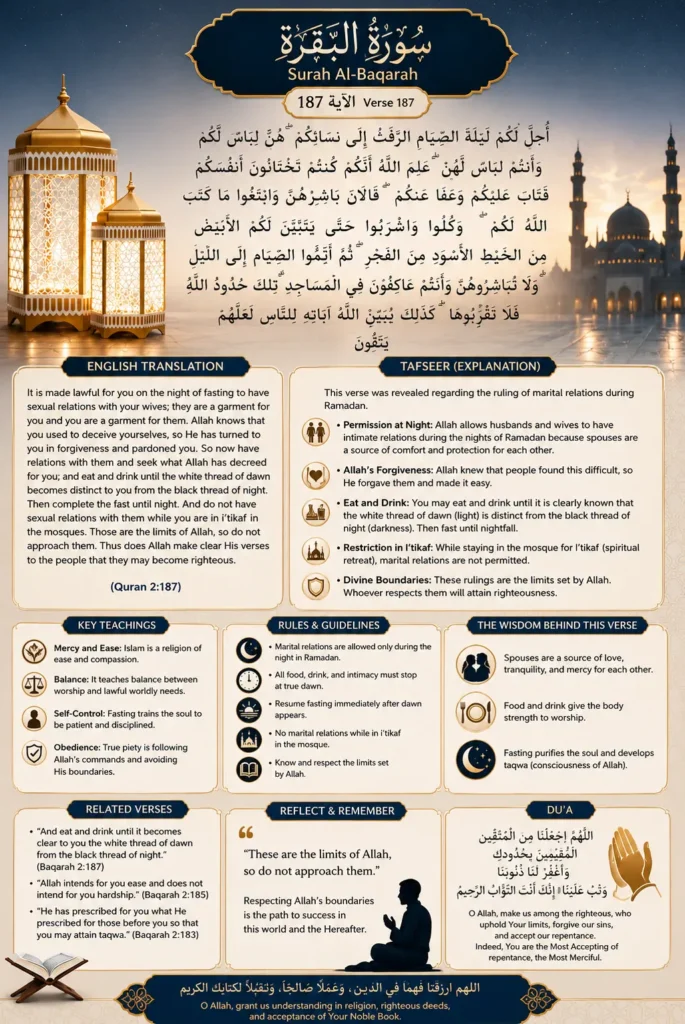
Arabic Text: أُحِلَّ لَكُمْ لَيْلَةَ الصِّيَامِ الرَّفَثُ إِلَىٰ نِسَائِكُمْ ۚ هُنَّ لِبَاسٌ لَّكُمْ وَأَنتُمْ لِبَاسٌ لَّهُنَّ ۗ عَلِمَ اللَّهُ أَنَّكُمْ كُنتُمْ تَخْتَانُونَ أَنفُسَكُمْ فَتَابَ عَلَيْكُمْ وَعَفَا عَنكُمْ ۖ فَالْآنَ بَاشِرُوهُنَّ وَابْتَغُوا مَا كَتَبَ اللَّهُ لَكُمْ ۚ وَكُلُوا وَاشْرَبُوا حَتَّىٰ يَتَبَيَّنَ لَكُمُ الْ الْأَبْيَضُ مِنَ الْخَيْطِ الْأَسْوَدِ مِنَ الْفَجْرِ ۖ ثُمَّ أَتِمُّوا الصِّيَامَ إِلَى اللَّيْلِ ۚ وَلَا تُبَاشِرُوهُنَّ وَأَنتُمْ عَاكِفُونَ فِي الْمَسَاجِدِ ۗ تِلْكَ حُدُودُ اللَّهِ فَلَا تَقْرَبُوهَا ۗ كَذَٰلِكَ يُبَيِّنُ اللَّهُ آيَاتِهِ لِلنَّاسِ لَعَلَّهُمْ يَتَّقُونَ
Transliteration:
Uḥilla lakum laylata aṣ-ṣiyāmir-rafathu ilā nisā’ikum. Hunna libāsun lakum wa-antum libāsun lahunn. ‘Alimallāhu annakum kuntum takhtānūna anfusakum fatāba ‘alaykum wa ‘afā ‘ankum. Fal-āna bāshirūhunna wabtaghū mā kataballāhu lakum, wa kulū washrabū ḥattā yatabayyana lakumul-khayṭul-abyaḍu minal-khayṭil-aswadi minal-fajr. Thumma atimmuṣ-ṣiyāma ilal-layl. Wa lā tubāshirūhunna wa antum ‘ākifūna fil-masājid. Tilka ḥudūdullāhi falā taqrabūhā. Kathālika yubayyinullāhu āyātihī lin-nāsi la’allahum yattaqūn.
English Translation:
“It has been made permissible for you the night preceding fasting to go to your wives [for sexual relations]. They are clothing for you and you are clothing for them. Allah knows that you used to deceive yourselves, so He accepted your repentance and forgave you. So now, have relations with them and seek that which Allah has decreed for you. And eat and drink until the white thread of dawn becomes distinct to you from the black thread [of night]. Then complete the fast until the sunset. And do not have relations with them as long as you are staying for worship in the mosques. These are the limits of Allah, so do not approach them. Thus does Allah make clear His ordinances to the people that they may become righteous.”
Urdu Translation:
روزے کی راتوں میں اپنی بیویوں سے ملنا تمہارے لیے حلال کر دیا گیا ہے۔ وہ تمہارے لیے لباس ہیں اور تم ان کے لیے لباس ہو۔ اللہ جانتا ہے کہ تم اپنے آپ سے خیانت کرتے تھے، تو اس نے تمہاری توبہ قبول کی اور تمہیں معاف کر دیا۔ پس اب ان سے مباشرت کرو اور جو اللہ نے تمہارے لیے لکھ دیا ہے اسے طلب کرو۔ اور کھاؤ پیو یہاں تک کہ فجر کی سفید دھاری رات کی سیاہ دھاری سے تمہارے لیے واضح ہو جائے۔ پھر رات تک روزہ پورا کرو۔ اور جب تم مسجدوں میں اعتکاف بیٹھے ہو تو ان سے مباشرت نہ کرو۔ یہ اللہ کی حدیں ہیں، لہٰذا ان کے قریب نہ جاؤ۔ اسی طرح اللہ لوگوں کے لیے اپنی آیتیں بیان کرتا ہے تاکہ وہ پرہیزگار بن جائیں۔
Hindi Translation:
रोज़े की रातों में अपनी पत्नियों के पास जाना तुम्हारे लिए हलाल (वैध) कर दिया गया है। वे तुम्हारे लिए लिबास (वस्त्र) हैं और तुम उनके लिए लिबास हो। अल्लाह जानता है कि तुम अपने आप से खयानत (धोखा) करते थे, तो उसने तुम्हारी तौबा क़ुबूल की और तुम्हें माफ़ कर दिया। तो अब उनसे सहवास करो और जो अल्लाह ने तुम्हारे लिए लिख दिया है उसे तलाश करो। और खाओ और पियो यहाँ तक कि सुबह की सफ़ेद धारी रात की काली धारी से तुम्हारे लिए साफ़ नज़र आने लगे। फिर रात तक रोज़ा पूरा करो। और जब तुम मस्जिदों में एतिकाफ़ बैठे हो तो उनसे सहवास न करो। ये अल्लाह की सीमाएँ हैं, इसलिए उनके क़रीब न जाओ। इसी तरह अल्लाह लोगों के लिए अपनी आयतें स्पष्ट करता है ताकि वे परहेज़गार बन जाएँ।
Why Was This Verse Revealed?
This verse was revealed because early Muslims struggled severely with the original rules of fasting, which forbade eating, drinking, and intimacy if one fell asleep after breaking their fast. Their physical exhaustion and quiet guilt prompted Allah to reveal this merciful change.
Let’s understand the real meaning by looking at the exact historical context preserved in Sahih Al-Bukhari and detailed by classical scholars in Tafsir Ibn Kathir. Originally, if a believer prayed Isha or fell asleep before eating, they were forbidden from consuming food or approaching their spouses until sunset the next day.
A companion named Qais bin Sirma was working tirelessly in the fields all day. When he came home fasting, his wife went out to find food for him. Because of extreme fatigue, he fell asleep before she returned. Bound by the rules of the time, he woke up the next morning and continued his fast. By midday, his body gave out, and he fainted completely.
Around the same time, Umar bin Al-Khattab and other companions struggled immensely with the strict prohibition of intimacy at night after sleeping. They felt crushing guilt for being overcome by their natural human desires. When they confessed this to the Prophet (PBUH), Allah responded not with wrath, but with absolute mercy, proving that Islam is not designed to crush human nature.
The Psychology of Spiritual Habits: A Divine Shift
The shift in these fasting rules highlights the psychology of spiritual habits. Allah designed Ramadan to match human biology, transitioning from an impossibly strict routine to a sustainable practice that builds discipline without causing despair.
Here is why this matters for your daily spiritual life. We often treat worship as an all-or-nothing endurance test, believing that the harder we suffer, the better we are. Yet, Ayat 187 is a masterclass in psychological well-being. Allah explicitly states, “Allah knows that you used to deceive yourselves, so He accepted your repentance and forgave you.”
This verse validates human frailty. A believer cannot achieve sustained spiritual growth if they are constantly starved, exhausted, and burdened by guilt over their natural biological needs. By permitting sustenance and intimacy throughout the entire night, Allah established a habit-loop that human neurobiology responds to: strict discipline during the day, followed by permitted comfort and reward at night.
Fasting transforms from a punishment into a manageable rhythm. It teaches us that true Taqwa (God-consciousness) is built on balance. This structured clarity is a recurring theme in the Quran. Similar to the precision of social and financial contracts detailed in the longest verse in the Quran, Surah Baqarah 282, Allah provides definitive, livable boundaries so that believers can navigate life with confidence rather than anxiety.
“They Are Clothing For You”: The Beautiful Metaphor of Marriage
The phrase “they are clothing for you” signifies that spouses protect, comfort, and cover the flaws of one another. Just as a garment is the closest layer to the skin, a spouse provides unparalleled emotional and physical intimacy.
This single phrase—Hunna libāsun lakum wa-antum libāsun lahunn—reshapes the entire Islamic framework of marriage. According to Tafsir Al-Sa’di, a garment serves three distinct purposes that perfectly mirror a healthy, thriving relationship:
- Protection: Clothing provides warmth in the winter and shields from the sun in the summer. Spouses protect one another from loneliness, societal harm, and the temptation to commit sin.
- Concealment: Clothing covers our physical imperfections. A husband and wife are commanded to cover each other’s emotional and character flaws from the outside world, acting as a vault for each other’s secrets and maintaining mutual dignity.
- Beautification: Clothing adorns the wearer. Spouses bring out the best in one another, adding beauty and tranquility to the household.
Now let’s connect this to daily life. The verse directly addresses physical intimacy, but wraps it in profound emotional intelligence. It reminds couples that marital relations are not merely a biological function; they are a profound layer of comfort and closeness meant to bring enduring peace.
The Boundaries of I’tikaf and Spiritual Retreat
During I’tikaf (spiritual seclusion in the mosque), marital intimacy is strictly forbidden, even at night. This specific boundary ensures that the believer is temporarily detached from worldly desires and fully focused on worshipping Allah.
While the night hours of Ramadan are open for normal marital relations, Allah establishes one clear exception: “And do not have relations with them as long as you are staying for worship in the mosques.”
This refers to the practice of I’tikaf, typically observed during the last ten days of Ramadan. According to authentic Hadith, the Prophet Muhammad (PBUH) maintained strict boundaries during I’tikaf. He separated himself from the comforts of home to focus entirely on the Divine realm.
This teaches a crucial lesson about prioritizing spaces. While human desires are healthy, pure, and rewarded within marriage, spiritual ascension sometimes requires temporary, total detachment. Just as a believer must be highly vigilant to protect their home from spiritual harms, as warned in surah baqarah ayat 102, they must also protect the purity of their most sacred acts of worship by observing the physical limits Allah has set.
People Also Ask
Yes, affection such as hugging or kissing is permitted while fasting, provided it does not lead to intercourse or the breaking of the fast. However, it is highly recommended to maintain strict self-control during the daylight hours to protect the validity of the fast.
This refers to the exact timing of Fajr (true dawn). It means you can eat and drink until the first horizontal streak of white morning light (the white thread) becomes visibly distinct from the darkness of the night sky (the black thread) on the horizon.
The verse ends with “These are the limits of Allah, so do not approach them.” This is a powerful psychological strategy. By avoiding the gray areas near a sin, you protect yourself from accidentally crossing the line, which is the true essence of building Taqwa (God-consciousness).
Take the next step in your spiritual journey: Read our complete guide to maximizing the last 10 nights of Ramadan and the rules of I’tikaf.
