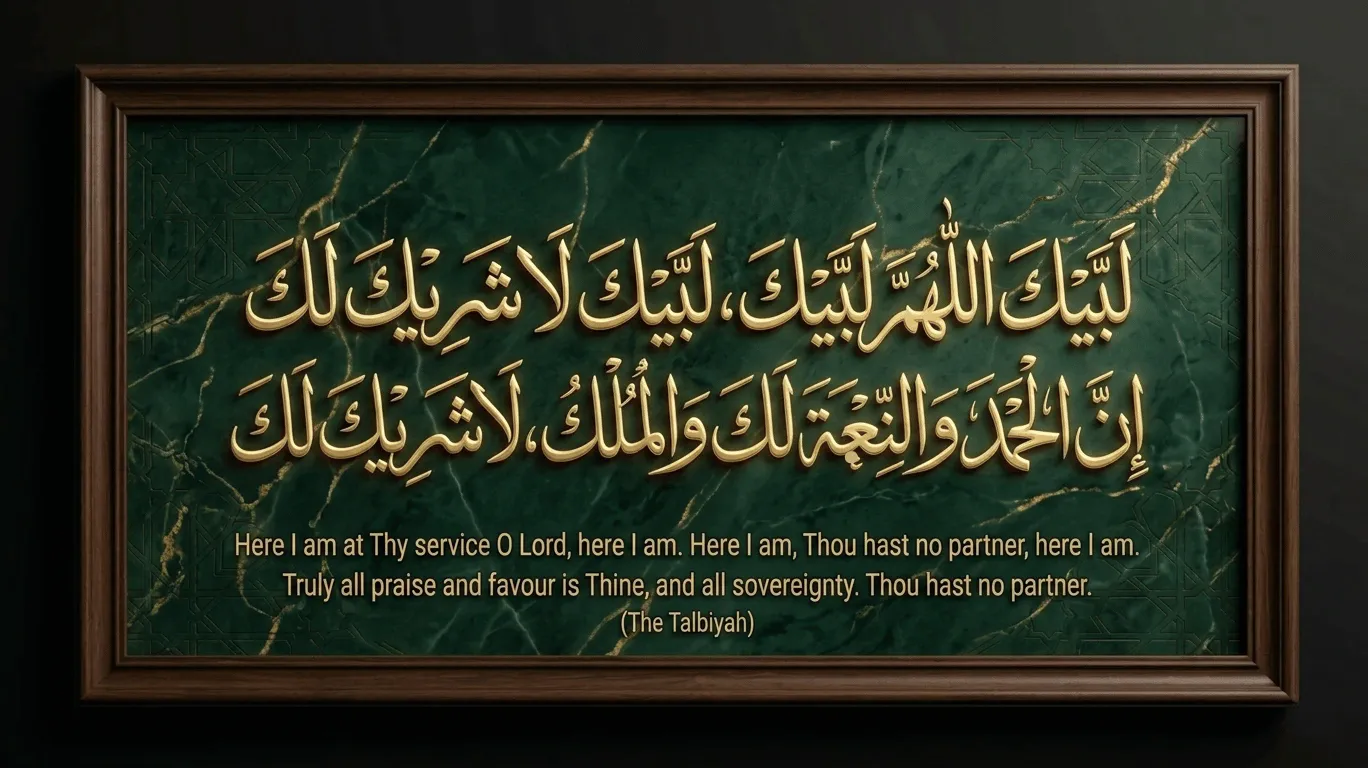
Why do millions of pilgrims repeat the same words with tears, longing, and joy? Because “Labbaik Allahumma Labbaik” is not just a phrase; it is a believer’s answer to Allah’s call, a declaration of devotion, and a public sign of tawhid.
What does Labbaik Allahumma Labbaik mean?
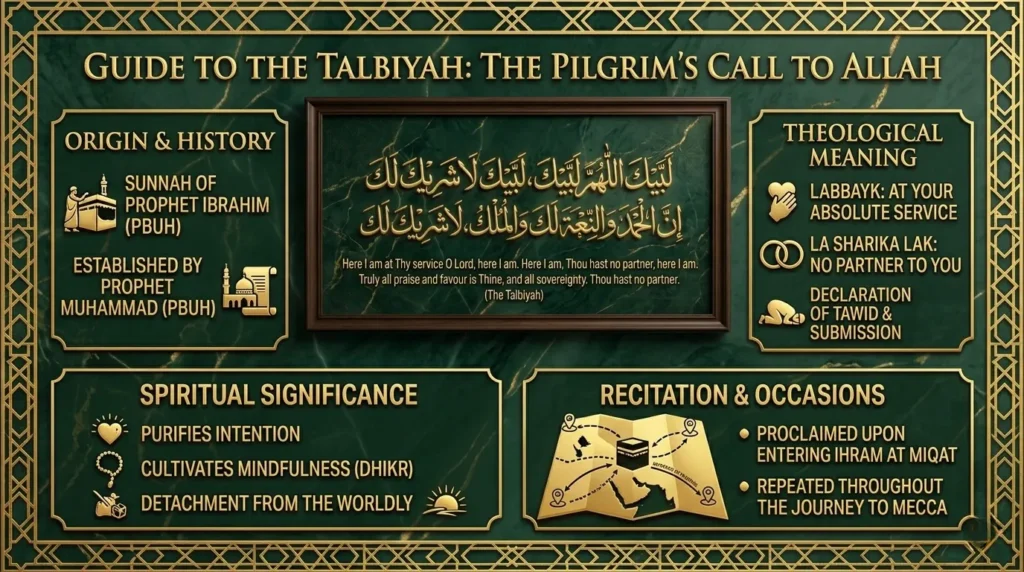
“Labbaik Allahumma Labbaik” means: “Here I am, O Allah, here I am.” It is the pilgrim’s response to Allah, showing readiness, obedience, and sincere devotion. The phrase is central to Talbiyah, the sacred recitation of Hajj and Umrah.
In deeper meaning, it says: I am present before You, O Allah, and I answer Your call with humility and love. It is not a casual sentence; it is a surrender of the heart.
لَبَّيْكَ اللَّهُمَّ لَبَّيْكَ، لَبَّيْكَ لَا شَرِيكَ لَكَ لَبَّيْكَ، إِنَّ الْحَمْدَ وَالنِّعْمَةَ لَكَ وَالْمُلْكَ، لَا شَرِيكَ لَكَ
A simple transliteration is:
Labbaik Allahumma labbaik, labbaik la sharika laka labbaik, innal-hamda wan-ni‘mata laka wal-mulk, la sharika lak.
English meaning:
Here I am, O Allah, here I am. Here I am, You have no partner, here I am. Indeed, all praise, blessings, and sovereignty belong to You. You have no partner.
Word by word meaning
The phrase becomes clearer when broken into parts. “Labbaik” carries the sense of responding again and again, while “Allahumma” means “O Allah.” Together, the words express repeated devotion and immediate obedience.
- Labbaik: Here I am; I respond.
- Allahumma: O Allah.
- Labbaik: Here I am again; I keep responding.
- La sharika laka: You have no partner.
- Inna al-hamda: Truly all praise belongs to You.
- Wa ni‘mata: And all blessings/favors.
- Laka wal-mulk: And all sovereignty belongs to You.
- La sharika lak: You have no partner.
This is why the phrase feels both personal and theological at the same time.
Urdu translation
“Labbaik Allahumma Labbaik” in Urdu is commonly understood as:
“میں حاضر ہوں اے اللہ، میں حاضر ہوں”
. It is a deeply respectful response that reflects eagerness to obey Allah.
The full Talbiyah can also be translated in Urdu as:
“میں حاضر ہوں، اے اللہ! میں حاضر ہوں۔ تیرا کوئی شریک نہیں، میں حاضر ہوں۔ بے شک تمام تعریفیں، نعمتیں اور بادشاہی تیرے لیے ہیں۔ تیرا کوئی شریک نہیں۔”
Is it in the Quran?
The exact phrase “Labbaik Allahumma Labbaik” is not a Quranic verse, but its meaning is strongly connected to the Quran’s call to Hajj in Surah Al-Hajj. The Quran commands the proclamation of pilgrimage and highlights Allah’s right to be worshipped alone.
One especially relevant verse is Surah Al-Hajj 22:27, which calls people to perform Hajj. The Talbiyah is understood as the pilgrim’s response to that divine invitation.
Quranic reference
Arabic:
وَأَذِّن فِي النَّاسِ بِالْحَجِّ
Transliteration:
Wa-adhdhin fin-nāsi bil-ḥajj
English:
“And proclaim to the people the Hajj…”
Urdu:
“اور لوگوں میں حج کا اعلان کر دو”
This verse is important because Talbiyah is the lived response to that proclamation.
Hadith about Talbiyah
Authentic hadith show that Talbiyah is part of the Prophet’s Hajj practice and remains one of the most recognizable acts of pilgrimage. Reports in Sahih collections preserve the wording of Talbiyah and its use during Hajj and Umrah.
A well-known narration also mentions that stones and trees echo the Talbiyah, which gives the phrase a powerful spiritual atmosphere. This is why many scholars describe Talbiyah as a proclamation of sincerity, submission, and remembrance.
Tafseer and scholarly meaning
Classical scholarship explains Talbiyah as more than repetition. It is an affirmation of Allah’s oneness, a sign of willing obedience, and a public declaration that the worshipper has answered the divine call.
Ibn Kathir and other tafsir traditions connect the Hajj call in Surah Al-Hajj with the believer’s readiness to come before Allah in worship. The phrase also reflects the meaning of servitude: the pilgrim does not merely speak, but answers with the whole self.
From a spiritual angle, Imam Nawawi’s hadith-based approach to worship helps explain why this phrase matters: it is simple in wording but profound in meaning. It combines presence, sincerity, and tawhid in one repeated declaration.
When should Talbiyah be recited?
Talbiyah is recited after entering the state of ihram and continues during the pilgrimage journey. It is closely tied to Hajj and Umrah, especially after the pilgrim begins the sacred rites.
For many pilgrims, this is the moment life feels transformed. Ordinary speech gives way to remembrance, and the heart begins to live in a new rhythm of worship.
How many times should it be repeated?
There is no single fixed number that defines the spiritual value of Talbiyah. It is repeated often, and the emphasis is on sincerity, presence of heart, and continued remembrance rather than counting a strict total.
That is why pilgrims often keep reciting it throughout the journey. The repetition itself trains the heart to stay awake to Allah’s call.
Benefits of saying Labbaik Allahumma Labbaik
The first benefit is spiritual focus. Talbiyah pulls the heart away from distraction and directs it toward Allah alone.
It also strengthens tawhid, because the phrase repeatedly declares that Allah has no partner in worship, praise, favor, or sovereignty.
Other benefits include:
- A deeper sense of humility.
- A stronger connection to Hajj and Umrah.
- A feeling of closeness to the prophetic tradition.
- Calmness and inner presence.
- A powerful reminder that life is a response to Allah’s call.
Why this matters today
This phrase matters today because modern life is full of noise, speed, and distraction. Talbiyah offers a Heart-Centered Hajj lesson even outside the pilgrimage: return to Allah, answer Him sincerely, and let worship shape the heart.
People Also Ask
It means “Here I am, O Allah, here I am,” and it is the pilgrim’s response to Allah’s call.
The exact phrase is not a Quran verse, but it is strongly connected to Surah Al-Hajj and the call to pilgrimage.
It means “میں حاضر ہوں” or “I am present / I respond.”
Because it expresses obedience, tawhid, and the pilgrim’s readiness to answer Allah’s invitation.
It is best understood as a sacred declaration and remembrance, not a casual chant.
Related reading
If you want to understand how this phrase fits into the larger structure of Islam, read about the Five Pillars of Islam and how worship forms the believer’s life.
You can also study Iman-e-Mufassal meaning, word by word, benefits, and Urdu translation to connect Talbiyah with the foundations of faith and belief.
Hajj and Umrah guide
Talbiyah is one of the most beautiful signs of entering sacred worship. If you are preparing for pilgrimage, the next step is to learn the practical sequence of Hajj and Umrah so the meaning of this phrase becomes even more alive in your heart.
