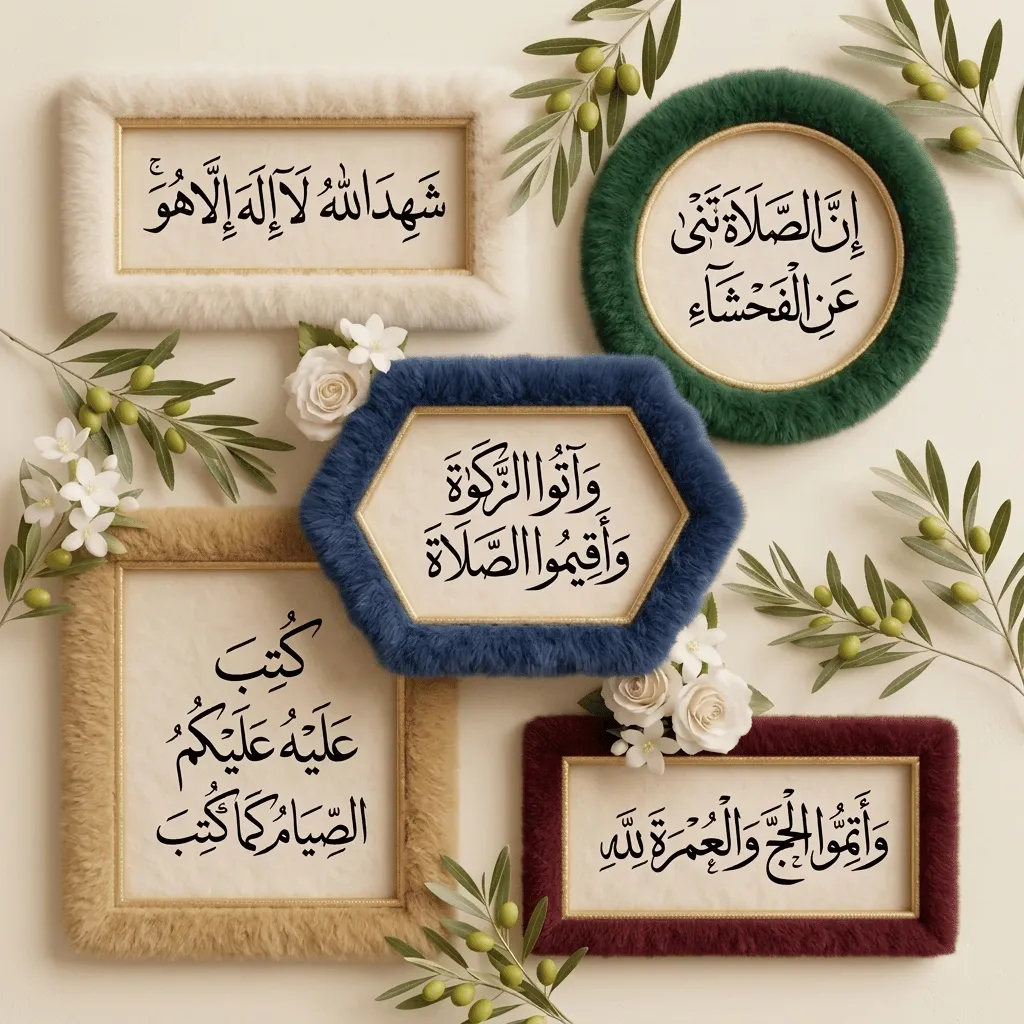
What if the real foundation of a Muslim’s life is not just belief, but a daily system that shapes time, wealth, self-control, and identity?
The Five Pillars of Islam are the core acts of worship that structure a Muslim’s life: the declaration of faith, prayer, charity, fasting, and pilgrimage. This guide explains them in simple English, with Qur’anic and Hadith proof, word-by-word meaning, Urdu support, and a modern framework for daily practice.
What Are the Five Pillars of Islam?
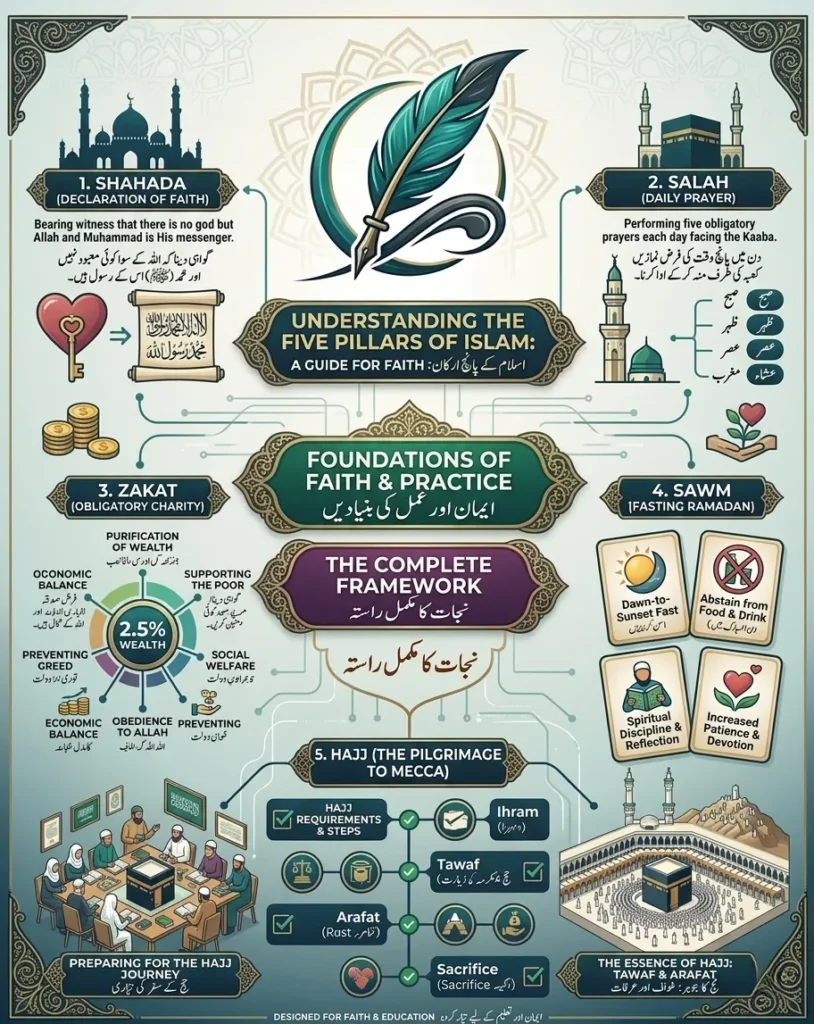
The Five Pillars of Islam are the basic duties that define Muslim worship and practice. They are Shahada, Salah, Zakat, Sawm, and Hajj. Together, they show that Islam is not only belief in the heart, but also action in daily life.
These pillars are called “pillars” because they support the whole structure of a Muslim’s religious life. Without them, the faith experience becomes weak, incomplete, or disconnected from real obedience.
The five pillars in one line
- Shahada: The testimony of faith.
- Salah: The five daily prayers.
- Zakat: Obligatory charity.
- Sawm: Fasting in Ramadan.
- Hajj: Pilgrimage to Makkah.
Why they are central
Islam teaches that faith must become visible in worship, discipline, and ethics. The pillars connect belief with movement, speech, time, money, hunger, and travel. That is why they are not side practices; they are the foundation.
Word by Word Meaning
The Five Pillars become much easier to understand when we look at their literal meanings. This section helps beginners, Urdu readers, and younger Muslims connect the Arabic terms with practical life.
1.Shahada
The Shahada is the declaration that there is no god but Allah and Muhammad is His messenger. It is the entrance point into Islam and the core statement of Muslim identity.
- Arabic: لا إله إلا الله محمد رسول الله
- Transliteration: La ilaha illallah Muhammadur Rasulullah
- English: There is no god but Allah; Muhammad is the Messenger of Allah.
- Urdu: اللہ کے سوا کوئی معبود نہیں، محمد ﷺ اللہ کے رسول ہیں۔
The word La ilaha means “there is no god,” and illallah means “except Allah.” Muhammadur Rasulullah means “Muhammad is the Messenger of Allah.” This is not only a sentence to recite; it is a belief that shapes the whole life of a Muslim.
2.Salah
Salah means ritual prayer. It is the five-times-daily act of standing before Allah in obedience, humility, and remembrance.
- Arabic: الصلاة
- Transliteration: As-Salah
- English: Prayer
- Urdu: نماز
Salah gives structure to the day. It reminds a Muslim that work, family, and goals are all important, but none are greater than worship.
3.Zakat
Zakat means purification and growth through giving a fixed portion of wealth to those in need. It is both a financial duty and a moral cleansing.
- Arabic: الزكاة
- Transliteration: Az-Zakat
- English: Obligatory charity
- Urdu: زکوٰۃ
Zakat teaches that wealth is a trust. It protects the heart from greed and the society from neglect.
4.Sawm
Sawm means fasting, especially the fasting of Ramadan. It means refraining from food, drink, and other invalidators from dawn to sunset with sincere intention.
- Arabic: الصوم
- Transliteration: As-Sawm
- English: Fasting
- Urdu: روزہ
Sawm trains the soul to say no to desires. It builds patience, gratitude, and awareness of those who struggle with hunger every day.
5.Hajj
Hajj means pilgrimage to Makkah. It is the sacred journey every able Muslim is required to perform once in a lifetime.
- Arabic: الحج
- Transliteration: Al-Hajj
- English: Pilgrimage
- Urdu: حج
Hajj is a journey of surrender, equality, and remembrance. It gathers Muslims from every language, race, and class into one act of worship.
The Hadith Foundation
The Five Pillars are rooted in one of the most famous and important hadiths in Islam. This hadith gives the overall framework for why these five acts matter so much.
Arabic text
بُنِيَ الإِسْلَامُ عَلَى خَمْسٍ: شَهَادَةِ أَنْ لَا إِلَهَ إِلَّا اللَّهُ وَأَنَّ مُحَمَّدًا رَسُولُ اللَّهِ، وَإِقَامِ الصَّلَاةِ، وَإِيتَاءِ الزَّكَاةِ، وَصَوْمِ رَمَضَانَ، وَحَجِّ الْبَيْتِ
Transliteration
Buniya al-Islamu ‘ala khamsin: shahadati an la ilaha illallah wa anna Muhammadan Rasulullah, wa iqamis-salah, wa ita’iz-zakah, wa sawmi Ramadan, wa hajjil-bayt.
English meaning
Islam is built upon five: testifying that there is no god but Allah and that Muhammad is the Messenger of Allah, establishing prayer, giving zakat, fasting Ramadan, and pilgrimage to the House.
Urdu translation
اسلام کی بنیاد پانچ چیزوں پر رکھی گئی ہے: اس بات کی گواہی دینا کہ اللہ کے سوا کوئی معبود نہیں اور محمد ﷺ اللہ کے رسول ہیں، نماز قائم کرنا، زکوٰۃ ادا کرنا، رمضان کے روزے رکھنا، اور بیت اللہ کا حج کرنا۔
Why this hadith matters
This hadith is the master key to the topic. It does not merely list five actions; it shows that Islam is built on a balanced system of belief and practice. That is why scholars treat it as the foundation for understanding the religion as a whole.
Quranic Evidence
The Five Pillars are not all listed in one single verse, but the Qur’an gives strong support for each one across different places. This is important because it shows that the pillars are not later inventions; they are rooted in revelation.
1.Shahada in the Qur’an
The Qur’an repeatedly emphasizes the oneness of Allah and the truth of His messengers. The central message of Shahada is tawhid, the belief that worship belongs only to Allah.
A key meaning appears throughout verses that call people to worship Allah alone and follow His messenger. The Qur’an presents faith as loyalty to Allah, not divided devotion.
2.Salah in the Qur’an
The Qur’an commands believers to establish prayer and keep it regular. Prayer is described as a sign of faith and a shield against wrongdoing.
This matters because Salah is not optional decoration in Islam. It is an obligation that trains the believer in discipline, humility, and awareness of Allah.
3.Zakat in the Qur’an
The Qur’an repeatedly pairs prayer with zakat, showing that worship and social responsibility belong together. Giving wealth is part of spiritual purification.
Zakat matters because Islam refuses to separate devotion from justice. A sincere believer cares not only about personal piety, but also about the welfare of others.
4.Sawm in the Qur’an
The Qur’an clearly mentions fasting in Ramadan and explains its purpose: taqwa, or God-consciousness. This makes fasting more than hunger; it is a training of the soul.
Sawm is important because it teaches self-control in a world that constantly pushes desire, consumption, and instant gratification.
5.Hajj in the Qur’an
The Qur’an commands pilgrimage for those who are able. It presents Hajj as a solemn act of devotion, remembrance, and submission.
Hajj is important because it gathers the entire Ummah around one sacred center and reminds Muslims that their final return is to Allah.
Tafsir and Scholarly Notes
Classical scholars explain the Five Pillars as the visible framework of Islam, not just symbolic actions. Their interpretations help us read the Qur’an carefully and avoid shallow understanding.
Ibn Kathir on worship and obligation
Ibn Kathir emphasizes that commands of worship are signs of Allah’s mercy and guidance. He shows how prayer, fasting, and pilgrimage are not random rules, but divinely designed acts that reform the believer.
This matters because classical tafsir connects the text to practice. It helps the reader see why every pillar has a spiritual purpose.
Imam Nawawi on foundational religion
Imam Nawawi places the hadith of the five pillars at the center of Islamic understanding. His explanation shows that these five acts define the outward structure of Islam.
That is why the hadith is often taught at the beginning of Islamic learning. It gives learners a clear map of what Islam requires in action.
Why classical scholarship matters
Modern readers often want quick answers, but tafsir gives depth. It shows how the Qur’an and Hadith work together and how scholars understood them across generations.
This protects the reader from oversimplification. It also gives your article authority, because it does not rely on modern opinion alone.
Why Each Pillar Matters
Each pillar shapes a different part of the human person. When you look at them together, you can see that Islam is a complete system of belief, worship, and moral training.
1.Shahada and identity
Shahada answers the question, “Who am I?” It declares that a Muslim belongs to Allah and follows His messenger.
This is why Shahada is the doorway to Islam. It defines identity before action.
2.Salah and time-management
Salah organizes the day around remembrance of Allah. It breaks the cycle of distraction and gives the believer five spiritual checkpoints.
This is where the modern value becomes clear. In a world of endless scrolling and noise, prayer teaches focus, rhythm, and calm.
3.Zakat and social justice
Zakat teaches that wealth is not only personal property. It is also a trust from Allah that must benefit the wider community.
This is why zakat protects society from neglect and the heart from greed. It turns worship into care.
4.Sawm and self-control
Sawm trains the soul to resist impulse. It creates patience, compassion, and discipline.
In a time of instant gratification, fasting remains one of Islam’s most powerful tools for inner strength.
5.Hajj and unity
Hajj removes class, race, and status from the center of human identity. Everyone stands before Allah as a servant.
This makes Hajj one of the clearest signs of Islamic unity. It is a global reminder that all Muslims return to one Lord.
The Digital Sunnah Angle
The Five Pillars still speak to modern life, especially in an age of digital overload. They can be understood as a spiritual habit system that keeps a believer anchored.
Faith in a distracted age
Today, many people struggle with scattered attention, identity confusion, and constant comparison. The pillars give structure where the internet gives fragmentation.
Shahada gives identity, Salah gives rhythm, Zakat gives responsibility, Sawm gives restraint, and Hajj gives perspective.
Time-blocking the five prayers
Prayer can be understood as the original time-management system. It divides the day into purposeful segments and prevents life from becoming spiritually empty.
A Muslim who protects Salah is not losing time. He is organizing time around what matters most.
Building a habit loop
The pillars work like a repeated habit loop: intention, action, and renewal. Each one trains the body and heart through regular practice.
That is why Islam remains practical for every era. It does not only teach beliefs; it builds disciplined human beings.
Common Questions
This section answers the most common questions people ask when they search about the Five Pillars.
Are the five pillars in one verse?
No, the pillars are not all gathered in one verse. They are explained across the Qur’an and brought together clearly in the hadith of Islam being built on five.
Are they mentioned in hadith?
Yes, the core hadith about the five pillars is one of the most famous narrations in Islam and is widely taught in classical scholarship.
Do all Muslims practice them the same way?
The pillars are agreed upon by all major Muslim traditions, though some legal details may differ. The foundation remains the same.
Why are they called pillars?
They are called pillars because they support the structure of Islam. Without them, the practice of religion becomes weak and incomplete.
What is the difference between pillars and beliefs?
Beliefs are what a Muslim accepts in the heart, while pillars are the main acts that express that belief in life. In simple terms, beliefs shape faith, and pillars shape action.
People Also Ask:
They are the five main duties in Islam: faith, prayer, charity, fasting, and pilgrimage.
They are the foundation of Muslim life and connect belief with daily practice.
It is the declaration of faith that there is no god but Allah and Muhammad is His messenger.
Zakat is obligatory charity given to help people in need and purify wealth.
Muslims fast to obey Allah, grow in taqwa, and remember those who are poor.
Hajj is the pilgrimage to Makkah, performed to worship Allah and show unity and humility.
Yes. The famous hadith says Islam is built on five: Shahada, Salah, Zakat, fasting Ramadan, and Hajj.
The Qur’an commands believers to establish prayer regularly and sincerely.
Related Reading
If you want to continue building topical depth, the next best reads are the pages on meaning and benefits of La ilaha illallah Muhammadur Rasulullah
🚀and🚀
Iman-e-Mufassal word by word meaning and Urdu translation.
Final Practical Takeaway
The Five Pillars of Islam are not five disconnected rituals. They are a complete system that shapes belief, worship, character, identity, and daily life.
