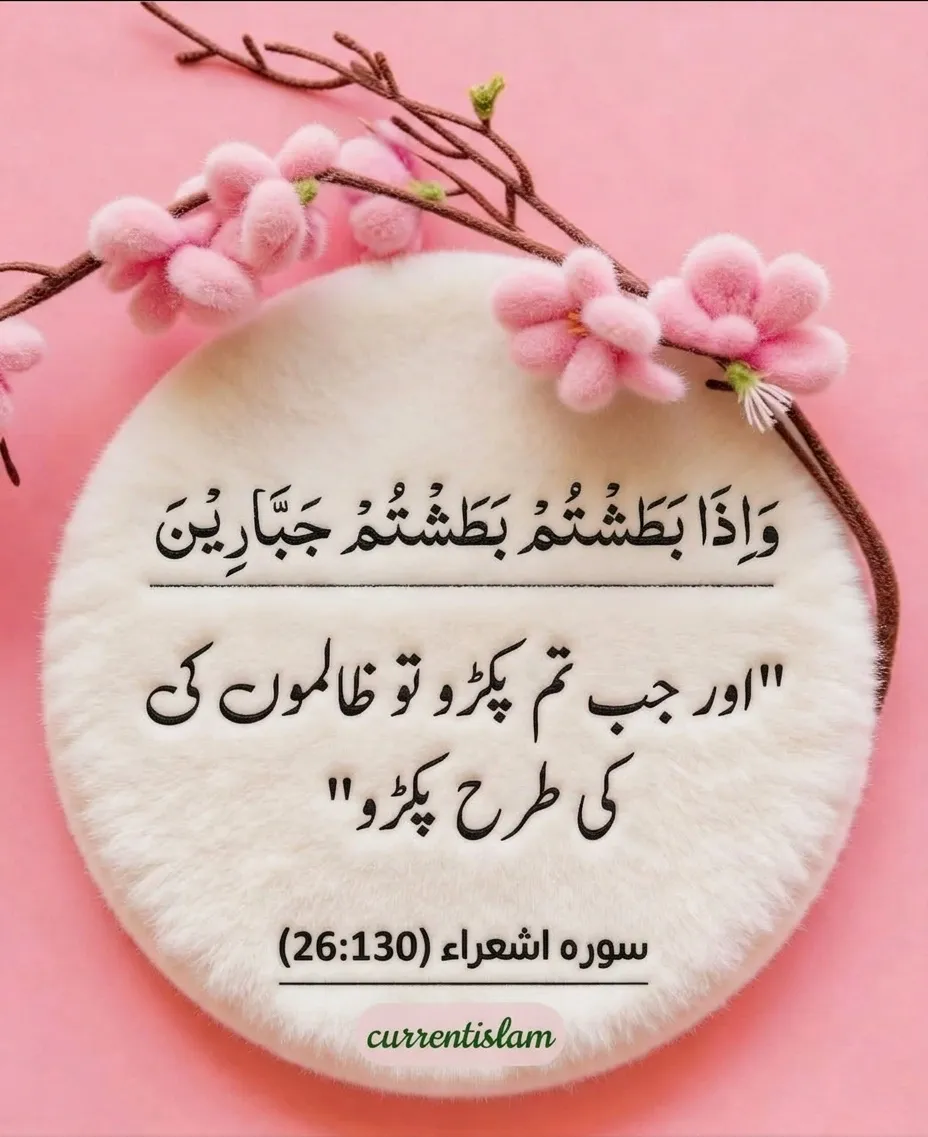
What if one verse could transform how you use power—in your workplace, your home, and your relationships? The words “Waiza batashtum batashtum jabbarin” from Surah Ash-Shu’ara aren’t just 14th‑century Arabic; they’re a timeless warning about how we exercise strength today.
What Does “Waiza Batashtum batashtum Jabbarin” Mean?
Waiza batashtum batashtum jabbarin” (وَإِذَا بَطَشْتُم بَطَشْتُمْ جَبَّارِينَ) means “And when you seize or strike, you seize like tyrants.” This verse (Surah Ash-Shu’ara 26:130) criticizes the people of ‘Ad for using power cruelly, without mercy or justice. It commands us to exercise strength with accountability to Allah.
The Full Verse in Context
Arabic Text with Transliteration & Translation
| Language | Text |
|---|---|
| Arabic | ﴿وَإِذَا بَطَشْتُم بَطَشْتُمْ جَبَّارِينَ﴾ |
| Transliteration | Wa-izā baṭashtum baṭashtum jabbārīn |
| English (Sahih) | “And when you strike, you strike as tyrants” |
| Urdu | “اور جب تم پکڑو تو ظالموں کی طرح پکڑو” |
Complete Context (Verses 127–131)
Prophet Hud (علیہ السلام) is addressing the arrogant people of ‘Ad:
This verse follows criticism of their ostentatious architecture and precedes Hud’s call to repentance.
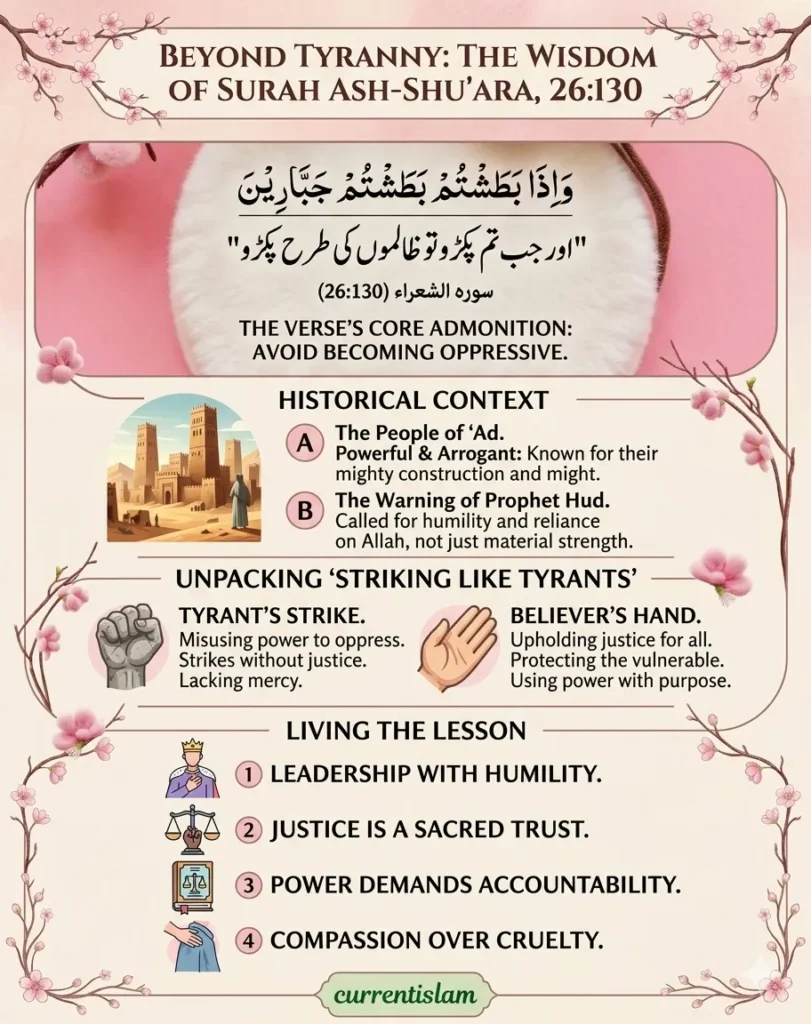
Word-by-Word Linguistic Analysis
Core Root: ب ط ش (Baṭsh)
Core Root: ج ب ر (Jabbar)
Why the Verb is Repeated
The word بَطَشْتُم (baṭashtum) appears twice for emphasis:
| Occurrence | Function |
|---|---|
| First | Establishes the action: “when you seize” |
| Second | Emphasizes how: “you seize as tyrants” |
This repetition intensifies the criticism—it’s not just that they seize, but every time they seize, it’s tyrannically.
Classical Tafseer Authority
Ibn Kathir’s Explanation
“And when you attack a place, you attack like tyrants, killing and with violence, showing no kindness or mercy.”
Ibn Kathir emphasizes the cruelty and lack of mercy in how the people of ‘Ad exercised power.
Tafseer Taḥfeem-ul-Qur’ān (Maududi)
“In order to meet the demands of your ever-rising standards of life, you do not rest content with small living quarters but you build castles and fortresses… But as human beings you have become so depraved that there is no mercy in your hearts for the weak, no justice for the poor, and all people of lower social strata… are being oppressed tyrannically and none is safe from your barbarities.”
Key Insights from Classical Scholars
Why This Verse Matters Today: Faith in Modern Life
The Power Dynamic Problem
This verse matters today because we all exercise power—employers over employees, parents over children, officials over citizens. The Quran warns that power without mercy and justice is tyranny. Every time you use authority, you’re being tested on whether you’re a tyrant or a servant of Allah.
Modern Applications Table
| Modern Context | How “Batsh” Shows Up | Tyrannical Behavior | Righteous Alternative |
|---|---|---|---|
| Workplace | Manager firing employee | Sudden dismissal without warning/help | Give notice, offer support, be merciful |
| Parenting | Discipline child | Physical abuse, harsh punishment | Gentle correction with love |
| Government | Police enforcement | Brutality, excessive force | Proportional force, respect rights |
| Social Media | Public shaming | Destroying reputation, bullying | Constructive criticism, forgiveness |
| Business | Negotiation | Exploiting weak party | Fair deal, consider their situation |
The Ethical Principle
According to Alim.org’s analysis:
This verse expresses a Quranic prohibition, valid for all times, of all unnecessary cruelty in warfare, coupled with the implied injunction to subordinate every act of war—and the decision to wage war itself—to moral considerations and restraints.
This principle extends beyond warfare to all power dynamics.
Benefits of Reciting Surah Ash-Shu’ara Ayat 130
Spiritual Benefits
Practical Benefits
| Area | Impact |
|---|---|
| Leadership | Become a just, merciful leader people trust |
| Family | Create peaceful home without fear or abuse |
| Workplace | Build reputation as fair, ethical professional |
| Community | Become someone who protects weak, not oppresses |
Is “Waiza Batashtum” Used for Hair or Beauty?
No, this verse has no authentic connection to hair growth or beauty. Some social media posts claim “Waiza batashtum batashtum jabbarin for hair” or “for beauty,” but this is not supported by Quran, Hadith, or classical scholarship. This verse is about ethical use of power, not physical transformation.
Why This Myth Exists
| Claim | Reality |
|---|---|
| “Recite for hair growth” | No authentic hadith supports this |
| “For beauty enhancement” | Verse is about tyranny vs. mercy, not cosmetics |
| “Wazifa for physical benefits” | Classical scholars never documented this use |
| “Ruqyah for appearance” | Ruqyah is for protection/healing, not beautification |
Important Warning
Misusing Quranic verses for unverified purposes (hair, beauty, wealth) can lead to:
- Shirk (associating partners with Allah through incorrect beliefs)
- Wasting recitation on false intentions
- Spreading misinformation about Islam
Always verify claims with authentic scholars before believing viral social media posts.
How to Recite This Verse as a Daily Wazifa
Recommended Practice
Recite Surah Ash-Shu’ara Ayat 130 3 times daily (morning, afternoon, evening) with the intention of seeking protection from becoming tyrannical and asking Allah for just, merciful character.
Step-by-Step Recitation Guide
| Step | Action |
|---|---|
| 1 | Perform wudu (ablution) |
| 2 | Face qiblah if possible |
| 3 | Make niyyah (intention): “O Allah, protect me from tyranny” |
| 4 | Recite Bismillah: Bismillāhir-Raḥmānir-Raḥīm |
| 5 | Recite verse 3 times: Wa-izā baṭashtum baṭashtum jabbārīn |
| 6 | Follow with: A’ūdhu billāhi min ash-shayṭānir-rajīm |
| 7 | Make dua: Ask Allah for just character and mercy toward others |
| 8 | Give sadaqah (charity) as practical application |
Best Times to Recite
| Time | Recommendation |
|---|---|
| Fajr | Morning protection from tyrannical behavior all day |
| Dhuhr | Midday check-in before work/authority interactions |
| Maghrib | Evening reflection on how you used power that day |
Consistency Matters More Than Quantity
| Approach | Outcome |
|---|---|
| 3 times daily for 40 days | Builds spiritual habit, character transformation |
| 100 times once then stop | Minimal impact, no habit formation |
| Daily with reflection | Deep understanding, real behavioral change |
People Also Ask
Practical Modern Application: The Justice Habit Loop
The 4-Step Framework
Every time you exercise power, use this Justice Habit Loop: (1) Pause before acting, (2) Ask “Would Allah approve this?” (3) Consider the weaker person’s perspective, (4) Act with mercy. This transforms the verse from words to daily character.
The Habit Loop Visualized
textTRIGGER → INTERRUPTION → REFLECTION → ACTION
   ↓          ↓              ↓           ↓
Authority  "Wait"       "Would Allah  Act with
to act     pause        approve?"     mercy
Real-Life Scenarios
| Situation | Tyrannical Response | Just Response (Verse Applied) |
|---|---|---|
| Boss fires employee | Sudden, no explanation, no severance | Give notice, explain clearly, offer support |
| Parent disciplines child | Hitting, yelling, shaming | Gentle correction, explanation, love |
| Teacher grades student | Harsh, no feedback, unfair | Fair, constructive, encouraging |
| Police stops driver | Aggressive, insulting, excessive force | Professional, respectful, proportional |
| Spouse argues | Controlling, name-calling, dominating | Listening, respectful, seeking resolution |
Common Misconceptions Debunked
Quranic References Related to Justice and Mercy
Additional Verses to Study
Hadith References on Power and Mercy
Authentic Hadith Supporting This Verse
| Hadith | Source | Teaching |
|---|---|---|
| “The merciful are shown mercy by the Merciful One” | Tirmidhi | Mercy in all interactions |
| “Whoever is not merciful to others, will not be treated mercifully” | Bukhari | Reciprocity of mercy |
| “Power is not in striking hard; power is in controlling anger” | Bukhari/Muslim | True strength is self-control |
| “None of you believes until he loves for his brother what he loves for himself” | Bukhari/Muslim | Empathy before power |
If You’re Interested in Reading More
If you found this article helpful and want to deepen your Islamic knowledge, explore these essential guides:
Five Pillars of Islam: Complete Guide with Evidence
Iman‑e‑Mufassal Meaning: Word‑by‑Word, Benefits & Urdu Translation
Frequently Asked Questions
﴿وَإِذَا بَطَشْتُم بَطَشْتُمْ جَبَّارِينَ﴾ — with shadda on ط and ر.
No fixed number in Quran or authentic Hadith. Scholars recommend 3 times daily for character building.
Yes, children can recite it to learn about justice and mercy from a young age.
No—this verse is specifically about ethical power use, not ruqyah for evil eye. Use authentic ruqyah verses like Ayat-ul-Kursi instead.
Jabbar (human) = tyrant, oppressor (negative). Al-Jabbar (Allah) = The Compeller, The Restorer (positive divine attribute).
Because there’s no authentic evidence linking this verse to physical benefits. Classical scholars focused on its ethical meaning.
Yes, but keep intention clear: this verse is for character refinement, not physical benefits.
Final Reminder: The Core Message
“And when you strike, you strike as tyrants” is not a magic spell—it’s a mirror. It asks: When you have power over someone, do you use it mercifully or cruelly? The answer determines whether you’re following the Prophet’s (ﷺ) Sunnah or the people of ‘Ad’s path.
Your Action Plan
| Week | Focus |
|---|---|
| Week 1 | Recite 3x daily, reflect on power in your life |
| Week 2 | Identify one area where you’ve been tyrannical |
| Week 3 | Practice mercy in that specific situation |
| Week 4 | Help someone weaker than you without expecting return |
Share This Knowledge
If this article helped you understand “Waiza batashtum batashtum jabbarin” correctly, please:
- Share with friends who believe viral beauty myths
- Save for daily reflection
- Comment with your experience applying this verse
Remember: True Islamic knowledge comes from authentic sources, not social media rumors. Verify before you believe.
