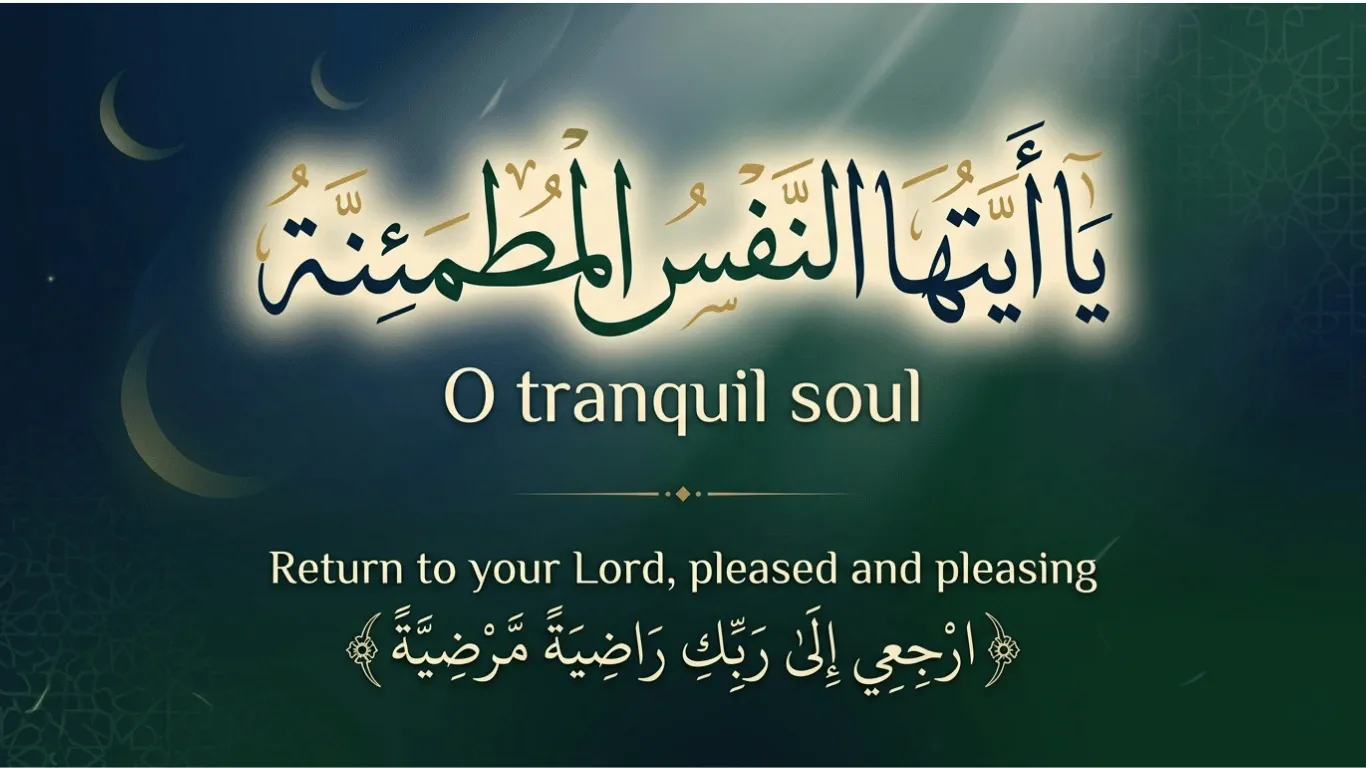
Have you ever wondered what it really means to be among the souls Allah calls back with honor? The phrase ya ayyuhan nafsul muthmainnah is one of the most moving addresses in the Qur’an, because it describes not only a soul at peace, but a soul that has reached the station of divine reassurance, trust, and final acceptance.
What does “ya ayyuhan nafsul muthmainnah” mean?
Ya ayyuhan nafsul muthmainnah means: “O tranquil soul,” “O peaceful soul,” or “O soul at rest.” In Surah Al-Fajr, Allah uses this phrase to address the believer whose heart has become calm through faith, certainty, and submission to Allah’s decree. The verse is not just poetic; it is a profound statement about the final state of a life lived with iman.
Arabic:
يَا أَيَّتُهَا النَّفْسُ الْمُطْمَئِنَّةُ
Transliteration: Ya ayyatuhan-nafsul-muthma’innah
English translation: O tranquil soul.
Urdu translation: اے اطمینان پانے والی جان۔
This phrase is the opening of a larger divine call in Surah Al-Fajr 27–30, where Allah invites this soul to return to its Lord in a state of pleasure and acceptance.
Surah Al-Fajr 27–30 in full context
These four verses are the heart of the passage. They explain what happens to the soul that reaches peace through faith and obedience, and they show the honor Allah grants at the end of a believer’s journey.
Arabic text:
يَا أَيَّتُهَا النَّفْسُ الْمُطْمَئِنَّةُ
ارْجِعِي إِلَىٰ رَبِّكِ رَاضِيَةً مَرْضِيَّةً
فَادْخُلِي فِي عِبَادِي
وَادْخُلِي جَنَّتِي
Transliteration:
Ya ayyatuhan-nafsul-muthma’innah
Irji’i ila rabbiki radiyatan mardiyyah
Fadkhuli fi ‘ibadi
Wadkhuli jannati
English translation:
O tranquil soul,
Return to your Lord, well pleased and pleasing.
So enter among My servants.
And enter My Paradise.
Urdu translation:
اے اطمینان والی جان!
اپنے رب کی طرف لوٹ آ، اس حال میں کہ تو اس سے راضی ہے اور وہ تجھ سے راضی ہے۔
پس میرے بندوں میں داخل ہو جا۔
اور میری جنت میں داخل ہو جا۔
These verses form a complete spiritual portrait: inner peace, return to Allah, divine satisfaction, companionship with the righteous, and entry into Paradise.
Why this verse matters
This verse matters because it shows that the real success of a believer is not worldly comfort, but a soul that is calm at the moment of return to Allah. The Qur’an presents this tranquility as the fruit of faith, not as the result of wealth, status, or ease. That is why this passage continues to speak to Muslims today: it defines peace in a way the modern world often misses.
A tranquil soul is not one that never struggles. It is one that remains anchored in trust, patience, remembrance, and surrender to Allah even during trials. That is the deeper meaning of muthmainnah.
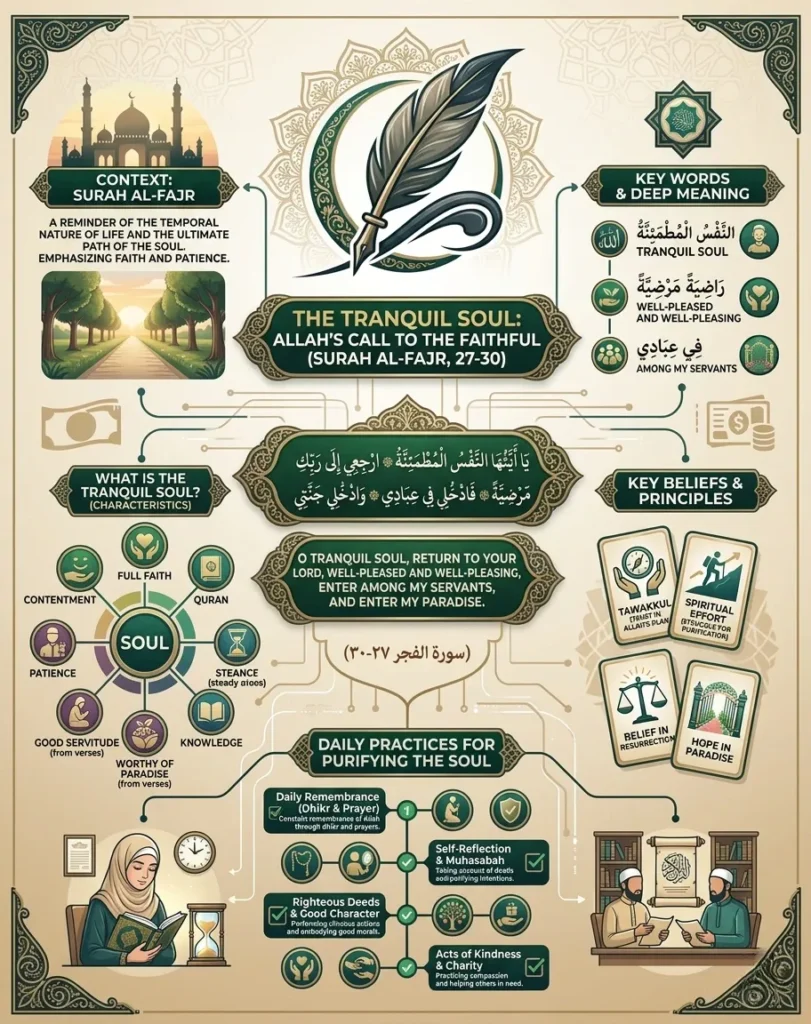
Word-by-word meaning
A word-by-word reading makes the verse much more vivid.
- Ya = O
- Ayyatuhan = the one who is addressed
- Nafs = soul, self
- Al-muthmainnah = tranquil, settled, reassured
In the next verse:
- Irji’i = return
- Ila rabbiki = to your Lord
- Radiyatan = pleased, content
- Mardiyyah = pleasing, accepted
Then:
- Fadkhuli fi ‘ibadi = enter among My servants
- Wadkhuli jannati = and enter My Paradise
This progression is beautiful. It moves from inner state to divine welcome, from the soul’s peace to eternal reward.
Classical tafsir perspective
Classical scholars explain this passage as the speech of Allah to the believer at the time of death or resurrection, honoring the soul that remained faithful. The main idea is that the believer’s heart found rest in Allah during life, so Allah grants rest in the hereafter.
A common tafsir theme is that the nafsul muthmainnah is the soul that believed in Allah, trusted His promise, and lived in obedience. Because it remained firm, it is called back with dignity. The phrase radiyatan mardiyyah shows a two-way pleasure: the soul is pleased with Allah’s reward, and Allah is pleased with the soul’s obedience.
This is not a casual expression of comfort. It is a divine declaration of acceptance.
What “tranquil soul” really means
The tranquil soul is not someone who never feels grief, fear, or pressure. It is someone whose heart returns to Allah again and again until faith becomes stronger than anxiety. This soul is marked by three qualities: trust in Allah, patience in hardship, and satisfaction with divine decree.
That means tranquility is spiritual, not emotional convenience. A person may be in difficulty and still have a muthmainnah soul if their heart stays tied to Allah. This is why the verse remains relevant for Muslims facing stress, uncertainty, loneliness, or loss.
The spiritual habit loop
Here is why this matters for daily life: the Qur’an does not only describe the final destination of the soul, it points to the habits that shape it. A tranquil soul is built through repeated acts of worship and surrender.
That habit loop usually includes:
- Regular salah.
- Dhikr and Qur’an recitation.
- Patience in trials.
- Gratitude in ease.
- Tawakkul, or trust in Allah.
- Repentance when one slips.
Over time, these habits train the heart to stop depending on the temporary and start resting in the eternal. That is the real spiritual transformation behind this verse.
Modern relevance
This verse speaks powerfully to modern Muslims because many people are emotionally exhausted, distracted, and overwhelmed. The world rewards speed, comparison, and anxiety, but Surah Al-Fajr teaches a different model: inner peace through Allah.
When a believer understands ya ayyuhan nafsul muthmainnah, they begin to see peace differently. Peace is no longer just the absence of problems. Peace is the presence of certainty, even when problems remain.
That is why this verse can become a daily reminder for anyone trying to live with faith in a noisy world.
Benefits of reflecting on the verse
Reflecting on this passage brings several spiritual benefits.
- It softens the heart.
- It strengthens hope in Allah’s mercy.
- It reminds the believer that death is not abandonment for the righteous.
- It encourages patience during hardship.
- It helps reframe success around Allah’s acceptance, not public approval.
This reflection also protects a person from despair. The verse ends with Paradise, not fear. It is a promise that calm faith leads to divine welcome.
Is there a wazifa for this verse?
There is no sound basis for treating this verse as a magical formula or repeating it as a guaranteed special wazifa with fixed numbers unless that practice is grounded in reliable scholarship and evidence. The safer and more authentic approach is to recite it for reflection, prayer, and remembrance, while asking Allah to make us among the people of the tranquil soul.
In other words, the verse is meant to transform the heart, not to be reduced to a ritual shortcut.
Why the verse is so moving
This verse is deeply moving because it speaks to the believer with tenderness and honor. Allah does not merely admit the soul into Paradise; He calls it by a beautiful title first. The address itself is part of the reward.
The sequence is also significant. The soul is first recognized as peaceful, then invited back, then welcomed among the righteous, then admitted into Paradise. The Qur’an is showing us that the end of iman is not emptiness, but intimate divine welcome.
Frequently Asked Questions About
What is ya ayyuhan nafsul muthmainnah?
It means “O tranquil soul,” the soul that is calm through faith and ready to return to Allah.
Which surah contains ya ayyuhan nafsul muthmainnah?
It appears in Surah Al-Fajr, verses 27 to 30.
What is the meaning of Surah Al-Fajr 27?
It is Allah’s address to the peaceful soul, honoring it and calling it back to Him.
Is the tranquil soul a special rank?
Yes, it describes a high spiritual state earned through iman, patience, and trust in Allah.
Related Qur’anic themes
This passage connects with other Qur’anic themes about the believer’s end, the mercy of Allah, and the reward of steadfastness. It also echoes the Qur’an’s repeated call to remember Allah, trust Him, and live with certainty in the Hereafter.
Readers who want to explore more can also study verses about sabr, tawakkul, and the peace that comes from dhikr. These themes help explain how the tranquil soul is formed over time.
Internal reading path
A natural reading path for this topic would be:
- Surah Al-Fajr 27–30 for the full verse context.
- A word-by-word tafsir of nafsul muthmainnah.
- A guide to the qualities of a tranquil soul.
- Related Qur’anic reflections on divine judgment and mercy.
You can also connect this article internally with related Islamic readings such as Waiza Batashtum Batashtum Jabbarin 🚀 for Qur’anic moral warning and 🚀 Labbaik Allahumma Labbaik for the spirit of surrender and calling to Allah.
FAQ:
It means tranquil, peaceful, settled, or reassured. In this verse, it refers to a soul that has found peace in Allah.
It is most often read during Qur’anic study, tafsir reflection, and spiritual reminders about death, faith, and the afterlife.
It is a universal invitation in meaning, but its full honor applies to the soul that lives with iman and obedience to Allah.
Yes, in a spiritual sense. It reminds believers that true peace comes from Allah, not from worldly control.
The main lesson is that the soul that remains firm in faith will be welcomed by Allah with honor, peace, and Paradise.
Final reflection
The phrase ya ayyuhan nafsul muthmainnah is more than a verse to memorize. It is a vision of what the believer can become: calm in faith, steady in hardship, and ready to meet Allah with hope. Surah Al-Fajr 27–30 teaches that the highest peace is not found in the world, but in returning to the Lord with a heart that has learned to trust Him.
This is the soul every Muslim should ask Allah for: not perfect, not untouched by struggle, but deeply anchored, sincerely obedient, and ultimately welcomed by Allah Himself.
