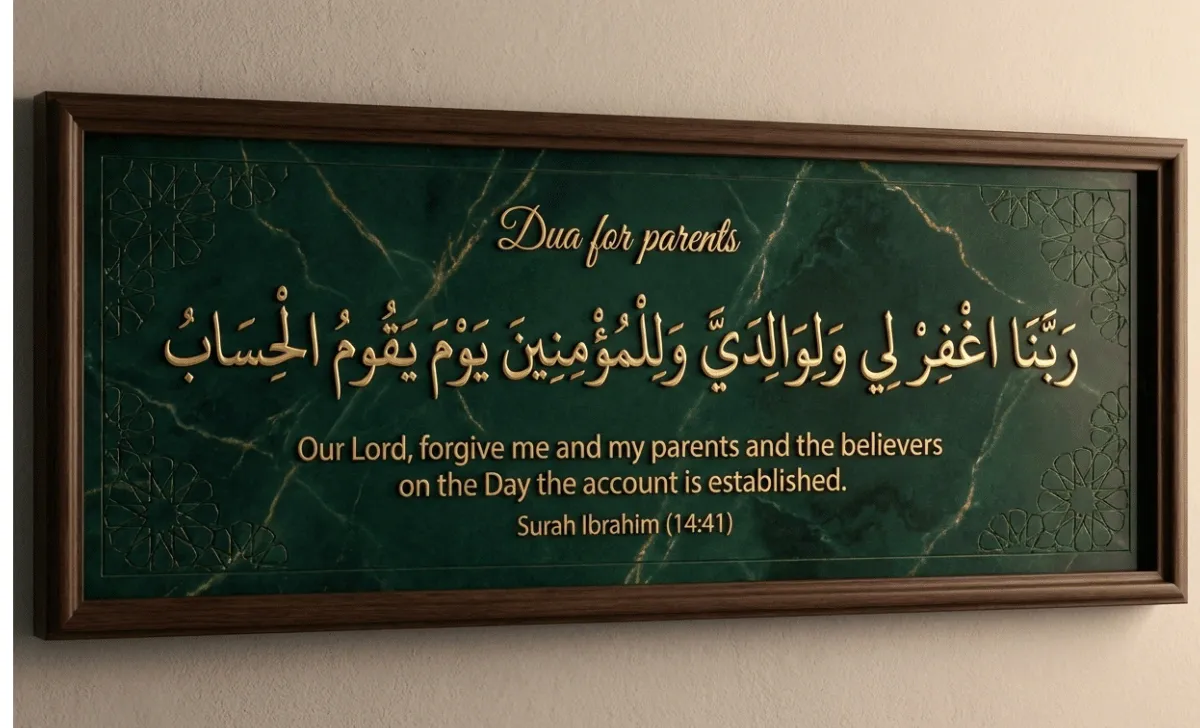
What if one short dua could raise your parents’ rank in Jannah — even after they’ve returned to Allah?
We worry about doing enough for them while they are alive. But Islam gives us something powerful: a supplication that benefits you, your parents, and the entire Ummah in one breath.
Here’s why this matters for you: this dua is not cultural. It is Qur’anic. It is prophetic in spirit. And it carries eternal impact.
What Is “Allahummaghfirli Waliwalidayya Walil Mu’mineena Wal Mu’minaat”?
Allahummaghfirli waliwalidayya walil mu’mineena wal mu’minaat” is a Quranic-style dua asking Allah to forgive you, your parents, and all believing men and women. It appears in Surah Ibrahim (14:41) and reflects the prophetic tradition of making inclusive forgiveness for the entire Ummah.
This dua combines:
- Personal repentance
- Gratitude to parents
- Mercy for all believers
It is spiritually expansive. You start with yourself. Then your parents. Then the Ummah.
That order is not random.
📖 The Quranic Source – Surah Ibrahim (14:41)
The full Quranic version of this dua appears in Surah Ibrahim, verse 41. It was made by Prophet Ibrahim (peace be upon him), asking Allah to forgive him, his parents, and the believers on the Day of Judgment.
Arabic
رَبَّنَا اغْفِرْ لِي وَلِوَالِدَيَّ وَلِلْمُؤْمِنِينَ يَوْمَ يَقُومُ الْحِسَابُ
Transliteration
Rabbana ighfir li wa li-walidayya wa lil-mu’mineena yawma yaqoomul hisaab.
English (Saheeh International)
“Our Lord, forgive me and my parents and the believers the Day the account is established.”
Urdu (Fateh Muhammad Jalandhari)
اے ہمارے پروردگار! مجھے اور میرے ماں باپ کو اور مومنوں کو اس دن بخش دے جس دن حساب قائم ہوگا۔
📚 Classical Tafsir Insight
Ibn Kathir
Ibn Kathir explains that Prophet Ibrahim included all believers in his dua to show mercy beyond personal family. It teaches Muslims to think collectively, not individually, especially when asking for forgiveness.
He highlights that this verse demonstrates:
- The virtue of remembering parents in dua.
- The legitimacy of praying for all believers.
- Awareness of Yawm al-Hisab (Day of Accountability).
This is not a casual dua. It is anchored in Akhirah consciousness.
🧎♂️ Is This Dua Beneficial for Deceased Parents?
Yes. Authentic hadith confirms that a righteous child’s dua benefits deceased parents. When a person dies, their deeds stop except ongoing charity, beneficial knowledge, and a righteous child who prays for them.
Hadith Evidence – Sahih Muslim
Arabic
إِذَا مَاتَ الإِنسَانُ انْقَطَعَ عَنْهُ عَمَلُهُ إِلَّا مِنْ ثَلاَثَةٍ…
Transliteration
Idha maata al-insaan inqata‘a ‘anhu ‘amaluhu illa min thalaathah…
English
“When a person dies, his deeds come to an end except for three: ongoing charity, beneficial knowledge, or a righteous child who prays for him.”
Urdu
جب انسان مر جاتا ہے تو اس کے اعمال منقطع ہو جاتے ہیں سوائے تین کے…
This hadith is recorded in Sahih Muslim.
Commentary from Imam Nawawi
Imam Nawawi
Imam Nawawi states that this hadith proves the clear benefit of a child’s dua for deceased parents. Scholars unanimously agree that supplication reaches the dead and raises their rank.
This establishes scholarly consensus (ijma‘).
So if your parents have passed away — this dua is a gift you can still give.
🧠 Word-by-Word Meaning Breakdown
Each word in this dua carries deep meaning. It asks for forgiveness rooted in divine mercy and expands from the individual to the global Muslim community.
- Allahumma – O Allah
- Ighfir – Forgive (from root gh-f-r, to cover, conceal sins)
- Li – For me
- Waliwalidayya – And for my parents
- Walil Mu’mineena – And believing men
- Wal Mu’minaat – And believing women
Notice the progression: self → parents → Ummah.
This is spiritual expansion.
📱 The Spiritual Habit Loop (Modern Framework)
Turning this dua into a daily habit creates emotional relief and spiritual consistency. When repeated regularly, it reduces guilt, strengthens gratitude, and builds a connection with your parents and the Ummah.
The loop works like this:
- Trigger – After every Fard prayer
- Action – Recite the dua once or three times
- Reward – Inner peace and hope for your parents
Over time, it becomes automatic.
This is Digital Sunnah in practice — using routine moments for eternal reward.
📖 Related Quranic Duas for Parents
Surah Al-Isra (17:24)
Another powerful dua for parents appears in Surah Al-Isra. It asks Allah to have mercy on them as they raised you when you were small.
Arabic
رَبِّ ارْحَمْهُمَا كَمَا رَبَّيَانِي صَغِيرًا
Transliteration
Rabbi irhamhuma kama rabbayani sagheera.
English
“My Lord, have mercy upon them as they brought me up when I was small.”
Urdu
اے میرے رب! ان دونوں پر رحم فرما جیسے انہوں نے مجھے بچپن میں پالا۔
🌍 Why Include “All Believers”?
Including all believers multiplies reward. The Prophet ﷺ taught that when you pray for others in their absence, angels say “Ameen, and for you the same.”
This makes the dua self-benefiting.
You forgive the Ummah. Allah forgives you.
It builds collective mercy.
❓ People Also Ask:
The best Quranic dua for parents is “Rabbighfir li wa liwalidayya…” in Surah Ibrahim 14:41 and “Rabbi irhamhuma…” in Surah Al-Isra 17:24.
Yes. Authentic hadith confirms that a righteous child’s dua benefits deceased parents.
There is no fixed number in authentic sources. Once after each prayer is recommended for consistency.
Yes. The core wording appears in Surah Ibrahim (14:41).
🕌 Here’s Why This Matters for You
Every day that passes is a day your parents move closer to their eternal account — or if they have passed, closer to their final rank.
Your dua may be:
- A light in their grave
- A shield on the Day of Judgment
- A means for your own forgiveness
This is Birr al-Walidayn beyond death.
📌 Practical Action Plan
Starting today:
- Recite after every Fard prayer.
- Teach it to your siblings.
- Save it in your phone wallpaper.
- Make it part of Ramadan routine.
Small words. Eternal consequences.
