Quick Answer
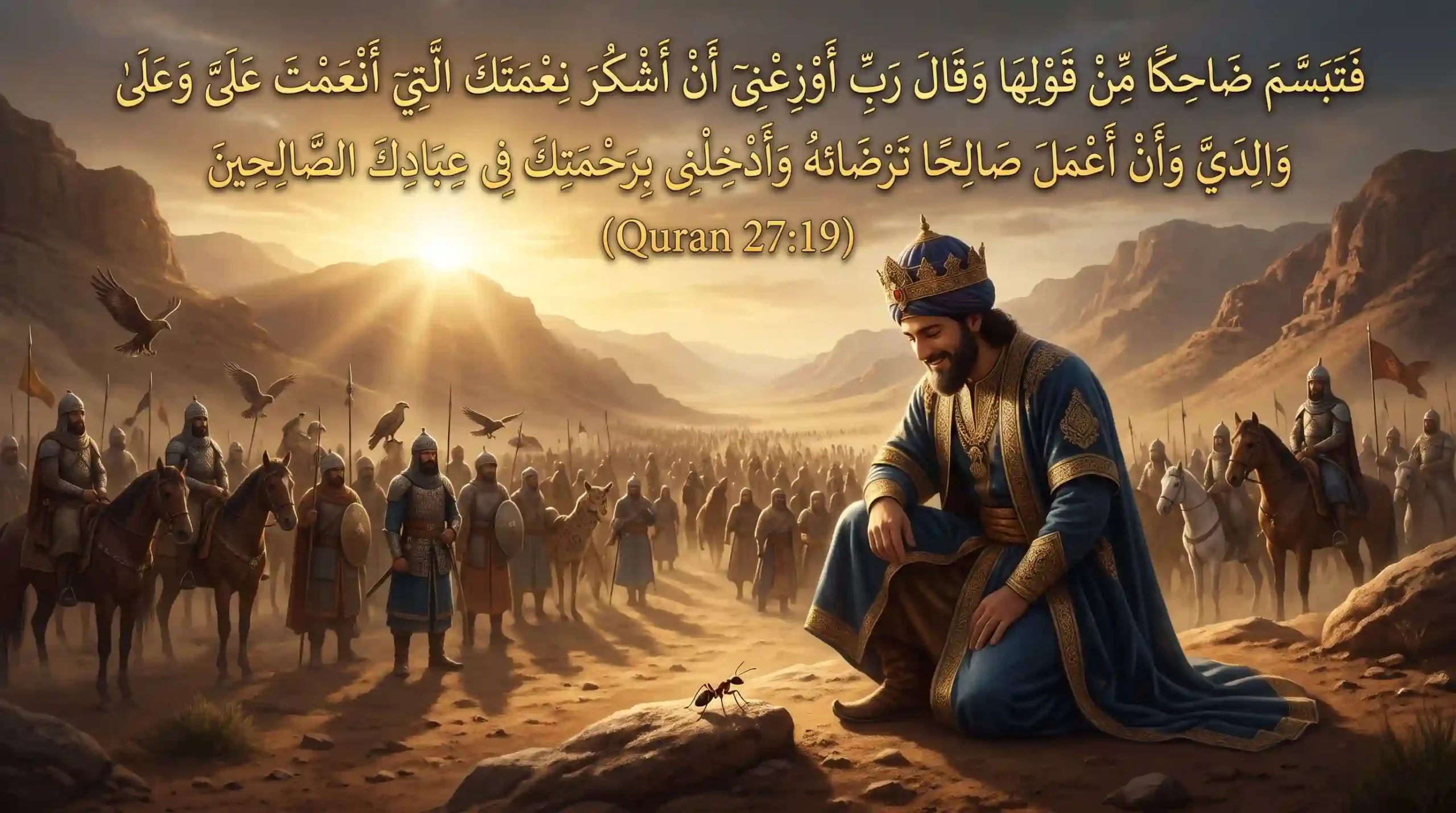
- Surah Naml ayat 19 records the moment the prophet Sulaiman (Solomon) heard an ant’s warning, smiled, and prayed the Quran’s signature dua of gratitude: “My Lord, inspire me to be thankful for Your favours…” (Quran 27:19).
- The dua asks for three things in order: a thankful heart for blessings given to him and his parents, deeds that please Allah, and a place among the righteous.
- No source gives this dua a fixed count or a promised worldly benefit. It is a dua to say when a blessing reaches you — and the Prophet Muhammad ﷺ taught a companion dua of thanks to be said after every prayer (Sunan Abi Dawud 1522).
Table of Contents
- What Is Surah Naml Ayat 19?
- Surah Naml Ayat 19 in Arabic, Transliteration, English, Urdu and Hindi
- Word-by-Word Meaning of Fatabassama Dahikan Min Qawliha
- What Did the Ant Say? The Story in Two Verses
- Why Does This Dua Appear Twice in the Quran?
- Three Requests Inside One Dua
- Is There a Wazifa or Fixed Count for This Dua?
- How Do You Practice the Ant Pause?
- Where Does This Dua Fit in a Working Day?
- Common Mistakes and Misconceptions
- Save This: The Ant Pause Card
- FAQ
- Next Step
What Is Surah Naml Ayat 19?
Surah Naml ayat 19 is the verse where Sulaiman (Solomon), marching with an army of men, jinn and birds, overhears an ant warning her colony about him — and smiles. Instead of pride, the moment produces the Quran’s fullest dua of gratitude, asking Allah for thanks, pleasing deeds, and righteous company.
A king who understood animals could have treated the scene as proof of his greatness. The verse shows the opposite reflex: the smallest creature in the valley names his power plainly — “Solomon and his armies” — and his response is not a speech about himself, but a prayer about his Lord. That is why this verse became the gratitude verse of the Quran.
Gratitude (shukr) here is not a feeling that visits lucky people. Sulaiman asks for it as something Allah must enable: awzi’ni — inspire me. That word turns the dua into a request any reader can copy on an ordinary day.
Surah Naml Ayat 19 in Arabic, Transliteration, English, Urdu and Hindi
فَتَبَسَّمَ ضَاحِكًا مِّن قَوْلِهَا وَقَالَ رَبِّ أَوْزِعْنِىٓ أَنْ أَشْكُرَ نِعْمَتَكَ ٱلَّتِىٓ أَنْعَمْتَ عَلَىَّ وَعَلَىٰ وَٰلِدَىَّ وَأَنْ أَعْمَلَ صَـٰلِحًا تَرْضَىٰهُ وَأَدْخِلْنِى بِرَحْمَتِكَ فِى عِبَادِكَ ٱلصَّـٰلِحِينَ
Fatabassama dahikan min qawliha wa qala: Rabbi awzi’ni an ashkura ni’mataka-llati an’amta ‘alayya wa ‘ala walidayya wa an a’mala salihan tardahu wa adkhilni birahmatika fi ‘ibadikas-salihin.
“So Solomon smiled in amusement at her words, and prayed, “My Lord! Inspire me to ˹always˺ be thankful for Your favours which You have blessed me and my parents with, and to do good deeds that please you. Admit me, by Your mercy, into ˹the company of˺ Your righteous servants.”” (Surah An-Naml 27:19, Dr. Mustafa Khattab, The Clear Quran, checked on Quran.com)
Urdu (Fateh Muhammad Jalandhari):
تو وہ اس کی بات سن کر ہنس پڑے اور کہنے لگے کہ اے پروردگار! مجھے توفیق عطا فرما کہ جو احسان تونے مجھ پر اور میرے ماں باپ پر کئے ہیں ان کا شکر کروں اور ایسے نیک کام کروں کہ تو ان سے خوش ہوجائے اور مجھے اپنی رحمت سے اپنے نیک بندوں میں داخل فرما
Hindi (Maulana Azizul Haque al-Umari): “तो वह (सुलैमान) उसकी बात से हँसता हुआ मुसकुराया और उसने कहा : ऐ मेरे पालनहार! मुझे सामर्थ्य प्रदान कर कि मैं तेरी उस ने’मत का शुक्र अदा करूँ, जो तूने मुझे तथा मेरे माता-पिता को प्रदान की है, और यह कि मैं अच्छा कार्य करूँ, जिसे तू पसंद करे और मुझे अपनी दया से अपने सदाचारी बंदों में शामिल कर ले।”
Surah An-Naml (the Ant) is the 27th chapter of the Quran, revealed in Makkah, with 93 verses. Ayat 19 sits on page 378 of the Madinah mushaf, in Juz 19. The surah carries the Quran’s only extended account of Sulaiman’s kingdom — and near its head, this valley of ants.
Word-by-Word Meaning of Fatabassama Dahikan Min Qawliha
| Arabic | Transliteration | Meaning |
|---|---|---|
| فَتَبَسَّمَ | Fatabassama | So he smiled |
| ضَاحِكًا | Dahikan | Laughing, in amusement |
| مِّن قَوْلِهَا | Min qawliha | At her words, because of what she said |
| وَقَالَ | Wa qala | And he said |
| رَبِّ | Rabbi | My Lord |
| أَوْزِعْنِىٓ | Awzi’ni | Inspire me, enable me, grant me the ability |
| أَنْ أَشْكُرَ | An ashkura | That I may be thankful, that I may give thanks |
| نِعْمَتَكَ | Ni’mataka | Your favour, Your blessing |
| ٱلَّتِىٓ أَنْعَمْتَ | Allati an’amta | Which You bestowed |
| عَلَىَّ وَعَلَىٰ وَٰلِدَىَّ | ‘Alayya wa ‘ala walidayya | On me and on my parents |
| وَأَنْ أَعْمَلَ صَـٰلِحًا | Wa an a’mala salihan | And that I may do righteous deeds |
| تَرْضَىٰهُ | Tardahu | That You are pleased with, that please You |
| وَأَدْخِلْنِى | Wa adkhilni | And admit me |
| بِرَحْمَتِكَ | Birahmatika | By Your mercy |
| فِى عِبَادِكَ ٱلصَّـٰلِحِينَ | Fi ‘ibadikas-salihin | Among Your righteous servants |
One word carries the whole dua: awzi’ni. Sulaiman does not say “I am thankful.” He asks Allah to make him thankful. It is a gift requested before it is a feeling reported — which is why the dua works on days the feeling is missing.
What Did the Ant Say? The Story in Two Verses
The ant said: “O ants! Go quickly into your homes so Solomon and his armies do not crush you, unknowingly” (Quran 27:18, Khattab). Her whole speech is one sentence of care for her colony, and one accurate sentence about Sulaiman: she trusts he would never crush them on purpose.
Read the two verses as one scene. Verse 18 is all smallness: a valley floor, a creature with no name, a warning passed mouth to mouth. Verse 19 is all scale: a prophet-king, an army, a prayer that outlives them both. Ibn Kathir (abridged, on Quran.com) treats them in his section on the blessings given to Dawud and Sulaiman — father and son already saying “All praise is for Allah” two verses earlier (27:15).
Notice what the ant gets right. She neither flatters the king nor fears him wrongly; she excuses him in advance — “unknowingly.” Sulaiman smiles the smile of a man described fairly by the weakest witness in his kingdom. What that fairness produces is the dua: thanks, and a request to be kept thankful.
Why Does This Dua Appear Twice in the Quran?
Because the Quran gives the same opening dua to two different lives. Sulaiman says it at the summit of power, surrounded by armies (27:19). An unnamed believer says it at forty years of age, in a passage about honouring his parents (46:15). Gratitude is not sized to the blessing.
At forty, the words come with additions: “instil righteousness in my offspring. I truly repent to You” (46:15, Khattab). The shape is the same in the most ordinary setting: no armies, no talking creatures, just a person at middle age reviewing the account. Between the king and the forty-year-old, most readers will find their own address.
If it belonged only to Sulaiman’s miracle, it would be a story to admire. On the lips of an unnamed person at forty, it becomes a script to borrow.
Three Requests Inside One Dua
| Request in the Dua | His Words | What it Covers |
|---|---|---|
| 1. A thankful heart | “Inspire me to be thankful for Your favours… on me and on my parents” | Blessings received, including the ones that arrived through your parents before you could ask |
| 2. Pleasing deeds | “and to do good deeds that please you” | Gratitude proved by action, measured by Allah’s pleasure, not by applause |
| 3. Righteous company | “Admit me, by Your mercy, into the company of Your righteous servants” | The end of the road: entry is by mercy, and the company asked for is the righteous |
Read the order slowly. Thanks comes first, but it may not stay a feeling: it must become deeds. And the deeds may not become pride: the final request admits that even a prophet-king enters only “by Your mercy.” Heart, hands, destination — a complete map in one breath. The dua for your parents follows from its first request, since his thanks begins with his parents’ favours.
Is There a Wazifa or Fixed Count for This Dua?
No. No verse, hadith, or classical source checked for this article sets a number of repetitions, a time of day, or a promised worldly return for reciting Surah Naml ayat 19. It is Sulaiman’s dua, preserved so believers can ask with his words — not a formula with a dosage.
This needs saying plainly: the searches are full of counts — recite it so many times for rizq, for a job, for success. A wazifa (a fixed recitation practice) needs a basis; none of the sources used here gives one. Attaching a count and a promised outcome turns gratitude into a transaction.
What the sources give instead is a pattern. The Prophet Muhammad ﷺ took Mu’adh ibn Jabal by the hand and said: “By Allah, I love you, Mu’adh. I instruct you: never leave this supplication after every prayer — Allahumma a’inni ‘ala dhikrika wa shukrika wa husni ‘ibadatik, O Allah, help me to remember You, to thank You, and to worship You well” (Sunan Abi Dawud 1522; graded sahih by al-Albani). In the Sunnah, gratitude is scheduled after salah, not counted toward a purchase. The companion page walks through that dua — the Allahumma a’inni ‘ala dhikrika wa shukrika supplication — word by word.
One promise about dua is certain: Allah describes Himself as near and answering: Wa idha sa’alaka ‘ibadi ‘anni — “when My servants ask you about Me, I am near; I respond to the call of the caller when he calls Me” (Quran 2:186). Presence beats a count repeated with a shopping list.
How Do You Practice the Ant Pause?
Use the Ant Pause: a 60-second routine built on the verse’s order — Notice, Smile, Ask. Once a day, name one ant-sized blessing out loud, receive it as Sulaiman did, then say his dua once, in Arabic or in translation. That is the whole practice.
Notice. Sulaiman’s blessing arrived at ant scale: one true sentence from one small creature. Yours will too — a message at the right hour, a parent answering the phone, rain clearing before the commute. The practice fails when we wait for palace-sized blessings. Train the eye downward: one small, nameable favour, daily.
Smile. The verse’s first verb is a smile. Before the dua, before the analysis, Sulaiman received the moment as a gift. Do the same: breathe out, let the blessing land for two seconds. It is the hinge between noticing a favour and thanking for it.
Ask. Then say the dua; let its three requests set your day. Pair it with a prayer you already keep — after Fajr, or with the dua after salah — because a habit attached to a prayer survives; one attached to motivation does not. Start tonight: name today’s smallest blessing in one sentence, smile at it, and say the dua once.
Where Does This Dua Fit in a Working Day?
It fits wherever a blessing reaches you: the inbox, the school gate, the family chat. The dua was first said on a march, by a man running a kingdom. It needs no quiet room or free hour. It was made for ordinary days, not retreats.
At work, it answers the promotion and the near-miss with the same sentence: the favour is from Allah, and the next deed is what matters. At school, it steadies results day: thanks for what was given, then work that pleases Him. In the family group chat, sending this dua makes you the person who names the Giver. Woven into the morning and evening azkar, one Ant Pause a day joins a rhythm older than any app.
And when the day is about desperate need rather than thanks, the same surah carries the other door: Surah Naml ayat 62, the desperate caller’s verse. Gratitude and desperation are neighbours in this surah; most weeks, a believer needs both addresses.
Common Mistakes and Misconceptions
Treating the dua as a rizq formula. The verse contains no count and no wealth promise. Reciting it for a salary reverses its meaning: he thanked for what he had; he did not invoice for what he lacked.
Skipping the parents. The dua thanks Allah for favours “on me and on my parents.” Reading it for years without turning it toward them — a prayer, a call, a kindness — keeps the first request half-said.
Waiting to feel grateful before saying it. The first request is to be made grateful: “inspire me to be thankful.” It was designed for days the feeling is absent. Say it to get the feeling; do not wait for the feeling to say it.
Reading the smile as decoration. The smile is the verse’s second word — its hinge. A king heard a just word about himself from the weakest creature present, and it pleased him. Missing that misses why the dua follows.
Assuming the story is only for children. The valley sits in a passage that begins with two prophets saying Alhamdulillah (27:15) and runs to the Queen of Sheba — see Innahu min Sulaiman. Small creature, large curriculum.
Save This: The Ant Pause Card
Print this card or save it to your phone. Run it once a day, at the prayer you already keep.
- ☐ Notice: I named one small blessing from today, out loud, in one sentence.
- ☐ Smile: I paused two seconds and received it as a gift before analysing it.
- ☐ Ask (thanks): I thanked Allah for favours to me — and to my parents.
- ☐ Ask (deeds): I chose one deed today whose only audience is Allah’s pleasure.
- ☐ Ask (company): I ended the dua asking, by His mercy, for the company of the righteous.
- ☐ No count attached: I said it once, with presence — not as a tally toward an outcome.
7-Day Blessing Tracker: each evening, write the date and the one blessing you noticed. Seven lines are enough to prove the eye is learning.
FAQ
What is the dua in Surah Naml ayat 19?
It is Sulaiman’s dua: “My Lord! Inspire me to be thankful for Your favours which You have blessed me and my parents with, and to do good deeds that please you. Admit me, by Your mercy, into the company of Your righteous servants” (Quran 27:19, Khattab).
What does fatabassama dahikan min qawliha mean?
It is the verse’s opening Arabic: “So he smiled, laughing, at her words.” Fatabassama means “so he smiled,” dahikan means laughing or amused, and min qawliha means “at her words” — the words being the ant’s warning to her colony in verse 18, which Sulaiman was given to understand.
How many times should I recite Surah Naml ayat 19?
There is no fixed number. No verse, hadith, or classical commentary checked for this article sets a repetition count for this dua. Say it when a blessing reaches you, or once a day in a gratitude routine. Presence is the point; no tally is attached to Sulaiman’s prayer.
Is there a wazifa of Surah Naml ayat 19 for rizq or success?
No verified wazifa exists. Websites that assign this verse a count for wealth or success give no chain and no classical source. The dua’s own requests are gratitude, deeds that please Allah, and righteous company. Gratitude itself is the posture this verse trains.
Why does the same dua appear in Surah Al-Ahqaf 46:15?
It places the same opening dua in two lives: Sulaiman at the height of power (27:19) and an unnamed believer at forty, in a passage on honouring parents (46:15). The repetition makes the dua a script for ordinary believers too; at forty it adds repentance and a prayer for offspring.
Can I say this dua for my parents?
Yes — its first request already includes them. Sulaiman thanks Allah for favours “which You have blessed me and my parents with.” Say it, grateful for everything that reached you through them, and pair it with direct prayer for them — gratitude and kindness to parents travel together in the Quran (46:15).
What did the ant actually say to Sulaiman?
The ant warned her own colony, not the king: “O ants! Go quickly into your homes so Solomon and his armies do not crush you, unknowingly” (Quran 27:18, Khattab). She excused him in advance — he would never harm them knowingly. Sulaiman heard it, smiled, and prayed.
What dua did the Prophet ﷺ teach for gratitude?
He ﷺ taught Mu’adh: “Never leave this supplication after every prayer: Allahumma a’inni ‘ala dhikrika wa shukrika wa husni ‘ibadatik — O Allah, help me to remember You, to thank You, and to worship You well” (Sunan Abi Dawud 1522, graded sahih by al-Albani). Gratitude, scheduled after salah.
Next Step
- Say the dua once today, at the next prayer, with one named blessing in mind.
- Read the valley scene whole: Surah An-Naml, verses 15–19, in translation.
- When the need is urgent rather than thankful, continue in the same surah with Surah Naml ayat 62.
- Build the daily rhythm around it with the morning and evening azkar.
