Quick Answer
- Namaz Janaza is prayed standing, with four takbirs, no bowing, and no prostration.
- After the first takbir, recite Surah Al-Fatiha or the Thana. After the second, send blessings on the Prophet ﷺ. After the third, make dua for the deceased. After the fourth, give salam.
- If you know no Arabic yet, still stand in the row, follow the imam, and make a sincere dua in your own words.
Contents:
What Is Namaz-e-Janaza (Salat al-Janazah)?
· Prerequisites & Wudu for Janaza Prayer
· How to Pray Namaz-e-Janaza Step-by-Step
· Janaza Duas for Adult Male, Female, and Child
· What to Recite if You Don’t Know the Arabic Duas
· Common Mistakes in Janaza Prayer
· Condolences & Supporting the Grieving Family
· Namaz-e-Janaza FAQs
· Save Your Quick Janazah Checklist
The call comes at work. A name in the family group chat. A short message: the prayer is in an hour. You drive to the mosque, and your chest feels tight for two reasons at once. You are grieving. And you are afraid of getting it wrong in front of everyone.
You are not alone. Most people learn Janazah on the day they need it. The prayer is short, all standing, and uses words many Muslims already know. This guide gives you the method, the duas, and a simple way to follow along.
Salat al-Janazah is the funeral prayer. Namaz is the Urdu word for prayer, so Namaz Janaza names the same prayer. A takbir is saying Allahu Akbar, “Allah is the Greatest.” Dua is asking Allah with sincerity.
What Is Namaz Janaza?
Namaz Janaza, also called Salat al-Janazah, is the funeral prayer Muslims pray standing for a deceased Muslim before burial. It has four takbirs, no bowing, and no prostration. It is a communal duty: when some Muslims pray it, the duty lifts from the rest.
Fard al-Kifayah means a communal duty. If enough people in the community do it, the rest are excused. If no one does it, the whole community bears the fault. Your presence matters, even when you are not leading it.
There is no adhan for Janazah, the call to prayer, and no iqamah, the second call before a congregational prayer. There is no ruku, bowing, and no sujud, prostration. The body is placed in front of the imam, and the congregation stands in rows facing the qibla.
The Quran frames why this moment feels so heavy:
كُلُّ نَفْسٍ ذَائِقَةُ الْمَوْتِ ۗ وَإِنَّمَا تُوَفَّوْنَ أُجُورَكُمْ يَوْمَ الْقِيَامَةِ ۖ فَمَن زُحْزِحَ عَنِ النَّارِ وَأُدْخِلَ الْجَنَّةَ فَقَدْ فَازَ ۗ وَمَا الْحَيَاةُ الدُّنْيَا إِلَّا مَتَاعُ الْغُرُورِ
Transliteration: Kullu nafsin dha’iqatul mawt, wa innama tuwaffawna ujurakum yawma al-qiyamah, faman zuhziha ‘ani an-nar wa udkhila al-jannah faqad faz, wa ma al-hayatu ad-dunya illa mata’u al-ghurur.
English (Sahih International, Surah Al-Imran 3:185): “Every soul will taste death, and you will only be given your [full] compensation on the Day of Resurrection. So he who is drawn away from the Fire and admitted to Paradise has attained [his desire]. And what is the life of this world except the enjoyment of delusion.”
Urdu meaning:
ہر جان موت کا مزہ چکھنے والی ہے، اور تمہیں تمہارے اجر قیامت کے دن پورے پورے دیے جائیں گے۔ پس جو آگ سے بچا لیا گیا اور جنت میں داخل کر دیا گیا، وہ کامیاب ہو گیا، اور دنیا کی زندگی دھوکے کے سامان کے سوا کچھ نہیں۔
Hindi meaning: हर जान मौत का मज़ा चखने वाली है, और तुम्हें तुम्हारे बदले क़ियामत के दिन पूरे-पूरे दिए जाएँगे। जो आग से बचा लिया गया और जन्नत में दाख़िल कर दिया गया, वही कामयाब हुआ, और दुनिया की ज़िंदगी धोखे के सामान के सिवा कुछ नहीं।
That verse does not ask you to stop grieving. Sabr is patient endurance that keeps turning to Allah in hardship. Tawakkul is trust in Allah after you have done your part. (Surah Al-Imran 3:185)
What Do You Need Before You Stand for Janazah?
Come with wudu and clean clothes, facing the qibla, the direction of prayer toward Makkah. Stand in a row behind the imam, with the body placed in front. Set your intention in your heart: you are praying Janazah for this deceased person, for Allah’s sake.
Wudu is the ablution before prayer. Qibla is the direction Muslims face, toward the Kaaba in Makkah. Niyyah is intention, made in the heart, with no spoken formula required.
Arrive early when you can. Find the row, stand shoulder to shoulder, and keep your phone silent. Women stand in their own rows. Follow the mosque’s arrangement on the day.
For the dua after wudu, the habit from daily prayer carries straight into Janazah: purity first, then prayer. If you arrive without wudu, make wudu first and join the row even if you join late.
Step-by-Step Namaz-e-Janaza (The 4 Takbirs) Flowchart
How Do You Pray Namaz Janaza Step by Step?
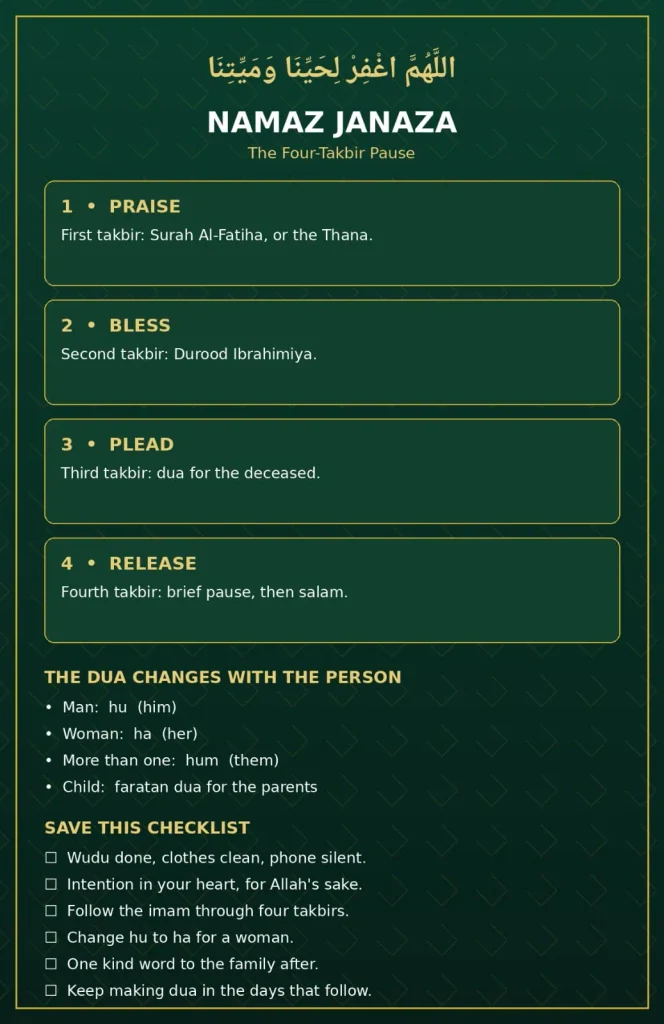
Janazah is prayed standing, in four parts. After the first takbir, recite Surah Al-Fatiha or the Thana, as your school teaches. After the second, send blessings on the Prophet ﷺ. After the third, make dua for the deceased. After the fourth, pause briefly, then give salam.
Use this framework and you will never be lost in the row. Call it the Four-Takbir Pause. Pause first: set your intention and stand still. Then each takbir does one job. One: praise Allah. Two: bless the Prophet ﷺ. Three: plead for the deceased. Four: release, with salam.
| Takbir | What you do | What you recite |
| 1st | Raise hands, say Allahu Akbar, fold hands | Surah Al-Fatiha, or the Thana in the Hanafi school |
| 2nd | Say Allahu Akbar | Durood Ibrahimiya (blessings on the Prophet ﷺ) |
| 3rd | Say Allahu Akbar | Dua for the deceased |
| 4th | Say Allahu Akbar, pause briefly | Brief dua, then salam to the right |
After the First Takbir, What Do You Recite?
After the first takbir, raise your hands, fold them, and recite. Many Muslims recite Surah Al-Fatiha, as Ibn Abbas did and called it the Sunnah. In the Hanafi school, the Thana is recited instead. Follow your imam and the teaching you follow; both paths are held by scholars.
The imam says Allahu Akbar aloud. Say it quietly, raise your hands, then fold your right hand over your left. Whether hands are raised again later differs by practice. Follow your imam.
Ibn Abbas prayed Janazah, recited Al-Fatiha, and said people should know it is the Sunnah, the practice of the Prophet ﷺ (Sahih al-Bukhari 1335).
Surah Al-Fatiha is the Opening chapter of the Quran. Its Arabic, with full tashkeel:
بِسْمِ اللَّهِ الرَّحْمَٰنِ الرَّحِيمِ (1) الْحَمْدُ لِلَّهِ رَبِّ الْعَالَمِينَ (2) الرَّحْمَٰنِ الرَّحِيمِ (3) مَالِكِ يَوْمِ الدِّينِ (4) إِيَّاكَ نَعْبُدُ وَإِيَّاكَ نَسْتَعِينُ (5) اهْدِنَا الصِّرَاطَ الْمُسْتَقِيمَ (6) صِرَاطَ الَّذِينَ أَنْعَمْتَ عَلَيْهِمْ غَيْرِ الْمَغْضُوبِ عَلَيْهِمْ وَلَا الضَّالِّينَ (7)
Transliteration: Bismillahir Rahmanir Rahim. Alhamdu lillahi Rabbil ‘alamin. Ar-Rahmanir Rahim. Maliki yawmid-din. Iyyaka na’budu wa iyyaka nasta’in. Ihdinas-siratal mustaqim. Siratal-ladhina an’amta ‘alayhim, ghayril maghdubi ‘alayhim wa lad-dallin.
English (Sahih International, Surah Al-Fatiha 1:1-7): “In the name of Allah, the Entirely Merciful, the Especially Merciful. [All] praise is [due] to Allah, Lord of the worlds. The Entirely Merciful, the Especially Merciful. Sovereign of the Day of Recompense. It is You we worship and You we ask for help. Guide us to the straight path. The path of those upon whom You have bestowed favor, not of those who have evoked [Your] anger or of those who are astray.”
In the Hanafi school, the Thana is recited after the first takbir instead of Al-Fatiha. Thana means praise, and this short praise is also recited at the start of regular prayer:
سُبْحَانَكَ اللَّهُمَّ وَبِحَمْدِكَ وَتَبَارَكَ اسْمُكَ وَتَعَالَى جَدُّكَ وَلَا إِلَهَ غَيْرُكَ
Transliteration: Subhanaka Allahumma wa bihamdika, wa tabarakasmuka, wa ta’ala jadduka, wa la ilaha ghayruk.
Meaning: “Glory be to You, O Allah, and praise be to You. Blessed is Your name and exalted is Your majesty. There is no god but You.”
If your imam recites one and you learned the other, follow the imam and ask a trusted teacher later.
After the Second Takbir, What Is Durood Ibrahimiya?
After the second takbir, send blessings on Prophet Muhammad ﷺ with Durood Ibrahimiya, the same blessings recited at the end of regular prayer. You ask Allah to bless Muhammad ﷺ and his family, as He blessed Ibrahim and his family. Say it quietly, with your hands folded, following the imam.
Durood means sending blessings on the Prophet ﷺ. Ibrahimiya links this wording to Prophet Ibrahim (peace be upon him). You already say a form of it in every prayer, in the final sitting.
اللَّهُمَّ صَلِّ عَلَى مُحَمَّدٍ وَعَلَى آلِ مُحَمَّدٍ كَمَا صَلَّيْتَ عَلَى إِبْرَاهِيمَ وَعَلَى آلِ إِبْرَاهِيمَ إِنَّكَ حَمِيدٌ مَجِيدٌ اللَّهُمَّ بَارِكْ عَلَى مُحَمَّدٍ وَعَلَى آلِ مُحَمَّدٍ كَمَا بَارَكْتَ عَلَى إِبْرَاهِيمَ وَعَلَى آلِ إِبْرَاهِيمَ إِنَّكَ حَمِيدٌ مَجِيدٌ
Transliteration: Allahumma salli ‘ala Muhammadin wa ‘ala ali Muhammadin, kama sallayta ‘ala Ibrahima wa ‘ala ali Ibrahima, innaka Hamidun Majid. Allahumma barik ‘ala Muhammadin wa ‘ala ali Muhammadin, kama barakta ‘ala Ibrahima wa ‘ala ali Ibrahima, innaka Hamidun Majid.
Meaning: “O Allah, send blessings upon Muhammad and upon the family of Muhammad, as You sent blessings upon Ibrahim and upon the family of Ibrahim. Indeed, You are Praiseworthy, Glorious. O Allah, bless Muhammad and the family of Muhammad, as You blessed Ibrahim and the family of Ibrahim. Indeed, You are Praiseworthy, Glorious.”
After the Third Takbir, What Is the Dua for the Deceased?
After the third takbir, make dua for the deceased. This is Janazah’s heart. Ask Allah to forgive the deceased, show mercy, and admit the person to Paradise. Use a taught dua if you know one. If you do not, ask sincerely in your own words while you learn it.
Two taught duas follow, each with its source. Learn one and trust what you are saying. The first is the general dua, taught for the living and the dead together:
اللَّهُمَّ اغْفِرْ لِحَيِّنَا وَمَيِّتِنَا وَشَاهِدِنَا وَغَائِبِنَا وَصَغِيرِنَا وَكَبِيرِنَا وَذَكَرِنَا وَأُنْثَانَا
Transliteration: Allahummaghfir lihayyina wa mayyitina, wa shahidina wa gha’ibina, wa saghirina wa kabirina, wa dhakarina wa unthana.
Meaning: “O Allah, forgive our living and our dead, those present among us and those absent, our young and our old, our males and our females.”
Urdu meaning:
اے اللہ! ہمارے زندوں اور مردوں، حاضر اور غائب، چھوٹوں اور بڑوں، مردوں اور عورتوں کو بخش دے۔
Hindi meaning: ऐ अल्लाह! हमारे ज़िंदा और मुर्दा, हाज़िर और ग़ाइब, छोटों और बड़ों, मर्दों और औरतों को बख़्श दे।
The same narration appears in Sunan Abi Dawud 3201 with a longer ending. Word order differs slightly between narrations, so learn one narration fully rather than mixing lines.
| Arabic word | Transliteration | Meaning |
| اللَّهُمَّ | Allahumma | O Allah |
| اغْفِرْ | Ighfir | Forgive |
| لِحَيِّنَا | Lihayyina | Our living |
| وَمَيِّتِنَا | Wa mayyitina | And our dead |
| وَشَاهِدِنَا | Wa shahidina | And those present |
| وَغَائِبِنَا | Wa gha’ibina | And those absent |
| وَصَغِيرِنَا | Wa saghirina | And our young |
| وَكَبِيرِنَا | Wa kabirina | And our old |
| وَذَكَرِنَا | Wa dhakarina | And our males |
| وَأُنْثَانَا | Wa unthana | And our females |
The second dua is specific to the deceased. ‘Awf ibn Malik memorized it from the Prophet ﷺ at a funeral prayer (Sahih Muslim 963a-b):
اللَّهُمَّ اغْفِرْ لَهُ وَارْحَمْهُ وَعَافِهِ وَاعْفُ عَنْهُ وَأَكْرِمْ نُزُلَهُ وَوَسِّعْ مُدْخَلَهُ وَاغْسِلْهُ بِالْمَاءِ وَالثَّلْجِ وَالْبَرَدِ وَنَقِّهِ مِنَ الْخَطَايَا كَمَا نَقَّيْتَ الثَّوْبَ الْأَبْيَضَ مِنَ الدَّنَسِ وَأَبْدِلْهُ دَارًا خَيْرًا مِنْ دَارِهِ وَأَهْلًا خَيْرًا مِنْ أَهْلِهِ وَزَوْجًا خَيْرًا مِنْ زَوْجِهِ وَأَدْخِلْهُ الْجَنَّةَ وَأَعِذْهُ مِنْ عَذَابِ الْقَبْرِ أَوْ مِنْ عَذَابِ النَّارِ
Transliteration: Allahummaghfir lahu warhamhu wa ‘afihi wa’fu ‘anhu, wa akrim nuzulahu wa wassi’ mudkhalahu, waghsilhu bil-ma’i wath-thalji wal-barad, wa naqqihi minal-khataya kama naqqayta ath-thawbal abyada minad-danas, wa abdilhu daran khayran min darihi, wa ahlan khayran min ahlihi, wa zawjan khayran min zawjihi, wa adkhilhul jannah, wa a’idhhu min ‘adhabil qabri aw min ‘adhabin-nar.
Meaning: “O Allah, forgive him, have mercy on him, grant him well-being, and pardon him. Honor his arrival and widen his entrance. Wash him with water, snow, and hail. Cleanse him of sins as You cleanse a white garment of dirt. Give him a home better than his home, a family better than his family, and a spouse better than his spouse. Admit him to Paradise, and protect him from the punishment of the grave or from the punishment of the Fire.”
‘Awf said he wished he had been that deceased person, so beautiful was the dua he heard.
After the Fourth Takbir, What Happens Next?
After the fourth takbir, pause briefly. You may make a short dua for all Muslims, then end with salam, turning to the right and saying, ‘Assalamu alaikum wa rahmatullah.’ Some give salam to both sides. Follow your imam, and do not rush away at once.
Salam ends the prayer: Assalamu alaikum wa rahmatullah, “Peace be upon you, and the mercy of Allah.” A brief dua here asks Allah not to deprive us of the deceased person’s reward (Sunan Abi Dawud 3201). Stay for the burial when you can: staying until the prayer earns one qirat, and until the burial earns two, each like a great mountain. A qirat is a measure of reward.
What Is the Dua for a Man, a Woman, and a Child?
The prayer is the same, but the words change with the deceased. For a man, the dua uses ‘hu’ (him). For a woman, it uses ‘ha’ (her). For a child, use the short child dua, which asks Allah to make the child a forerunner and a reward for the parents.
In Arabic, pronouns change with the deceased. Lahu means “for him.” For a woman, say laha, “for her,” changing matching words the same way. For more than one person, use hum, “for them.”
| Deceased | Shortest form | Meaning |
| Man | Allahummaghfir lahu warhamhu | O Allah, forgive him and have mercy on him |
| Woman | Allahummaghfir laha warhamha | O Allah, forgive her and have mercy on her |
| More than one | Allahummaghfir lahum warhamhum | O Allah, forgive them and have mercy on them |
| Child | Allahummaj’alhu lana faratan wa salafan wa ajra | O Allah, make him for us a precursor, a forerunner, and a cause of reward |
For a child, jurists recommend a specific dua, rather than asking forgiveness as for an adult, because a child who has not reached puberty has no sins recorded in the same sense. The short dua below is reported from Al-Hasan al-Basri (Hisn al-Muslim 161; Al-Bukhari, mu’allaq report):
اللَّهُمَّ اجْعَلْهُ لَنَا فَرَطًا وَسَلَفًا وَأَجْرًا
Transliteration: Allahummaj’alhu lana faratan wa salafan wa ajra.
Meaning: “O Allah, make him for us a precursor, a forerunner, and a cause of reward.”
Faratan means one who goes ahead and prepares the way. For a girl, the pronoun changes to ha: Allahummaj’alha lana faratan wa salafan wa ajra. Learn the short form first; add longer wording only from a checked source, with a teacher.
Where the imam stands also follows the deceased. In the commonly taught arrangement, he stands level with the head for a man and level with the middle for a woman.
What If You Do Not Know the Arabic Duas Yet?
If you do not know the Arabic duas yet, still stand in the row. Do not stay away because you fear a mistake. Make a sincere dua in words you understand, follow the imam through the four takbirs, and learn one taught dua line by line after the prayer.
The minimum is a sincere dua for the deceased. If your only words are “O Allah, forgive him and have mercy on him,” said with a full heart, you have prayed. The taught duas are the goal, not the entry ticket.
Learn it the Spiritual Habit Loop way: cue, routine, reward. Cue: after Fajr or before sleep. Routine: two minutes, one line of transliteration, then its meaning. Reward: a steadier heart next time you stand in a row. Start tonight with one line. There is no prescribed count. Pair the habit with daily remembrance, such as Tasbeeh Fatima, which many Muslims recite after prayer and before sleep.
For asking in general, see the guide on how to make dua. Janazah follows the same order: praise, bless, then ask.
What Are the Common Mistakes in Janazah Prayer?
Common mistakes come from hurry and copying others without asking. People bow, recite aloud over the imam, or leave before the prayer ends. Slow down, watch the imam, keep your voice low, and ask a trusted person after the prayer if you are unsure what to do.
Janazah is not like the five daily prayers. That difference causes most mistakes: people bow, sit, or wait for a second rak’ah that never comes.
| Feature | Regular prayer | Janazah prayer |
| Posture | Standing, bowing, prostrating, sitting | Standing only |
| Units | Rak’ahs | Four takbirs, no rak’ahs |
| Adhan / iqamah | Adhan is given; iqamah before the prayer | No adhan, no iqamah |
| Recitation | Quran recited aloud or quietly by imam | Short recitations and duas, said quietly by followers |
| End | Two salams in most practice | Salam to the right; some give salam to both sides |
Other mistakes break the calm of the moment: talking in the row, checking a phone, taking photos, or leaving at once without a word to the family. Slow down, join the row fully, and treat the next ten minutes as belonging to the deceased and the family.
Do not argue about method in the row. Schools differ on Al-Fatiha or Thana, on raising the hands, and on one salam or two. Follow your imam, pray sincerely, and ask a trusted teacher later.
How Do You Support the Family After the Prayer?
After the prayer, support means presence, not perfect words. Say, ‘Inna lillahi wa inna ilayhi raji’un,’ offer food, help with errands, and keep making dua for the deceased. At work, say simply that a loved one has died. Ask for time, and accept help when it is offered.
When you hear of a death, the words Muslims say come from the Quran (2:156):
إِنَّا لِلَّهِ وَإِنَّا إِلَيْهِ رَاجِعُونَ
Transliteration: Inna lillahi wa inna ilayhi raji’un.
Meaning: “Indeed, we belong to Allah, and indeed, to Him we will return.”
Say it quietly, with eye contact, and then stop talking. The family needs a person who stays. Offer food that can be reheated, a ride, or help with one small task. Grief makes small tasks feel large.
After the burial, keep making dua. A dua for parents helps when a parent has died.
The Kabristan dua is the greeting for a graveyard visit.
At work or school, keep it simple: “A loved one has died. I prayed the funeral prayer today. I am grieving, and I may need a few days.” If a colleague asks, say: “It is a short standing prayer for the person who died, asking Allah to forgive them.”
Sabr in grief is not the absence of tears. The Prophet ﷺ wept at loss. Crying is human. Wailing and words against Allah’s decree are what Islam forbids in mourning.
Frequently Asked Questions About Namaz Janaza
What is the dua for Namaz Janaza?
The best-known dua after the third takbir asks Allah to forgive the living and the dead, the present and the absent, the young and the old, and males and females (Jami’ at-Tirmidhi 1024). A second taught dua asks forgiveness and mercy for the deceased (Sahih Muslim 963).
How many takbirs are in Namaz Janaza?
Janazah has four takbirs. The Prophet ﷺ prayed four takbirs for An-Najashi, the ruler of Abyssinia, when he prayed for him in his absence (Sahih al-Bukhari 1245; Sahih Muslim 951). Follow your imam for each takbir, and do not add extra takbirs on your own.
Some reports mention more than four takbirs early on. The settled practice is four. If your imam says a fifth, follow the imam and ask later.
Do women pray Namaz Janaza?
Yes. Women pray Janazah, standing in their own rows behind the men, as in other congregational prayers. A woman who is menstruating does not pray, as with other prayers, and she can still make dua and offer condolences. Follow the mosque’s arrangement for rows and space on the day.
Can you pray Janazah without wudu?
No. Janazah is a prayer, so wudu is required, like other prayers. If water is not available, tayammum, dry ablution with clean earth, is the substitute taught in Islam. If you arrive without wudu, make wudu first, then join the row, even if you join late.
What is the niyyah for Janazah?
The niyyah, intention, for Janazah is made in the heart. You intend to pray Janazah for the deceased, following the imam, for the sake of Allah. No spoken formula is required. A spoken intention can help you focus, but the prayer does not depend on Arabic words for the intention.
A spoken nawaitu wording is a teaching aid, not a condition. The intention in your heart is what counts.
What do you do if you arrive late for Janazah?
If you arrive late, join the row and follow the imam from the takbir he is on. Do not wait, and do not rush through missed parts while the imam is still praying. After salam, ask a trusted scholar about completing missed takbirs, as guidance differs on this point.
Can Janazah be prayed for someone far away?
Janazah in absentia means praying for a deceased person whose body is not present. The Prophet ﷺ prayed four takbirs for An-Najashi in Madinah after he died in Abyssinia (Sahih al-Bukhari 1245). Scholars differ on when this prayer is done today, so follow a trusted local scholar for your case.
This is called Salat al-Janazah al-Gha’ib. It is not a second prayer for every death. Ask before organizing one.
Is there azan or iqamah for Janazah?
No. There is no adhan, the call to prayer, and no iqamah, the second call, for Janazah. The prayer starts at once with the first takbir. This is part of what makes Janazah different from the five daily prayers and from other prayers with bowing and prostration.
Save This: Your Janazah Checklist
- Wudu done, clothes clean, phone silent.
- Intention in your heart: Janazah for this deceased person, for Allah’s sake.
- 1st takbir: Al-Fatiha, or Thana as your school teaches.
- 2nd takbir: Durood Ibrahimiya.
- 3rd takbir: dua for the deceased; change hu to ha for a woman; child dua for a child.
- 4th takbir: brief pause, brief dua, then salam to the right.
- After: one kind word to the family, one offer of help, and dua in the days that follow.
For the days after a loss, the complete guide to overcoming anxiety can help a grieving reader keep turning to Allah.
Allah knowing what is in hearts speaks to a grieving reader’s inner state.
The words of Yaqub, Fallahu khairun hafizan, hand a loved one into Allah’s care. Carry grief with prayer, with people, and with time.
