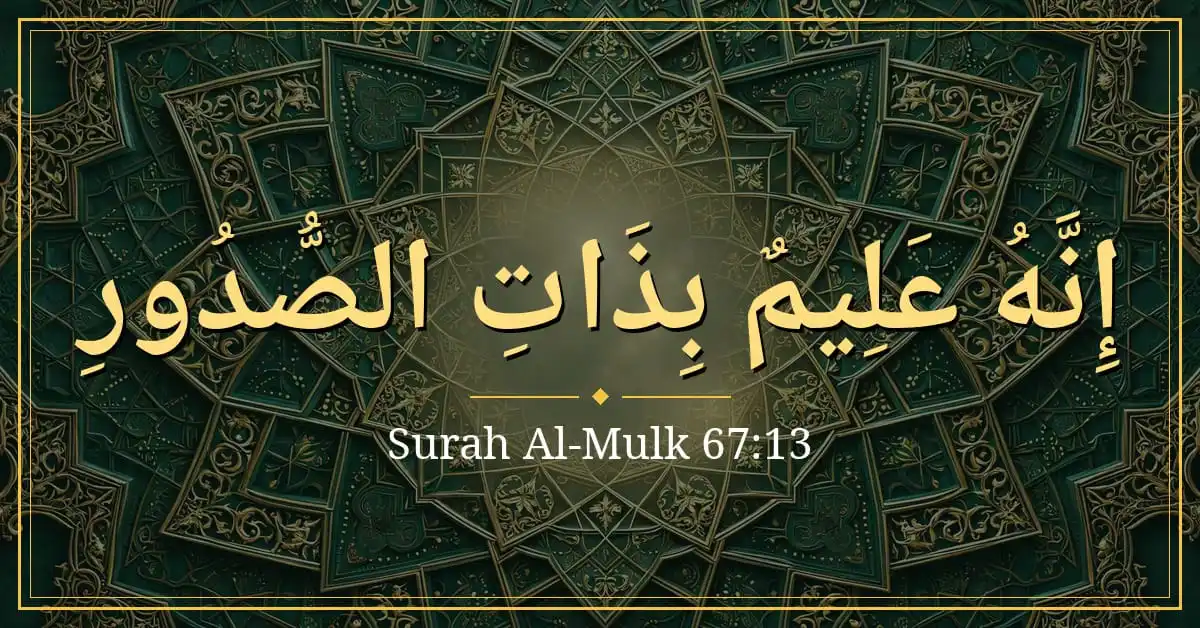
Arabic:
إِنَّهُ عَلِيمٌ بِذَاتِ الصُّدُورِ
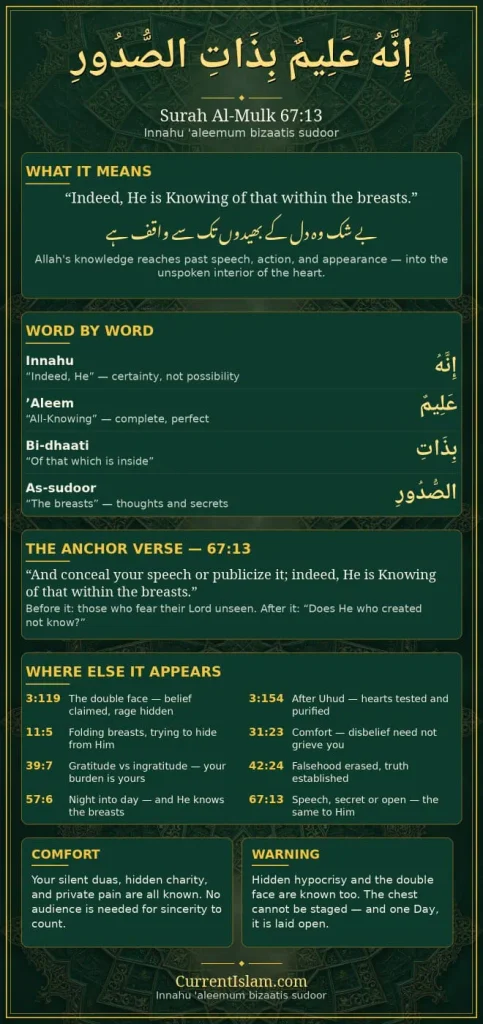
Transliteration: Innahu ‘aleemum bizaatis sudoor
Translation: “Indeed, He is Knowing of that within the breasts.” (Sahih International)
Urdu:
بے شک وہ دل کے بھیدوں تک سے واقف ہے
There are things you have never said out loud. A grief you carry quietly. A dua you whisper when no one is listening. A resentment you never voiced. A good deed no one saw. All of it sits in your chest. This verse says all of it is known. Not guessed. Not partly seen. Fully known, by the One who made you.
That is the whole weight of this phrase. It is short, but it changes how a person sees their inner life. Nothing inside you is off the record.
What the Words Mean
Innahu means “Indeed, He.” It is a statement of certainty. There is no doubt in it, no “maybe.”
‘Aleem means “All-Knowing.” This is an intensive word. It does not mean He knows a lot. It means His knowledge is complete and perfect. Human knowledge is learned piece by piece. We find things out. We forget things. His knowledge is not like that. It simply is, and it covers everything.
Bi-dhaati means “of that which is inside.” It points to what a thing carries within itself.
As-sudoor means “the breasts,” the chests. In the language of the Quran, the chest is where thoughts, intentions, secrets, and motives live. When the Quran speaks of the chest, it is speaking of the inner life of a person, not the body.
Put the four words together and the meaning is plain: Allah’s knowledge reaches past your speech, past your actions, and past your appearance, all the way into the unspoken interior of your heart.
The Anchor Verse: Surah Al-Mulk 67:13
The most famous place this phrase appears is Surah Al-Mulk, verse 13:
“And conceal your speech or publicize it; indeed, He is Knowing of that within the breasts.”
Read the verses around it and the picture becomes sharper. The verse before it speaks of those who fear their Lord unseen. Their faith is real even when no one is watching. No audience is needed for their fear of Allah to be true.
The verse after it gives the reason: “Does He who created not know, while He is the Subtle, Allah, the All-Aware?” The One who made you knows what He made. A craftsman knows his work. The Creator knows His creation, inside and out. That is the logic of the passage, and it is hard to argue against.
So the verse sets up a simple test. Whisper it or shout it. Hide it or say it openly. To Allah, it is the same. Your speech is not the limit of His knowledge. Your silence is not a hiding place either.
Where Else the Phrase Appears
This phrase is not a one-time line. It closes verses across the Quran, and each time it lands in a different human situation. That repetition is part of its power. Wherever human beings hide something, the Quran answers with the same line.
In Surah Al-Imran 3:119, it answers the double face. Some people say “we believe” to your face, then bite their fingertips in rage when they are alone. Allah knows what their breasts conceal.
In Surah Al-Imran 3:154, it comes after the pain of Uhud. Allah tests what is in the breasts and purifies what is in the hearts. Hardship is not random. It shows what is inside, and it cleans it.
In Surah Hud 11:5, it answers those who fold up their breasts and cover themselves with their clothes, trying to hide from Him. He knows what they conceal and what they reveal. Covering yourself does not cover you from Him.
In Surah Luqman 31:23, it comforts the Prophet. “Let not his disbelief grieve you.” Their return is to Allah, and He will inform them of what they did. The hidden rejection is not missed, and the Prophet is not asked to carry that grief.
In Surah Az-Zumar 39:7, it sits beside gratitude and ingratitude. No bearer of burdens bears the burden of another. What is in your chest is yours, and you will answer for it.
In Surah Ash-Shura 42:24, it follows truth against falsehood. Allah erases falsehood and establishes truth by His words. The false claims people hide behind do not survive Him.
In Surah Al-Hadid 57:6, it follows the rhythm of creation itself. He causes night to enter day and day to enter night, “and He is Knowing of that within the breasts.” The same power that turns the sky also knows your heart.
The Quran also calls itself a healing for what is in the breasts. That is the other side of this knowledge. The One who knows the sickness also sent the cure.
Two Sides: Comfort and Warning
This phrase has two sides, and an honest article must hold both.
The first side is comfort. Your private pain is known. Your hidden charity is known. Your silent duas are heard before you speak them. You do not need an audience for your sincerity to count. When you give quietly, when you forgive quietly, when you cry in prayer and no one else knows, none of it is wasted. It is all recorded by the One who sees the chest.
Think of the complaint of grief only to Allah in Surah Yusuf. A father loses his son, and he does not perform his pain for people. He takes it to Allah alone. That is what this verse protects: the quiet believer is not overlooked.
The second side is warning. Hidden hypocrisy is also known. Secret enmity, private mockery, and the double face are all visible to Him. The person who performs belief in public and conceals something else in private is not fooling anyone who matters. The chest cannot be staged.
That is why the phrase appears next to hypocrisy so often. It is a mirror. It asks the reader a direct question: does what is in your chest match what people see of you?
There is also a Day when the question is answered openly. Surah Al-Adiyat says that when the contents of the graves are scattered, “that within the breasts is obtained.” What the chest held in secret is brought out. Hidden things do not stay hidden forever.
What to Do With This Knowledge
Knowing that Allah knows your heart should change something practical. Here are three things it changes.
First, check your intention before a deed. The same outward act can be sincere or showy. Only Allah knows which one it was. Before you give, speak, or post, ask yourself one question: would I still do this if no one ever found out? If the answer is yes, your chest is in a good place.
Second, trust your silent duas. You do not need perfect words. You do not need to be heard by anyone else. When hardship presses, the dua for distress and hardship puts words to what your chest already feels, but even without words, the feeling itself is known. Do not grieve, Allah is with us. Those words were spoken in a cave, when only two people knew the danger. They are still true in your hardest hour.
Third, stop performing goodness for people. If your good deeds need witnesses, your chest is serving the wrong audience. Do one good thing this week that no one will ever know about. Give quietly. Forgive quietly. Pray quietly. That is the kind of deed this verse honors.
If anxiety sits in your chest, the dua for anxiety and depression is one place to turn. And if your heart feels unsteady, ask the turner of hearts to keep it firm. Hearts find rest in Allah’s remembrance, and that rest is real even when no one else sees your struggle.
A Final Word
You were never talking to an empty room. The One who made the chest knows what it holds. That is frightening if you are hiding something. It is deeply comforting if you are hurting quietly. Either way, it is true.
So carry this phrase with you: Innahu ‘aleemum bizaatis sudoor. Indeed, He is Knowing of that within the breasts. Let it make your intentions honest, your duas confident, and your quiet good deeds enough.
