
You receive a medical diagnosis that offers no cure. You look at a bank statement that shows crushing debt. You face a broken relationship that seems beyond repair. The physical world of cause and effect tells you it is over. The doors are shut. The math does not work.
The weight in your chest tells you to give up.
But as a Muslim, you are not bound by the physical math of this world. Your Creator is not restricted by material rules, timelines, or human logic. The cure to your despair is found near the end of Surah Ya-Sin, in a single verse that shatters the illusion of worldly limitations.
Quick Answer: What You Need to Know
- The Verse: “Innama amruhu iza arada shay’an an yaqula lahu kun fayakun” means “His command is only when He intends a thing that He says to it, ‘Be,’ and it is.”
- The Promise: Allah does not need physical tools, time, or circumstances to fix your problem. He only needs to will it.
- The Action: Use this verse in your daily dua to build unshakeable Tawakkul (trust in Allah) when facing “impossible” hardships.
The Text: Arabic, Transliteration, and Meanings
Understanding the exact wording is the first step to internalizing its power.
إِنَّمَا أَمْرُهُ إِذَا أَرَادَ شَيْئًا أَن يَقُولَ لَهُ كُن فَيَكُونُ
Transliteration: Innama amruhu idha arada shay’an an yaqula lahu kun fayakun.
English Translation (Sahih International): “His command is only when He intends a thing that He says to it, ‘Be,’ and it is.”
Urdu Translation:
“اس کا حکم تو یہ ہے کہ جب وہ کسی چیز کا ارادہ کرتا ہے تو اس سے فرماتا ہے کہ ‘ہوجا’ تو وہ ہو جاتی ہے۔”
Hindi Translation: “उसका आदेश तो यह है कि जब वह किसी चीज़ का इरादा करता है, तो उससे कहता है, ‘हो जा’, और वह हो जाती है।”
Word-by-Word Breakdown
| Arabic Word | Transliteration | Core Meaning | Theological Significance |
| إِنَّمَا | Innama | Only / Nothing else but | A restriction. It limits the process of creation strictly to His word, negating the need for any physical effort or assistance. |
| أَمْرُهُ | Amruhu | His Command | The command originates from His divine authority, entirely separate from the physical laws of the universe. |
| إِذَا أَرَادَ | Idha Arada | When He intends | Highlights Allah’s absolute Will (Iradah). Nothing is random. |
| شَيْئًا | Shay’an | A thing | Highly indefinite. It applies to a massive galaxy, a microscopic cell, or the resolution of your personal crisis. |
| كُن | Kun | “Be” | The singular, immediate imperative command. |
| فَيَكُونُ | fa-yakun | Then it is | Immediate manifestation. No delay between the command and the reality. |
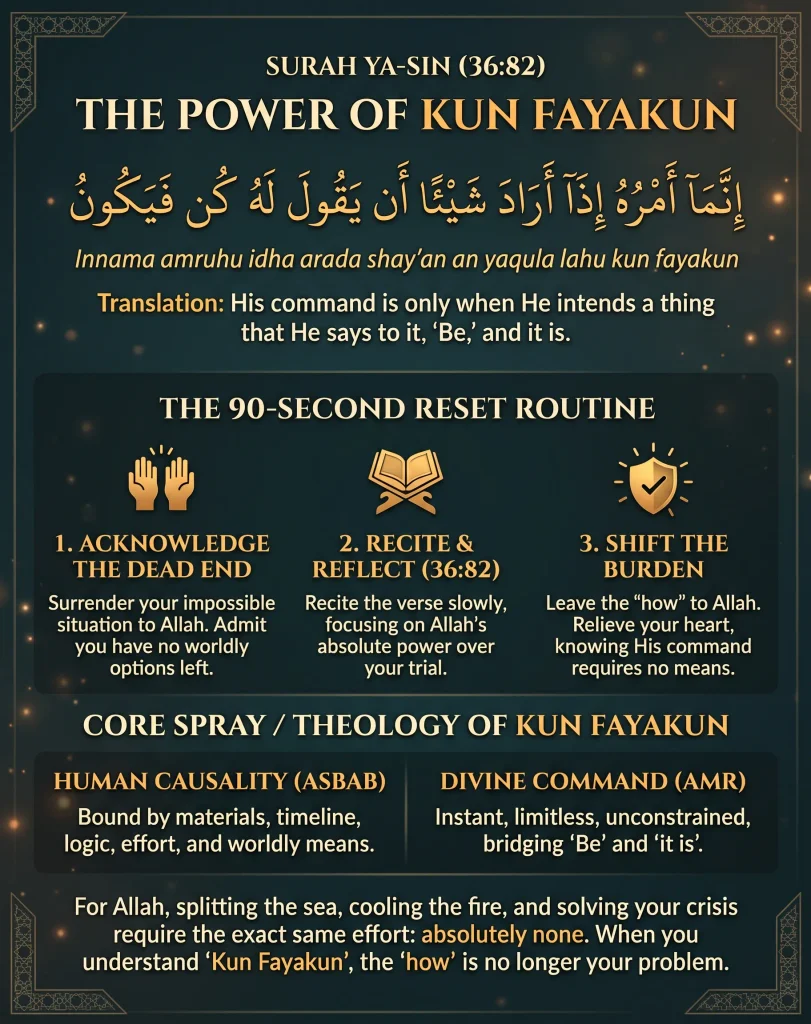
Innama amruhu iza arada Infographic
The Tafsir: Why Was This Verse Revealed?
The context of this verse directly addresses human doubt.
During the time of the Prophet ﷺ in Mecca, the polytheists mocked the concept of resurrection. A man named Ubayy bin Khalaf brought a decayed, crumbling bone to the Prophet ﷺ. He crushed it in his hands, blew the dust into the wind, and challenged, “Who will give life to these bones when they have rotted away?”
According to the classical Tafsir of Ibn Kathir, Allah revealed the closing verses of Surah Ya-Sin to answer this exact arrogance. The human mind looks at bone dust and sees a permanent end. Humans rely on Asbab (cause and effect). To build a house, we need bricks, mortar, and months of labor.
Allah responds by declaring He is the Lord of the causes themselves. He does not require pre-existing material to create life, nor does He need physical tools to alter your reality.
The Concept of Kun Fayakun in Daily Hardships
The core lesson of Kun Fayakun is recognizing that your hardship is only difficult for you. For Allah, splitting the Red Sea, cooling the fire for Prophet Ibrahim, and solving your specific financial or medical crisis require the exact same amount of effort: none at all.
Health Disclaimer: In Islam, dua complements professional medical care. Seeking medical treatment is an established Sunnah. Relying on this verse builds your spiritual resilience, but it must never replace consulting with a qualified doctor for physical or mental health conditions.
[SCHOLAR ANECDOTE: A few years ago, a young brother came to me in complete despair. His business had collapsed, leaving him with a mountain of debt. He brought a printed spreadsheet to our meeting, pointing at the red columns with a shaking finger. “Look at the numbers,” he said. “Even if I work three jobs, it will take me forty years to pay this off. It is mathematically impossible to survive this.”
I closed his laptop and told him, “You are trapped by the math, but you are forgetting the Creator of the math.”
I advised him to stop staring at the spreadsheet and start reflecting on Surah Ya-Sin 36:82. We did not ignore his financial reality or his obligation to pay it back, but we shifted his reliance entirely to Allah. We discussed how Allah is not bound by interest rates, timelines, or economic downturns. Once he truly internalized that Allah’s command is simply “Be,” his crushing anxiety evaporated. He stopped carrying the weight of the “how.” Just months later, an unexpected halal business partnership opened up for him. The debt did not magically vanish overnight, but the impossible burden became completely manageable. His spiritual peace returned long before his bank balance did.]
If you struggle with trusting Allah’s plan, engaging in Tazkiyat al-Nafs (purification of the soul) can help clear the anxiety that clouds your heart.
Is the “313 Times Wazifa” Authentic?
Many people search for a specific wazifa (recitation routine), often asking if reading “Innama amruhu iza arada” 313 times is the key to getting a dua answered.
The direct answer is that no authentic hadith prescribes reciting this specific verse exactly 313 times.
While the number 313 holds historical significance in Islam (such as the number of companions at the Battle of Badr), fixing a specific number to a verse for a guaranteed worldly result is not from the Sunnah of the Prophet ﷺ. When we treat Quranic verses like a vending machine—believing a specific numerical code forces an outcome—we lose the actual essence of the verse.
The verse is meant to build awe of Al Quddus (The Most Holy, The Pure) and complete submission to His will. Recite it as often as you need to calm your heart, but focus on the profound meaning rather than a strict numerical count.
The 90-Second “Kun Fayakun” Reset Routine
Instead of a baseless numerical counting routine, apply a meaning-based framework when anxiety strikes. Use this 90-second mental reset before your daily dua:
- Acknowledge the Dead End (30 seconds): Name your problem explicitly in your dua. Admit to Allah that by human standards, you have no options left.
- Recite Surah Ya-Sin 36:82 (30 seconds): Recite Innama amruhu iza arada shay’an an yaqula lahu kun fayakun slowly.
- Shift the Burden (30 seconds): Tell yourself: “My job is only to make the dua and take practical steps. The ‘How’ is Allah’s department.” Remind yourself that Allah is Ya Haseebo (The Sufficient), and His command requires no earthly materials.
What to Do When Your Dua Still Feels Unanswered
Sometimes, we make dua with full conviction in Kun Fayakun, yet our situation does not change immediately. It is entirely normal to feel a sudden drop in faith.
During these moments, remember that Allah’s Will (Iradah) includes perfect timing. He says “Be” at the exact millisecond it is best for your soul, not a moment earlier. If you feel forgotten, read Surah ad duha ayat 10 and the surrounding verses, which were revealed specifically to comfort the Prophet ﷺ when he felt his connection to revelation was paused.
Frequently Asked Questions
What does Innama amruhu iza arada mean?
It translates to: “His command is only when He intends a thing that He says to it, ‘Be,’ and it is.” It highlights Allah’s limitless ability to create and alter reality instantly without physical means.
Which Surah contains this verse?
This is verse 82 of Surah Ya-Sin, which is the 36th chapter of the Quran. Surah Ya-Sin is widely referred to as the heart of the Quran.
Is the 313 times wazifa for Surah Yaseen authentic?
No. There is no authentic hadith that instructs Muslims to read this specific verse 313 times to fulfill a need. Recite it with deep reflection and understanding instead of focusing on an unverified number.
Can I recite this verse for marriage or wealth?
You can recite any part of the Quran as a means of seeking blessings (Tawassul) before making dua for lawful desires like marriage, health, or wealth. However, do not treat the verse as a magic spell; treat it as an affirmation of your faith in His power.
Does Allah always say Kun Fayakun?
Yes, every single thing in existence, from the beating of your heart to the orbit of the planets, exists because Allah commands it to be.
Next Steps
If you found comfort in understanding how Allah’s command bypasses worldly struggles, continue your reading here:
- Read Next: Surah Anbiya ayat 10 – Understanding the honor given to you in the Quran.
Last reviewed by: Shahab Khan. All Quranic translations verified via Sahih International. Tafsir derived from Tafsir Ibn Kathir.
