You wake up, check your phone, and immediately feel the heavy weight of expectations. Whether you are a university student striving for top grades, a working professional chasing a promotion in a highly competitive market, or a diaspora parent trying to preserve your family’s identity, the pursuit of validation is exhausting. We constantly look for honor in society, wealth, and status, only to feel empty when those things inevitably fade.
Allah provides the ultimate cure for this modern identity crisis. Surah Anbiya Ayat 10 steps in to radically shift our perspective. It tells us clearly that our ultimate glory, worth, and honor already exist within the Book of Allah. We just need the intellect to realize it.
What is the meaning of Surah Anbiya Ayat 10?
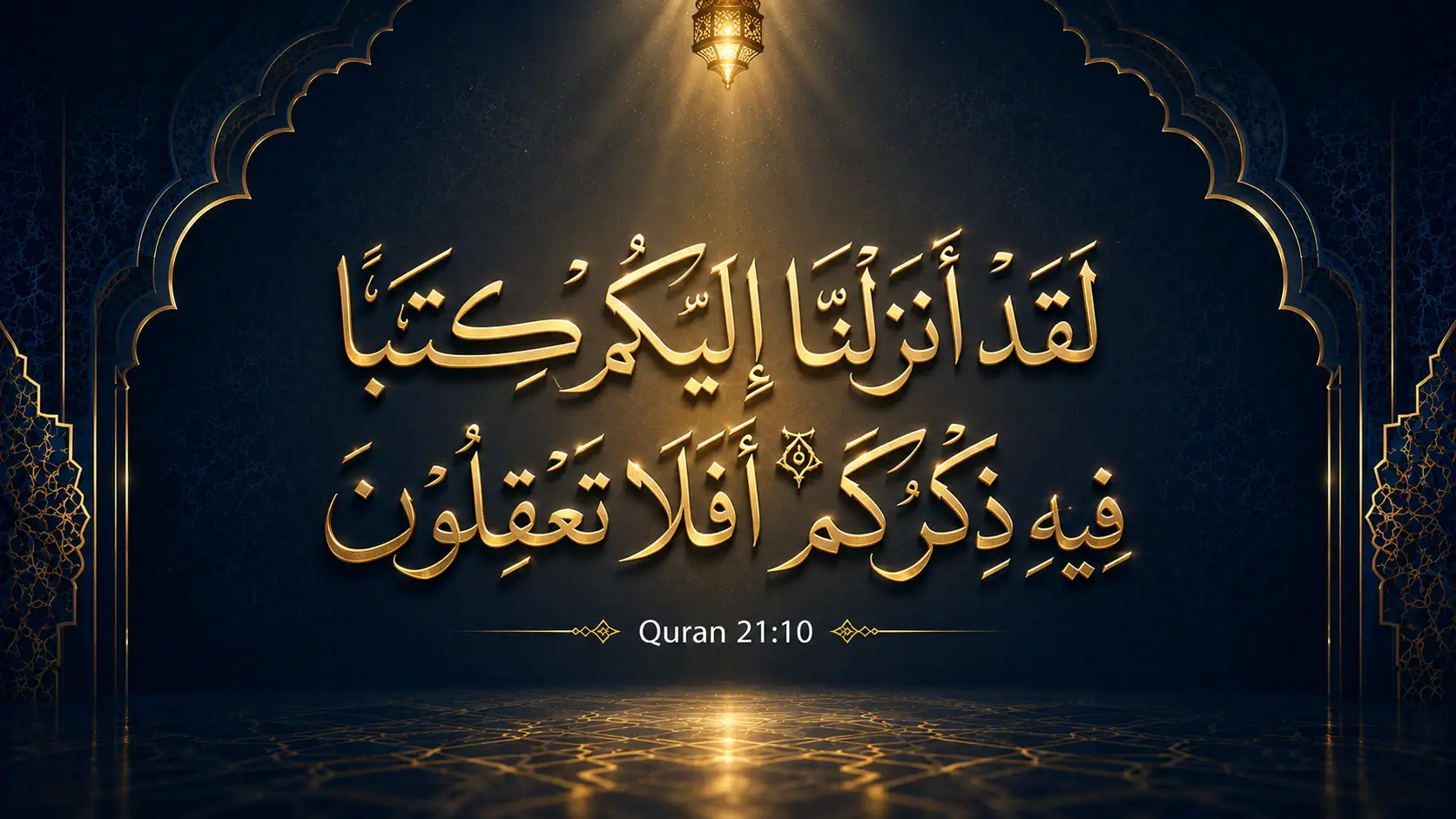
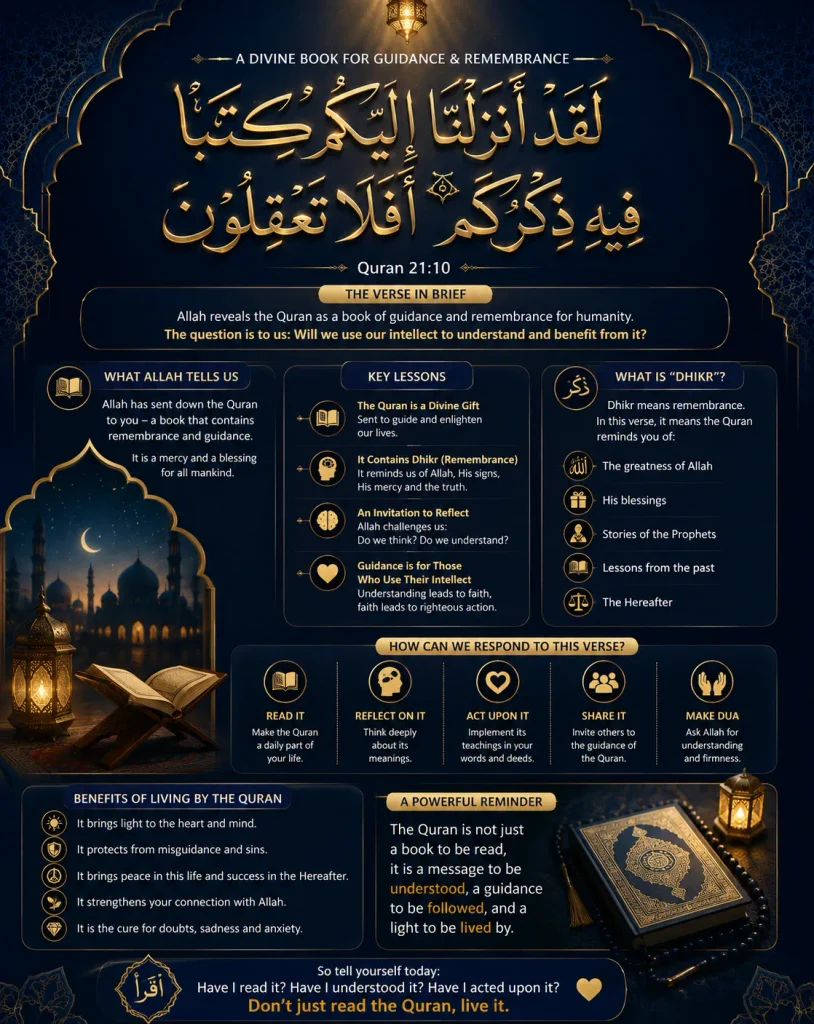
The meaning of Surah Anbiya Ayat 10 is that Allah has sent down the Quran as a direct source of honor, dignity, and guidance for humanity. The verse boldly challenges human intellect, asking why people seek prestige elsewhere when their ultimate glory is found within divine revelation.
The Multilingual Translation of Quran 21:10
Here is the exact linguistic breakdown of the verse to help you memorize and internalize its meaning.
- Arabic Text: لَقَدْ أَنزَلْنَا إِلَيْكُمْ كِتَابًا فِيهِ ذِكْرُكُمْ ۖ أَفَلَا تَعْقِلُونَ
- Transliteration: Laqad anzalna ilaykum kitaban feehi thikrukum; afala ta’qiloon.
- English Translation (US/UK): “We have surely revealed to you a Book, in which there is glory and a reminder for you. Will you not then understand?”
- Urdu Translation: “بیشک ہم نے تمہاری طرف ایک ایسی کتاب نازل کی ہے جس میں تمہارا ذکر (اور شرف) ہے۔ کیا تم عقل سے کام نہیں لیتے؟”
- Hindi Translation: “बेशक, हमने तुम्हारी तरफ एक ऐसी किताब उतारी है जिसमें तुम्हारी ही चर्चा (और सम्मान) है। क्या तुम अक्ल से काम नहीं लेते?”
The Tafsir of Quran 21:10: Finding Your “Dhikrukum”
The tafsir of Surah Anbiya verse 10 focuses on the word “Dhikrukum,” which means both “your reminder” and “your honor.” Classical scholars explain that the Arabs were globally insignificant until the Quran elevated their status, proving that true human dignity comes solely from attaching oneself to this Book.
To truly grasp the power of this verse, we must look at classical exegesis. Ibn Kathir explains that the primary audience initially consisted of the Quraysh. Before Islam, they were a desert community with little geopolitical power. The Quran was sent down to elevate them. Ibn Kathir emphasizes that whoever acts upon this Book achieves absolute honor in this life and the next.
Similarly, in Maarif-ul-Quran, Mufti Muhammad Shafi clarifies that the Quran does not just remind us of rules. It reminds us of our high status as the best of creation. When the noise of life makes you feel small, this verse acts as a profound Islamic guide to overcoming modern anxiety.
Because Allah made the Quran easy to remember, the path to claiming this honor is highly accessible to everyone, regardless of background or language.
The Linguistic Depth of Dhikr
To feed your intellect, here is how classical Arabic breaks down the core concepts of this verse.
“Will You Not Understand?” The Call to Intellect
The phrase “Afala Ta’qiloon” is a direct challenge to the human mind. Allah is asking why we blindly follow societal trends for validation when logic dictates that the Creator holds our true worth. Islam actively demands intellectual reasoning, not just blind, passive faith.
This is a crucial point for college students and working professionals facing secular academic environments. Islam is frequently mischaracterized as a religion devoid of logic. Quran 21:10 shatters that myth. The verse demands that we use our brains.
Prophet Muhammad (PBUH) constantly linked faith with active learning. He stated in Sahih Al-Bukhari (5027) that the best among you is the one who learns the Quran and teaches it. Engaging with the Quran is an intellectual exercise that literally rewires how you perceive your self-worth. If you struggle to grasp complex meanings, reciting a dua to increase knowledge is a powerful Prophetic habit to implement before opening the Book.
How to Apply Surah Al-Anbiya Verse 10 in Modern Life
To apply Surah Anbiya Ayat 10 daily, stop seeking validation from social media or corporate titles. Anchor your self-esteem in your relationship with the Quran. Recite it daily, study its meanings, and let its logic govern your emotional reactions to everyday stress.
Here is how you can build a spiritual habit loop around this verse:
- For the Working Professional: When a project fails or you feel overlooked at work, remember that Allah is with us. Your title does not define your honor; your adherence to ethical, Islamic principles does.
- For the Student: Before studying secular subjects, read one page of the Quran. Recognizing that Allah has power over all things will calm your test anxiety. Scientific studies increasingly show the Quranic benefits for anxiety, proving that spiritual grounding improves cognitive focus.
- For Parents: Teach your children this verse early. When they ask why they must pray or read Arabic, tell them: “This Book is where your honor is kept.” Teach them to always ask Allah to guide us to the straight path so they never lose their true identity.
FAQs:
The main message is that the Quran contains the honor, dignity, and explicit guidance for humanity. It challenges the reader to use their intellect to realize that true prestige comes from following divine revelation, rather than chasing worldly validation.
“Your mention” (Dhikrukum) implies that the Quran directly addresses human nature, psychological needs, and historical legacy. Classical scholars note that a person’s global respect and eternal legacy are directly tied to how tightly they hold onto the Quran.
This verse cures low self-esteem by shifting your source of validation from people to the Creator. When you realize that the Lord of the universe has sent a Book specifically to elevate your honor, societal opinions lose their power over your mind.
Keep Elevating Your Intellect
Surah Anbiya Ayat 10 demands that we use our intellect to find our honor. To truly understand the depths of the Quran and speak its truths with confidence, you need mental clarity. Take the next step in your spiritual journey by learning the exact prayer Prophet Musa (AS) used to expand his mind and speech.
Read Next: Rabbi Shrahli Sadri: The Ultimate Dua for Confidence and Intellect
