
Another rejection email — or worse, silence where a salary used to be. The bills do not pause, and every application feels like shouting into an empty room. If that is your season, the Quran hands you the words of a man who stood in a foreign town with no home, no money and no contacts, and watched Allah open door after door. His name was Musa (Moses), and his short prayer in Surah Al-Qasas is the dua for a job this guide unpacks.
Quick Answer
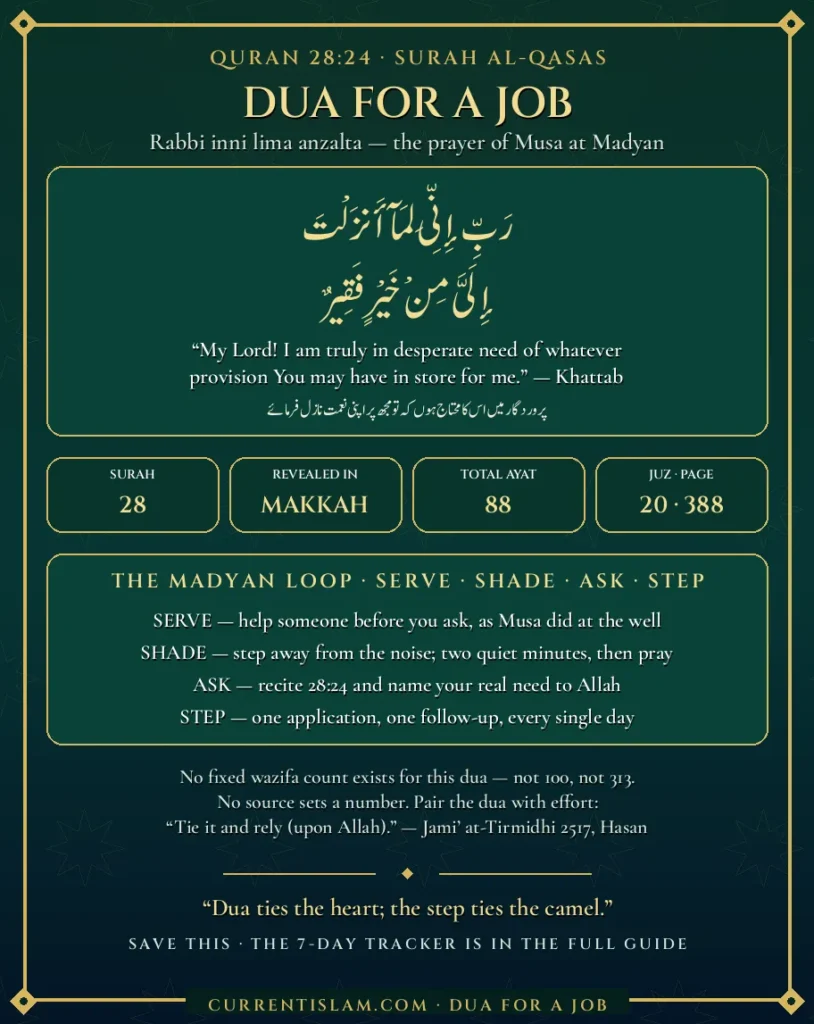
- The core dua is Surah Al-Qasas 28:24: Rabbi inni lima anzalta ilayya min khayrin faqir — “My Lord! I am truly in desperate need of whatever provision You may have in store for me.”
- No fixed recitation count for it exists in the Quran or Sunnah; make it often, as a dua, not a numbered ritual.
- Pair it with effort: Musa helped others before he prayed, and the Prophet ﷺ taught “tie it and rely (upon Allah).”
Contents: The dua and its meaning · What happened at Madyan · The fixed-count question · More duas for the search · The Madyan Loop practice plan · When provision feels delayed · Mistakes to avoid · FAQs · Next steps
What is the dua for getting a job?
The dua for getting a job is Musa’s prayer in Surah Al-Qasas 28:24, Rabbi inni lima anzalta ilayya min khayrin faqir. Homeless in Madyan, he asked Allah for whatever good He would send down. Muslims recite it for work, provision (rizq — all Allah provides, not salary) and marriage.
The verse (Surah Al-Qasas 28:24)
فَسَقَىٰ لَهُمَا ثُمَّ تَوَلَّىٰٓ إِلَى ٱلظِّلِّ فَقَالَ رَبِّ إِنِّى لِمَآ أَنزَلْتَ إِلَىَّ مِنْ خَيْرٍ فَقِيرٌ
The dua itself:
رَبِّ إِنِّى لِمَآ أَنزَلْتَ إِلَىَّ مِنْ خَيْرٍ فَقِيرٌ
Transliteration: Rabbi inni lima anzalta ilayya min khayrin faqir.
English (Khattab, The Clear Quran): “So he watered ˹their herd˺ for them, then withdrew to the shade and prayed, ‘My Lord! I am truly in ˹desperate˺ need of whatever provision You may have in store for me.'”
Urdu (Jalandhari):
تو موسٰی نے اُن کے لئے (بکریوں کو) پانی پلا دیا پھر سائے کی طرف چلے گئے۔ اور کہنے لگے کہ پروردگار میں اس کا محتاج ہوں کہ تو مجھ پر اپنی نعمت نازل فرمائے
| Word (Arabic & Transliteration) | Meaning |
|---|---|
| رَبِّ (Rabbi) | My Lord |
| إِنِّى (inni) | Indeed I |
| لِمَآ (lima) | For whatever |
| أَنزَلْتَ (anzalta) | You send down |
| إِلَىَّ (ilayya) | To me |
| مِنْ (min) | From / of |
| خَيْرٍ (khayrin) | Good, provision |
| فَقِيرٌ (faqir) | In desperate need, poor |
Notice what Musa never did: he named no job title, town or salary. He asked for whatever good Allah would send, leaving the answer’s shape to Allah. That open hand is why these words serve a graduate’s first application, a parent between contracts, and a new Muslim rebuilding in a city where nobody knows their name. Go deeper on our Surah Qasas ayat 24 page, or use the Arabic and Urdu breakdown.
What happened to Musa at Madyan?
Musa reached Madyan a fugitive who had fled Egypt with nothing. At the well he helped two women water their flock, then sat in the shade and made this dua. The chapter records the answer: an invitation home, paid work, safety and marriage, arriving through people within the day.
Read the order in Surah Al-Qasas (28:23–27) slowly; it becomes the practice plan below. Shepherds crowd the well while two women hold their flock back, unable to push through. Musa does not walk past. He waters their animals — hard work for strangers, with no promise of payment — and only then prays verse 24 in the shade. A daughter returns with her father’s invitation: he wants to reward him. The old man hears Musa’s story, tells him not to fear, and offers work — eight years, ten if he willingly completes them — and marriage into the family.
Service first, prayer second, and the answer arriving through a door Musa could not have applied for. Not because the words are a formula — because he brought Allah his need with a helpful heart and empty hands.
Is there a fixed wazifa count for this dua?
No fixed count exists. No Quran verse and no hadith in the collections checked sets a number for Rabbi inni lima anzalta — not 100, not 313, not 1,000. Sites prescribing a count, with Durood before and after, give no source for the figure. It is a dua, not a ritual.
What the sources do support: repeat a dua as often as you wish — repetition is beloved — but a personal habit differs from a promised count tied to a guaranteed result. Nobody can sell you a number Allah never set. If a site ties this dua to a total and a job by a date, ask for the source; when none comes, that is custom, not Sunnah (the Prophet’s ﷺ practice and teaching).
So recite it as Musa did: when the need is in front of you. After prayer, before an application, in the car outside an interview — no counter required.
Which other duas help in a job search?
Three more duas cover the search. After Fajr, the Prophet ﷺ asked Allah for beneficial knowledge, good provision and accepted deeds (Ibn Majah 925). Musa’s confidence dua in Surah Taha steadies the tongue before interviews, and Surah Al-Isra 17:80 prays for an honourable new beginning.
After Fajr — the Prophet’s ﷺ rizq dua. Umm Salamah reported that after the dawn prayer (Fajr, the first of the five daily prayers) the Prophet ﷺ would say: Allahumma inni as’aluka ‘ilman nafi’an, wa rizqan tayyiban, wa ‘amalan mutaqabbalan — “O Allah, I ask You for beneficial knowledge, goodly provision and acceptable deeds” (Sunan Ibn Majah 925, graded Sahih by Darussalam).
Before an interview — Musa’s confidence dua. Facing the greatest assignment of his life, Musa asked for an opened chest and an eased task (Surah Taha 20:25–28). Its opening line:
قَالَ رَبِّ ٱشْرَحْ لِى صَدْرِى
Rabbi-shrah li sadri — “My Lord! Uplift my heart for me” (Khattab). Our Rabbish rahli sadri guide gives all four verses.
Starting something new — the entrance dua. Surah Al-Isra 17:80:
وَقُل رَّبِّ أَدْخِلْنِى مُدْخَلَ صِدْقٍ وَأَخْرِجْنِى مُخْرَجَ صِدْقٍ وَٱجْعَل لِّى مِن لَّدُنكَ سُلْطَـٰنًا نَّصِيرًا
“And say, ‘My Lord! Grant me an honourable entrance and an honourable exit and give me a supporting authority from Yourself'” (Khattab). Read it on your first morning in a new role or city — see the Surah Bani Israel ayat 80 guide. For halal income itself, Allahumma akfini bihalalika ‘an haramika anchors our dua for rizq guide.
How do I practise this during a job search? The Madyan Loop
Practise it as a daily loop, not a one-off recitation. The Madyan Loop repeats Musa’s own order — Serve, Shade, Ask, Step — every day of the search: help someone, withdraw to pray, name your real need to Allah, then take one concrete step toward work.
Serve. Before Musa prayed a word, he lifted water for strangers. Your version takes ten minutes: share a contact, review a CV in the family chat, volunteer a skill at the masjid. Service keeps a seeker generous, not bitter — and builds the network answers travel through.
Shade. Musa withdrew to the shade, away from the crowd. Yours is a fixed quiet slot: after Fajr, or on the commute, phone away. Two minutes is enough — step off the timeline of panic before speaking to Allah.
Ask. Recite Rabbi inni lima anzalta slowly, then ask in your own words: the rent, the visa, Thursday’s interview. Add Ibn Majah 925 each morning and the Surah Taha dua on interview days.
Step. End each loop with one visible action: send the application, chase the follow-up, learn one skill for one hour. Asked whether to tie his camel or trust Allah and leave it loose, the Prophet ﷺ answered: “Tie it and rely (upon Allah)” (Jami’ at-Tirmidhi 2517, graded Hasan by Darussalam). Dua ties the heart; the step ties the camel. Wider support sits in our dua for success guide.
| Day | Dua Focus | One Step |
|---|---|---|
| 1 | 28:24 after every prayer | Send 2 applications |
| 2 | Ibn Majah 925 after Fajr | Ask one person for a referral |
| 3 | 28:24 in the last third of the night | Improve one CV section |
| 4 | 20:25–28 before any call or interview | Practise interview answers aloud |
| 5 | 28:24 + gratitude for one past blessing | Help one person, Musa-style |
| 6 | 17:80 for new beginnings | Apply outside your usual list |
| 7 | Review the week with 65:3 | Rest, then plan next week’s loop |
What does the Quran say when provision feels delayed?
The Quran answers delay with a promise about the source, not the schedule. Allah provides from unexpected places, and He suffices whoever trusts Him. Surah At-Talaq 65:3 pairs provision with tawakkul (trust in Allah while taking the means) — pictured by Prophet ﷺ as a bird leaving empty and returning full.
وَمَن يَتَوَكَّلْ عَلَى ٱللَّهِ فَهُوَ حَسْبُهُۥٓ وَيَرْزُقْهُ مِنْ حَيْثُ لَا يَحْتَسِبُ ۚ
“…and provide for them from sources they could never imagine. And whoever puts their trust in Allah, then He ˹alone˺ is sufficient for them” (Surah At-Talaq 65:3, Khattab).
‘Umar bin Al-Khattab narrated that the Messenger of Allah ﷺ said: “If you were to rely upon Allah with the required reliance, then He would provide for you just as a bird is provided for, it goes out in the morning empty, and returns full” (Jami’ at-Tirmidhi 2344, graded Hasan by Darussalam). The bird still goes out — trust is not a reason to stay in the nest, but the reason you can leave it without despair.
And if the search has worn you down, hear the verse for people who feel finished: in Surah Az-Zumar (39:53) Allah tells servants who have wronged themselves not to despair of Allah’s mercy. A delayed answer is not a denied one; Musa’s life turned on one afternoon he could not have predicted that morning.
What mistakes should I avoid while making dua for a job?
Avoid four mistakes: treating a fixed count as a guarantee, making dua while skipping applications, accepting haram (unlawful) income out of panic, and reading delay as rejection. Each breaks the Madyan pattern, where Musa served, prayed honestly, stayed within Allah’s limits, and let the answer come through people.
A fifth is quieter: hiding the search out of shame. Musa told Madyan’s old man his whole story, and that honesty opened the door. Tell two or three trusted people you are looking — in every country, most jobs travel through such conversations.
Frequently asked questions
What is the best dua for getting a job?
The best-known Quranic dua for a job is Musa’s prayer in Surah Al-Qasas 28:24 — Rabbi inni lima anzalta ilayya min khayrin faqir: “My Lord! I am truly in desperate need of whatever provision You may have in store for me.” He prayed it homeless in Madyan; work and shelter followed.
How many times should I recite Rabbi inni lima anzalta?
As often as you like — no count is fixed in the Quran or Sunnah, and popular totals such as 313 come with no source. Recite it after prayers, before applications, whenever need presses. One sincere dua, with action behind it, outweighs a distracted thousand counted from habit.
Can I recite this dua for marriage too?
Yes. Musa asked for whatever good Allah would send, and the answer at Madyan included work and marriage into a righteous family (28:27). The wording covers every need, so it is read for provision, marriage and relief alike. Our dua for love and marriage guide adds spouse-specific duas.
Which dua should I read before a job interview?
Read Musa’s confidence dua, Surah Taha 20:25–28 — Rabbi-shrah li sadri wa yassir li amri, “My Lord, uplift my heart and ease my task.” Musa prayed it before the greatest appointment of his life. Say it before leaving and in the waiting room, then walk in trusting Allah.
Is a wazifa for a job guaranteed to work?
No one can guarantee that. A wazifa is a recitation practice; the Quran and Sunnah promise Allah hears dua, not that a count forces a result by a date. Be wary of anyone charging money with a job promised by Friday — dua plus honest effort is the prophetic pattern.
What did the Prophet ﷺ read for rizq?
After Fajr, the Prophet ﷺ would say: “O Allah, I ask You for beneficial knowledge, goodly provision and acceptable deeds” (Sunan Ibn Majah 925, graded Sahih by Darussalam, from Umm Salamah). Ten seconds each morning, pairing provision with knowledge and accepted work — a complete job prayer in one line.
How long should I keep making dua if nothing changes?
Keep going. The Prophet ﷺ said a supplication is granted unless a person grows impatient and says, “I supplicated but it was not granted” (Sahih Muslim 2735a). Silence is not a verdict; Musa’s answer came after years of hardship, in one afternoon. Hold the loop: serve, shade, ask, step.
Can a non-Muslim or new Muslim read this dua?
Yes. The words are a simple, honest request anyone can say, and new Muslims often start here: the transliteration is short, the meaning plain. There is no membership step before asking your Creator for work — bring your need as you are, empty-handed and hopeful, as Musa did.
Next steps
- Start tonight: recite 28:24 after your next prayer, then take one Step — send one application.
- Deepen the verse: Surah Qasas ayat 24, word by word.
- Widen the toolkit: dua for rizq for halal income, and dua for success for the effort itself.
- Students in exam season: the same loop works with our dua for exams guide.
