
You check your email for the hundredth time. Another automated rejection from a recruiter, or worse, absolute silence. Your savings are dwindling, the societal pressure to settle down and find a righteous spouse is mounting, and the weight of your future feels entirely on your shoulders. You feel completely stuck.
The anxiety of job insecurity and the exhausting wait for the right life partner can drain your soul. When you do everything right—apply for jobs, speak to matchmakers, upgrade your skills—and doors still remain closed, the spiritual fatigue is very real.
But what if the absolute best remedy for provision and marriage was recited by a Prophet who had just lost absolutely everything? Surah Qasas Ayat 24 contains a desperate, life-altering supplication that instantly transformed Prophet Musa’s (AS) life from homelessness to absolute security.
Here is exactly how to practice it.
What is Surah Qasas Ayat 24?
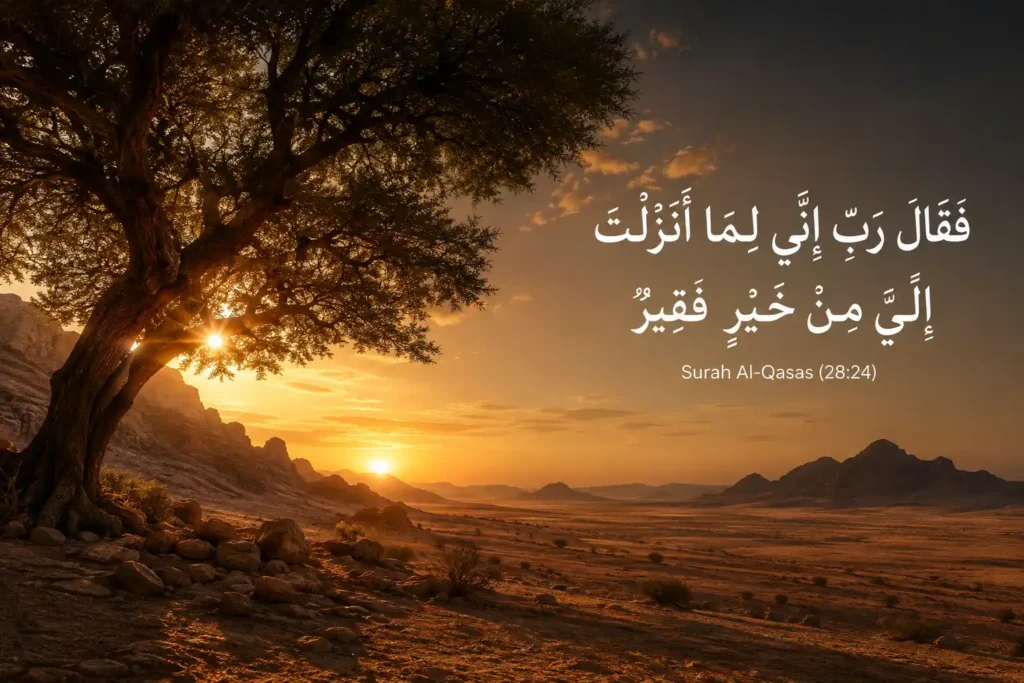
Surah Qasas Ayat 24 is a profound Quranic prayer (dua) recited by Prophet Musa (Moses) when he was homeless, starving, and seeking refuge in Madyan. The verse translates to: “My Lord, indeed I am, for whatever good You would send down to me, in need.”
Multilingual Translation: Surah Al-Qasas (28:24)
- Arabic Text: فَقَالَ رَبِّ إِنِّي لِمَا أَنزَلْتَ إِلَيَّ مِنْ خَيْرٍ فَقِيرٌ
- Transliteration: Faqala Rabbi inni lima anzalta ilayya min khairin faqir.
- English Translation: He said, “My Lord, indeed I am, for whatever good You would send down to me, in need.”
- Urdu Translation: اس نے کہا، “اے میرے رب، جو بھلائی تو میری طرف اتارے، میں اس کا محتاج ہوں۔”
- Hindi Translation: उसने कहा, “ऐ मेरे रब, जो भलाई तू मेरी तरफ उतारे, मैं उसका मोहताज हूँ।”
The Story Behind the Dua: Prophet Musa’s Darkest Hour
The story behind Surah Qasas verse 24 shows Prophet Musa fleeing Egypt in fear. After selflessly watering the flocks for two women in Madyan, he retreated to the shade, utterly exhausted, and begged Allah for provision, leading to immediate employment and marriage.
Let’s look at the exact circumstances surrounding this verse. Musa (AS) was a fugitive. He had traveled across the harsh desert without money, food, or even shoes. When fear and isolation cloud your mind, the Quranic reminder la tahzan innallaha ma’ana (do not grieve, Allah is with us) becomes a lifeline. Musa lived this reality.
Upon reaching Madyan, he saw two women struggling to water their sheep because they did not want to mix with the aggressive male shepherds. Despite his own severe starvation, Musa stepped in and helped them. He did not ask for a wage. He simply walked away to the shade of a tree and surrendered his situation to Allah.
Within hours of making this dua, the women’s father (often identified as Prophet Shoaib) invited Musa to his home, offered him a secure job for eight to ten years, and gave him one of his daughters in marriage.
Word-by-Word Meaning: Breaking Down the Plea
Let’s break down the exact meaning of this verse to understand why it is so effective.
- Rabbi (رَبِّ): My Sustainer. He does not use a generic title; he calls upon the specific attribute of Allah that feeds, nurtures, and protects.
- Inni (إِنِّي): Indeed, I am. This is a declaration of absolute vulnerability.
- Lima Anzalta (لِمَا أَنزَلْتَ): For whatever You send down. Notice that Musa did not ask for bread, a house, or a sword. He left the definition of “good” entirely up to Allah, perfectly embodying the mindset of wama tawfiqi illa billah (my success is only by Allah).
- Min Khairin (مِنْ خَيْرٍ): Of good.
- Faqir (فَقِيرٌ): Desperately poor. In Arabic, faqr literally refers to the breaking of the vertebrae of the back. It signifies a poverty or need so severe that it “breaks the back.”
How to Apply the Spiritual Habit Loop Today
Here is why this matters for your daily routine. Knowing the history is good, but applying it as a spiritual habit loop is life-changing.
When you feel crushed by modern pressures, complaining to people rarely helps. Instead, channel that desperation into your prayers. Whether you are crying on your bedroom floor in the middle of the night performing Tahajjud namaz, or you ever find yourself making dua at holy sites like maqam-e-ibrahim, reciting this verse shifts your mindset from panic to total reliance.
Many scholars highly recommend this exact phrase as the ultimate dua for love marriage and finding a righteous spouse, simply because it worked for Prophet Musa. If you are struggling at work, pair this verse with a dedicated dua for rizq (sustenance) to open blocked financial doors.
Authentic Hadith on Absolute Reliance (Tawakkul)
The core engine behind Surah Qasas Ayat 24 is Tawakkul—complete trust in Allah’s timing and provision. Prophet Muhammad (PBUH) beautifully explained how Allah treats those who rely on Him entirely.
The Messenger of Allah (ﷺ) said: “If you depend on Allah with due reliance, He would certainly give you provision as He gives it to birds who go forth hungry in the morning and return with full bellies at dusk.”
- Arabic Text: لَوْ أَنَّكُمْ تَتَوَكَّلُونَ عَلَى اللَّهِ حَقَّ تَوَكُّلِهِ لَرَزَقَكُمْ كَمَا يَرْزُقُ الطَّيْرَ، تَغْدُو خِمَاصاً وَتَرُوحُ بِطَاناً
- Transliteration: Law annakum tatawakkaluna ‘alallahi haqqa tawakkulihi larazaqakum kama yarzuqut-tayra, taghdu khimasan wa taruhu bitanan.
- English Translation: “If you all depend on Allah with due reliance, He would certainly give you provision as He gives it to birds who go forth hungry in the morning and return with a full belly at dusk.” (Sunan at-Tirmidhi 2344 – Hasan Sahih)
- Urdu Translation: اگر تم اللہ پر اس طرح توکل کرو جیسا کہ توکل کرنے کا حق ہے، تو وہ تمہیں اس طرح رزق دے گا جیسے پرندوں کو دیتا ہے۔
- Hindi Translation: यदि तुम अल्लाह पर वैसा ही भरोसा करो जैसा भरोसा करने का हक़ है, तो वह तुम्हें उसी तरह रिज़्क़ देगा जैसे पक्षियों को देता है।
Surah al qasas ayat 24 pdf
FAQs:
The best dua for getting a job is Surah Qasas Ayat 24: “Rabbi inni lima anzalta ilayya min khairin faqir.” Prophet Musa recited this when he was unemployed and homeless, and Allah immediately granted him a secure job and shelter in Madyan.
This exact phrasing is found in Surah Al-Qasas (28:24) in the Holy Quran. It is universally recognized by Islamic scholars as the premier supplication for anyone facing severe financial, emotional, or marital distress.
Yes, Surah Qasas Ayat 24 is highly recommended for marriage. Because Prophet Musa was offered a righteous spouse immediately after making this exact plea, scholars advise single Muslims to recite it consistently when seeking a husband or wife.
There is no strict Sunnah count for reciting Surah Qasas Ayat 24. You can recite it as often as you like throughout the day. Many scholars suggest reciting it 11, 33, or 100 times after your daily obligatory prayers to build a consistent spiritual habit.
Does someone you know feel overwhelmed by job hunting or the search for a spouse? Share this article with them right now. A simple forward might be the exact spiritual lifeline they need today.
