You check the seatbelt again. Your daughter is only going across town, but your hand stays on the door a second too long. A son boards a plane for his first job abroad. Letting go of someone you love is among the hardest acts of faith.
Prophet Yaqub (Jacob, peace be upon him) stood in that exact doorway. Years earlier, his sons took young Yusuf out for the day and came home without him. Now the same sons asked to take his youngest, Binyamin, to Egypt. What Yaqub said then became one of the most loved duas in the Quran:
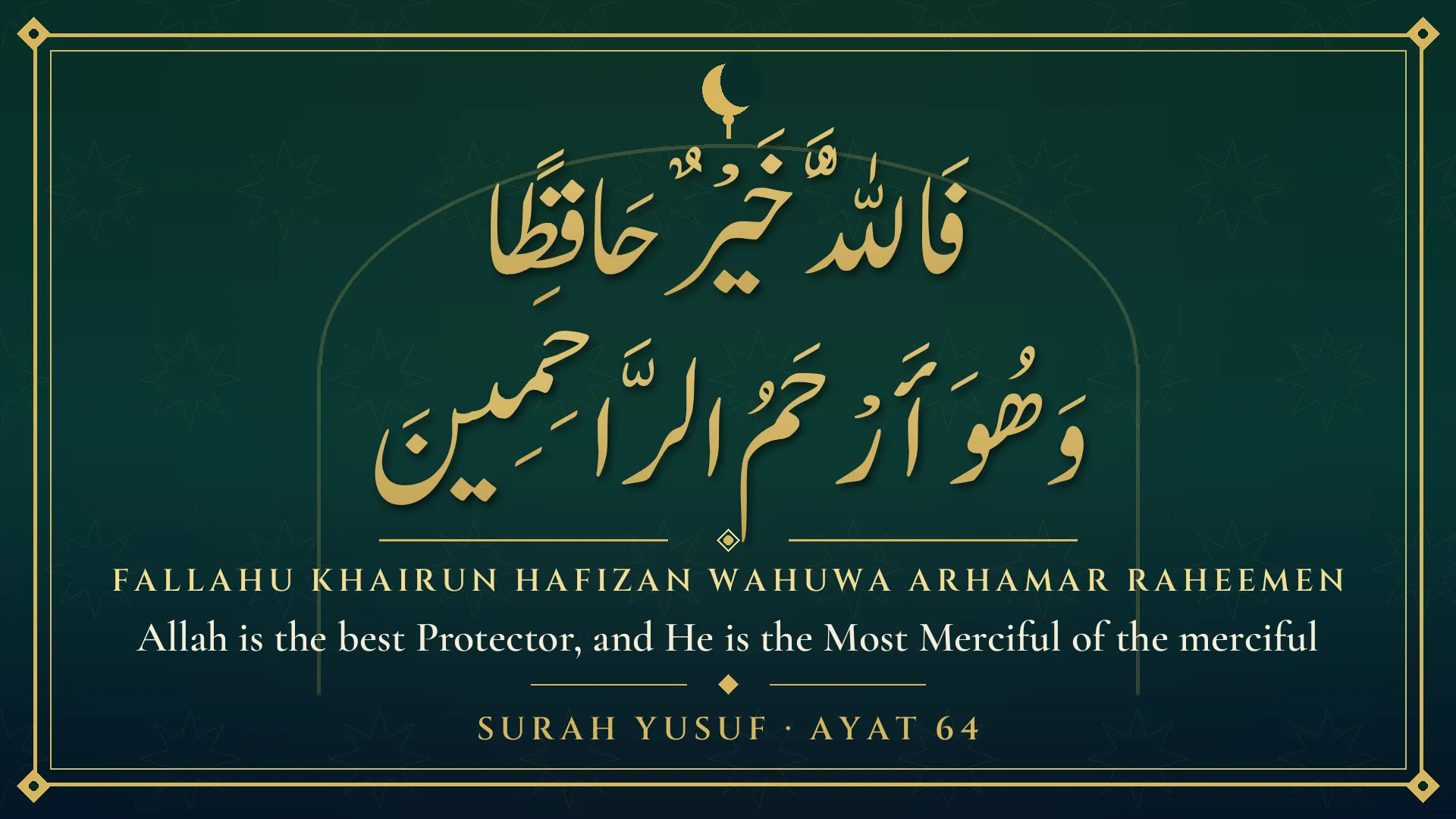
Fallahu khairun hafizan wahuwa arhamar rahemeen — “But Allah is the best Protector, and He is the Most Merciful of the merciful.”
Quick Answer
– Fallahu khairun hafizan is from Surah Yusuf, ayat 64 (Quran 12:64), spoken by Yaqub as he sent his son Binyamin to Egypt.
– It means Allah is the best Protector and the Most Merciful of the merciful — for handing someone you love into His care.
– No fixed number of repetitions is prescribed in the Quran or authentic Sunnah. Recite it as Quran and dua, meaning in mind.
Contents: What it means · Who said it, and why · Benefits · The wazifa count question · The Yaqub Handover · Common mistakes · Comparison · FAQs · Your next step
What does “Fallahu khairun hafizan wahuwa arhamar rahemeen” mean?
It means: “But Allah is the best Protector, and He is the Most Merciful of the merciful.” It is the second half of Surah Yusuf, ayat 64. A father who had lost one son says that human guarding failed him once, so his trust rests with Allah alone.
Qala hal aamanukum ‘alayhi illa kama amintukum ‘ala akheehimin qabl. Fallahu khayrun hafizan wa huwa arhamur-rahimeen.
“He responded, ‘Should I trust you with him as I once trusted you with his brother [Joseph]? But [only] Allah is the best Protector, and He is the Most Merciful of the merciful.'” (12:64, Dr. Mustafa Khattab, The Clear Quran)
Urdu (Fateh Muhammad Jalandhari):
سو خدا ہی بہتر نگہبان ہے اور وہ سب سے زیادہ رحم کرنے والا ہے
Hindi (Maulana Azizul Haque al-Umari): अल्लाह ही बेहतर संरक्षण करने वाला है और वह सब दया करने वालों से अधिक दया करने वाला है।
| Arabic | Transliteration | Meaning |
|---|---|---|
| فَاللَّهُ | Fallahu | So / but Allah |
| خَيْرٌ | khairun | is the best |
| حَافِظًا | hafizan | Protector, Guardian |
| وَهُوَ | wahuwa | and He |
| أَرْحَمُ | arhamar | the Most Merciful |
| الرَّاحِمِينَ | rahemeen | of those who show mercy |
Two words carry the dua. Hafiz means one who guards and preserves — the root of Al-Hafiz, a name of Allah. And arhamar rahemeen says Allah’s mercy stands above every other mercy, including a parent’s.
Who said this dua, and why?
Prophet Yaqub said it when his sons returned from Egypt short of grain. Egypt’s storehouses would release no more food unless the brothers brought young Binyamin with them (12:63). Yaqub had to choose between hunger at home and risking a second son.
He names the past plainly: “Should I trust you with him as I once trusted you with his brother?” The promise “we will guard him” had been made before, and it ended in loss — and in envy, the danger named in min sharri hasidin iza hasad (113:5). People plot, as the brothers once plotted. Against every human plan stands Allah’s plan — Surah Tariq last 3 ayat: people plot, and Allah plans, and His plan prevails.
Tafsir Ibn Kathir reads Yaqub’s closing words as a dua: conscious of his old age and longing, Yaqub was invoking Allah to return his son and reunite them. He voices it again in Innama ashku bassi wa huzni ilallah — “I only complain of my suffering and grief to Allah” (12:86). Yet Yaqub does not collapse, and he does not refuse. He takes a promise from his sons, gives practical instructions, and hands the outcome to Allah. That is tawakkul (trust in Allah): trust that works through the means, not instead of them. What Allah wills, comes to be — kun fayakun, “Be, and it is” (36:82).
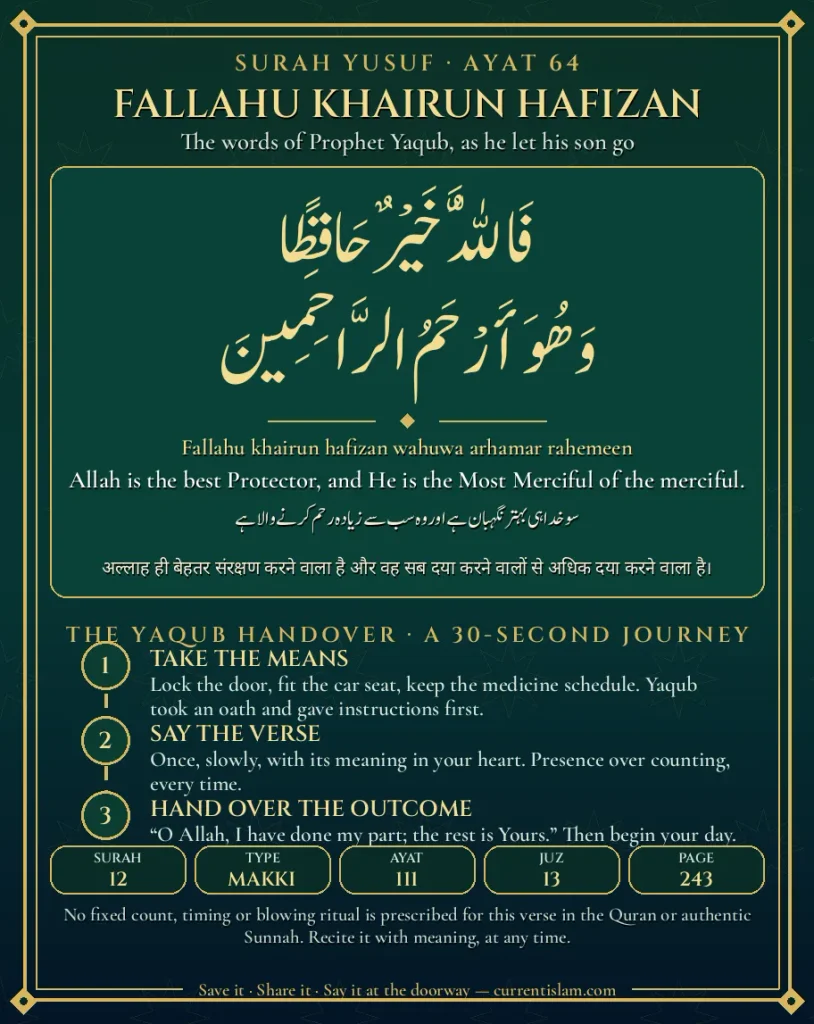
Surah Yusuf Ayat 64 Infographic: Translations and Trust in Allah
What are the benefits of reciting Fallahu khairun hafizan?
Its benefits flow from its meaning, not from a formula. Recited slowly, with understanding, it settles the fear of letting go. It turns a parting into worship, places the person you love with the best Protector, and reminds you that Allah’s mercy reaches where your hands cannot.
Four things change at the door. Your dua becomes Quran — Allah’s own words. Your trust gains a reason: the Protector is khair, the best, not merely adequate. Your grief has somewhere to go — compare the Dua Yunus. And love becomes action: do your part, then release the result.
One honesty note: no verse or hadith promises this phrase will prevent every accident or illness. Its gifts are nearness to Allah and a calm heart; outcomes rest with His wisdom.
Is there a fixed wazifa count for this verse?
No. Neither the Quran nor any authentic hadith fixes a count, a time of day, or a blowing ritual. Counts shared online, such as reciting it set times over a child for guaranteed protection from the evil eye or disease, are not established in the sources.
This frees the dua rather than weakening it. A Quran verse may be recited as worship and supplication at any time, once or many times. If a teacher’s routine helps your consistency, treat it as personal advice, not a condition set by Allah or His Messenger ﷺ. For established daily protection remembrances, see morning and evening azkar.
How can I practise this dua today? The Yaqub Handover
Copy Yaqub’s pattern at your own doorway moment. The Yaqub Handover takes about thirty seconds, in three steps:
- Take the means. Lock the door, fit the car seat, keep the medicine schedule. Yaqub took an oath and gave instructions first — as Zakariya’s dua in old age, Qala rabbi inni wa hanal azmu, joined asking with action.
- Say the verse once, slowly, with its meaning.
- Hand over the outcome. “O Allah, I have done my part; the rest is Yours.” Then get on with your day.
Start tonight. At bedtime, recite the verse once aloud, softly, and give your child its meaning in one line: “Allah guards you better than I can.”
Work, school, commute. Before a presentation or exam: prepare honestly, recite once, begin. As the train doors close, begin with Allah’s name, not dread. When worry returns: Allah knows what no guard can see — Innahoo aleemum bizaatis sudoor, what is hidden within the chests (67:13), before whom every face will bow, wa anatil wujuhu lil hayyul qayyum (20:111).
Common mistakes when using this dua
- Treating it as a magic shield. It is a dua, not a force field. It expresses trust; it does not cancel Allah’s decree.
- Believing a fixed count is required. Invented numbers shift trust from Allah to arithmetic.
- Skipping the practical steps. Dua never replaces a seatbelt, a locked door, or a doctor. For illness, treatment comes first, dua beside it.
- Despairing if harm still occurs. Yusuf was lost for years, and Yaqub kept trusting. A painful outcome is not proof of failure; Musa in a strange land prayed Rabbi inni lima anzalta and waited (28:24).
Fallahu khairun hafizan vs Hasbunallahu wa ni’mal wakeel
Both are Quranic words of trust; the difference is the moment each was spoken. Yaqub’s words hand over a person you love. Hasbunallahu wa ni’mal wakeel — “Allah is sufficient for us, and He is the best Disposer of affairs” — is for when you yourself face threat.
| Fallahu khairun hafizan | Hasbunallahu wa ni’mal wakeel | |
|---|---|---|
| Source | Surah Yusuf 12:64 | Surah Aal-e-Imran 3:173 |
| Spoken by | Prophet Yaqub | The believers, facing an enemy |
| Core idea | Allah best protects the one I love | Allah is enough for me |
| Best moment | Letting a loved one go | Facing fear or bad news yourself |
Fallahu Khairun Hafizan (Surah Yusuf Ayat 64): Meaning, Translations, and PDF Guide
FAQs
Which surah is Fallahu khairun hafizan in?
It is in Surah Yusuf, the twelfth chapter of the Quran, ayat 64 — reference Quran 12:64, in Juz 13. Prophet Yaqub speaks the words near the middle of Yusuf’s story, as his sons prepare to return to Egypt with their younger brother Binyamin (Benjamin).
Can I read it for my children’s protection?
Yes. Reciting Quran and making dua for your children is a beloved act, and these are a father’s words for his son. Recite it with its meaning, alongside practical care. No specific count or blowing ritual is established in the Quran or authentic Sunnah.
How many times should I recite it?
As often as you wish, with no fixed number. No hadith or verse sets a count, a time, or a number of days for this phrase. Once with full attention beats many rushed repetitions. Consistency and presence matter more than any total.
Can I read it when I am anxious about my family?
Yes, and you will be following Yaqub himself, who spoke it from inside fear and grief, not after they passed. Say it slowly, take the practical steps open to you, then hand the outcome to Allah. If anxiety becomes constant, seek professional support alongside dua.
Is Fallahu khairun hafizan a dua or a verse?
It is both. The words are part of a Quran verse, Surah Yusuf 12:64, recording what Prophet Yaqub said. Because they ask Allah for protection and praise His mercy, believers also recite them as a dua in their own moments of letting go.
What is the meaning of Fallahu khairun hafizan in Urdu and Hindi?
The phrase means that Allah alone guards best, and that His mercy is greater than the mercy of anyone who shows mercy. Both published translations keep the same order — protection first, then mercy — exactly as Yaqub spoke the words. Urdu (Jalandhari): سو خدا ہی بہتر نگہبان ہے اور وہ سب سے زیادہ رحم کرنے والا ہے. Hindi (al-Umari): अल्लाह ही बेहतर संरक्षण करने वाला है और वह सब दया करने वालों से अधिक दया करने वाला है।
Your next step
Tonight, pick one doorway moment — a bedtime or a goodbye at the gate — and do the Yaqub Handover once: take the means, say the verse with its meaning, hand over the outcome.
Three lines worth saving:
- “You can guard the door. Only Allah guards the road.”
- “Yaqub let go of his son twice, and trusted Allah both times.”
- “Do your part carefully. Then let the Most Merciful carry the rest.”
Last reviewed: 30 October 2026 · Author: Shahab Khan · Reviewed by: Atif khan.
