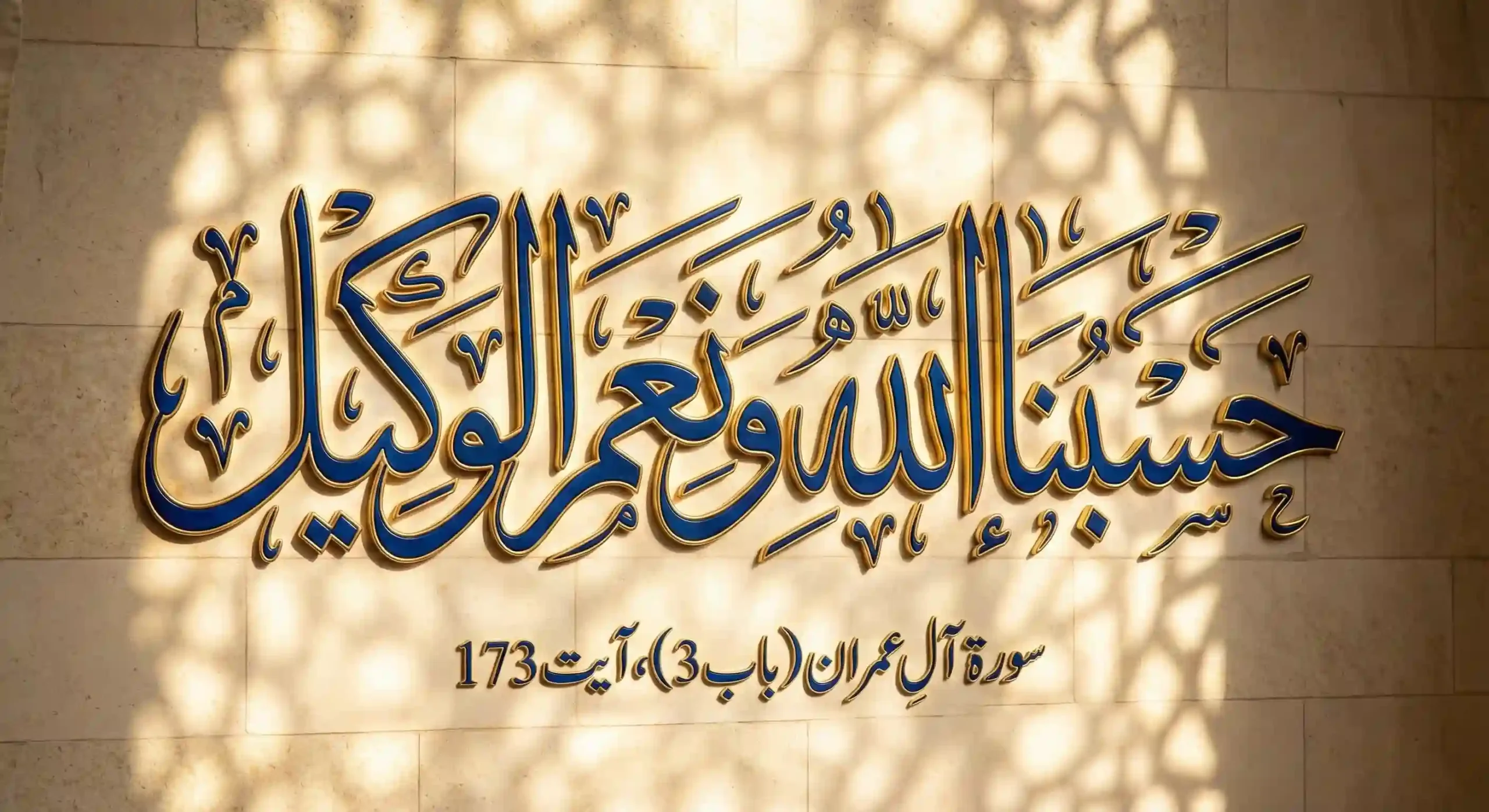
Meaning, Benefits & The “313 vs. 450” Wazifa Guide
Is your heart racing right now? Are you staring at a problem—a debt, a diagnosis, or a conflict—that feels like a mountain you can’t climb?
Stop. Breathe.
You don’t need a new plan. You need a new Guardian.
The phrase “Hasbunallahu wa ni’mal Wakeel” isn’t just a prayer; it is a divine release of control. It is the exact sentence Prophet Ibrahim (Abraham) said when he was thrown into a fire, and the fire turned cool. It is the sentence Prophet Muhammad (PBUH) said when an army gathered to destroy him, and he returned unharmed.
Here is how to use this ancient “spiritual technology” to shift your burden from your shoulders to the Owner of the Heavens.
What Does “Hasbunallahu Wa Ni’mal Wakeel” Mean?
Hasbunallahu wa ni’mal Wakeel is an Arabic phrase from the Quran (Surah Al-Imran, Verse 173). It translates to “Allah is sufficient for us, and He is the best Disposer of affairs.” It is recited to overcome fear, anxiety, and helplessness by placing total trust in God.
The Multilingual Quadrant (Authentic Sources)
To ensure your recitation is accepted, accuracy matters. Here is the verified script from the Holy Quran (3:173):
| Language | Script / Text |
| Arabic | حَسْبُنَا اللَّهُ وَنِعْمَ الْوَكِيلُ |
| Transliteration | Hasbunallahu wa ni’mal Wakeel |
| English (Saheeh Intl.) | “Sufficient for us is Allah, and [He is] the best Disposer of affairs.” |
| Urdu (Fateh M. Jalandhari) | “مجھ کو خدا کافی ہے اور وہ بہت اچھا کارساز ہے” |
Deep Tafsir: The “Wakeel” Concept
Classical scholar Ibn Kathir explains that a Wakeel is not just a “trustee.” Think of a lawyer in a courtroom. You don’t speak; your lawyer speaks for you because they know the law better than you. When you call Allah your Wakeel, you are officially handing over your “case” to the One who cannot lose.
The “Digital Sunnah” Master Plan: A New Way to Handle Stress
The Digital Sunnah strategy involves using Dhikr to break modern anxiety loops. Instead of doom-scrolling when you feel stressed, you recite Hasbunallahu wa ni’mal Wakeel to trigger a “Cognitive Switch,” moving your mind from panic to peace.
Modern life traps us in a “Control Loop”: we obsess over texts, emails, and news we can’t control.
Try the “Notification Rule”:
Every time you get a piece of bad news (a bill, a rude comment, a scary headline), immediately say this phrase before you react. It interrupts the brain’s “Fight or Flight” response and activates Tawakkul (spiritual reliance).
7 Miraculous Benefits of Reciting Hasbunallahu Wa Ni’mal Wakeel
The benefits of reciting Hasbunallahu wa ni’mal Wakeel include immediate relief from anxiety, divine protection from enemies, and the strengthening of faith (Tawakkul). It is also known to bring financial sufficiency and turn impossible hardships into ease, just as it did for Prophet Ibrahim (AS).
Scholars and spiritual masters have identified seven core benefits of making this Dhikr a daily habit:
1. The “Fire-Cooling” Effect on Anxiety
Just as the fire became cool for Prophet Ibrahim (AS), this Dhikr “cools” the fires of panic and stress in the heart. It is the ultimate spiritual antidote for overthinking.
2. Divine Protection (Hifz)
When you say “Allah is sufficient,” you are building a spiritual fortress. It acts as a shield against the evil eye (Nazar), jealousy, and hidden plots from enemies.
3. Financial Sufficiency
One of the hidden benefits is the opening of doors for Rizq (sustenance). It shifts your reliance from your job or business to the Provider of the job, often resulting in unexpected financial aid.
4. Courage in the Face of Oppression
If you are dealing with a difficult boss, a toxic relationship, or a legal battle, this phrase instills a supernatural bravery. It reminds you that no human has power over you without Allah’s permission.
5. Acceptance of Dua
Reciting this phrase before asking for your needs shows Allah that you trust His timing. This state of submission (Tawakkul) is often the key to having your specific prayers answered.
6. Replacing Weakness with Power
It transforms feelings of helplessness into empowerment. You stop feeling like a victim of circumstance and start feeling like a protected servant of the King of Kings.
7. The Reward of the Prophets
By reciting this, you are reviving the Sunnah of the two greatest Prophets (Ibrahim and Muhammad, peace be upon them). This carries immense weight on your scale of good deeds (Mizan) in the Hereafter.
“Ya Naru Kuni Bardan”: The Verse That Cooled the Fire
Discover the secrets of Surah Al-Anbiya (Verse 69) and how Prophet Ibrahim (AS) survived the impossible.
Read Full Guide →“Wallahu Ghalibun Ala Amrihi”: The Secret of Surah Yusuf
Unlock the hidden power of “Allah is Predominant over His Affairs” to conquer your fears and master your destiny.
Read Full Guide →3 Powerful Wazifa Methods (Tested by Spiritual Experience)
Note: While the Sunnah supports reciting this phrase generally at any time, the following counts (Adad) are based on the spiritual experiences (Mujarrabat) of pious scholars and saints for focus and discipline.
1. The “313 Times” Method (For Urgent Hajat/Needs)
Reciting Hasbunallahu wa ni’mal Wakeel 313 times is often done for urgent needs or specific requests. This number corresponds to the number of Muslim soldiers at the Battle of Badr, symbolizing victory against impossible odds.
- Best Time: After Isha prayer.
- Duration: 7 to 11 days.
- Method:
- Recite Durood Shareef 11 times.
- Recite the verse 313 times with deep focus on your problem.
- Recite Durood Shareef 11 times.
- Make Dua explicitly mentioning your need.
2. The “450 Times” Method (For Wealth & Rizq)
- Target: People drowning in debt or facing unemployment.
- The Logic: Scholars have noted this count acts as a powerful “spiritual magnet” for sustenance (Rizq).
- Instruction: Perform this daily after Fajr (dawn) prayer before speaking to anyone. It sets a shield of sufficiency around your finances for the day.
3. The “1000 Times” Method (For “Impossible” Situations)
- Target: Legal cases, severe oppression, or terminal illness diagnoses.
- The Intensity: This high volume requires sitting in solitude (Khalwa). It is a declaration of total surrender. When you say it 1,000 times, you are hammering the reality of God’s power into your heart until the fear of the creation vanishes.
Hasbunallahu Wa Ni’mal Wakeel in Urdu (PDF)
People Also Ask:
Yes. Since this is a form of Dhikr (remembrance) and Dua (supplication), women can recite it during their cycle. If you are reading it with the intention of a Quranic verse, you should pause, but as a general Dhikr, it is permissible.
The Prophet (PBUH) used this primarily for protection and safety during times of war and danger (Sahih Bukhari). However, safety includes financial safety. When you are safe from poverty, you are secure.
It is pronounced “Wa-keel” with a “W” sound (like ‘Water’), not a “V”. The “keel” rhymes with “heel.”
Your Next Step
You don’t need to commit to 1,000 times today. Start small.
The Challenge: For the next 24 hours, whenever you feel a tightening in your chest or a worry about the future, say “Hasbunallahu wa ni’mal Wakeel” just once, but say it with the conviction that your case has just been accepted by the Supreme Court of the Heavens.
Which burden are you handing over to your Wakeel today?

2 thoughts on “Hasbunallahu wa ni mal wakeel wa ni mal maula wa ni mal naseer”