You wake up, check your phone, and feel behind before the day starts. A job, a title, a reply, a bill. Each one feels like it can make you or break you. That weight is real. This verse answers it in one line: power belongs to Allah alone, and all good is in His hand.
What Does Qulillahumma Malikal Mulki Mean?
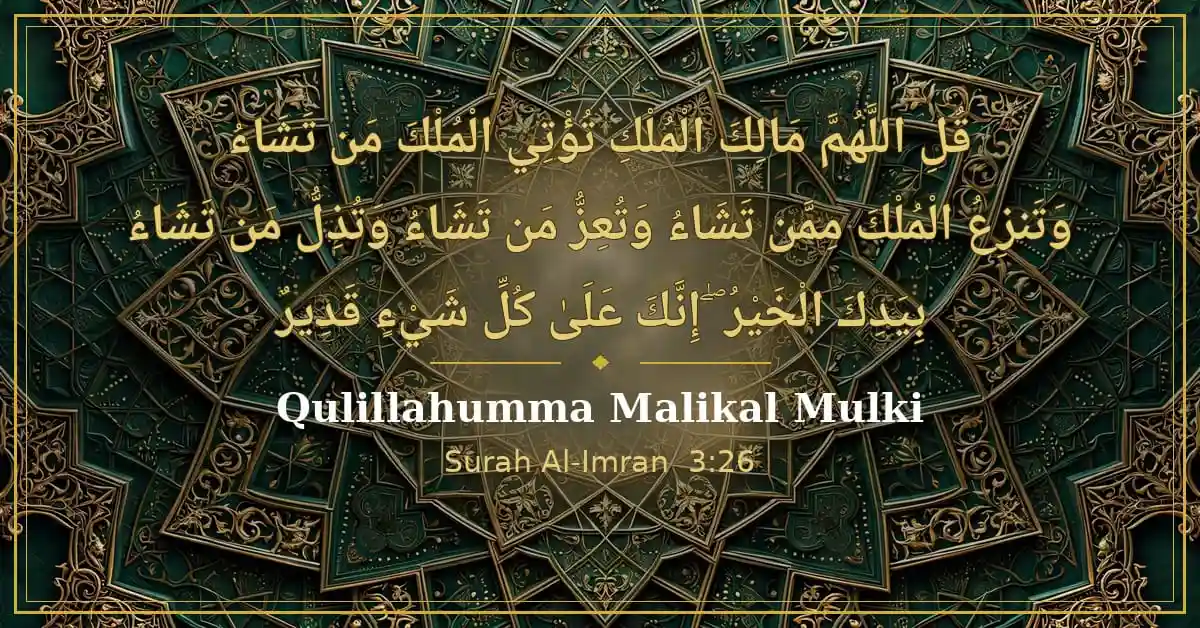
Qulillahumma Malikal Mulki means “Say, O Allah, Owner of Sovereignty.” It opens Surah Al-Imran, verse 26. Allah gives rule to whom He wills, takes it from whom He wills, honours whom He wills, and humbles whom He wills. All good is in His hand.
Arabic:
قُلِ اللَّهُمَّ مَالِكَ الْمُلْكِ تُؤْتِي الْمُلْكَ مَن تَشَاءُ وَتَنزِعُ الْمُلْكَ مِمَّن تَشَاءُ وَتُعِزُّ مَن تَشَاءُ وَتُذِلُّ مَن تَشَاءُ ۖ بِيَدِكَ الْخَيْرُ ۖ إِنَّكَ عَلَىٰ كُلِّ شَيْءٍ قَدِيرٌ
Transliteration: Qulil laahumma Maalikal Mulki tu’til mulka man tashaaa’u wa tanzi’ul mulka mimman tashhaaa’u wa tu’izzu man tashaaa’u wa tuzillu man tashaaa’u biyadikal khairu innaka ‘alaa kulli shai’in Qadeer
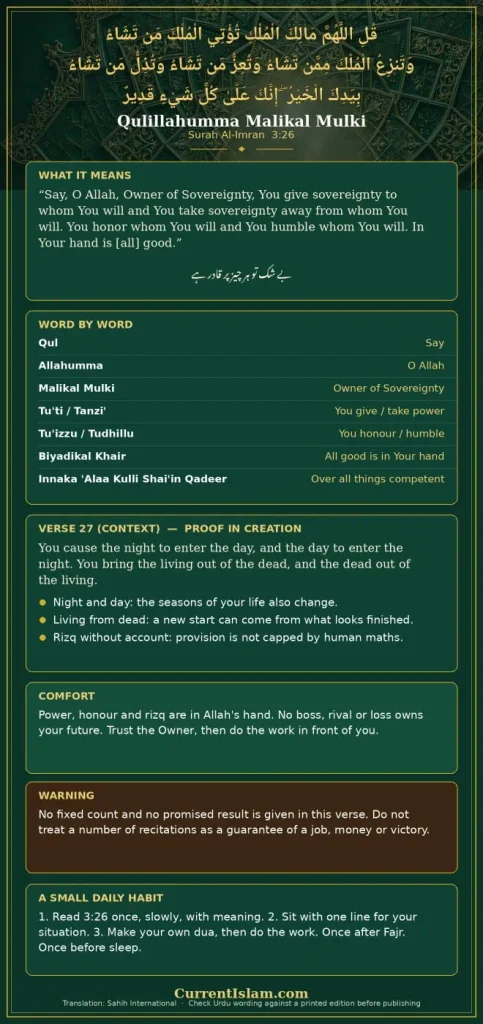
English (Sahih International): “Say, ‘O Allah, Owner of Sovereignty, You give sovereignty to whom You will and You take sovereignty away from whom You will. You honor whom You will and You humble whom You will. In Your hand is [all] good. Indeed, You are over all things competent.'”
Urdu (Muhammad Junagarhi):
آپ کہہ دیجئے اے اللہ! اے تمام جہان کے مالک! تو جسے چاہے بادشاہی دے اور جس سے چاہے سلطنت چھین لے اور تو جسے چاہے عزت دے اور جسے چاہے ذلت دے، تیرے ہی ہاتھ میں سب بھلائیاں ہیں، بے شک تو ہر چیز پر قادر ہے
Hindi: ऐ अल्लाह! सल्तनत के मालिक! तू जिसे चाहे सल्तनत अता फरमा दे और जिससे चाहे सल्तनत छीन ले और तू जिसे चाहे इज़्ज़त अता फरमा दे और जिसे चाहे ज़िल्लत दे, सारी भलाई तेरे ही दस्ते क़ुदरत में है, बेशक तू हर चीज़ पर बड़ी क़ुदरत वाला है।
This is the full verse 3:26, from “Qulillahumma malikal mulki” to “biyadikal khair,” with its closing clause. Verse 3:27 follows as context only.
Why This Verse Changes How You See Power at Work and School
This verse moves ownership of power from people to Allah. A manager, a teacher, or an algorithm can open or close a door, but none owns your future. When you believe Allah gives and takes honour, you work hard without fearing people, and you stay humble when you succeed.
Ibn Kathir calls this praise, thanks, reliance, and trust in Allah in all matters: Allah is the Giver and the Taker. Reports say the Prophet Muhammad (peace be upon him) was promised the kingdoms of Persia and Byzantium, and critics called it far-fetched. Here is why this matters for your daily routine: your status is not decided by a meeting or a post. But how do we apply this at work or school? Do the work well, speak kindly, and leave the outcome with its Owner. For the shorter phrase in Urdu, see honour and humiliation in Urdu. That trust is tawakkul: whoever relies on Allah, He will make a way out.
Word by word:
| Arabic | Transliteration | Meaning |
| قُلِ | Qul | Say |
| اللَّهُمَّ | Allahumma | O Allah |
| مَالِكَ الْمُلْكِ | Malikal mulki | Owner of Sovereignty |
| تُؤْتِي الْمُلْكَ | Tu’til mulka | You give sovereignty |
| وَتَنزِعُ الْمُلْكَ | Wa tanzi’ul mulka | And You take sovereignty away |
| وَتُعِزُّ / وَتُذِلُّ | Wa tu’izzu / wa tudhillu | You honour / You humble |
| بِيَدِكَ الْخَيْرُ | Biyadikal khair | In Your hand is all good |
| إِنَّكَ عَلَىٰ كُلِّ شَيْءٍ قَدِيرٌ | Innaka ‘alaa kulli shai’in Qadeer | Indeed, You are over all things competent |
Understanding Surah Al-Imran 3:26 (Qulillahumma Malikal Mulki)
In Your Hand Is All Good, Even When Life Feels Unfair
In Your hand is all good means every gift and loss sits inside Allah’s wisdom and justice. A closed door can protect you from unseen harm. A hard season can teach reliance and patience. Life may not feel good. The Hand holding it is good.
The Prophet Muhammad (peace be upon him) linked honour to humility in Sahih Muslim 2588, narrated by Abu Hurairah:
Arabic:
مَا نَقَصَتْ صَدَقَةٌ مِنْ مَالٍ، وَمَا زَادَ اللَّهُ عَبْدًا بِعَفْوٍ إِلَّا عِزًّا، وَمَا تَوَاضَعَ أَحَدٌ لِلَّهِ إِلَّا رَفَعَهُ اللَّهُ
Transliteration: Ma naqasat sadaqatun min mal, wa ma zadallahu ‘abdan bi ‘afwin illa ‘izza, wa ma tawada’a ahadun lillahi illa rafa’ahullah.
English: “Charity does not decrease wealth, no one forgives another except that Allah increases his honor, and no one humbles himself for the sake of Allah except that Allah raises his status.”
Urdu meaning:
صدقہ مال کو کم نہیں کرتا، جو کسی کو معاف کرے اللہ اس کی عزت بڑھا دیتا ہے، اور جو اللہ کے لیے عاجزی کرے اللہ اس کا درجہ بلند کر دیتا ہے۔
Hindi meaning: सदक़ा माल को कम नहीं करता, जो किसी को माफ़ करे अल्लाह उसकी इज़्ज़त बढ़ा देता है, और जो अल्लाह के लिए विनम्रता अपनाए अल्लाह उसका दर्जा ऊँचा कर देता है।
Humility is not weakness here. Do your part, forgive where you can, and trust that Allah is sufficient for us when human help runs out.
The Next Verse Is Proof You Can Watch Every Day
Verse 27 is proof you can watch because Allah points to night, day, life, death, and provision. Night enters day and day enters night. The living comes from the dead. If Allah can change light, seasons, and life itself, He can change your season too, and give provision without account.
Arabic (3:27):
تُولِجُ اللَّيْلَ فِي النَّهَارِ وَتُولِجُ النَّهَارَ فِي اللَّيْلِ ۖ وَتُخْرِجُ الْحَيَّ مِنَ الْمَيِّتِ وَتُخْرِجُ الْمَيِّتَ مِنَ الْحَيِّ ۖ وَتَرْزُقُ مَن تَشَاءُ بِغَيْرِ حِسَابٍ
Transliteration: Toolijul laila fin nahaari wa toolijun nahaara fil laili wa tukhrijul haiya minal maiyiti wa tukhrijul maiyita minal haiyi wa tarzuqu man tashaaa’u bighayri hisaab
English (Sahih International): “You cause the night to enter the day, and You cause the day to enter the night; and You bring the living out of the dead, and You bring the dead out of the living. And You give provision to whom You will without account.”
Rizq is more than money: health, time, family, knowledge, and peace. Ask like Musa did for whatever good You would send down, and ask for good in this world and the Hereafter, then work and trust. A dry seed becomes a green plant. When He says, Be, and it is, no dead end is final.
How to Build a 90-Second Habit With This Verse
Build this habit in ninety seconds by tying the verse to a moment you already have. Read it once after Fajr and once before sleep, slowly, in Arabic if you can, then in your own language. Name one need, make your dua, and do the next task well.
- Cue: Waking up, or a moment of worry at work. Do not reach for your phone first.
- Routine: Read 3:26 once, slowly. Sit with one line that fits today.
- Reward: A steadier heart. You have handed the outcome to its Owner, and you can act without panic.
No fixed count for this verse is set in the Quran, and no count-setting hadith for 3:26 was verified here. Read it once with meaning. That is enough.
Three Mistakes to Avoid With This Verse
Avoid three mistakes. Do not use this verse only for wealth, because rizq is wider than money. Do not promise a result in seven days for a set count. No such promise was verified. Do not seek honour while humiliating others. Honour here belongs to Allah’s giving, not pride.
- Money only: Rizq includes health, time, family, and peace.
- A promised result: A set count does not guarantee a job, a visa, or a marriage.
- Pride: Read it when you are low, and when you succeed, so success does not turn into arrogance.
Frequently Asked Questions
People ask which para this verse is in, what its benefit is, and whether it helps with rizq and jobs. Verse 26 is in Juz 3. Its benefit is trust and steadiness. It is a dua for rizq when you ask Allah and then work, without a promised result.
Which para is Surah Al-Imran verse 26 in?
Surah Al-Imran, verse 26 is in Juz 3, also called Para 3. Surah Al-Imran is the third surah, it has 200 verses, and it is a Madani surah. Verse 26 sits early in the surah.
What is the benefit of reciting Qulillahumma Malikal Mulki?
The benefit is steadiness: less fear of people, less pride in success, and more trust in Allah’s timing. It reminds you that honour and provision are in Allah’s hand. The One who knows what is in the breasts also knows your need, so ask Him directly.
Can I read this verse for rizq, a job, or a breakthrough?
Yes, read it as a dua for rizq, a job, or a breakthrough, and then do the work. Ask the Owner of Sovereignty for good, plan well, and trust His timing. The verse promises Allah’s control, not your preferred outcome.
Say it when you feel small. Say it when you feel strong. When human help ends, Allah is the best Protector, and your Lord is going to give you, in His time, what is best for you.
Sources and review note: English: Sahih International. Urdu for 3:26: Muhammad Junagarhi. Hindi for 3:26: rendering as shown by Irfan-ul-Quran. Hadith: Sahih Muslim 2588, narrated by Abu Hurairah; Urdu/Hindi hadith lines are plain meanings, not a named edition. A reviewer should check the Urdu and Hindi wording against a printed edition before publishing. No scholar byline was added; none was supplied for this article.
