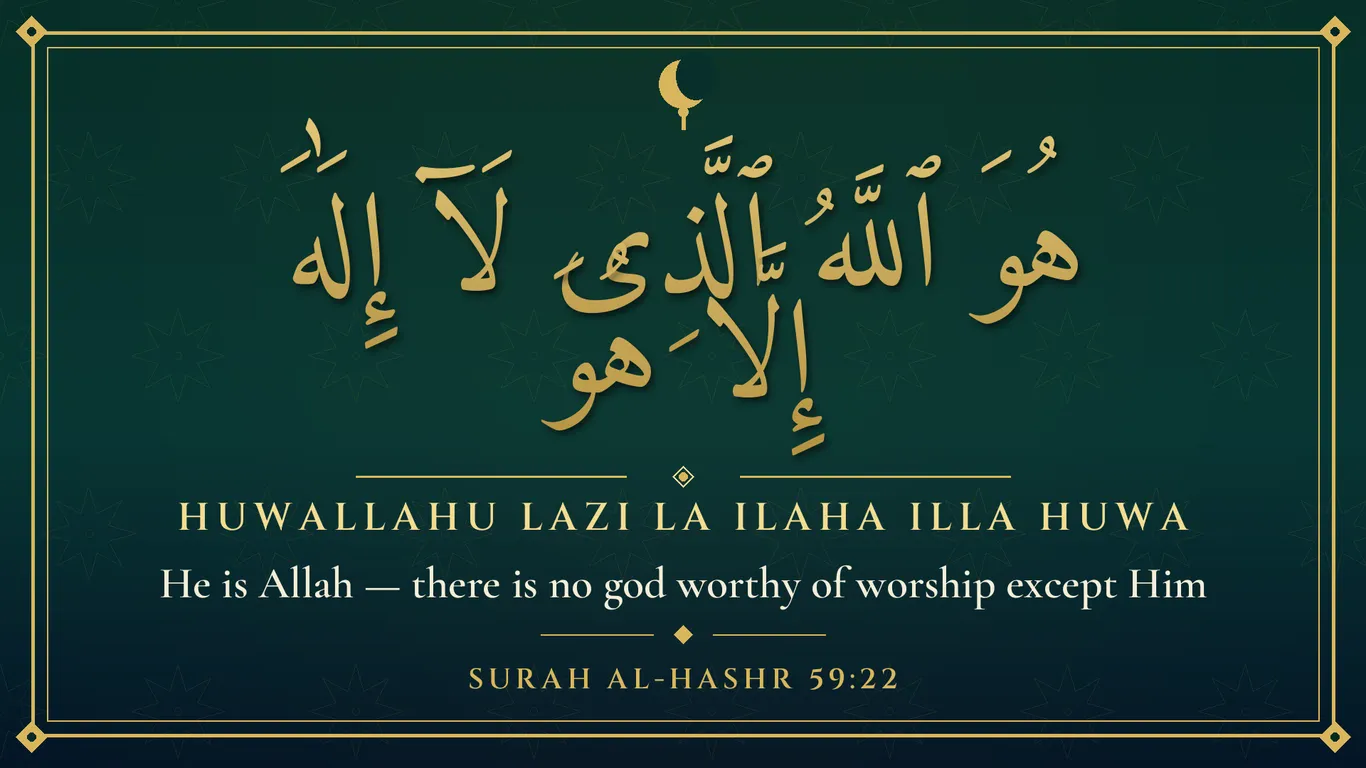
The Surah Hashr last 3 ayat are verses 22 to 24 of Surah Al-Hashr (Quran 59:22-24), beginning “Huwallahu lazi la ilaha illa Huwa” — He is Allah, besides Whom there is no god. Recited morning and evening by many Muslims, these verses gather fifteen of Allah’s attributes in three short lines.
Quick Answer
- The last 3 ayat are 59:22, 59:23 and 59:24, in Para 28. Verse 21 is separate.
- They name Ar-Rahman, Ar-Rahim, Al-Malik, Al-Quddus, As-Salam, Al-Khaliq and other Beautiful Names.
- The 70,000 angels report (Tirmidhi 2922) is graded weak. No authentic source fixes seven recitations.
Contents
The ayat | 15 Names | Teaching | Hadith check | Benefits | Hashr Loop | Mistakes | FAQs
You may have heard these verses in a WhatsApp forward promising angels, protection, and a set number of repeats. Then a second video said something different. You want to recite with love, not doubt. This page separates the Quran itself, which is certain, from reports about extra rewards, where scholars ask for care. You get the Arabic, a clear meaning, an honest hadith check, and a routine for tonight.
What are the Surah Hashr last 3 ayat?
They are the closing verses of the 59th chapter of the Quran, a Madani surah with 24 verses. Each verse starts with “Huwa” (He), points to Allah alone, then lists His Names. Read slowly, using transliteration until Arabic becomes easy.
Ayah 22 — Knower of the unseen and the seen
هُوَ ٱللَّهُ ٱلَّذِى لَآ إِلَٰهَ إِلَّا هُوَ ۖ عَٰلِمُ ٱلْغَيْبِ وَٱلشَّهَٰدَةِ ۖ هُوَ ٱلرَّحْمَٰنُ ٱلرَّحِيمُ
Huwallahul-lazi la ilaha illa Huwa, ‘Aalimul-ghaybi wash-shahadah, Huwar-Rahmanur-Rahim
“He is Allah—there is no god worthy of worship except Him: Knower of the unseen and the seen. He is the Most Compassionate, Most Merciful.” (Dr. Mustafa Khattab, The Clear Quran)
Urdu
وہی اللہ ہے جس کے سوا کوئی معبود نہیں، پوشیدہ اور ظاہر کو جاننے والا ہے، وہی بڑا مہربان، نہایت رحم والا ہے۔
Hindi वही अल्लाह है जिसके सिवा कोई पूज्य नहीं; वह छुपे और खुले को जानने वाला है; वही बड़ा कृपालु, अत्यन्त दयावान है।
Ayah 23 — eight Names in one verse
هُوَ ٱللَّهُ ٱلَّذِى لَآ إِلَٰهَ إِلَّا هُوَ ٱلْمَلِكُ ٱلْقُدُّوسُ ٱلسَّلَٰمُ ٱلْمُؤْمِنُ ٱلْمُهَيْمِنُ ٱلْعَزِيزُ ٱلْجَبَّارُ ٱلْمُتَكَبِّرُ ۚ سُبْحَٰنَ ٱللَّهِ عَمَّا يُشْرِكُونَ
Huwallahul-lazi la ilaha illa Huwa, Al-Malikul-Quddusus-Salamul-Mu’minul-Muhayminul-‘Azizul-Jabbarul-Mutakabbir. Subhanallahi ‘amma yushrikoon
“He is Allah—there is no god except Him: the King, the Most Holy, the All-Perfect, the Source of Serenity, the Watcher of all, the Almighty, the Supreme in Might, the Majestic. Glorified is Allah far above what they associate with Him in worship!”
Urdu:
وہی اللہ ہے جس کے سوا کوئی معبود نہیں، بادشاہ ہے، نہایت پاک ہے، سلامتی دینے والا ہے، امن دینے والا ہے، نگہبان ہے، سب پر غالب ہے، زبردست ہے، بڑائی والا ہے، پاک ہے اللہ اس سے جو وہ شریک ٹھہراتے ہیں۔
Hindi: वही अल्लाह है जिसके सिवा कोई पूज्य नहीं; वह सच्चा बादशाह है, परम पवित्र है, शान्ति और सुरक्षा देने वाला है, रक्षक है, प्रभुत्वशाली है, ज़बरदस्त है, और बड़ाई वाला है; अल्लाह उन चीज़ों से पवित्र है जिन्हें वे उसका साझीदार ठहराते हैं।
Ayah 24 — the Creator and His Beautiful Names
هُوَ ٱللَّهُ ٱلْخَٰلِقُ ٱلْبَارِئُ ٱلْمُصَوِّرُ ۖ لَهُ ٱلْأَسْمَآءُ ٱلْحُسْنَىٰ ۚ يُسَبِّحُ لَهُۥ مَا فِى ٱلسَّمَٰوَٰتِ وَٱلْأَرْضِ ۖ وَهُوَ ٱلْعَزِيزُ ٱلْحَكِيمُ
Huwallahul-Khaliqul-Bari’ul-Musawwir, lahul-asma’ul-husna. Yusabbihu lahu ma fis-samawati wal-ard, wa Huwal-‘Azizul-Hakim
“He is Allah: the Creator, the Inventor, the Shaper. He alone has the Most Beautiful Names. Whatever is in the heavens and the earth constantly glorifies Him. And He is the Almighty, All-Wise.”
Urdu:
وہی اللہ ہے پیدا کرنے والا، وجود بخشنے والا، صورت بنانے والا، اسی کے لیے بہترین نام ہیں، جو کچھ آسمانوں اور زمین میں ہے سب اسی کی تسبیح بیان کرتے ہیں، اور وہی غالب، حکمت والا ہے۔
Hindi: वही अल्लाह है पैदा करने वाला, अस्तित्व बख़्शने वाला, रूप देने वाला; उसी के लिए सबसे अच्छे नाम हैं; जो कुछ भी आकाशों और धरती में है, उसी की तसबीह (महिमा) करता है; और वही प्रभुत्वशाली, तत्वदर्शी (हिकमत वाला) है।
Read the passage at Quran 59:22-24. Urdu meaning (Jalandhari) is in the checklist asset.
How many Names of Allah are in these verses?
Fourteen distinct Names appear, plus one great attribute, Knower of the unseen and the seen, making the often quoted total of fifteen attributes. Al-‘Aziz appears twice, in verses 23 and 24. Verse order helps memory: each verse groups Names by theme.
| Ayah | Name / Attribute | Meaning |
|---|---|---|
| 22 | ‘Aalim-ul-Ghayb wash-Shahadah | Knower of the unseen and the seen |
| 22 | Ar-Rahman, Ar-Rahim | Most Compassionate, Most Merciful |
| 23 | Al-Malik | The King, Owner of all things |
| 23 | Al-Quddus | The Most Pure |
| 23 | As-Salam | Source of Peace, free of defect |
| 23 | Al-Mu’min | Giver of security and faith |
| 23 | Al-Muhaymin | Watcher over all |
| 23 | Al-‘Aziz | The Almighty |
| 23 | Al-Jabbar | Supreme in Might |
| 23 | Al-Mutakabbir | The Majestic |
| 24 | Al-Khaliq | The Creator |
| 24 | Al-Bari | The Inventor |
| 24 | Al-Musawwir | Shaper of forms |
| 24 | Al-Hakim | The All-Wise |
Full list, with Urdu: the 99 Names of Allah hub.
Quick Reference: Surah Hashr 59:22-24.”
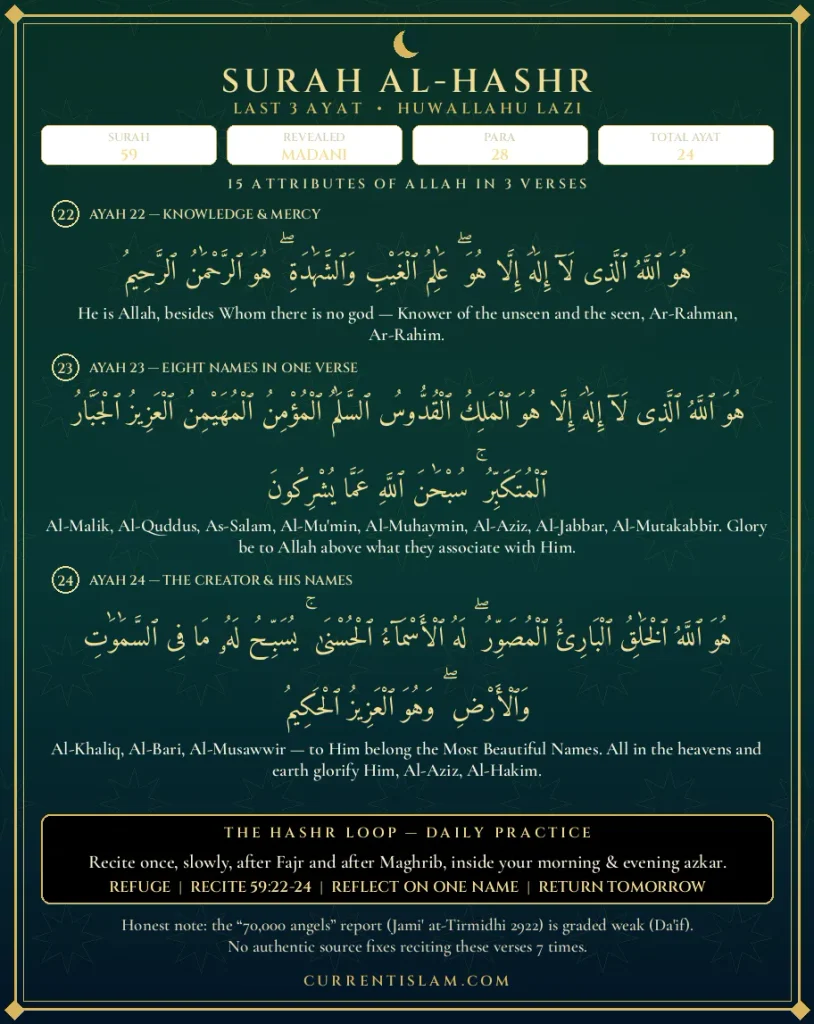
What do these verses teach us about Allah?
They teach tawhid, the oneness of Allah, by showing who He is, not only what He gives. Verse 22 joins total knowledge with total mercy. Verse 23 joins power with purity, so strength never means injustice. Verse 24 ends with creation and praise. Tafsir Ibn Kathir on 59:23 explains Al-Malik as Owner and King of all things.
At work, Al-Muhaymin reminds you Allah sees honest effort no manager saw. At school, verse 22 covers the result you cannot see yet. On a train, As-Salam calms a rushed mind.
Is the 70,000 angels hadith authentic?
A report says: whoever says three times in the morning, “A’udhu billahis-Sami’il-‘Alim minash-Shaytanir-Rajim” (I seek refuge with Allah, the All-Hearing, the All-Knowing, from the accursed Satan), then recites the last three verses of Surah Al-Hashr, Allah appoints seventy thousand angels to pray for him until evening, and if he dies that day, he dies as a martyr. The same is said for the evening. (Tirmidhi 2922, from Ma’qil ibn Yasar)
Imam at-Tirmidhi himself called this report gharib, meaning known through a single route. Al-Albani graded it weak (da’if), as does the Darussalam grading. One narrator, Khalid ibn Tahman, became confused in later years, weakening the chain.
Quote it if you wish, but label it weak. Do not promise its reward as fact, and do not build a fixed wazifa — a set formula for a set result — on it. These verses are still Quran.
What are the benefits of reciting Surah Hashr last 3 ayat?
The proven benefit is ma’rifah: knowing Allah by His Names, which strengthens faith, trust (tawakkul), and patience (sabr). Whoever learns Allah is Al-Malik and Al-Hakim submits with less panic. Whoever learns Ar-Rahman and As-Salam treats people with more calm. The heart changes first, then conduct.
Compare them with the last 2 ayat of Surah Baqarah, often recited at night. Baqarah ends with a plea for pardon. Hashr ends with praise of who Allah is. Together: ask, then praise; praise, then ask.
The Hashr Loop: how can I recite these verses daily?
Use the Hashr Loop:
Refuge, Recite, Reflect, Return. Say the refuge words once, or three times as in the Tirmidhi report, with no promise attached. Recite verses 22 to 24 once, slowly. Reflect on one Name only. Return morning and evening, inside your morning and evening azkar. One slow recitation takes about two minutes.
Start tonight:
after Maghrib (the sunset prayer), sit for two minutes before you touch your phone. Read verse 22 aloud, then its meaning. Pick Al-Malik. Ask: if Allah is the true King, what worry can I hand Him tonight? Take the next Name tomorrow. In fifteen days, you will have covered every attribute once. The loop stays private, even if you are the only Muslim in your office.
What mistakes do people make with these verses?
First, many sites list verses 21 to 24 and call them the last three. Verse 21, the mountain verse, is a fourth verse. Second, many blogs call Tirmidhi 2922 sahih, meaning authentic. It is graded weak. Third, social posts fix seven, eleven, or twenty-one repeats. No authentic source fixes any of them. Fourth, some pages promise wealth, cure, or a spouse from this recitation. Dua (supplication) sits beside effort and, for health, professional care. It never replaces either.
See the same approach on the Surah Taubah last 2 ayat page.
Next step
Tonight, recite verses 22 to 24 once, with the meaning open beside you, and save the checklist below. This week, pair them one morning with the last 10 ayat of Surah Al-Imran.
Surah hashr last 3 ayat - PDF
FAQs
What are the last 3 ayat of Surah Hashr?
They are verses 22, 23 and 24 of Surah Al-Hashr, chapter 59, in Para 28. They begin “Huwallahu lazi la ilaha illa Huwa.” Each verse declares there is no god but Allah, then names His knowledge, mercy, kingship, purity, power, creation, and wisdom in turn.
Which para is Surah Hashr in?
Surah Al-Hashr is in Para 28, also called Juz 28, Qad Sami’ullah. It is the 59th chapter of the Quran, revealed in Madinah, with 24 verses. Its name means the Gathering, or the Exile, and the word itself appears in its verse 2.
Is the 70,000 angels hadith sahih?
No. The report in Jami’ at-Tirmidhi 2922, from Ma’qil ibn Yasar, was called gharib by Imam at-Tirmidhi. Al-Albani and the Darussalam grading both class it as da’if, meaning weak. Mention it with that label, but do not present its reward as certain.
Should I recite Surah Hashr last 3 ayat 7 times?
No authentic hadith fixes seven recitations of these verses, or any fixed count, for a promised result. The Tirmidhi report speaks of the refuge words three times, then the verses once. Recite once with presence, learn the meaning, and keep the habit daily.
When is the best time to recite these verses?
Morning after Fajr (the dawn prayer) and evening after Maghrib are the times named in the Tirmidhi report, and they fit the daily pattern of remembrance. That report is weak, so treat those times as a good routine, not a strict rule.
How many Names of Allah are in the last 3 ayat?
Fourteen distinct Names appear across verses 22 to 24, and Al-‘Aziz appears twice. With the attribute “Knower of the unseen and the seen” in verse 22, writers often give fifteen attributes in total here. Verse 23 alone holds eight Names, the most of the three.
Can I recite from transliteration if I cannot read Arabic yet?
Yes. Start where you are. Transliteration helps you say the sounds while you learn Arabic script, and translation tells you what you are saying. Grow both together: a few minutes a week on Arabic letters, and one Name a day from these verses.
