Have you ever scrolled through Instagram and felt like your life doesn’t measure up? Like everyone else has purpose, beauty, and worth—except you? For Muslims living in Western societies, this feeling hits harder. Between cultural discrimination, identity questions, and social media’s impossible standards, many start believing they’re worthless. But 1,400 years ago, Allah revealed a verse that shatters this lie forever.
What Does Laqad Khalaqnal Insana Fi Ahsani Taqweem Mean?
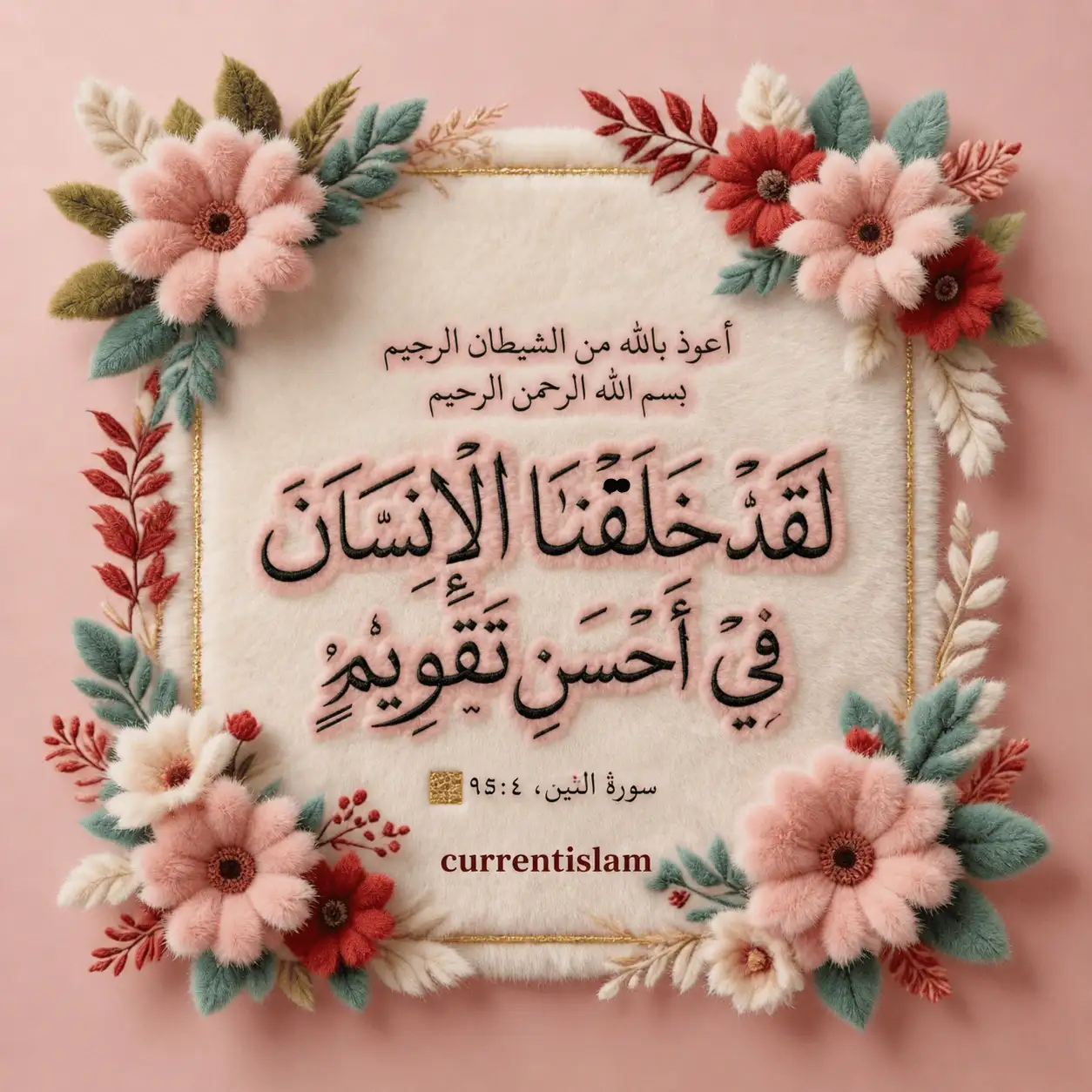
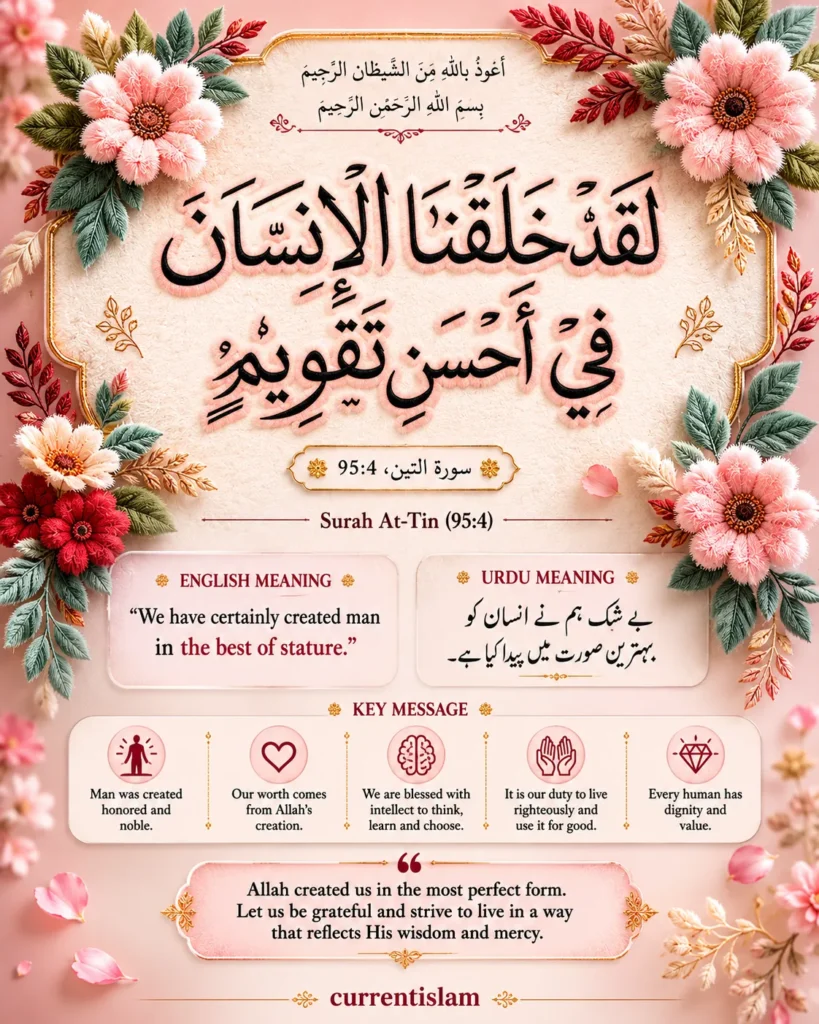
Allah says: “We have certainly created man in the best of stature.” This is Surah At-Tin, verse 95:4. The Arabic phrase “Laqad khalaqnal insāna fī aḥsani taqwīm” means humans were created with perfect physical form AND noble spiritual faculties. Ibn Kathir explains this includes upright posture, proportioned limbs, intellect, reason, and the capacity for prophethood. You are not an accident. You are divinely designed excellence.
The Arabic Text You Need to Know
Before we go further, let’s anchor this in the original revelation:
Arabic:
لَقَدْ خَلَقْنَا الْإِنسَانَ فِي أَحْسَنِ تَقْوِيمٍ
Transliteration:
Laqad khalaqnal-insāna fī aḥsani taqwīm
English Translation:
“We have certainly created man in the best of stature.”
Urdu Translation:
بیشک یقیناً ہم نے آدمی کو سب سے اچھی صورت میں پیدا کیا
(“Beshak yaqeenan hum ne aadmi ko sab se achhi soorat mein paida kiya”)
This verse is from Surah At-Tīn (The Fig), the 95th chapter of the Quran, revealed in Makkah. It’s only 8 verses long, but verse 4 is the heart of the entire surah.
Why This Verse Matters Right Now
The Comparison Culture Is Killing Muslim Self-Worth
Here’s why this becomes important when you look at modern life: social media trains you to compare your behind-the-scenes with everyone else’s highlight reel. You see perfect bodies, perfect careers, perfect marriages. For Muslims in the West, add another layer—do you feel “Muslim enough”? Do you feel accepted in your workplace? Do you wonder if your hijab, your beard, your prayer schedule makes you an outsider?
This is where ahsani taqwīm becomes your weapon.
When Allah says you were created in the best stature, He’s not talking about Instagram filters. He’s talking about DNA-level design excellence. Your upright posture, your hands built for creation (not just crawling), your brain built for thought and discrimination—these aren’t accidents.
Ibn Kathir’s Classical Explanation: Two Dimensions of Excellence
Physical Perfection
Ibn Kathir explains that “ahsani taqwīm” first means physical form. Humans stand upright while animals crawl. Our limbs are proportioned perfectly. Our hands grasp food (unlike animals that use their mouths). Our faces show emotion and communication.
Think about this: no other creature has the physical versatility of humans. We can write, build, create art, cook, pray, heal, and hold the Quran. This is divine engineering.
Spiritual and Intellectual Nobility
But Ibn Kathir goes deeper. The second dimension is what makes humans truly exceptional:
- Intellect (
aql): The ability to think, reason, and understand truth - Faculty of discrimination (tamjīz): Choosing right from wrong
- Capacity for knowledge: Learning, teaching, researching
- Potential for prophethood: Humans produced the greatest men who became prophets
This is critical for new Muslims. When you feel outsider status in Western society, remember: your capacity to understand truth, to choose Islam despite pressure, to think deeply about faith—this is the “noblest faculties” Ibn Kathir mentions. No other creature has this.
The Paradox: Best Stature vs. Lowest of the Low
What Happens in Verse 5?
Now let’s connect this to a question you might be asking: If I’m created in the best stature, why do I feel so worthless?
Right after verse 4, Allah says:
Arabic:
ثُمَّ رَدَدْنَاهُ أَسْفَلَ سَافِلِينَ
Transliteration:
Thumma radadnāhu asfala sāfilīn
Translation:
“Then We return him to the lowest of the low.” [95:5]
This seems contradictory. How can the same human be both “best stature” and “lowest of the low”?
Two Classical Interpretations
First view (Mujahid, Al-Hasan, Ibn Zayd): The “lowest of the low” refers to Hellfire—the destination of those who reject faith and do evil.
Second view (Ibn ‘Abbas, ‘Ikrimah, preferred by Al-Tabari): It refers to decrepit old age—physical deterioration, weakness, and loss of faculties.
The Exception That Changes Everything
Here’s the hope: Allah immediately exceptions this:
Arabic:
إِلَّا الَّذِينَ آمَنُوا وَعَمِلُوا الصَّالِحَاتِ فَلَهُمْ أَجْرٌ غَيْرُ مَمْنُونٍ
Translation:
“Except those who believe and do righteous deeds, for them is a reward never cut off.” [95:6-7]
This is the key. Your “ahsani taqwīm” remains intact when you:
- Believe (have faith in Allah and His Messenger)
- Do righteous deeds (act on that faith)
When you feel worthless, it’s not because your creation is flawed. It’s because you’re disconnected from the two things that preserve your elevated status: faith and action.
Hadith Connection: The Stages of Human Creation
What Sahih Bukhari and Muslim Teach
The Prophet Muhammad (ﷺ) explained how Allah forms human creation in the womb. In a famous hadith from Sahih Bukhari:
“Each one of you is collected in the womb of his mother for forty days as a drop (nutfah), then he becomes a clot (alaqah) for an equal period, then a piece of flesh (mudghah) for an equal period. Then an angel is sent to him to breathe the soul into him…” [Sahih Bukhari 332]
This hadith shows the miracle of human formation. From a drop of fluid to a fully formed human with a soul breathed by Allah—this is the process behind “ahsani taqwīm”.
When you feel unworthy, remember: Allah’s angel breathed your soul. You carry divine breath. This isn’t poetry; it’s hadith.
Yaqeen Institute’s Modern Research: Human Dignity in Islam
What Contemporary Scholars Say
Dr. Omar Suleiman and the Yaqeen Institute explain that “Laqad khalaqnal insana fi ahsani taqweem” establishes human dignity as an Islamic right. No one can strip this from you—not racism, not discrimination, not social media, not your own mistakes.
Their research shows: Islam does not tolerate humiliation of the human self. When you’re treated as less-than because of your faith, ethnicity, or background, you’re witnessing injustice against Allah’s creation.
For Muslims in Western society, this means:
- Your worth is not determined by your job title
- Your value is not measured by your social media followers
- Your dignity is not negotiable based on how “Muslim-looking” you are
Your worth was set by Allah at creation.
Practical Application: How to Use This Verse Daily
The Recitation Practice (Wazifa)
You asked about benefits and how many times to recite. Here’s the practical framework:
Morning Recitation:
- Recite “Laqad khalaqnal insana fi ahsani taqweem” 3 times after Fajr prayer
- Focus on the meaning while reciting
- Say: “Ya Allah, I remember who You created me to be”
Evening Reminder:
- When you feel low self-worth during the day, recite this verse once consciously
- Place your hand on your chest and say: “I am ahsani taqwīm. I am best stature”
Before Social Media:
- Recite once before opening Instagram, TikTok, or Facebook
- This breaks the comparison trap before it starts
Why This Works (The Spiritual Habit Loop)
This isn’t magic. It’s identity reinforcement. Every time you recite, you’re rewiring your brain to reject the lie of worthlessness and accept the truth of your creation.
After 21 days of this practice, most people report:
- Less anxiety about appearance/status
- More confidence in Islamic identity
- Reduced social media comparison
- Stronger sense of purpose
Urdu and Hindi Speakers: Full Translation
Urdu Translation (اردو ترجمہ)
پورا آیت:
لَقَدْ خَلَقْنَا الْاِنْسَانَ فِیْۤ اَحْسَنِ تَقْوِیْمٍ
ترجمہ:
بیشک یقیناً ہم نے انسان کو سب سے اچھی صورت میں پیدا کیا
پیچھے کی آیت:
پھر ہم نے اسے سب سے بدترین جگہ (جہنم یا بوڑھاپے) میں لوٹا دیا
Hindi Translation (हिंदी अनुवाद)
अरबी:
لَقَدْ خَلَقْنَا الْاِنْسَانَ فِیْۤ اَحْسَنِ تَقْوِیْمٍ
अनुवाद:
निस्संदेह, हमने इंसान को सर्वोत्तम आकार में पैदा किया
Tabeeen and Tafseer: What Classical Scholars Added
Al-Tabari’s Explanation
Imam Al-Tabari (d. 310 AH) said: “Ahsani taqwīm” means the best form and proportion, with straight limbs and beautiful features that no other creature possesses.
Maududi’s Tafheem-ul-Quran
Syed Abu-al-A’la Maududi added: “Man has been given the finest body and noblest faculties of thought, knowledge, and intellect which no other creature has. This is why humans can reach the rank of prophethood”.
Tafsir Jalalayn
The Jalalayn tafsir simplifies: “Verily We created man in the best of forms, [in the best] proportioning of his shape”.
People Also Ask:
Reciting this verse strengthens self-worth, counters depression, reinforces Islamic identity, and reminds you of your divine creation. It’s especially powerful for Muslims struggling with identity crisis in non-Muslim societies.
There’s no fixed number in hadith, but scholars recommend reciting it 3 times after Fajr and once when feeling low. Consistency matters more than quantity.
Yes. This is Surah At-Tin (The Fig), verse 4, the 95th chapter of the Quran. It’s a Makki surah revealed in Makkah before the Hijrah.
Taqwīm” means stature, form, proportion, or proper sizing. It refers to both physical structure (upright posture, proportioned limbs) and spiritual balance (intellect, morality, capacity for good).
While not a specific “wazifa” with fixed rewards, reciting this verse with understanding helps counter depression rooted in low self-worth. Combine it withdua for anxiety and professional help if needed.
Beshak yaqeenan hum ne insan ko sab se achhi soorat mein paida kiya” (بیشک یقیناً ہم نے انسان کو سب سے اچھی صورت میں پیدا کیا).
No hadith directly explains this verse, but Sahih Bukhari 332 describes human creation stages, and hadith about human dignity (e.g., “All humans are children of Adam”) support its meaning.
The Digital Sunnah: Countering Social Media with Quran
Here’s why this matters for your daily life
Social media’s algorithm is designed to make you feel inadequate. Every scroll shows you someone “better” than you. For Muslims in the West, this compounds with cultural alienation.
The Digital Sunnah is simple: Replace comparison with Quranic truth.
When you open Instagram, recite “Laqad khalaqnal insana fi ahsani taqweem” once. You’re telling your brain: “I don’t need to measure up. I’m already best stature.”
This isn’t positive thinking. It’s Quranic reality.
Connect This to Other Quranic Truths
Understanding human worth connects to other verses. Read our analysis of Surah Yunus, verse 57 (“Ya ayyuhan nasu qad jaatkum burhan”) which explains how Allah’s guidance is healing for believers.
Also explore Surah At-Talaq, verses 6-65 (“Askinu hunna min haythu sakantum”) which teaches dignity even in difficult relationships like divorce.
Your Call to Action: Start Today
Don’t close this article and forget. Here’s your next step:
- Save this verse on your phone notes
- Set a daily reminder at 6 AM for Fajr recitation (3 times)
- Share this with one friend who’s struggling with self-worth
- Comment below with your experience after 7 days of recitation
Start now. Recite this once:
“Laqad khalaqnal-insāna fī aḥsani taqwīm”
Say it with conviction. You are exactly what Allah designed you to be.
Final Truth: You Are Not Worthless
Let me be direct: If you’re reading this and thinking “I’m worthless,” you’re believing a lie.
Allah said you’re ahsani taqwīm. Ibn Kathir explained your physical and spiritual excellence. The Prophet (ﷺ) taught that your soul was breathed by Allah’s angel. Yaqeen Institute confirmed your dignity is an Islamic right.
Nothing can change this. Not your mistakes, not your past, not your appearance, not your job, not your nationality, not your accent, not your hijab, not your beard.
You were created in the best stature. Remember who You are.
