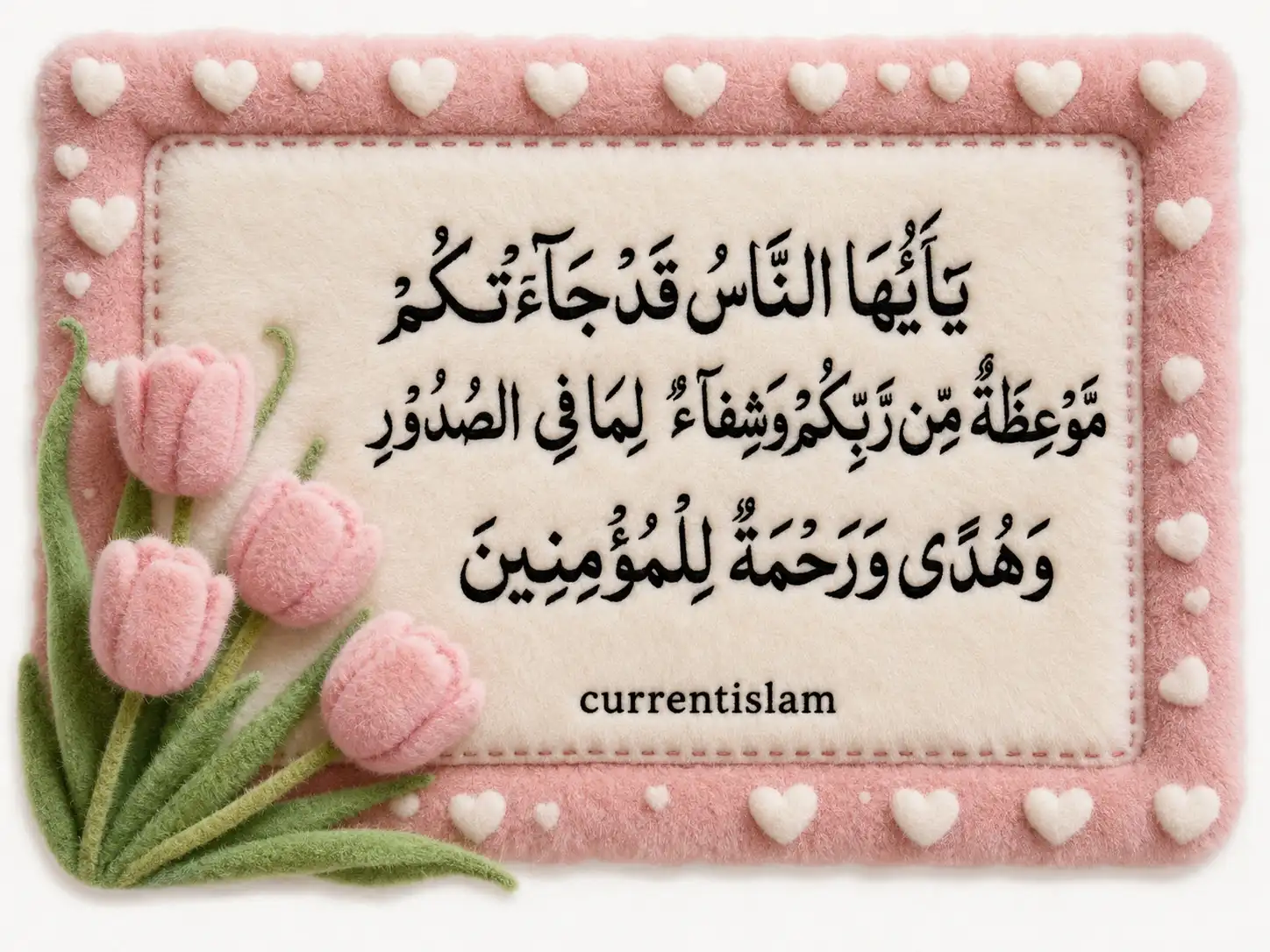
O humanity! Indeed, there has come to you a warning from your Lord, a cure for what is in the hearts, a guide, and a mercy for the believers [Quran 10:57]
What Does Surah Yunus Ayat 57 Mean for Anxiety?
Surah Yunus Ayat 57 is Allah’s direct promise that the Quran contains healing for what’s in your heart—including overwhelming anxiety, worry, and spiritual distress. This verse addresses all of humanity but specifically brings mercy to believers struggling with modern life’s pressures. The Arabic word shifā’ (healing) confirms the Quran isn’t just information—it’s active treatment for heart diseases like anxiety, fear, and restlessness.
Why This Ancient Verse Matters Today
You’re not alone in feeling overwhelmed. Studies show that 74% of people experienced overwhelming stress in the past year, and anxiety disorders affect 284 million people globally. As workplace demands, relationship pressures, and digital overload intensify, many Muslims are discovering that Surah Yunus Ayat 57 offers something modern psychology cannot: divine healing that addresses both spiritual and psychological root causes of anxiety.
This isn’t about replacing therapy—it’s about adding Allah’s promises to your healing journey. Let’s understand what this verse actually means and how to apply it when anxiety hits.
The Complete Arabic Text with Transliteration
Arabic Script
يَـٰٓأَيُّهَا ٱلنَّاسُ قَدْ جَآءَتْكُم مَّوْعِظَةٌۭ مِّن رَّبِّكُمْ وَشِفَآءٌۭ لِّمَا فِى ٱلصُّدُورِ وَهُدًۭى وَرَحْمَةٌۭ لِّلْمُؤْمِنِينَ
Transliteration (Roman Urdu/English)
Yā ayyuhan-nāsu qad jā’atkum maw’izatum mir-rabbikum wa shifā’ul limā fīṣ-ṣudūri wa hudan wa raḥmatul lilmu’minīn
English Translation
“O mankind, there has come to you admonition from your Lord, healing for what is in the breasts, guidance and mercy for the believers” [Ibn Kathir]
Urdu Translation
ایا لوگو! تمہارے رب کی طرف سے تمہاریلوگ ایک نصیحت آ چکی ہے اور سینوں کی بیماریوں کا شفا اور مؤمنوں کے لیے ہدایت اور رحمت ہے
Hindi Translation (Devanagari Script)
हे लोगो! निश्चय ही तुम्हारे रब की तरफ से तुम्हारे पास एक उपदेश आ चुकी है और सीनों में जो कुछ है उसका शिफा (इलाज) है और मु़मिनों के लिए हदायत और रहमत है।
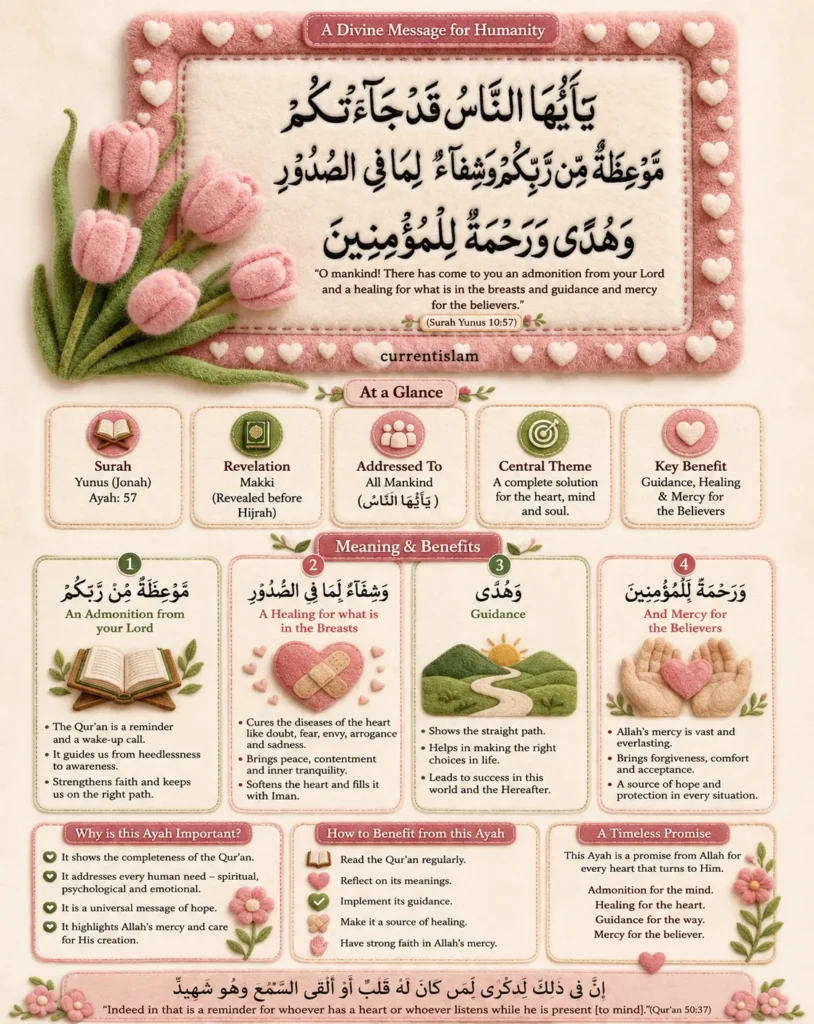
The Four Functions of Quranic Healing Explained
1. Maw’izah (موعظة) — Divine Admonition
Maw’izah means wise counsel that redirects your heart from worldly obsession to Allah’s remembrance, breaking the anxiety cycle.
Ibn Kathir explains that maw’izah is advice that detaches you from dunya’s distractions and reconnects you with Allah. When anxiety strikes, this admonition reminds you: your value isn’t your productivity, your worth isn’t your job title, your peace comes from Allah—not circumstances.
Modern application: When workplace stress hits, recite this verse while repeating: “My Lord knows my struggle. I’m not alone.”
2. Shifā’ (شفاء) — Healing for Heart Diseases
Shifā’ is active healing for spiritual and psychological diseases—specifically anxiety, depression, envy, fear, and doubt that fill modern hearts.
Imam Al-Ghazali classified heart diseases into three categories:
- Diseases of belief (doubt, shirk, hypocrisy)
- Diseases of emotion (envy, anger, excessive fear)
- Diseases of desire (greed, addiction, compulsive behavior)
Overwhelming anxiety falls under emotional diseases. The Quran doesn’t just describe anxiety—it treats it. When you recite Surah Yunus Ayat 57 with understanding, Allah’s words actively heal the neural pathways of fear.
2024 research finding: A peer-reviewed study in Takwil Journal developed a four-dimensional Qur’anic counseling framework from this verse, showing it effectively treats anxiety, depression, and existential meaninglessness through integrative spiritual-psychological intervention.
3. Hudā (هٰدى) — Complete Guidance
Hudā provides step-by-step direction for every life situation—career decisions, relationship conflicts, parenting challenges—removing the uncertainty that fuels anxiety.
Unlike self-help books that offer generic advice, hudā comes from the One who created human psychology. It tells you:
- How to handle workplace injustice
- When to set boundaries in toxic relationships
- How to balance dunya and deen without guilt
- What to do when you feel lost
4. Raḥmah (رحمة) — Divine Mercy
Raḥmah is Allah’s compassion that wraps around your heart when you feel broken, forgiven, and unworthy—exactly what anxiety makes you feel.
This mercy isn’t earned through perfection. It’s given to mu’minīn (believers)—those who turn to Allah even when their faith feels weak. When anxiety tells you “Allah is disappointed in you,” this verse says “Allah’s mercy is right here with you.”
Word-by-Word Breakdown for Deeper Understanding
| Arabic Word | Root Meaning | Spiritual Significance |
|---|---|---|
| يَـٰٓأَيُّهَا (Ya ayyuha) | O you who | Direct address—Allah speaks to you personally |
| ٱلنَّاسُ (an-nās) | Mankind | Includes everyone—your anxiety matters to Allah |
| قَدْ (qad) | Indeed/Certainly | Confirms this healing is already here, not future |
| جَآءَتْكُم (ja’atkum) | Has come to you | Present tense—healing is available now |
| مِّن رَّبِّكُمْ (mir-rabbikum) | From your Lord | Source is Rabb (nurturer)—He knows your needs |
| وَشِفَآءٌ (wa shifā’) | And healing | Active cure, not passive comfort |
| لِّمَا فِى ٱلصُّدُورِ (limā fīṣ-ṣudūr) | For what’s in chests | Targets specific heart conditions—your anxiety |
| وَهُدًى (wa hudā) | And guidance | Shows the path forward |
| وَرَحْمَةٌ (wa raḥmah) | And mercy | Embraces you with compassion |
How Surah Yunus Ayat 57 Compares to Other Healing Verses
| Verse | Primary Focus | Best For |
|---|---|---|
| Surah Yunus 10:57 | Complete healing (4 functions) | General anxiety, spiritual distress |
| Surah Al-Fatihah 1:1-7 | Foundational healing | Daily prayer, starting point |
| Surah At-Talaq 65:3 | Trust in Allah’s provision | Financial anxiety, uncertainty |
| Surah Ash-Sharha 94:5-6 | Ease after difficulty | Post-trauma recovery, burnout |
| Surah Taha 20:2-5 | Quran as mercy | Spiritual emptiness, doubt |
Surah Yunus 57 is unique because it combines all four healing dimensions in one verse—making it your go-to for comprehensive anxiety relief.
Practical Wazifa: How to Recite for Anxiety Relief
Step-by-Step Daily Practice
When to recite: Morning (after Fajr) and evening (after Asr), plus whenever anxiety spikes
How many times:
- Minimum: 3 times per session
- Optimal: 11 times per session
- For severe anxiety: 33 times (with understanding, not rushed)
Method:
- Wudu first (purification increases接受ance)
- Sit quietly, place hand on chest
- Recite Bismillah mentally
- Recite full verse slowly (10:57), pause after each phrase
- After completing, say: “Hasbunallāhu wa ni’mal wakīl“ (Allah is sufficient for us)
- Make dua in your own words for specific anxiety trigger
- Continue day with awareness that healing is active
What to expect: Initial sessions may feel mechanical. Consistency (7-21 days) builds spiritual muscle. Most report reduced anxiety within 2 weeks when combined with practical coping strategies.
Real-Life Applications for Modern Anxiety Triggers
Workplace Stress
Situation: Overwhelming deadlines, toxic boss, imposter syndrome
Application: When panic rises, recite 10:57 while remembering: “This is testing my sabr, not defining my worth. Allah is my Rabb—He nurtures me through this.”
Complement with: Islamic guide for workplace anxiety and bechaini
Relationship Conflicts
Situation: Marital tension, family drama, friendship betrayal
Application: The hudā (guidance) in this verse shows you Allah’s boundaries for relationships. When you feel overwhelmed by conflict, ask: “What would Allah’s mercy look like here?”
Learn more about: Applying Quranic wisdom to marriage and family relationships
Financial Anxiety
Situation: Debt, job loss, uncertainty about future
Application: Raḥmah reminds you Allah’s provision isn’t tied to your bank account. Recite 10:57 while reciting Surah At-Talaq 65:3: “And whoever relies upon Allah—He is sufficient for him.”
Social Media & Digital Overload
Situation: Comparison anxiety, FOMO, digital burnout
Application: Maw’izah redirects you from others’ curated lives to Allah’s remembrance. Set boundaries: recite 10:57 before opening social media as a spiritual anchor.
What Classical Scholars Said About This Verse
Ibn Kathir’s Tafsir
Ibn Kathir explains this verse was revealed to criticize idolators who made lawful/unlawful without Allah’s permission. Despite their rebellion, Allah sent maw’izah as bounty—not punishment. He emphasizes: “The Quran is healing for what’s in hearts—shirk, disbelief, envy, malice, selfishness, and all spiritual diseases.”
Imam Al-Ghazali on Heart Healing
In Iḥyā’ ‘Ulūm ad-Dīn, Al-Ghazali writes that anxiety (khawf) is a disease of the heart that only Quranic remembrance cures. He states: “When the heart is empty of Allah’s dhikr, it becomes infected with worldly fears. The Quran fills this void with divine certainty.”
Common Questions:
There’s no fixed number in hadith, but scholars recommend 3-11 times daily with understanding. Consistency matters more than quantity.
Yes. Allah’s healing works through intention (niyyah). However, understanding the meaning increases impact—read translation alongside recitation.
No. The Quran complements professional treatment. Use both: Quran for spiritual healing, therapy for psychological support, medication if prescribed.
Spiritual healing varies by individual. Some feel calm within minutes; others need weeks of consistent practice. Trust Allah’s timing.
Yes. The verse addresses an-nās (all mankind). While full raḥmah is for believers, shifā’ and hudā benefit anyone seeking truth.
People Also Ask: Real Search Questions Answered
Q: What is the wazifa for anxiety in Islam?
A: Surah Yunus Ayat 57 is the primary wazifa for anxiety. Recite 11 times morning/evening with wudu.
Q: What does Surah Yunus 57 mean in Urdu?
A: “ایا لوگو! تمہارے رب کی طرف سے تمہیں ایک نصیحت آ چکی ہے اور سینوں کی بیماریوں کا شفا اور مؤمنوں کے لیے ہدایت اور رحمت ہے”
Q: Is there a hadith about Quran healing anxiety?
A: Sahih Bukhari records: “There is no disease that Allah has created, except that He also has created its treatment” (Quran being primary treatment).
Q: Can I listen to Surah Yunus Ayat 57 instead of reciting?
A: Listening brings reward, but reciting with understanding brings deeper healing. Do both.
Q: What surah is best for overwhelming anxiety?
A: Surah Yunus 57, Surah Al-Fatihah, Surah Ash-Sharha 94:5-6, and Ayat-ul-Kursi work together.
Your Next Step: Start the Healing Practice
Allah has already sent the healing. The question is: will you act on it?
Today, do this:
- Bookmark this page for daily reference
- Set phone reminder for morning/evening recitation
- Recite Surah Yunus Ayat 57 11 times right now with hand on chest
- Share this with someone struggling with anxiety
Your healing journey starts with one verse. Allah’s promise is real: “There has come to you healing for what’s in your heart.” That includes your anxiety, your fear, your overwhelming stress.
May Allah make the Quran the spring of our hearts and the cure for our diseases. Ameen.
For more Islamic guidance on anxiety and spiritual healing, explore our complete guide on Islamic anxiety management and bechaini dua and learn how Quranic wisdom transforms marriage and family relationships.
