
Quran aur Sahih Hadith ki Roshni Mein Dil Ka Sukoon
You’re praying… but your heart won’t stay still.
You try to focus… but thoughts won’t stop.
You want sukoon… but the mind keeps whispering.
Is this weak iman? Is it anxiety? Or is it waswasa?
Here’s what you need to know: Islam already gave you the cure.
What Is the Best Dua for Bechaini and Waswasa?
The most powerful dua for restlessness and intrusive whispers is to seek refuge in Allah using Surah An-Nas, the dua “Rabbana la tuzigh quloobana,” and the prophetic supplication against anxiety. These are authentically proven in the Qur’an and Sahih Hadith.
Restlessness (bechaini) in Islam is often connected to:
- Waswasa (shaytani whispering)
- Excessive overthinking
- Fear, grief, or future anxiety
- Distraction in salah
- Spiritual instability of the qalb (heart)
Let’s go to the primary sources.
1️⃣ Rabbana La Tuzigh Quloobana (For Stability of the Heart)
What is the Quranic dua to protect the heart from deviation?
The Quranic dua for protection from spiritual deviation is found in Surah Aal-e-Imran 3:8. It asks Allah not to let the heart deviate after guidance. This dua directly addresses inner instability, doubt, and spiritual restlessness.
From the Qur’an:
Arabic
رَبَّنَا لَا تُزِغْ قُلُوبَنَا بَعْدَ إِذْ هَدَيْتَنَا وَهَبْ لَنَا مِن لَّدُنكَ رَحْمَةً ۚ إِنَّكَ أَنتَ الْوَهَّابُ
Transliteration
Rabbana la tuzigh quloobana ba‘da idh hadaytana wa hab lana mil ladunka rahmah, innaka antal-Wahhab.
English (Saheeh International)
“Our Lord, let not our hearts deviate after You have guided us and grant us from Yourself mercy. Indeed, You are the Bestower.”
Urdu (Fateh Muhammad Jalandhari)
اے ہمارے رب! جب تو ہمیں ہدایت دے چکا تو ہمارے دلوں کو ٹیڑھا نہ کیجیو اور ہمیں اپنے ہاں سے رحمت عطا فرما۔ بے شک تو بہت عطا کرنے والا ہے۔
📖 Tafsir Insight
Ibn Kathir explains:
The heart is between the fingers of Allah. Stability is not self-generated — it is divinely granted.
Here’s why this matters for you:
Bechaini often begins when the heart fears losing guidance.
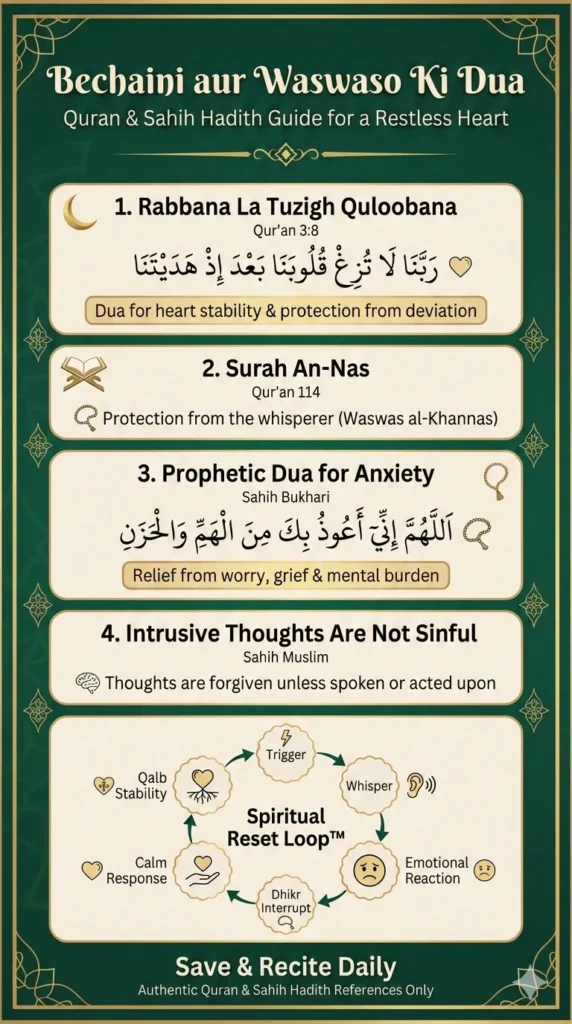
2️⃣ Surah An-Nas – Protection from Waswasa
Which Surah removes waswasa?
Surah An-Nas is the primary Quranic protection against waswasa. It commands believers to seek refuge in Allah from the whisperer who withdraws. Reciting it regularly protects the heart from intrusive thoughts and spiritual disturbance.
From the Qur’an:
Arabic
قُلْ أَعُوذُ بِرَبِّ النَّاسِ
مَلِكِ النَّاسِ
إِلَٰهِ النَّاسِ
مِن شَرِّ الْوَسْوَاسِ الْخَنَّاسِ
Transliteration
Qul a‘oodhu bi rabb-in-naas,
Malik-in-naas,
Ilah-in-naas,
Min shar-ril waswas-il khannas.
English (Saheeh International)
“Say, I seek refuge in the Lord of mankind… from the evil of the retreating whisperer.”
Urdu (Fateh Muhammad Jalandhari)
کہو کہ میں لوگوں کے پروردگار کی پناہ مانگتا ہوں… وسوسہ ڈالنے والے کے شر سے جو پیچھے ہٹ جاتا ہے۔
Tafsir Insight
According to Ibn Kathir,
“Al-Khannas” is the one who retreats when Allah is remembered.
That means dhikr is your interruption tool.
3️⃣ Prophetic Dua for Anxiety & Grief
What did Prophet Muhammad ﷺ read for anxiety?
The Prophet ﷺ taught a powerful dua against anxiety and sadness, recorded in Sahih Bukhari. It seeks protection from worry, grief, weakness, laziness, and debt. This supplication is a complete spiritual and emotional shield for restlessness.
From Sahih al-Bukhari:
Arabic
اللَّهُمَّ إِنِّي أَعُوذُ بِكَ مِنَ الْهَمِّ وَالْحَزَنِ، وَالْعَجْزِ وَالْكَسَلِ…
Transliteration
Allahumma inni a‘oodhu bika minal-hammi wal-hazan, wal-‘ajzi wal-kasal…
English
“O Allah, I seek refuge in You from anxiety and sorrow, from weakness and laziness…”
Urdu
اے اللہ! میں تیری پناہ مانگتا ہوں غم اور فکر سے، کمزوری اور سستی سے…
This dua addresses:
- Emotional distress
- Mental fatigue
- Overthinking
- Helplessness
It is holistic.
4️⃣ Are Intrusive Thoughts a Sin?
Is waswasa sinful?
No. Intrusive thoughts are not sinful unless acted upon or spoken. The Prophet ﷺ clearly stated that Allah forgives what crosses the mind as long as it is not expressed or acted upon. This removes unnecessary guilt for believers struggling with waswasa.
From Sahih Muslim:
“Allah has forgiven my Ummah for what crosses their minds so long as they do not speak of it or act upon it.”
Commentary Insight
Imam Nawawi explains:
Unwanted intrusive thoughts are not disbelief. They are a sign of faith when resisted.
Let that sink in.
The discomfort you feel?
It may actually be your iman rejecting falsehood.
The Spiritual Reset Loop™ (Modern 2026 Framework)
How do you break the waswasa cycle?
To stop waswasa, interrupt it immediately with dhikr and seek refuge in Allah. Do not analyze the thought. Do not argue with it. Replace it with remembrance. Consistency trains the heart to weaken the whisper over time.
The Loop
Trigger → Whisper → Emotional Reaction → Dhikr Interrupt → Calm Response → Stability
In 2026, triggers include:
- Social media overload
- Constant notifications
- Comparison culture
- Information fatigue
The Sunnah solution?
- Istia‘adhah (A‘oodhu billah)
- Short dhikr repetition
- Controlled breathing
- Regular Surah An-Nas recitation
Waswasa thrives on attention.
Dhikr starves it.
People Also Ask:
Doubts during salah are often shaytani whispers meant to distract focus. The Prophet ﷺ instructed believers to seek refuge in Allah and lightly blow to the left three times. Do not repeat the prayer unless certain of error.
Yes. Anxiety and restlessness can be a test that strengthens reliance on Allah. When handled with sabr and dua, it becomes a means of purification. Islam does not deny emotional struggle — it provides spiritual tools to manage it.
There is no fixed number unless specified in hadith. Read with sincerity and presence. Surah An-Nas is commonly recited three times in morning and evening adhkar. Consistency matters more than quantity.
Final Reflection
Bechaini does not mean weak iman.
Waswasa does not mean you are sinful.
Intrusive thoughts do not define you.
Your heart is in the care of Allah.
And Allah is closer than the whisper.
