
Every believing heart carries a quiet desire to send the highest, most profound blessings upon the Prophet Muhammad (ﷺ). But how do you quantify love? How do you send blessings that match the magnificent status of the Messenger? Darood e Lakhi offers a profound solution. Rather than relying on our limited human counting, this specific salawat attaches our prayers to the infinite, boundless realities of Allah’s creation. It is a prayer of immense spiritual intelligence, transforming a few moments of reflection into an eternity of reward.
What is Darood e Lakhi?
Darood e Lakhi is a comprehensive, multi-verse prayer of blessings upon the Prophet Muhammad (ﷺ). Scholars highlight that reciting this extensive salawat carries the spiritual weight and boundless reward of reciting immense volumes of traditional durood by attaching the blessings to Allah’s infinite knowledge and creation.
Let’s understand the real meaning behind this profound practice. In Islamic spiritual traditions, certain supplications bypass human limitations. Darood e Lakhi, famously attributed historically to the daily practice of devoted leaders like Sultan Mahmood Ghaznavi, does exactly this.
When you ask Allah to send blessings equal to the drops of rain, the leaves on the trees, and the stars in the sky, you are no longer limited by what you can count on a tasbeeh. You are asking the Creator of the universe to use His universe as the measuring scale for your love of His Prophet (ﷺ). This shifts your spiritual practice from a transaction of numbers to an ongoing state of boundless devotion.
The Multilingual Proof Format Short version: Arabic, Transliteration, and Translation
Arabic Text:
اللَّهُمَّ صَلِّ عَلَى سَيِّدِنَا مُحَمَّدٍ عَدَدَ مَا فِي عِلْمِ اللَّهِ صَلَاةً دَائِمَةً بِدَوَامِ مُلْكِ اللَّهِ
Transliteration:
Allahumma salli ‘ala Sayyidina Muhammadin ‘adada ma fi ‘ilmillahi salatan da’imatan bidawami mulkillah.
English Translation:
“O Allah, send blessings upon our Master Muhammad in the number of what is in the Knowledge of Allah, blessings that are eternal with the eternity of the Kingdom of Allah.”
Urdu Translation:
اے اللہ! ہمارے سردار حضرت محمد ﷺ پر اتنی رحمتیں نازل فرما جتنی اللہ کے علم میں ہیں، ایسی رحمتیں جو اللہ کی بادشاہی کے ساتھ ہمیشہ رہنے والی ہوں۔
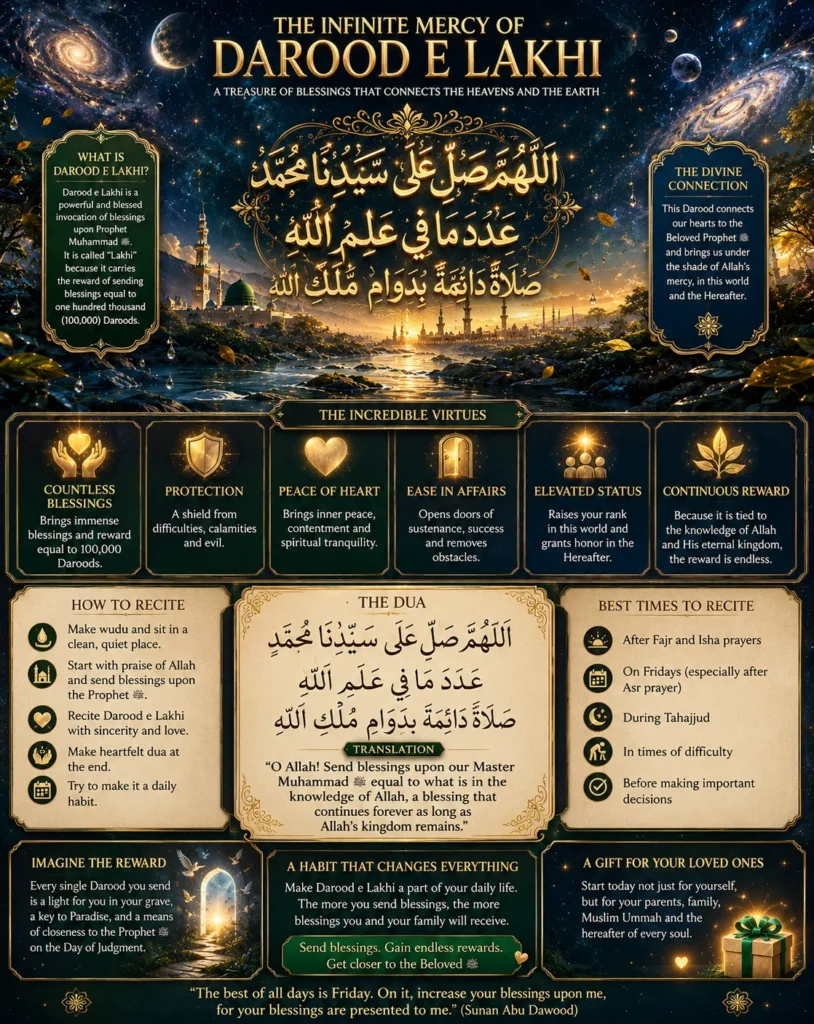
The Complete Arabic Text
To truly benefit from this prayer, you must understand its exact phrasing. Below is the complete, authentic multi-verse Arabic text of Darood e Lakhi, accompanied by its comprehensive translations in English and Urdu for deeper spiritual reflection.
The Arabic Verses
بِسْمِ اللَّهِ الرَّحْمَنِ الرَّحِيمِ
اَللَّهُمَّ صَلِّ وَسَلِّمْ عَلَىٰ سَيِّدِنَا وَمَوْلَانَا مُحَمَّدٍ وَعَلَىٰ آلِ سَيِّدِنَا مُحَمَّدٍ بِعَدَدِ رَحْمَةِ اللَّهِ اَللَّهُمَّ صَلِّ وَسَلِّمْ عَلَىٰ سَيِّدِنَا وَمَوْلَانَا مُحَمَّدٍ وَعَلَىٰ آلِ سَيِّدِنَا مُحَمَّدٍ بِعَدَدِ فَضْلِ اللَّهِ اَللَّهُمَّ صَلِّ وَسَلِّمْ عَلَىٰ سَيِّدِنَا وَمَوْلَانَا مُحَمَّدٍ وَعَلَىٰ آلِ سَيِّدِنَا مُحَمَّدٍ بِعَدَدِ خَلْقِ اللَّهِ اَللَّهُمَّ صَلِّ وَسَلِّمْ عَلَىٰ سَيِّدِنَا وَمَوْلَانَا مُحَمَّدٍ وَعَلَىٰ آلِ سَيِّدِنَا مُحَمَّدٍ بِعَدَدِ عِلْمِ اللَّهِ اَللَّهُمَّ صَلِّ وَسَلِّمْ عَلَىٰ سَيِّدِنَا وَمَوْلَانَا مُحَمَّدٍ وَعَلَىٰ آلِ سَيِّدِنَا مُحَمَّدٍ بِعَدَدِ كَلِمَاتِ اللَّهِ اَللَّهُمَّ صَلِّ وَسَلِّمْ عَلَىٰ سَيِّدِنَا وَمَوْلَانَا مُحَمَّدٍ وَعَلَىٰ آلِ سَيِّدِنَا مُحَمَّدٍ بِعَدَدِ كَرَمِ اللَّهِ اَللَّهُمَّ صَلِّ وَسَلِّمْ عَلَىٰ سَيِّدِنَا وَمَوْلَانَا مُحَمَّدٍ وَعَلَىٰ آلِ سَيِّدِنَا مُحَمَّدٍ بِعَدَدِ حُرُوفِ كَلَامِ اللَّهِ اَللَّهُمَّ صَلِّ وَسَلِّمْ عَلَىٰ سَيِّدِنَا وَمَوْلَانَا مُحَمَّدٍ وَعَلَىٰ آلِ سَيِّدِنَا مُحَمَّدٍ بِعَدَدِ قَطَرَاتِ الْأَمْطَارِ اَللَّهُمَّ صَلِّ وَسَلِّمْ عَلَىٰ سَيِّدِنَا وَمَوْلَانَا مُحَمَّدٍ وَعَلَىٰ آلِ سَيِّدِنَا مُحَمَّدٍ بِعَدَدِ أَوْرَاقِ الْأَشْجَارِ اَللَّهُمَّ صَلِّ وَسَلِّمْ عَلَىٰ سَيِّدِنَا وَمَوْلَانَا مُحَمَّدٍ وَعَلَىٰ آلِ سَيِّدِنَا مُحَمَّدٍ بِعَدَدِ رَمْلِ الْقِفَارِ اَللَّهُمَّ صَلِّ وَسَلِّمْ عَلَىٰ سَيِّدِنَا وَمَوْلَانَا مُحَمَّدٍ وَعَلَىٰ آلِ سَيِّدِنَا مُحَمَّدٍ بِعَدَدِ مَا خُلِقَ فِي الْبِحَارِ اَللَّهُمَّ صَلِّ وَسَلِّمْ عَلَىٰ سَيِّدِنَا وَمَوْلَانَا مُحَمَّدٍ وَعَلَىٰ آلِ سَيِّدِنَا مُحَمَّدٍ بِعَدَدِ الْحُبُوبِ وَالثِّمَارِ اَللَّهُمَّ صَلِّ وَسَلِّمْ عَلَىٰ سَيِّدِنَا وَمَوْلَانَا مُحَمَّدٍ وَعَلَىٰ آلِ سَيِّدِنَا مُحَمَّدٍ بِعَدَدِ اللَّيْلِ وَالنَّهَارِ اَللَّهُمَّ صَلِّ وَسَلِّمْ عَلَىٰ سَيِّدِنَا وَمَوْلَانَا مُحَمَّدٍ وَعَلَىٰ آلِ سَيِّدِنَا مُحَمَّدٍ بِعَدَدِ مَا أَظْلَمَ عَلَيْهِ اللَّيْلُ وَأَشْرَقَ عَلَيْهِ النَّهَارُ اَللَّهُمَّ صَلِّ وَسَلِّمْ عَلَىٰ سَيِّدِنَا وَمَوْلَانَا مُحَمَّدٍ وَعَلَىٰ آلِ سَيِّدِنَا مُحَمَّدٍ بِعَدَدِ مَنْ صَلَّىٰ عَلَيْهِ اَللَّهُمَّ صَلِّ وَسَلِّمْ عَلَىٰ سَيِّدِنَا وَمَوْلَانَا مُحَمَّدٍ وَعَلَىٰ آلِ سَيِّدِنَا مُحَمَّدٍ بِعَدَدِ مَنْ لَّمْ يُصَلِّ عَلَيْهِ اَللَّهُمَّ صَلِّ وَسَلِّمْ عَلَىٰ سَيِّدِنَا وَمَوْلَانَا مُحَمَّدٍ وَعَلَىٰ آلِ سَيِّدِنَا مُحَمَّدٍ بِعَدَدِ أَنْفَاسِ الْخَلَائِقِ اَللَّهُمَّ صَلِّ وَسَلِّمْ عَلَىٰ سَيِّدِنَا وَمَوْلَانَا مُحَمَّدٍ وَعَلَىٰ آلِ سَيِّدِنَا مُحَمَّدٍ بِعَدَدِ نُجُومِ السَّمَاوَاتِ اَللَّهُمَّ صَلِّ وَسَلِّمْ عَلَىٰ سَيِّدِنَا وَمَوْلَانَا مُحَمَّدٍ وَعَلَىٰ آلِ سَيِّدِنَا مُحَمَّدٍ بِعَدَدِ كُلِّ شَيْءٍ فِي الدُّنْيَا وَالْآخِرَةِ
صَلَوَاتُ اللَّهِ تَعَالَىٰ وَمَلَائِكَتِهِ وَأَنْبِيَائِهِ وَرُسُلِهِ وَجَمِيعِ خَلَائِقِهِ عَلَىٰ سَيِّدِ الْمُرْسَلِينَ وَإِمَامِ الْمُتَّقِينَ وَقَائِدِ الْغُرِّ الْمُحَجَّلِينَ وَشَفِيعِ الْمُذْنِبِينَ سَيِّدِنَا وَمَوْلَانَا مُحَمَّدٍ وَعَلَىٰ آلِهِ وَأَصْحَابِهِ وَأَزْوَاجِهِ وَذُرِّيَّتِهِ وَأَهْلِ بَيْتِهِ وَأَهْلِ طَاعَتِكَ أَجْمَعِينَ مِن أَهْلِ السَّمَاوَاتِ وَالْأَرَضِينَ بِرَحْمَتِكَ يَا أَرْحَمَ الرَّاحِمِينَ وَيَا أَكْرَمَ الْأَكْرَمِينَ صَلَّى اللَّهُ تَعَالَى عَلَيْهِ وَآلِهِ وَسَلَّمَ تَسْلِيمًا دَائِمًا أَبَدًا
English Translation
“In the Name of Allah, the Most Compassionate, the Most Merciful. O Allah, send blessings and peace upon our Master and Patron Muhammad, and upon the family of our Master Muhammad, by the number of Allah’s mercy. …by the number of Allah’s grace. …by the number of Allah’s creation. …by the number of Allah’s knowledge. …by the number of Allah’s words. …by the number of Allah’s generosity. …by the number of the letters of Allah’s speech. …by the number of the drops of rain. …by the number of the leaves of the trees. …by the number of the grains of sand in the deserts. …by the number of all that is created in the seas. …by the number of grains and fruits. …by the number of the days and the nights. …by the number of everything the night covers in darkness and the day illuminates. …by the number of those who send blessings upon him. …by the number of those who do not send blessings upon him. …by the number of the breaths of all creation. …by the number of the stars in the heavens. …by the number of everything in this world and the Hereafter.
May the blessings of Allah Almighty, His angels, His prophets, His messengers, and all of His creation be upon the Master of the Messengers, the Imam of the Pious, the Leader of the radiantly marked ones, and the Intercessor of the sinners—our Master and Patron Muhammad. And upon his family, his companions, his wives, his progeny, the people of his household, and all the people of Your obedience from the inhabitants of the heavens and the earths. By Your mercy, O Most Merciful of the merciful, and O Most Generous of the generous. May Allah Almighty send blessings and peace upon him and his family, an abundant and everlasting peace.”
Urdu Translation
“اللہ کے نام سے شروع جو نہایت مہربان رحم والا ہے۔ اے اللہ! درود و سلام نازل فرما ہمارے سردار اور آقا محمد ﷺ پر اور ان کی آل پر، اللہ کی رحمت کی تعداد کے برابر۔ …اللہ کے فضل کی تعداد کے برابر۔ …اللہ کی مخلوق کی تعداد کے برابر۔ …اللہ کے علم کی تعداد کے برابر۔ …اللہ کے کلمات کی تعداد کے برابر۔ …اللہ کے کرم کی تعداد کے برابر۔ …اللہ کے کلام کے حروف کی تعداد کے برابر۔ …بارش کے قطروں کی تعداد کے برابر۔ …درختوں کے پتوں کی تعداد کے برابر۔ …صحراؤں کی ریت کے ذروں کی تعداد کے برابر۔ …سمندروں میں پیدا کی گئی مخلوقات کی تعداد کے برابر۔ …اناج اور پھلوں کی تعداد کے برابر۔ …دن اور رات کی تعداد کے برابر۔ …ان تمام چیزوں کی تعداد کے برابر جن پر رات اندھیرا کرتی ہے اور دن روشنی ڈالتا ہے۔ …ان لوگوں کی تعداد کے برابر جو ان پر درود بھیجتے ہیں۔ …ان لوگوں کی تعداد کے برابر جو ان پر درود نہیں بھیجتے۔ …مخلوقات کی سانسوں کی تعداد کے برابر۔ …آسمانوں کے ستاروں کی تعداد کے برابر۔ …دنیا اور آخرت کی ہر چیز کی تعداد کے برابر۔
اللہ تعالیٰ، اس کے فرشتوں، اس کے نبیوں، اس کے رسولوں اور اس کی تمام مخلوق کی رحمتیں نازل ہوں رسولوں کے سردار، متقیوں کے امام، روشن چہروں والوں کے قائد، اور گناہگاروں کے شفیع، ہمارے سردار اور آقا محمد ﷺ پر۔ اور ان کی آل، ان کے صحابہ، ان کی ازواج، ان کی اولاد، ان کے اہل بیت، اور آسمانوں اور زمینوں کے تمام فرمانبرداروں پر۔ تیری رحمت کے طفیل، اے سب سے بڑھ کر رحم فرمانے والے، اور اے سب سے بڑھ کر کرم فرمانے والے۔ اللہ تعالیٰ ان پر اور ان کی آل پر ہمیشہ ہمیشہ کے لیے بے شمار درود و سلام نازل فرمائے۔”
Tafseer
The structure of Darood e Lakhi is not just a rhythmic list of words; it is a profound cognitive map. By moving systematically from the infinite unseen, through the tangible physical world, and finally into the rhythm of human breath, this prayer completely rewires human perspective, replacing worldly anxiety with cosmic awe.
Here’s why this matters. When a believer recites this specific sequence, they are not merely repeating a chant; they are undertaking a guided spiritual journey that scales the entirety of existence. Let’s understand the real meaning behind this three-tiered architecture.
Tier 1: The Divine Attributes (The Macro-Spiritual Surrender)
Verses: By the number of Allah’s Mercy, His Grace, His Creation, and His Knowledge.
We start where everything begins—with the Infinite. This opening section demands complete intellectual surrender. The human mind is naturally prone to calculation and limitation; we measure our wealth, our time, and our deeds. However, you cannot measure the borders of Rahmatillah (Allah’s Mercy) or Ilmillah (Allah’s Knowledge).
This becomes important when you look at the psychological weight we carry daily. By attaching the blessings upon the Prophet (ﷺ) to these infinite Divine realities, the reciter is forced to let go of their own limited metrics. It is a spiritual reset. You are silently declaring: “O Allah, my capacity to praise Your Messenger is weak and finite, so I borrow Your infinite attributes to do the job.” It anchors the anxious mind to absolute, unchanging certainty.
Tier 2: The Physical Universe (The Terrestrial Grounding)
Verses: By the number of the drops of rain, the leaves of trees, the grains of sand, and the fruits of the earth.
After soaring in the unseen realms of Divine attributes, the prayer purposefully descends into the physical world. Islam is a deeply grounded, practical faith. By specifically naming raindrops (Qatarat il-Amtar) and the leaves of trees (Awraq il-Ashjar), this durood turns the entire physical ecosystem into a living, visual tasbeeh (rosary).
Now let’s connect this to daily life. This section acts as a profound mindfulness trigger. In a world defined by screens and concrete, these verses re-attach the human soul to the earth. Every time a reciter walks through a forest, feels the wind rustle the leaves, or watches a rainstorm, their brain is trained to instantly recall this durood. The environment is no longer just a backdrop to life; it becomes an active participant in sending salawat upon the Prophet (ﷺ). The physical universe becomes your spiritual partner.
Tier 3: The Human Element (The Architecture of Empathy)
Verses: By the number of the breaths of creation, those who send blessings upon him, and those who do not.
Finally, the cosmic lens zooms all the way in, focusing intimately on human biology and sociology. To link blessings to the “breaths of creation” (Anfas il-Khala’iq) is a masterpiece of spiritual engineering. Breathing is an involuntary, subconscious survival mechanism. This verse takes the most basic, automatic biological function of billions of creatures and elevates it into deliberate, high-level spiritual devotion.
Furthermore, the inclusion of “those who do not send blessings upon him” is perhaps the most emotionally intelligent verse in the entire litany. It represents ultimate spiritual empathy. The reciter is looking at a distracted, forgetful world and deciding to stand in the gap. You are using your voice to cover the spiritual deficit of humanity, ensuring that the Prophet (ﷺ) receives honor even on behalf of those who have forgotten him. It builds profound spiritual resilience, shifting the believer from a state of individual worship to carrying the collective consciousness of the Ummah.
The Spiritual Habit Loop: Integrating Darood e Lakhi into Modern Life
Creating a consistent spiritual routine requires simplicity and emotional connection. The Spiritual Habit Loop uses small, meaningful triggers to anchor profound practices like Darood e Lakhi into your daily schedule, turning ordinary moments into infinite spiritual gains.
This becomes important when you look at how scattered our attention is today. We often feel we lack the hours required to sit in deep meditation. To build this into a lasting Spiritual Habit Loop, anchor the recitation of these verses to existing daily actions:
- The Morning Anchor: Recite the full verses once immediately after Fajr. This sets a tone of infinite blessing before the day’s stress begins.
- The Commute Anchor: Use the time spent driving or on public transit. The rhythmic nature of counting the drops of rain and leaves of trees naturally calms the nervous system.
- The Post-Jumu’ah Anchor: Friday is the pinnacle of sending salawat. Dedicate 10 minutes after Friday prayers to recite this beautiful litany slowly, visualizing the vastness of the universe.
Key Spiritual and Practical Benefits (Wazifa)
The regular recitation of Darood e Lakhi brings immense spiritual, emotional, and practical benefits. Scholars note that it acts as a spiritual shield, a multiplier for good deeds, and a direct pathway to gaining the intercession of the Prophet (ﷺ).
Now let’s connect this to daily life. What actually happens when you make this a consistent practice?
- Relief from Anxiety and Hardship: By invoking Allah’s infinite knowledge and the sheer scale of His universe, you silently acknowledge that He knows your struggles. The One who counts the grains of sand certainly sees your hidden tears.
- The Ultimate Reward Multiplier: Because the scale of this prayer is so vast, reciting it humbles the ego. It provides the spiritual equivalent of dedicating your entire life to reciting salawat.
- Cosmic Connection: It creates mindfulness. The next time it rains, or you see leaves falling from a tree, you will instantly be reminded of your prayer, turning nature itself into a reminder of the Prophet (ﷺ).
People Also Ask:
There is no fixed obligatory number. Because the full version is long, reciting it completely just once a day with deep focus is highly transformative. Some spiritual mentors recommend 3 or 7 times daily for those facing significant hardships.
While the exact multi-verse phrasing is drawn from the inspirational experiences of classical righteous scholars (Awliya), the concept of asking Allah for blessings according to the number of His creation is deeply rooted in the authentic Sunnah (such as the famous dua of Juwayriyya bint Al-Harith).
Yes. While it is always spiritually superior to be in a state of wudu when reciting any form of Dhikr, you can recite durood from memory while walking, working, or resting without wudu.
Building Your Global Daily Practice
True spiritual transformation doesn’t happen through reading alone; it happens through consistent action. Make a firm intention today to integrate this specific salawat into your daily routine, allowing the infinite knowledge of Allah to elevate your prayers.
The beauty of Islamic spirituality is its accessibility. Darood e Lakhi is one of the ultimate spiritual tools—a profound linguistic masterpiece that honors the Messenger (ﷺ) perfectly. Take the Arabic phrasing, read through the English or Urdu translation to understand the depth of what you are saying, and let your tongue become moist with the remembrance of the Prophet (ﷺ). Begin today with just one heartfelt recitation, and watch how the barakah unfolds in your daily life.
