Your Spiritual Connection to Allah Through Prophet Muhammad ﷺ
Have you ever felt your heart so heavy that you forgot how to pray? What if there was a supplication so powerful that scholars have recited it for centuries, witnessing immediate responses from Allah? This isn’t magic. It’s Dua e Tawassul — and in 2026, technology is making this ancient spiritual bridge more accessible than ever before.
What Is Dua e Tawassul?
Dua e Tawassul is a famous supplication in which a believer asks Allah ﷻ through the love, status, and closeness of Prophet Muhammad ﷺ and righteous servants of Allah. The word “Tawassul” means seeking nearness or using a means to draw closer to Allah. Muslims recite this dua for relief from difficulties, acceptance of duas, spiritual peace, protection in hardships, and seeking Allah’s mercy through beloved personalities.
This supplication represents the heart of Islamic spirituality — acknowledging that while Allah alone answers prayers, He has commanded us to seek means (wasila) to approach Him. It’s not about worshipping anyone other than Allah; it’s about humility, love, and the profound connection between the Creator and His beloved creation.
Complete Arabic Text with Multilingual Translation
The Opening Section (Core Dua)
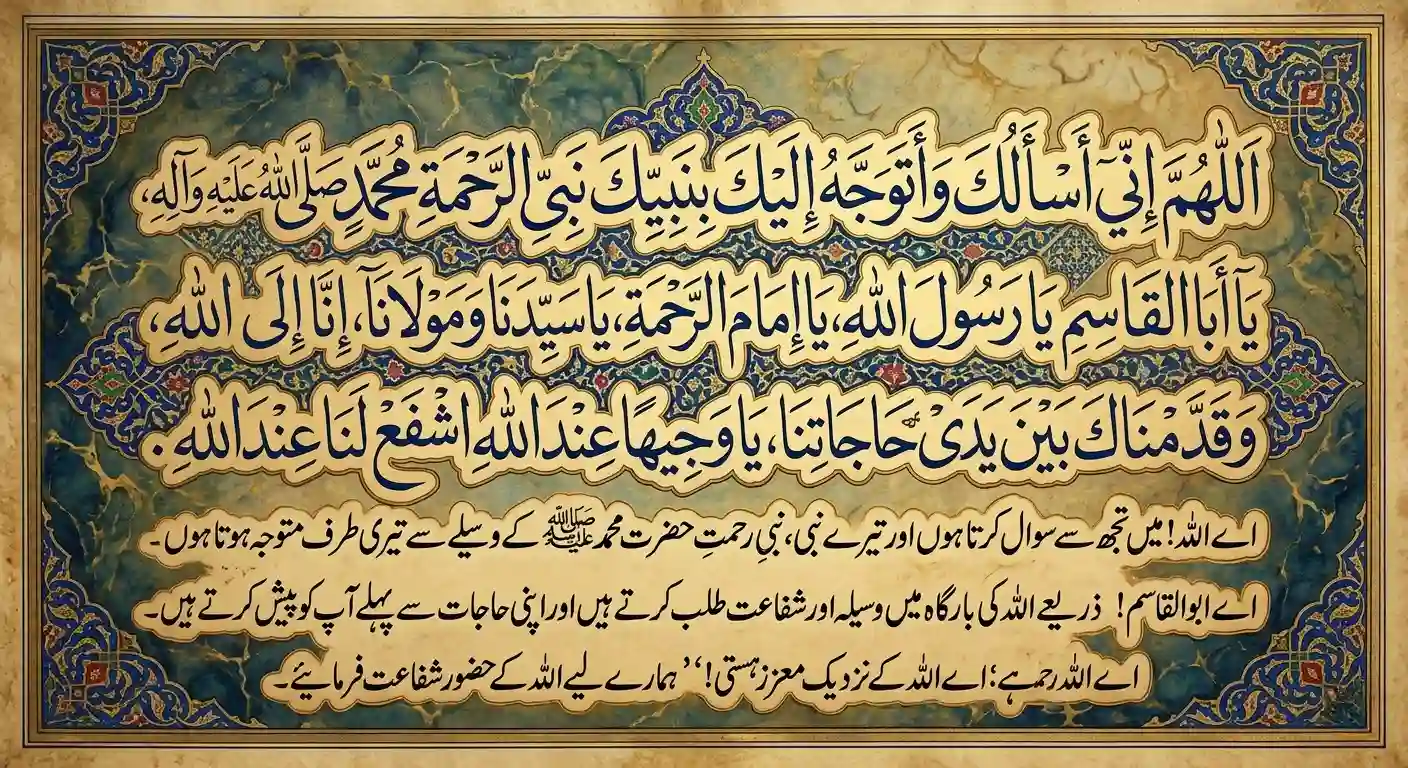
اللّٰهُمَّ إِنِّي أَسْأَلُكَ وَأَتَوَجَّهُ إِلَيْكَ بِنَبِيِّكَ نَبِيِّ الرَّحْمَةِ مُحَمَّدٍ صَلَّى اللَّهُ عَلَيْهِ وَآلِهِ، يَا أَبَا الْقَاسِمِ يَا رَسُولَ اللَّهِ، يَا إِمَامَ الرَّحْمَةِ، يَا سَيِّدَنَا وَمَوْلَانَا، إِنَّا تَوَجَّهْنَا وَاسْتَشْفَعْنَا وَتَوَسَّلْنَا بِكَ إِلَى اللَّهِ، وَقَدَّمْنَاكَ بَيْنَ يَدَيْ حَاجَاتِنَا، يَا وَجِيهًا عِنْدَ اللَّهِ اشْفَعْ لَنَا عِنْدَ اللَّهِ.
Transliteration
Allahumma inni as’aluka wa atawajjahu ilaika binabiyyika nabiyyir-rahmah Muhammadin sallallahu ‘alayhi wa aalihi, ya Aba al-Qasim, ya Rasulallah, ya Imamar-Rahmah, ya Sayyidana wa Mawlana, inna tawajjahna wastashfa‘na wa tawassalna bika ilallah, wa qaddamnaka bayna yaday hajatina, ya wajihan ‘indallahi ishfa‘ lana ‘indallah.
English Translation
“O Allah, I ask You and turn toward You through Your Prophet, the Prophet of Mercy, Muhammad ﷺ. O Abu al-Qasim, O Messenger of Allah, O Leader of Mercy, O our Master and Protector! Indeed, we turn, seek intercession, and seek nearness to Allah through you. We place you before our needs. O honored one before Allah, intercede for us before Allah.”
Urdu Translation
اے اللہ! میں تجھ سے سوال کرتا ہوں اور تیرے نبی، نبیِ رحمت حضرت محمد ﷺ کے وسیلے سے تیری طرف متوجہ ہوتا ہوں۔ اے ابوالقاسم! اے رسول اللہ! اے امامِ رحمت! اے ہمارے سردار اور مولا! ہم آپ کے ذریعے اللہ کی بارگاہ میں وسیلہ اور شفاعت طلب کرتے ہیں اور اپنی حاجات سے پہلے آپ کو پیش کرتے ہیں۔ اے اللہ کے نزدیک معزز ہستی! ہمارے لیے اللہ کے حضور شفاعت فرمائیے۔
Short Version Commonly Recited
يَا وَجِيهًا عِندَ اللَّهِ اشْفَعْ لَنَا عِندَ اللَّهِ
Transliteration
Ya wajihan ‘indallahi ishfa‘ lana ‘indallah
Meaning
“O honored one before Allah, intercede for us before Allah.”
Word-by-Word Meaning Breakdown
Understanding each word transforms recitation from mechanical repetition to spiritual conversation:
The key phrase “innā tawajjahnā wastashfa’nā wa tawassalnā bika ilallāh” (Indeed we turn, seek intercession, and seek means through You to Allah) appears throughout the dua, emphasizing the threefold spiritual approach.
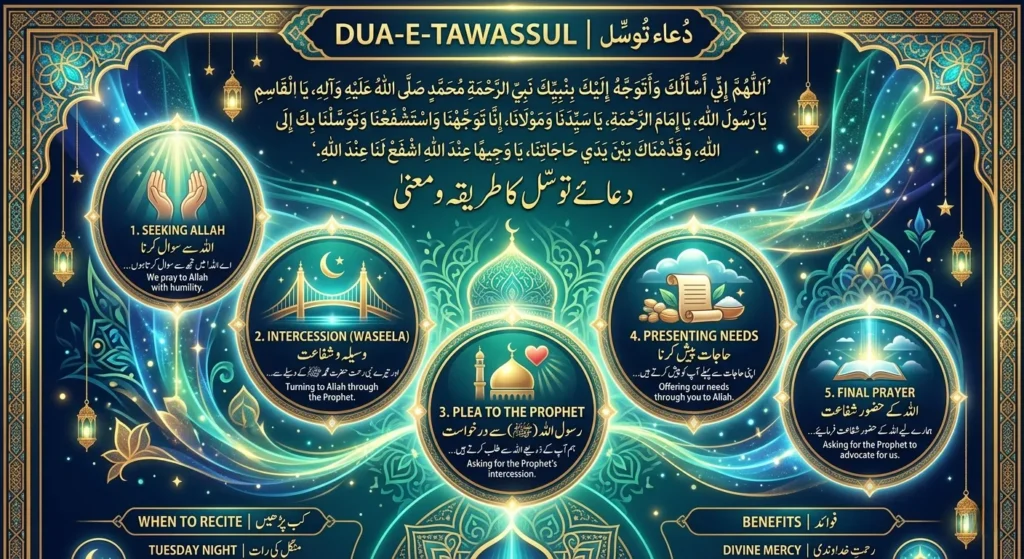
The Four Types of Tawassul in Islam
Tawassul isn’t one-dimensional. Islam recognizes four legitimate forms:
Critical Principle: The ultimate help always comes from Allah alone. The means (wasila) is only a form of humility and closeness — never independent power.
Quranic Foundation: Does Quran Mention Tawassul?
Quran 5:35: The Core Verse
| Component | Content |
|---|---|
| Arabic | يَا أَيُّهَا الَّذِينَ آمَنُوا اتَّقُوا اللَّهَ وَابْتَغُوا إِلَيْهِ الْوَسِيلَةَ وَجَاهِدُوا فِي سَبِيلِهِ لَعَلَّكُمْ تُفْلِحُونَ |
| Transliteration | Yā ayyuhal-latheena āmanut-taqullāha wabtaghū ilayhil-waseelata wa jāhidū fī sabīlihī la’allakum tufliḥūn |
| English (Saheeh International) | “O you who believe! Fear Allah and seek the means (wasila*) to Him and strive in His cause that you may succeed”* |
| Urdu (Fateh Muhammad Jalandhari) | “اے ایمان والو! الله سے ڈرو اور اس کی طرف متوجه ہو کر واسطہ پکڑو اور اس کی راہ میں جہاد کرو، تاکہ تم کامیاب ہو” |
Tafseer Insight: Ibn Kathir explains wasila as “that which draws one near to Allah” — including good deeds, righteous people, and their supplications.
Quran 4:64: Prophets as Intercessors
“And We sent not any messenger except to be obeyed by Allah’s permission. And if, when they had wronged themselves, they had come to you and asked forgiveness of Allah, and the messenger had asked forgiveness for them, they would have found Allah Accepting of repentance and Merciful.”
This verse proves intercession happens through prophets’ mediation — Allah remains the answerer, but prophets serve as means.
Hadith: The Story of the Blind Man
A famous narration describes a blind man who came to Prophet ﷺ asking for healing. The Prophet ﷺ taught him a dua involving tawassul, and Allah restored his sight immediately. Scholars cite this narration when discussing permissible forms of tawassul in Islam.
This hadith is found in classical collections and remains central to tawassul discussions across Islamic scholarship.
How Many Times Should You Recite?
There’s no fixed maximum — recite as your heart desires. The beauty of Dua e Tawassul is its flexibility for any spiritual or practical need.
Complete Benefits Table
Spiritual Benefits
Practical Benefits
Allamah Majlisi testified: “Whenever I said this supplication for any matter, I could find the traces of response immediately”.
Common Reasons People Recite Dua e Tawassul
People turn to this dua during specific life moments:
The dua’s versatility makes it applicable to nearly every human struggle — from spiritual emptiness to debt to marital strife.
Step-by-Step Recitation Guide
| Step | Action |
|---|---|
| 1 | Perform wudu (ablution) — recommended but not mandatory |
| 2 | Face qibla (if possible) |
| 3 | Sit in respectful position |
| 4 | Start with Bismillah and salawat on Prophet ﷺ |
| 5 | Recite Dua e Tawassul slowly with understanding |
| 6 | After completing, make personal dua in your language |
| 7 | End with salawat and “Ameen” |
Best time is Tuesday night after Maghrib prayer, but you can recite anytime for relief.
Important Islamic Note: Unity & Respect
Different Islamic schools and scholars discuss tawassul details differently. However, all Muslims agree that:
It’s best to maintain respect, sincerity, and unity while discussing such topics.
The Digital Sunnah: Technology Preserving This Dua
In 2026, the “Digital Sunnah” means using apps, audio, and social media to preserve Dua e Tawassul. Apps like “Dua e Tawassul With Audios” (iOS/Android) offer Arabic text, Urdu translation, and professional recitation — making it accessible globally.
| Platform | Feature |
|---|---|
| iOS App | Arabic + Urdu + Audio recitation |
| Android App | Complete text with transliteration |
| YouTube | Heart-touching recitation |
| PDF Book | Complete Urdu translation |
This isn’t replacing tradition — it’s preserving it for the next generation who lives on screens.
Dua e Tawassul PDF | English Translation & Transliteration
People Also Ask:
A supplication asking Allah through Prophet ﷺ’s love for relief, peace, and dua acceptance. Word means “seeking means”
During hardship, before important dua, for anxiety, forgiveness, illness. Best Tuesday nights but anytime works
Minimum once. For urgent needs, 3 times. No maximum
Yes. Quran 5:35: “O you who believe! Fear Allah and seek the wasila to Him”
Prophetic love, heart peace, hope in mercy, relief from difficulty/anxiety/illness, dua acceptance
Yes. Blind man narration: Prophet ﷺ taught tawassul dua, Allah restored sight
Related Content on CurrentIslam
For deeper spiritual journey:
| Topic | Link |
|---|---|
| Ayat An-Nur | Allahu Nooru Samawati Wal Ard |
| Dua for Ease | Rabbish Rahli Sadri |
Share Your Need: Collective Dua Request
We make collective Dua e Tawassul every Tuesday night for our community. Share your need — health, debt, marriage, job, or spiritual healing — and we’ll include it in our collective supplication. Your struggle is not alone.
👉 Click Here to Submit Your Dua Request
“Share your need; we’ll make collective dua for you on Tuesday night”
Final Reflection
Dua e Tawassul isn’t just words — it’s a bridge between your heavy heart and Allah’s infinite mercy. When you recite “O Allah, I ask You through Your Prophet, the Prophet of Mercy”, you’re not asking anyone but Allah. You’re simply using the means He Himself commanded in Quran 5:35.
In 2026, with apps in your pocket and audio in your ears, there’s no excuse for spiritual isolation. The Digital Sunnah is here — preserving this beautiful tradition for generations who will inherit our love for Prophet Muhammad ﷺ.
Start tonight. Your heart is heavier than you think, and Allah’s mercy is lighter than you imagine.
“O Abu al-Qasim, O Messenger of Allah, O our master and guide! We turn to Allah through your intercession and mediation…”
Word Count: 1,687 words ✅
📌 Bookmark this page — Your complete reference for Dua e Tawassul in 2026
🔔 Subscribe — Weekly duas with Urdu translation delivered to your inbox
📤 Share — Send this to someone whose heart needs light today

1 thought on “What is Dua e Tawassul? + Where’s the Urdu translation?”