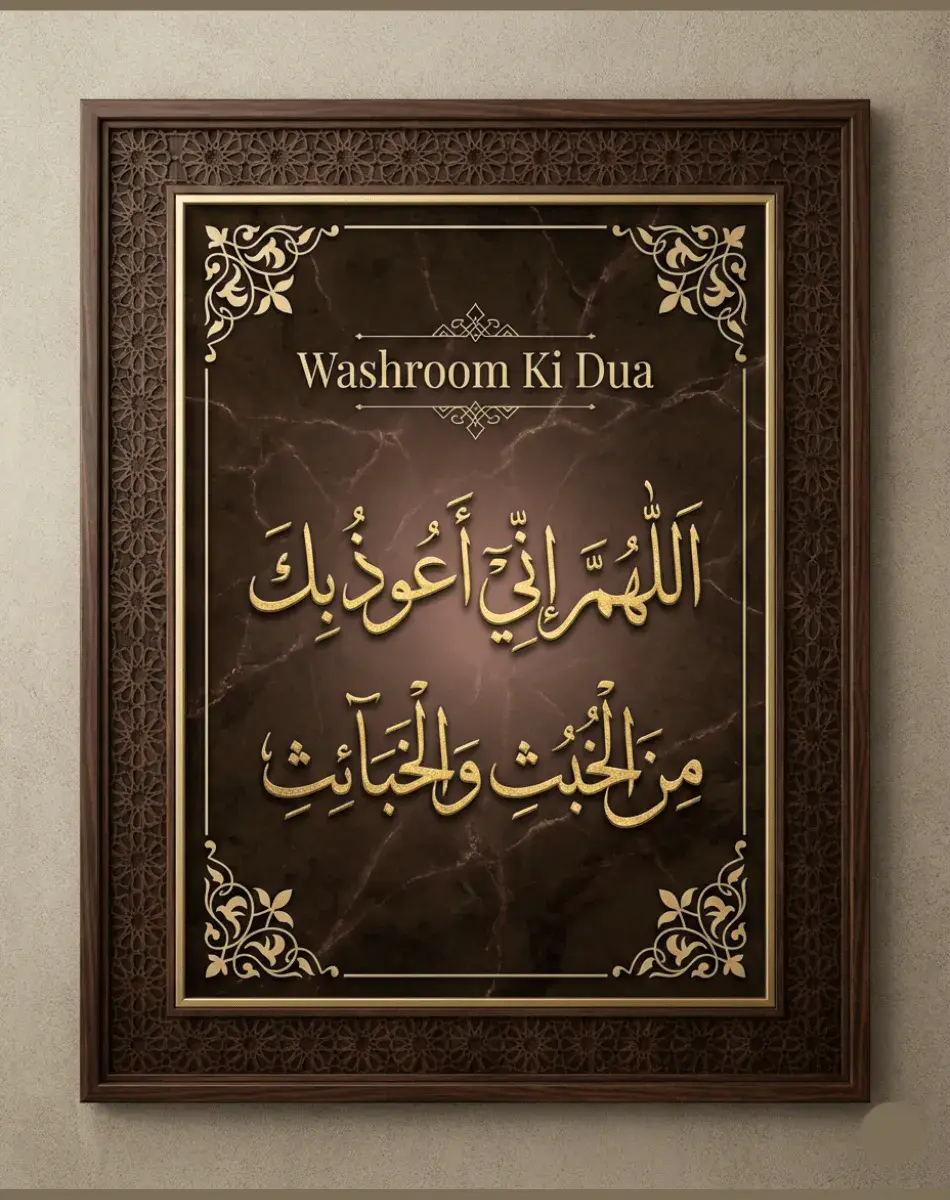
What if I told you that one of the most powerful acts of daily spiritual protection happens in a place we rarely think about — the washroom?
Not in the masjid.
Not during tahajjud.
But before stepping into a private space where no one sees you.
Here’s why this matters for you: Islam turns even ordinary moments into acts of worship. And the dua before entering the washroom is one of those hidden shields most Muslims recite — but few truly understand.
🕌 What Is the Dua Before Entering the Washroom?
The dua before entering the washroom is: “Allahumma inni a‘udhu bika minal-khubuthi wal-khaba’ith.” It means, “O Allah, I seek refuge in You from male and female devils.” This supplication is authentically reported in Sahih al-Bukhari and Sahih Muslim.
It is a Sunnah practice of the Prophet ﷺ and is recited before entering the toilet or bathroom.
Dua Ya Musabab ul Asbab: Full Meaning & Benefits
Learn the powerful prayer for opening doors of sustenance and mercy.
How Many Rakats in Isha Namaz? Step-by-Step Guide
A complete breakdown of Sunnah, Fard, and Witr rakats for Isha prayer.
📖 Primary Hadith Proof
Reported in:
- Sahih al-Bukhari
- Sahih Muslim
🕋 Arabic
اللَّهُمَّ إِنِّي أَعُوذُ بِكَ مِنَ الْخُبُثِ وَالْخَبَائِثِ
🔤 Transliteration
Allahumma inni a‘udhu bika minal-khubuthi wal-khaba’ith
🇬🇧 English (Saheeh International style)
O Allah, I seek refuge in You from male and female devils.
🇵🇰 Urdu (Fateh Muhammad Jalandhari style)
اے اللہ! میں ناپاک جنوں (شیطانوں) سے تیری پناہ مانگتا ہوں۔
📚 What Does “Al-Khubth wal-Khaba’ith” Mean?
“Al-Khubth” refers to evil or male devils, and “Al-Khaba’ith” refers to female devils. Scholars explain that impure places are dwelling areas of shayateen, so the believer seeks Allah’s protection before entering.
According to Imam Nawawi in Al-Adhkar, this dua is a shield against spiritual harm in places of impurity.
Ibn Hajar al-Asqalani explains in Fath al-Bari that this hadith highlights awareness of the unseen world and the believer’s constant reliance on Allah.
This is not superstition. It is prophetic training in spiritual consciousness.
🚪 What Is the Dua After Leaving the Washroom?
The dua after exiting the washroom is “Ghufranak.” It means, “I seek Your forgiveness.” This is authentically reported in Sunan Abu Dawood and Jami at-Tirmidhi.
It is recited immediately after stepping out of the washroom.
📖 Hadith Reference
Reported in:
- Sunan Abu Dawood
- Jami at-Tirmidhi
🕋 Arabic
غُفْرَانَكَ
🔤 Transliteration
Ghufranak
🇬🇧 English
I seek Your forgiveness.
🇵🇰 Urdu
اے اللہ! میں تجھ سے بخشش طلب کرتا ہوں۔
Scholars explain that after relieving oneself, a believer remembers Allah and seeks forgiveness for any shortcomings.
🔁 The Spiritual Habit Loop: A Modern Framework
This dua fits perfectly into what we call the Spiritual Habit Loop:
Cue → Entering washroom
Routine → Reciting the dua
Reward → Divine protection
Islam builds micro-habits. Small, repeated Sunnahs create constant spiritual awareness. Even in private spaces, a Muslim is connected to Allah.
Here’s why this matters for you: children who learn this early develop automatic remembrance of Allah in daily life.
👨👩👧 Parenting Blueprint: Teaching Washroom Ki Dua
Teaching your child “washroom ki dua” is not just memorization — it builds modesty, spiritual awareness, and protection consciousness.
Practical steps:
- Print the Arabic + transliteration card.
- Place it outside the bathroom door.
- Recite together for 21 days.
- Explain the meaning simply.
Children remember what is repeated consistently.
🗣 People Also Ask:
Washroom mein jane se pehle parhi jane wali dua hai: Allahumma inni a‘udhu bika minal-khubuthi wal-khaba’ith. Yeh dua Sahih Bukhari aur Sahih Muslim mein maujood hai.
Toilet se bahar aate waqt parhi jane wali dua hai: Ghufranak. Is ka matlab hai: “Main Allah se bakhshish talab karta hoon.”
Ji haan. Pehli dua Sahih al-Bukhari aur Sahih Muslim mein riwayat hai. Dusri dua Sunan Abu Dawood aur Jami at-Tirmidhi mein maujood hai aur usay hasan sahih qarar diya gaya hai.
🌍 Why This Sunnah Matters in 2026
In a hyper-digital world, Muslims are losing micro-Sunnahs. We remember motivational quotes — but forget prophetic daily shields.
This dua:
- Protects from unseen harm.
- Builds spiritual discipline.
- Turns ordinary moments into worship.
- Connects children to Sunnah naturally.
And it takes less than 7 seconds.
📥 Your Next Step
If this reminder benefited you:
- Teach it to one child today.
- Share it with your family WhatsApp group.
- Download a printable dua card and place it outside your bathroom.
Small Sunnahs. Daily protection. Lifelong barakah.
