Someone once asked a simple question. Is Allah near, so we should speak softly? Or is He far, so we must call out loudly? The answer came as one verse. It sits in the middle of the rules of fasting, and it speaks straight to the heart of dua.
Surah Al-Baqarah, verse 186, is short. It does not give a ritual. It does not give a count. It gives a promise and a condition. Allah is near. He answers the one who calls. And the caller is asked to answer Him back, and to believe.
Quick Answer: Wa iza sa’alaka ibadi means: when My servants ask you about Me, I am near. Allah answers the dua of the caller when he calls. So respond to Allah by obedience, believe in Him, and you will find guidance. The verse sits between fasting rules in Al-Baqarah 2:186.
The Verse in Arabic, Transliteration, English, Urdu and Hindi
Read it slowly first. The Arabic is one sentence with two halves. The first half is Allah’s answer. The second half is our part.
Arabic:
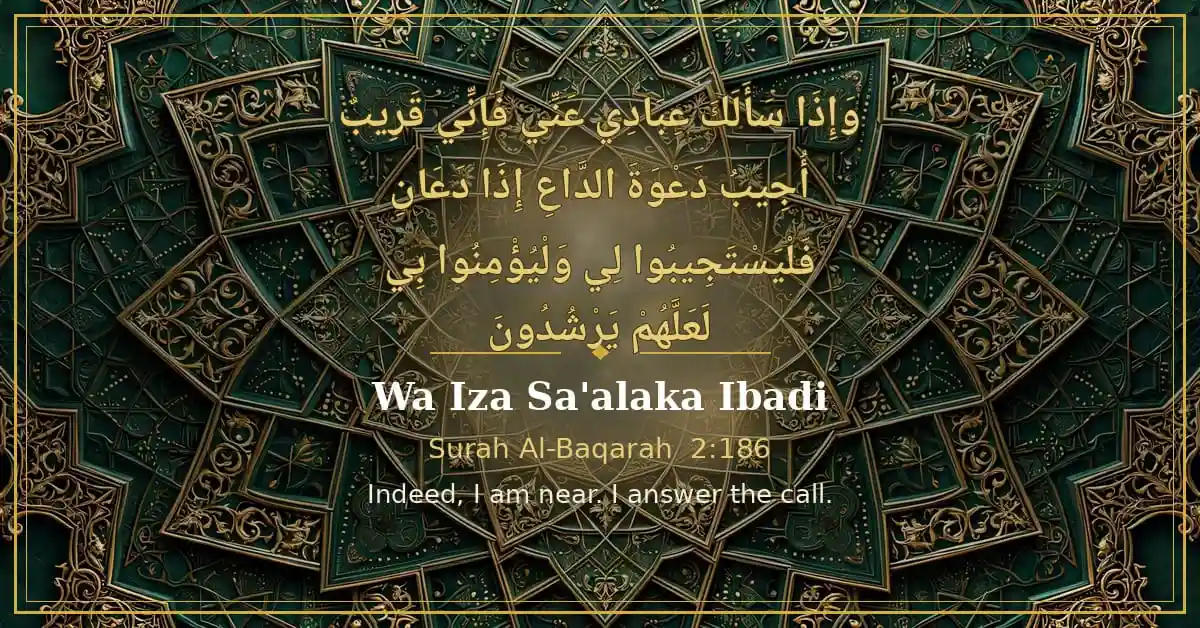
وَإِذَا سَأَلَكَ عِبَادِي عَنِّي فَإِنِّي قَرِيبٌ ۖ أُجِيبُ دَعْوَةَ الدَّاعِ إِذَا دَعَانِ ۖ فَلْيَسْتَجِيبُوا لِي وَلْيُؤْمِنُوا بِي لَعَلَّهُمْ يَرْشُدُونَ
Transliteration:
Wa-idha sa-alaka ‘ibadi ‘anni fa-inni qareeb, ujeebu da’wata ad-da’i idha da’an, falyastajiboo lee wa-lyu’minoo bee la’allahum yarshudoon.
English (Sahih International):
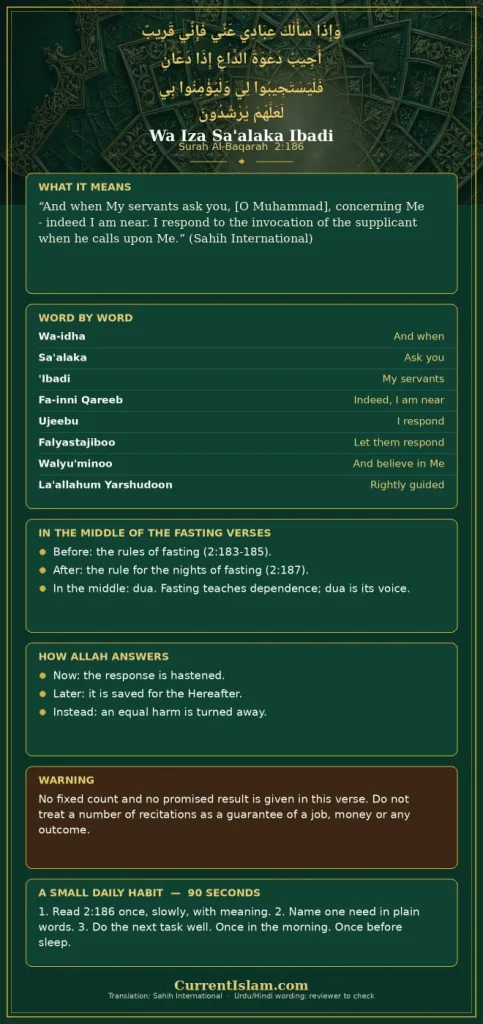
And when My servants ask you, [O Muhammad], concerning Me – indeed I am near. I respond to the invocation of the supplicant when he calls upon Me. So let them respond to Me [by obedience] and believe in Me that they may be [rightly] guided.
Urdu (Maududi, Tafheem-ul-Quran):
اور اے نبیؐ، میرے بندے اگر تم سے میرے متعلق پوچھیں، تو اُنہیں بتا دو کہ میں ان سے قریب ہی ہوں۔ پکارنے والا جب مجھے پکارتا ہے، میں اُس کی پکار سنتا اور جواب دیتا ہوں۔ لہٰذا انہیں چاہیے کہ میری دعوت پر لبیک کہیں اور مجھ پر ایمان لائیں، شاید کہ وہ راہ راست پالیں۔
Hindi (plain meaning):
और जब मेरे बंदे तुमसे मेरे बारे में पूछें, तो निश्चय ही मैं निकट हूँ। पुकारने वाला जब मुझे पुकारता है, मैं उसकी पुकार का उत्तर देता हूँ। इसलिए उन्हें मेरी बात माननी चाहिए और मुझ पर ईमान लाना चाहिए, ताकि वे सीधे रास्ते पर चलें।
Word by Word
Each word carries weight. Qareeb means near. Ujeebu means I respond. The verse ends with guidance, not with a reward list. The path is the reward.
| Arabic | Transliteration | Meaning |
|---|---|---|
| وَإِذَا | Wa-idha | And when |
| سَأَلَكَ | Sa-alaka | Ask you |
| عِبَادِي | ‘Ibadi | My servants |
| عَنِّي | ‘Anni | About Me |
| فَإِنِّي | Fa-inni | Then indeed I am |
| قَرِيبٌ | Qareebun | Near |
| أُجِيبُ | Ujeebu | I respond |
| دَعْوَةَ الدَّاعِ | Da’wata ad-da’i | To the invocation of the supplicant |
| إِذَا دَعَانِ | Idha da’an | When he calls Me |
| فَلْيَسْتَجِيبُوا لِي | Falyastajiboo lee | So let them respond to Me |
| وَلْيُؤْمِنُوا بِي | Wa-lyu’minoo bee | And let them believe in Me |
| لَعَلَّهُمْ يَرْشُدُونَ | La’allahum yarshudoon | So that they may be rightly guided |
Surah Al-Baqarah Ayat 186: Translation, Context, and Daily Habit
Allah Answers Directly, With No Say in Between
Most questions in the Quran are answered with a command: Say. This verse is different. The question is put to the Prophet Muhammad ﷺ, and Allah answers in the first person: Indeed, I am near. There is no go-between in the sentence, and no go-between is needed in the dua.
Ibn Kathir explains the nearness as nearness by knowledge. Allah hears, sees, and knows what is in the breasts. He is not far in a way that needs shouting, and He is not absent in a way that needs an agent. Maududi makes the same point in his tafsir: no recommendation or intercession is needed to place a request before Him, anywhere, at any time.
That is why this verse is often read with Surah Ghafir 40:60: Call upon Me; I will respond to you. The Prophet ﷺ said, The supplication is the worship (Jami’ at-Tirmidhi 2969). Dua is not a side task. It is worship itself. Learning how to make dua with adab keeps the asking honest and humble.
What Near Means for a Worried Heart
Near does not mean Allah is inside creation, or that distance has a size. The classical scholars read it as nearness of hearing, seeing, and knowledge. You do not need to raise your voice to be heard. You do not need perfect words to be understood. A whisper in a hospital corridor counts. A silent request in the heart counts.
The Prophet ﷺ taught this on a journey. His companions raised their voices with takbir on hills and in valleys. He said: be gentle with yourselves. You are not calling one who is deaf or absent. You are calling the All-Hearer, the All-Seer. The One you call is closer to you than the neck of your riding animal. Lower the voice. Raise the trust. This report is recorded in Sahih al-Bukhari and Sahih Muslim, as Ibn Kathir quotes it on this verse.
That nearness also steadies fear. When a problem feels too big to name, the verse says the Listener is already close. You do not have to earn an audience. You have to speak. And when words fail, the feeling itself is known. If fear sits in the chest day after day, read the guide on overcoming modern anxiety alongside this verse. Dua walks with professional care, never in its place.
Why This Verse Sits Between Fasting Verses
Verse 186 does not sit alone. Before it come the rules of fasting (2:183-185). After it comes the rule for the nights of fasting (2:187). The dua verse sits in the middle on purpose. Fasting teaches hunger, patience, and dependence. Dua is what dependence sounds like.
Ibn Kathir reads this placement as encouragement to make dua as the fast ends. The fasting person is named among three whose supplication is not turned back: the just ruler, the fasting person until he breaks the fast, and the oppressed person. The doors of heaven are opened for the oppressed person’s dua. This is recorded in the Musnad of Ahmad and the Sunan collections.
At iftar, keep it simple. Say the dua to break the fast first, then ask for one real need in your own words. The fast has already done its work. The heart is soft. That is the moment this verse is about.
Two Conditions: Respond and Believe
The verse gives a promise, then two verbs. So let them respond to Me, and let them believe in Me. The response is obedience: hear the call, keep the prayer, give what is due, leave what is forbidden. Belief is trust: Allah hears, Allah answers, and His answer is good even when it is not the answer you pictured.
This is a two-way street. Allah says, I am near, I answer. Then He says, Answer Me. The servant who only calls in crisis, and ignores the call the rest of the week, has missed half the verse. Guidance comes with the return, not only with the request. Sovereignty belongs to Allah alone, so the return is to the One who owns every outcome.
Belief also means patience with the answer. Allah may give now. He may save it for the Hereafter. He may turn away an equal harm. All three are answers. The verse does not promise your preferred outcome on your preferred day. It promises a Listener who never misses a call.
How Allah Answers, and Why You Should Not Give Up
A report from Anas, recorded by Ahmad and at-Tirmidhi, lists three ways a dua is met: Allah hastens the response, or saves it for the Hereafter, or turns away an equal amount of evil. The callers said, What if we ask for more? The Prophet ﷺ said, There is more with Allah. Asking more does not empty the store.
The one danger is haste. Ibn Kathir quotes the warning: a person says, I supplicated and supplicated, but I do not see it accepted. Then he loses interest and stops asking. Haste is not a timer. It is giving up. The verse says when he calls upon Me, with no expiry date. Keep calling.
So judge a dua by the calling, not only by the result. If you called with a clean heart, for a lawful need, without cutting family ties, the call reached its Listener. The answer may already be working in a form you cannot yet see. That is the same trust as whoever relies on Allah, and finds a way out he did not plan.
The Nearness Habit: 90 Seconds a Day
Turn the verse into a habit, not a project. Ninety seconds. One fixed moment. One reading. One personal dua. No count is prescribed for this verse in the Quran, and no count-setting hadith for 2:186 was verified here. Read it once, with meaning. That is enough.
Cue: the moment worry arrives, or the moment prayer ends. Routine: read 2:186 once, slowly, in Arabic if you can, then in your own language. Name one need in plain words. Reward: a steadier heart, because the need now has a Listener. Attach it to the dua after every prayer, so the habit has a home.
In the morning, read it before the phone. At night, read it before sleep. Pair it with short dhikr you already know. The point is return, not length. A small habit kept daily outlasts a long session done once. Many readers pair this with Tasbeeh Fatima after prayer, 33, 33, 34, as a second anchor.
The same surah closes with two more ayat for the night. Read the last two ayat of Surah Al-Baqarah when the day ends, and let 2:186 open the day.
Three Mistakes to Avoid
- Asking only in crisis. Dua is worship, not an emergency line. The verse asks for a life of response, not a single call.
- Fixing a count and promising a result. No verse count guarantees a job, a visa, or a marriage. Do not sell the verse as a formula.
- Shouting, performing, or copying words without meaning. Allah is near. Speak plainly, in your own language if you must, and mean it.
Frequently Asked Questions
What does wa iza sa’alaka ibadi mean?
It means: And when My servants ask you about Me. The full verse answers that Allah is near, He answers the caller when he calls, so respond to Him and believe in Him, that you may be rightly guided.
Which Juz is Surah Al-Baqarah 2:186 in?
Juz 2, also called Para 2. Surah Al-Baqarah is the second surah, it has 286 verses, and it is a Madani surah. Verse 186 sits in the fasting passage, between verses 183-185 and verse 187.
Can I make dua in my own language?
Yes. The verse places no language condition on the caller. Say the Arabic first if you can, then ask in your own words. Allah hears every language, and He knows the request before the words are formed.
Why has my dua not been answered yet?
The answer may come now, be saved for the Hereafter, or turn away an equal harm. Do not stop asking because you cannot see the result yet. Haste means giving up. Keep calling, keep obeying, and trust the Listener.
Is there a fixed count for reciting 2:186?
No. The Quran sets no count for this verse, and no count-setting hadith for 2:186 was verified here. Read it once with meaning, and make your own dua. One slow reading beats a hundred rushed ones.
Allah is near. Say it to yourself before you ask. Then ask. One verse, one voice, one Listener. That is enough for today.
Sources: English: Sahih International. Urdu: Maududi, Tafheem-ul-Quran, as shown on surahquran.com. Hindi: plain meaning. Hadith: Jami’ at-Tirmidhi 2969. Tafsir summaries: Ibn Kathir, al-Jalalayn, Maududi.
Download Deep Guide PDF (Free)