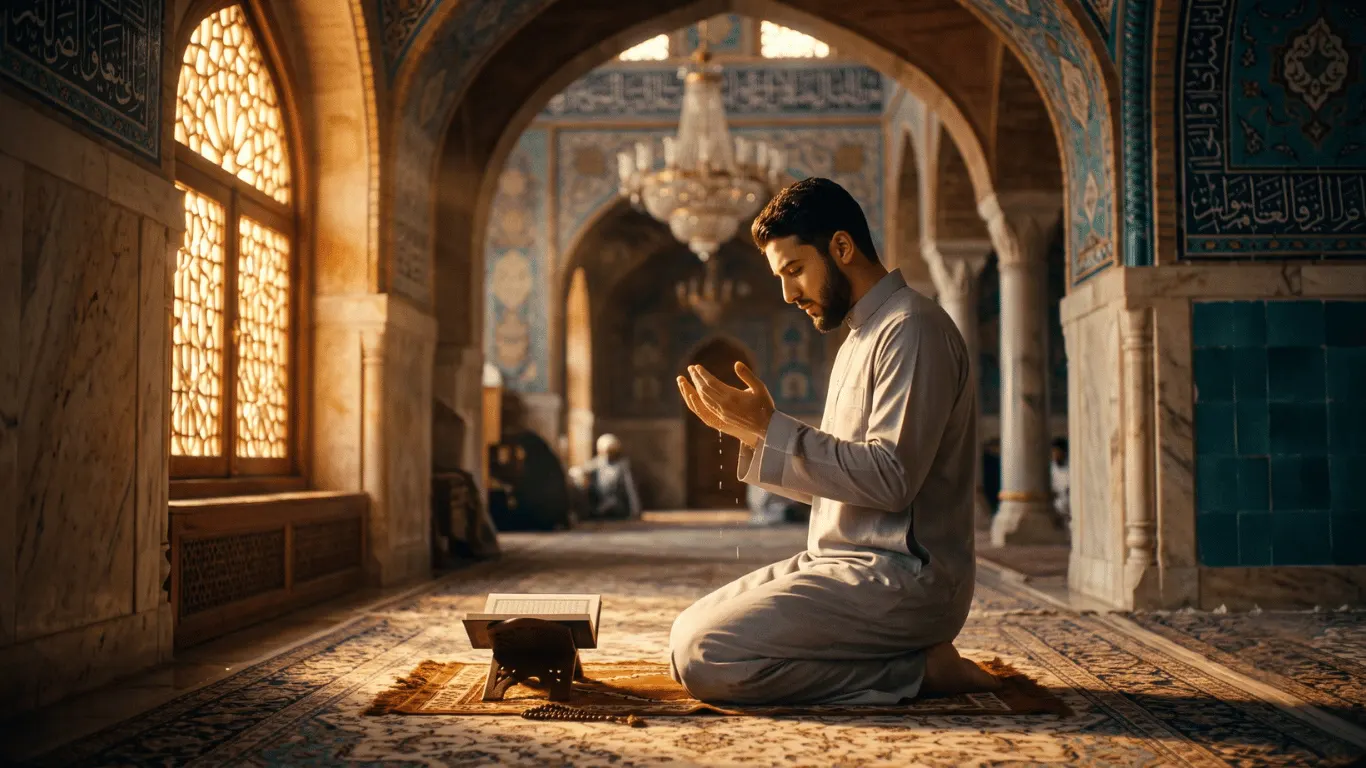
When you wake up in New York at 6 AM or face a gray, delayed commute in London, and feel overwhelmed before your day even starts, the ancient practice of supplication from Prophet Muhammad (PBUH) becomes your strongest shield against anxiety.
For Western Muslims navigating corporate demands, university stress, and modern life across the US and UK, knowing exactly how to ask for divine help is a critical life skill. This guide bridges classical Islamic scholarship with the realities of modern American and British life, giving you the exact blueprint for accepted prayers.
What Is the Correct Way to Make Dua?
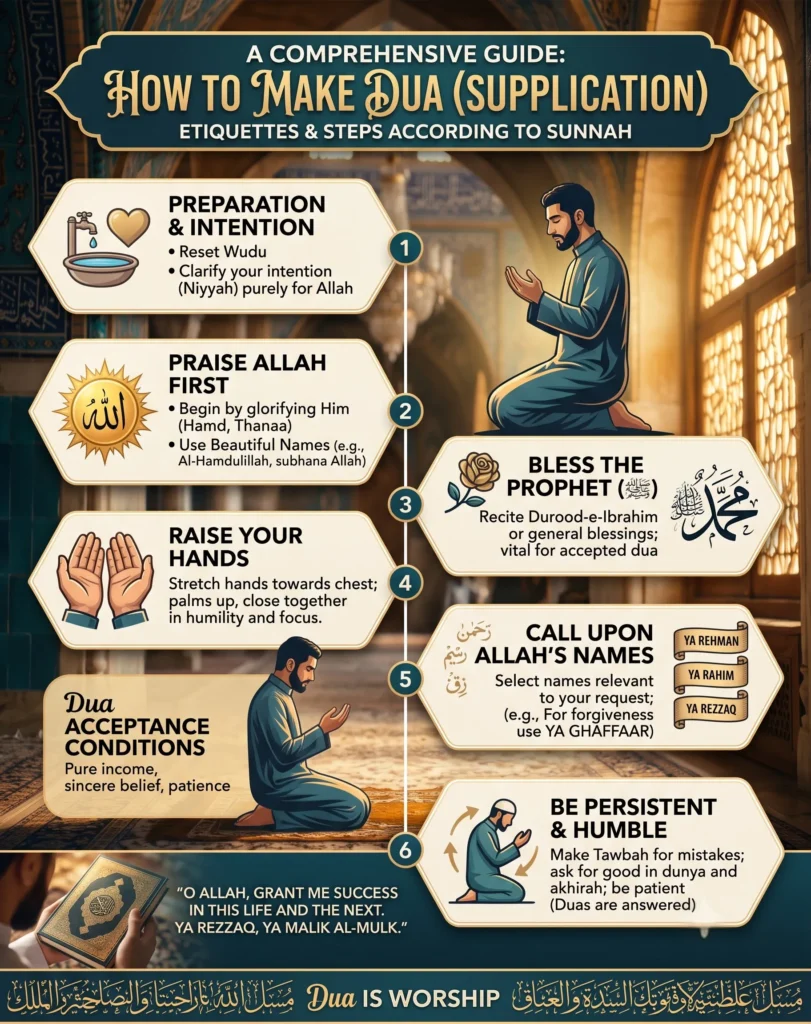
To make dua properly, start by praising Allah and sending blessings upon the Prophet Muhammad (PBUH). Then raise your hands, face the Qiblah with sincerity, and call upon Allah using His beautiful names while asking specifically and with full conviction for what you need.
Here is why this matters for you. The structured etiquette of dua is not just ritual; it is a spiritual habit loop that shifts your psychology from panic to absolute reliance on the Creator. Classical scholar Imam Al-Qurtubi emphasized that the posture of the hands and the direction of the face align the physical body with the spiritual intention.
Step-by-Step Method from the Sunnah
The Prophet Muhammad (PBUH) provided a clear framework for asking Allah. Whether you are sitting in your car on the I-405 in Los Angeles or taking a quiet moment in a Manchester office, follow this sequence:
- Achieve Purity: While not strictly mandatory, being in a state of ablution enhances your focus. Many Muslims find immense spiritual clarity by resetting their physical state. To perfect this, you can learn the exact dua after wudu.
- Face the Qiblah: Turn your heart and body toward Mecca.
- Raise Your Hands: Cup your hands together, palms facing upward, at chest level.
- Praise Allah First: Say Alhamdulillah (All praise is due to Allah) and use His beautiful names.
- Send Salawat: Send blessings upon Prophet Muhammad (PBUH).
- Ask with Absolute Certainty: Do not say “if You will.” Ask firmly.
Which Quran Verse Explains the Power of Dua?
The power of dua is rooted directly in the Quran. Allah commands believers to ask Him directly, promising an answer.
Surah Ghafir (Chapter 40, Verse 60)
- Arabic text: وَقَالَ رَبُّكُمُ ادْعُونِي أَسْتَجِبْ لَكُمْ
- Transliteration: Wa qala rabbukumu ud’ooni astajib lakum.
- English translation: And your Lord says, “Call upon Me; I will respond to you.”
- Urdu translation: اور تمہارے رب نے فرمایا ہے: مجھ سے دعا کرو، میں تمہاری دعا قبول کروں گا۔
Let’s understand the real meaning of this Arabic verse. According to the classical Tafseer Ibn Kathir, this verse is a manifestation of Allah’s infinite mercy. Ibn Kathir explains that Allah is angered when His servants do not ask Him for their needs. The promise “I will respond to you” is absolute, though the response may come immediately, be delayed for your benefit, or avert a hidden harm.
The Core Hadith: Supplication as Worship
To reinforce this, the Prophet (PBUH) stated that the act of asking is the core of faith itself.
Sahih At-Tirmidhi (Book 48, Hadith 3371)
- Arabic text: الدُّعَاءُ هُوَ الْعِبَادَةُ
- Transliteration: Ad-du’a’u huwal-‘ibadah.
- English translation: “Supplication is the essence of worship.”
- Urdu translation: دعا ہی عبادت ہے۔
This becomes important when you look at your morning routine in New York or London. When you rush out the door, viewing dua as a “last resort” limits your spiritual growth. The Hadith above, authenticated by At-Tirmidhi, proves that the very act of asking is how you worship.
How Many Times to Recite This Dua?
There is no strict limit on how many times you can make a general dua, but reciting specific prophetic supplications 3, 7, or 100 times aligns with the Sunnah, depending on the specific wording.
For general personal requests, repetition is highly encouraged. The Prophet (PBUH) would often repeat his supplications three times when asking for something vital. When dealing with modern anxieties, repeating a dua three times helps center your heart, pulling your focus away from a stressful email and back to divine reliance.
Modern Muslim Routine: Dua Before Work or the Commute
The morning dua is your spiritual armor before stepping into the workplace. For diaspora Muslims balancing secular environments with their faith, anchoring the day is vital.
Now let’s connect this to daily life at your office or school. If you are operating on US Eastern Time and commuting at 7:30 AM, or navigating the London Underground during GMT rush hour, use these transition periods. You do not need a prayer mat to make dua. You can supplicate quietly while walking, driving, or waiting for a meeting to begin.
Furthermore, you can attach your supplications to daily anchors. For instance, when your phone notifies you of the prayer time, that is a prime window for acceptance. See the precise dua after adhan to maximize this opportunity, turning a simple notification into a moment of worship.
How to make dua Properly According to the Sunnah
People Also Ask
The morning dua is: “All praise is due to Allah who gave us life after having taken it from us and unto Him is the resurrection.” It is a powerful way to start the day with gratitude before looking at your phone.
Surah Ash-Sharh (94:5-6) is highly effective for anxiety. It states: “For indeed, with hardship [will be] ease. Indeed, with hardship [will be] ease.” Reciting this reminds the heart that relief is permanently attached to difficulty.
For general personal prayers, reciting them three times is a recommended Sunnah practice that shows persistence and sincerity. For specific morning and evening adkhar (remembrances), follow the specific counts of 1, 3, or 100 as outlined in authentic Hadith collections.
Yes. You can recite: “O Allah, I ask You for beneficial knowledge, goodly provision, and acceptable deeds.” This is ideal for Western Muslims heading into the office, ensuring their income and efforts remain blessed
The Prophet (PBUH) prayed for blessings in the early hours, saying, “O Allah, bless my nation in their early mornings” (Sunan Ibn Majah). This establishes the morning as the most spiritually and materially productive time of the day.
Are you or your children facing severe academic pressure this semester? Spiritual preparation is just as critical as studying. Read our complete guide on the dua for exams to learn the authentic practices that secure success and calm your nerves before walking into the test room.

1 thought on “How to make dua – A step-by-step guide”