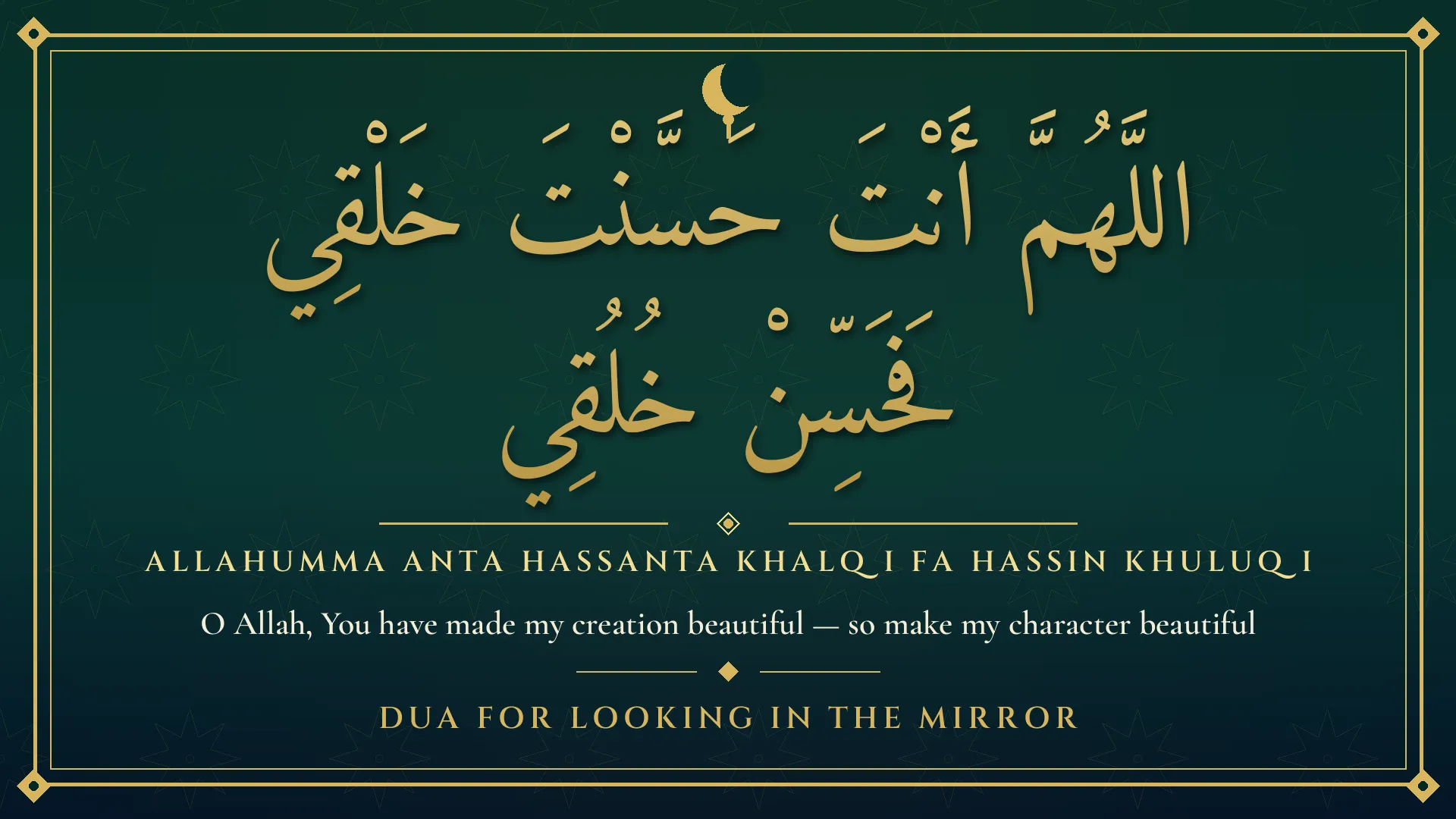
Quick Answer: The dua for looking in the mirror is Allahumma anta hassanta khalqi fa hassin khuluqi — “O Allah, You have made my creation beautiful, so make my character beautiful.” The dua itself is authentic as a general supplication. Reports that tie it specifically to the mirror are weak, as explained honestly below.
Every morning, the mirror gives most people the same two choices: approve of what they see, or criticize it. This short dua refuses both. It thanks Allah for the face He gave, then asks Him for the thing a mirror cannot show at all — good character. That is why sheesha dekhne ki dua (aaina dekhne ki dua) has stayed on Muslim tongues for centuries.
What Is the Dua for Looking in the Mirror?
The wording used in this article, the one in our title, is:
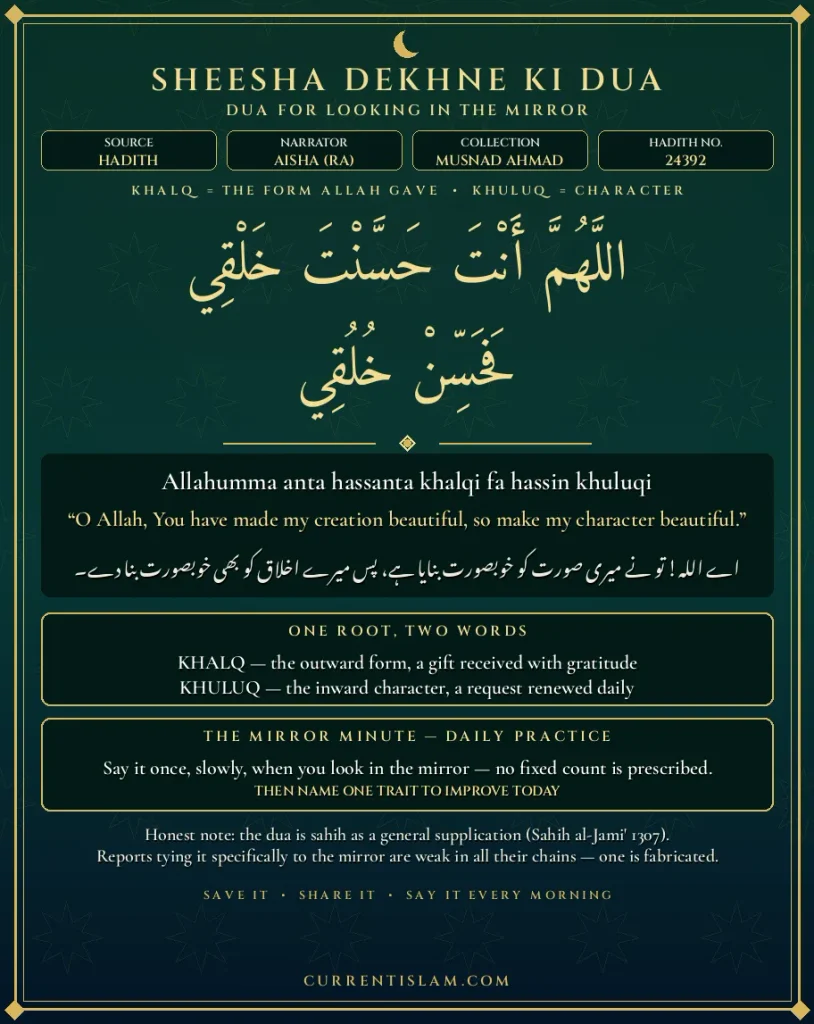
Transliteration: Allahumma anta hassanta khalqi fa hassin khuluqi.
English: “O Allah, You have made my creation beautiful, so make my character beautiful.”
Urdu:
اے اللہ! تو نے میری صورت کو خوبصورت بنایا ہے، پس میرے اخلاق کو بھی خوبصورت بنا دے۔
Say it once, slowly, when you are getting ready — after washing your face, while combing your hair, or before you step out of the house. There is no fixed count in the narration, so do not add a count of three, seven, or any other number as if it were prescribed. If you are still building your morning routine, pair this page with the dua after waking up and the morning and evening azkar, and see our full guide on how to make dua for the etiquette of asking.
What Do the Words Mean, Word by Word?
| Arabic | Transliteration | Meaning |
|---|---|---|
| اللَّهُمَّ | Allahumma | O Allah |
| أَنْتَ | anta | You |
| حَسَّنْتَ | hassanta | have made beautiful |
| خَلْقِي | khalqi | my creation, my outward form |
| فَحَسِّنْ | fa hassin | so make beautiful |
| خُلُقِي | khuluqi | my character, my manners |
Look closely at the pair in the middle: khalq and khuluq. In Arabic the two words share the same root letters and differ by a single vowel, yet one means the body Allah formed and the other means the character a person builds. The dua places them side by side on purpose. Outward form is a gift, given complete at birth. Character is a request, renewed every day. A believer can do nothing about the first beyond gratitude and care, and a great deal about the second with Allah’s help.
This matches the Quran’s own framing. Allah says He “formed you and perfected your forms” (Quran 64:3), and that He created the human being “in the best of stature” (Quran 95:4, explained on our page for Laqad Khalqnal Insana). Gratitude for that gift is the starting point of the dua, not pride in it.
Allahumma Anta Hassanta Khalqi — The Dua in One Image
Are There Other Wordings of This Dua?
Yes. Here are the forms readers meet on other sites:
| Wording | Transliteration | Note |
|---|---|---|
| اللَّهُمَّ أَنْتَ حَسَّنْتَ خَلْقِي فَحَسِّنْ خُلُقِي | Allahumma anta hassanta khalqi fa hassin khuluqi | The form in our title, quoted in classical dua collections such as Al-Hisn al-Hasin |
| اللَّهُمَّ أَحْسَنْتَ خَلْقِي فَأَحْسِنْ خُلُقِي | Allahumma ahsanta khalqi fa ahsin khuluqi | The wording in Aisha’s narration, below |
| اللَّهُمَّ كَمَا أَحْسَنْتَ خَلْقِي فَأَحْسِنْ خُلُقِي | Allahumma kama ahsanta khalqi fa ahsin khuluqi | “Just as You have made…” — a widely circulated form |
The meaning of all three is the same. Reciting any one of them is fine; what matters is that the words ask for character, not for a different face.
Is the Mirror Dua Authentic? An Honest Answer
Most pages on this dua skip this question or answer it with one word. The evidence needs two separate answers, because the dua and the mirror are two different claims.
The dua itself is authentic. Aisha (may Allah be pleased with her) reported that the Prophet ﷺ used to say: “O Allah, as You have beautified me, beautify my character.” This is recorded in Musnad Ahmad (24392), and Shaykh al-Albani included it in Sahih al-Jami’ as-Saghir (1307) as sahih. A similar wording from Abdullah ibn Mas’ud is recorded by Ahmad and in Sahih Ibn Hibban. As a general dua asking Allah for beautiful character, its chain is sound.
The mirror connection is weak. The reports that say the Prophet ﷺ spoke these words while looking in a mirror — narrated through Ali, Ibn Abbas, and Anas, in collections such as Ibn al-Sunni’s ‘Amal al-Yawm wa’l-Laylah (163–165) — were examined by the hadith critics and found weak in every chain. One version was even graded fabricated (mawdu’), because its chain contains narrators accused of lying. Shaykh al-Albani discussed these routes in Irwa’ al-Ghalil (74), and IslamQA’s detailed review of the question reaches the same summary: the hadith about dua when looking in the mirror is weak in all its isnads, while the dua itself has been soundly narrated in general terms, without mention of a mirror.
So what should a reader do? Say the dua at the mirror — it is an authentic dua, said at a moment when its meaning fits perfectly. Just do not claim that a mirror-specific Sunnah has been firmly established, and do not let anyone sell the dua to you as a guaranteed beauty treatment. Honesty about the chain costs the dua nothing; it is beautiful because of what it asks for.
What Does This Dua Teach?
The Prophet ﷺ said: “Allah does not look at your forms or your wealth, but He looks at your hearts and your deeds” (Sahih Muslim 2564). The mirror dua is that hadith turned into a daily habit. The mirror shows the one thing Allah does not judge us by, and the dua immediately redirects attention to the two things He does judge: the heart and its actions.
It also protects against two opposite errors. The first is vanity — standing pleased with a reflection and forgetting who formed it, a theme the Quran ties to Al-Musawwir, the One who shapes all forms (see Al-Musawwir meaning and the 99 Names of Allah). The second error is self-contempt — disliking the face Allah chose and speaking about His creation with contempt. Gratitude answers both: the face is received as a trust, and the energy goes into the character instead. Readers who enjoyed this balance in Surah Hashr last 3 ayat, where fifteen Names are gathered in three verses, will recognize the same pattern here.
How Do I Build This Into My Morning?
Keep it deliberately small:
- Say the dua once when you first look in the mirror while getting ready, reading the meaning in your head as you say the Arabic.
- Name, silently, one trait you want Allah to improve in you today — patience with your children, honesty in a hard conversation, a softer tone at home.
- Carry that one trait as the day’s intention, the way the dua after wudu turns washing into worship.
That is the whole practice. Like the khana khane ki dua at meals and the raat ko sone ki dua at night, its power is in being short enough to survive a busy life — one honest sentence, every day, pointed at the part of you that actually reaches the next world.
Dua for looking in the mirror pdf download
Frequently Asked Questions
What is the dua for looking in the mirror in Arabic?
It is:
اللَّهُمَّ أَنْتَ حَسَّنْتَ خَلْقِي فَحَسِّنْ خُلُقِي — Allahumma anta hassanta khalqi fa hassin khuluqi, meaning “O Allah, You have made my creation beautiful, so make my character beautiful.”
Is the mirror dua sahih or weak?
Both, in different respects. The dua is sahih as a general supplication of the Prophet ﷺ (Musnad Ahmad 24392; Sahih al-Jami’ 1307). The reports linking it specifically to looking in a mirror are weak in all their chains, and one version is fabricated, so that specific link should not be presented as established Sunnah.
How many times should I recite it?
No count is prescribed in the narrations. Say it once, with understanding, when you look in the mirror. Adding a fixed number as a religious requirement would be inventing something the sources do not say.
Can I say this dua at times other than at the mirror?
Yes. Because the dua is authentically reported in general terms, it can be said at any time — after prayer, in the morning, or whenever you catch yourself worrying about appearance more than character.
What is the difference between khalq and khuluq?
Khalq is outward creation — the body and face Allah formed. Khuluq is inward character — manners, temper, and conduct. The dua thanks Allah for the first and asks His help with the second.
Is there a dua for looking in the mirror in the Quran?
No. This dua is from the hadith literature, not the Quran. The Quran supports its meaning — Allah formed human beings and perfected their forms (64:3; 95:4) — but the wording itself is a supplication of the Prophet ﷺ.
