
Have you ever felt like no matter how hard you try, people just don’t understand? Or like you’re carrying the weight of everyone’s pain, and no one sees your struggle?
The Prophet Muhammad ﷺ felt that too. And in the final verses of the Quran he brought, Allah gave us a reminder that changed everything.
Surah Taubah’s last 2 ayat (9:128–129) reveal the Prophet’s heart—he was from among you, grieved by your suffering, and infinitely merciful. When people turned away, Allah taught him to say: “Allah is sufficient for me.” These verses aren’t just Quran; they’re divine comfort for anyone who’s ever felt alone in their faith journey.
Let’s understand what makes these two verses so powerful, why scholars call them the “final mercy,” and how you can make them part of your daily spiritual life.
What Are Surah Taubah’s Last 2 Ayat?
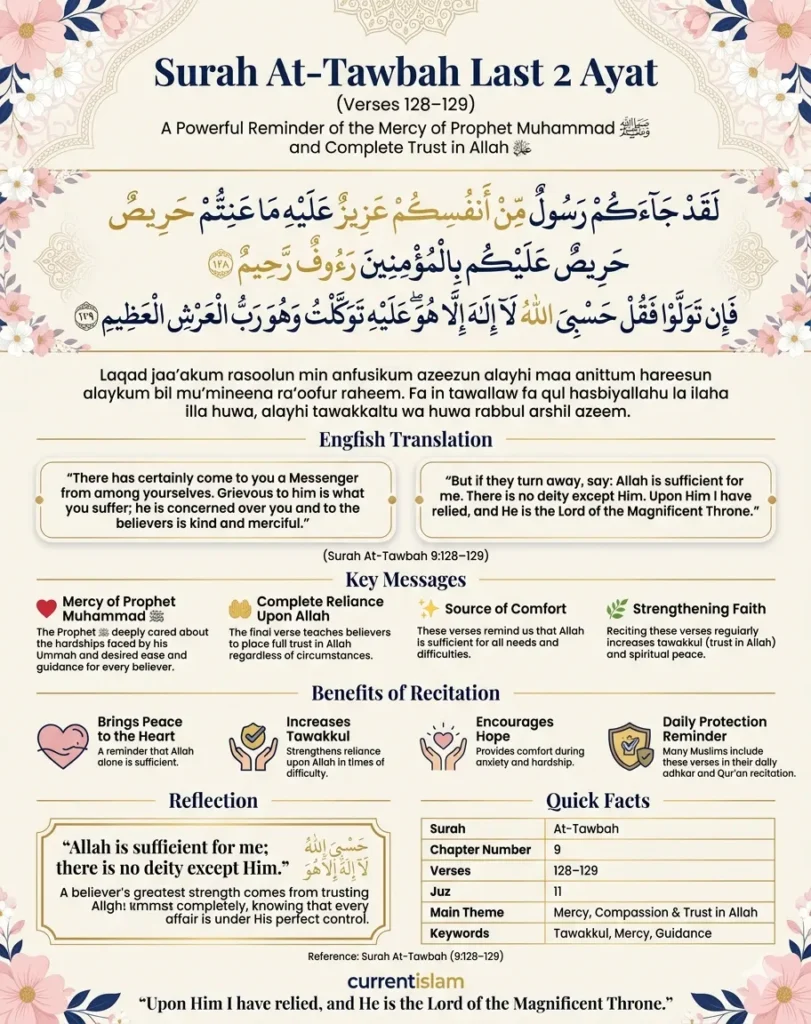
The last two verses of Surah At-Tawbah are Quran 9:128 and 9:129. They describe Prophet Muhammad ﷺ’s compassion—how he was from among yourselves, grieved by your hardship, eager for your guidance, kind to believers, and merciful. The second verse teaches complete reliance on Allah: “Allah is sufficient for me; in Him I trust, He is the Lord of the Mighty Throne.”
These verses conclude the 129-verse chapter revealed in Medina, marking the end of Quranic revelation before the Prophet’s death.
The Arabic Text, Transliteration & Translation
Quran 9:128: The Prophet’s Compassion
Arabic:
لَقَدْ جَآءَكُمْ رَسُولٌۭ مِّنْ أَنفُسِكُمْ عَزِيزٌ عَلَيْهِ مَا عَنِتُّمْ حَرِيصٌ عَلَيْكُم بِٱلْمُؤْمِنِينَ رَءُوفٌۭ رَّحِيمٌۭ
Transliteration:
Laqad jā’akum rasūlum min anfusikum ‘azīzun ‘alayhi mā ‘anittum ḥarīṣun ‘alaykum bil-mu’minīna ra’ūfun raḥīm
English Translation (Sahih International):
“There has certainly come to you a Messenger from among yourselves. Grievous to him is what you suffer; [he is] concerned over you and to the believers is kind and merciful.” [9:128]
Urdu Translation:
بےشبہ تمہارے پاس تمہاری ہی قوم سے ایک رسول آئے ہیں، انہیں تمہارا تکلیف میں ہونا بہت بھاری ہے، وہ تمہارے ہمارے لیے بہت چاہنے والے ہیں، مومنوں پر بہت مہربان اور رحم کرنے والے ہیں۔
Hindi Translation:
“निश्चित रूप से तुममें से एक रसूल (पैगंबर) आया है, जिसे तुम्हारा कष्ट उठाना बहुत कठिन है, वह तुममें बहुत चिंतित है, मुमिनों पर बहुत दयालु और रहम करने वाला है।”
Quran 9:129: Complete Reliance on Allah
Arabic:
فَإِن تَوَلَّوْا۟ فَقُلْ حَسْبِىَ ٱللَّهُ لَآ إِلَـٰهَ إِلَّا هُوَ ۖ عَلَيْهِ تَوَكَّلْتُ ۖ وَهُوَ رَبُّ ٱلْعَرْشِ ٱلْعَظِيمِ
Transliteration:
Fa-in tawallaw faqul ḥasbiy-Allāhu lā ilāha illā Huwa ‘alayhi tawakkaltu wa Huwa Rabbul-‘Arshil-‘Aẓīm
English Translation (Sahih International):
“But if they turn away, [O Muhammad], say, ‘Sufficient for me is Allah; there is no deity except Him. In Him I have placed my trust, and He is the Lord of the Mighty Throne.'” [9:129]
Urdu Translation:
پھر اگر منہ پھرائیں تو کہہ دیجیے کہ میرے لیے Allah کافی ہے، اس کے سوا کوئی معبود نہیں، میں نے اسی پر بھروسہ کیا اور وہ عظیم تخت کا رب ہے۔
Hindi Translation:
“अगर वे (तुम्हारी बात से) मुंह मोड़ लें, तो कहो कि ‘मुझे अल्लाह काफी है, उसके सिवा कोई इबादत का लायक नहीं, मैंने उसी पर भरोसा किया और वही बड़े सिंहासन का पालनहार है।'”
The Five Prophetic Attributes in Verse 128
Why This Matters for Modern Muslims
When you’re struggling with faith, feeling isolated, or wondering if anyone truly cares about your pain, these five attributes remind you that the Prophet ﷺ understood human suffering better than anyone.
1. “From Among Yourselves” (مِّنْ أَنفُسِكُمْ)
This means the Prophet ﷺ wasn’t a foreigner or alien. He shared your language, culture, food, family bonds, and human needs. He ate, slept, laughed, and cried like you do.
Ibn Kathir explains: Allah comforted the believers by saying the Messenger is from their own kind—not an angel or distant being, but a human who understands their struggles intimately.
2. “Grievous to Him Is What You Suffer” (عَزِيزٌ عَلَيْهِ مَا عَنِتُّمْ)
The Prophet ﷺ felt your pain deeply. When you struggled, he grieved. When you went through hardship, it weighed on him.
Al-Qurtubi notes: This isn’t just sympathy—it’s profound empathy. The Prophet’s heart broke when people suffered, even when they rejected him.
3. “Eager Over You” (حَرِيصٌ عَلَيْكُم)
He wasn’t indifferent. He was ardently desirous of your guidance, your salvation, your well-being. His concern wasn’t obligation—it was love.
4. “Kind to the Believers” (بِٱلْمُؤْمِنِينَ رَءُوفٌ)
The word Ra’ūf means excessive gentleness—more than regular kindness. It’s the mercy of a parent holding a crying child.
5. “Merciful” (رَّحِيمٌ)
Only Prophet Muhammad ﷺ is described with both Ra’ūf and Raḥīm in the Quran. This shows his mercy extends even to sinners and those who err.
Modern Relevance: In an age of digital isolation, these attributes remind us that faith isn’t cold ritual—it’s rooted in a Prophet who feels what you feel.
Verse 129: The Ultimate Expression of Tawakkul
What Does This Mean for You?
When people reject your message, ignore your efforts, or turn away from truth, you don’t despair. You say: “Allah is sufficient for me.” This is tawakkul—doing your best, then trusting Allah completely with the outcome.
Breaking Down the Four Parts
| Component | Meaning | Why It Matters |
|---|---|---|
| Ḥasbiy-Allāh | “Allah is sufficient for me” | You don’t need anyone else’s approval when Allah is enough |
| Lā ilāha illā Huwa | “No deity except Him” | Reaffirming tawheed when facing rejection |
| ‘Alayhi Tawakkaltu | “I have placed my trust in Him” | Active reliance—you act, Allah decides |
| Rabbul-‘Arshil-‘Aẓīm | “Lord of the Mighty Throne” | Allah’s sovereignty over all creation |
Scholarly Note: This verse was revealed to teach the Prophet ﷺ (and us) how to respond to rejection without bitterness or despair.
Clasees tafseer & Scholarly Commentary
Ibn Kathir’s Explanation
Ibn Kathir (may Allah have mercy on him) writes that verse 128 is Allah’s comfort to the Prophet ﷺ when he was distressed by the pagans’ rejection. Allah said: “Don’t grieve too much. They’re rejecting someone from among themselves—someone who shares their humanity.”
Key Point: Ibn Kathir emphasizes that the Prophet’s grief was for their salvation, not his own ego. He wanted them to enter Jannah.
Al-Tabari’s Commentary
Al-Tabari explains that “from among yourselves” means the Prophet was human like them—not an angel. This makes his message more accessible and relatable.
Al-Qurtubi’s Insight
Al-Qurtubi notes that the Prophet’s concern extended to all humanity, not just Muslims. His mercy was universal, even when people didn’t deserve it.
Authentic Hadith References & What’s Actually Sahih
Important Clarification: Separating Authentic from Weak
Many people claim there are authentic hadiths about the virtues of reciting these two verses. This needs correction.
What Scholars Say About Authenticity
Islamweb Fatwa (2017): After extensive research of Sunnah books, scholars found no authentic hadith from the Prophet ﷺ specifically about the virtues of reciting Surah Taubah’s last two verses.
Weak (Dha’eef) Narrations:
- “Recite 3x morning/evening and Allah makes affairs easy” — At-Tabarani, weak chain from Anas [Weak Hadith]
- “Protection from death by debris” — Muhammad ibn Bakkaar, weak chain [Weak Hadith]
- “7x recitation = supplication accepted” — No authentic evidence
What IS Authentic?
Abu al-Darda’ (RA) Narration — Sahih:
Reciting “Hasbiy-Allāhu lā ilāha illā Huwa, ‘alayhi tawakkaltu wa Huwa Rabbul-‘Arshil-‘Aẓīm” (verse 129 alone) 7 times in the morning and evening makes Allah ease your affairs.
Source: Sunan Abu Dawud (4/332), authenticated by Al-Albani and Shu’ayb Arna’oot. [Sahih Hadith]
Why This Matters: You can recite verse 129 alone as a dhikr with authentic backing. Reciting both verses 128–129 together is permissible but doesn’t have the same authentic virtue hadith.
Practical Application: How to Use These Verses in Daily Life
The Spiritual Habit Loop for Modern Faith
Here’s how to make these verses part of your daily routine without feeling overwhelmed:
Morning Practice (After Fajr)
- Recite verse 129 seven times (authentic dhikr with proven benefits)
- Reflect on one attribute of the Prophet ﷺ from verse 128
- Make a sincere du’a asking Allah to ease your difficulties
Evening Practice (After Maghrib)
- Recite both verses 128–129 slowly, understanding each word
- Ask yourself: “Am I relying on Allah like this verse teaches?”
- Write one thing you’re trusting Allah with today
When You’re Feeling Rejected or Alone
- Say: “Hasbiy-Allāh” (Allah is sufficient for me)
- Remember: The Prophet ﷺ felt rejected too, and he trusted Allah
- Act: Do your best, then let go of the outcome
Real-Life Example: Sarah, a new convert, felt isolated when her family rejected her faith. She started reciting verse 129 each morning. After 3 weeks, she reported: “I still feel lonely, but I don’t feel abandoned. I know Allah is enough.”
Benefits of Reciting These Verses (Evidence-Based)
What We Know From Classical Scholarship
| Benefit | Evidence Level | Source |
|---|---|---|
| Comfort during hardship | Strong thematic evidence | Ibn Kathir, Al-Tabari |
| Strengthening love for Prophet ﷺ | Strong thematic evidence | Classical tafseer |
| Learning tawakkul | Strong educational value | Quranic context |
| Affairs made easy (verse 129, 7x) | Sahih hadith | Abu Dawud, Al-Albani |
| Protection from sudden death | Weak hadith | At-Tabarani (weak chain) |
| Repaying debt/wealth | No authentic evidence | Scholars’ consensus |
Important Note: Don’t believe claims of miraculous benefits without authentic hadith support. The Quran’s real benefit is guidance, not magic spells.
Why These Verses Matter More Than Ever Today
The Crisis of Modern Faith
We live in an age where:
- Loneliness is epidemic (even with 500 “friends” online)
- People reject faith but don’t understand what they’re rejecting
- Believers feel isolated and misunderstood
- We’re overwhelmed by global suffering
These two verses answer every one of these struggles:
- You’re not alone: The Prophet ﷺ felt your pain
- Rejection hurts, but Allah is enough: Verse 129 gives you the response
- Your faith matters: You’re following a Messenger who was from among you
- You can trust Allah: Even when the world falls apart
Connecting to Faith in Modern Life: When you internalize these verses, you stop seeking validation from people and start finding peace in Allah’s sufficiency.
People Also Ask:
For verse 129 alone (the dhikr “Hasbiy-Allāh…”): 7 times morning and evening (authentic per Abu Dawud). For both verses 128–129 together: No specific number in authentic hadith, but reciting 3x is permissible.
Provided above in the Arabic section. The Urdu translation emphasizes the Prophet’s compassion (mehrban, reham karne wale) and Allah’s sufficiency (kafi hai).
The authentic wazifa is reciting verse 129 alone, 7 times morning and evening, for Allah to ease your affairs. This is from Sahih Abu Dawud.
Ra’uf means excessive gentleness and kindness (like a parent). Rahim means mercy, especially toward sinners. The Prophet ﷺ has both qualities in their highest form.
According to Ibn ‘Abbas and Ubayy ibn Ka’b (RA), yes. No verses were revealed after 9:128–129 before the Prophet’s death.
Memory Challenge: Commit These Verses to Heart
Why Memorize?
When you memorize these verses, you carry divine comfort in your heart. You can recite them when:
- You’re stressed and need peace
- Someone rejects your faith
- You feel alone in your struggle
- You want to remember the Prophet’s love
Memorization Strategy (3-Week Plan)
Week 1: Memorize verse 129 (shorter, powerful dhikr)
Week 2: Memorize verse 128 (focus on the 5 attributes)
Week 3: Recite both together, understand each word
Tip: Record yourself reading slowly, then listen while commuting or before sleep.
Related Reading: Deepen Your Understanding
Want to explore more verses about reliance on Allah and prophetic mercy?
- Surah Maidah Ayat 114: Isa’s Prayer for Divine Provision — Learn how Prophet Isa (AS) relied completely on Allah 🚀🚀🚀
- Surah Taha Ayat 39: When Allah Carried Moses in a Basket — Discover how Allah protected the youngest Prophet
Final Thought: Make These Verses Your Daily Anchor
Here’s your call to action: Start memorizing verse 129 today. Say it 7 times tomorrow morning. Next week, add verse 128. Within a month, you’ll carry these words in your heart forever.
The Prophet ﷺ was from among you. He felt your pain. He is kind and merciful. And when people turn away, Allah says: “Say, ‘Allah is sufficient for me.'”
You’re not alone. You’re never abandoned. Allah is enough.
Your turn: Which part of these verses resonates most with you right now? Share in the comments so we can support each other on this journey.
Note: All Quranic translations are from Sahih International. Hadith references are from authentic sources unless marked as weak. Classical tafseer scholars cited include Ibn Kathir, Al-Tabari, and Al-Qurtubi.
