You wake up exhausted, dreading the morning commute, and feeling entirely disconnected from your Salah. Memorizing long chapters feels impossible right now.
The guilt builds up. Whether you are a busy professional running on four hours of sleep, a university student drowning in deadlines, or a diaspora parent trying to teach your children the basics of faith, the gap between the Muslim you are and the Muslim you want to be feels massive.
It does not have to be this way. The Prophet Muhammad (PBUH) revolutionized spiritual growth through small, consistent actions. By anchoring your day to a specific short ayat of Quran, you build an unbreakable spiritual habit loop. These micro-transformations take less than five minutes but completely rewire your brain against anxiety, intimidation, and burnout.
Why Memorizing a Short Ayat of Quran Changes Everything
Direct Answer: Memorizing a short Ayat of Quran is the fastest way to improve focus (Khushu) in Salah, reduce daily anxiety, and build spiritual confidence. Short verses are easy to memorize in under five minutes, making them highly practical for busy professionals, students, and beginners looking for immediate spiritual relief.
Many believers wonder how many Surahs in the Quran they actually need to know to perform a valid prayer. The truth is, while knowing more is highly rewarded, quality always beats quantity.
When you are stressed, your brain struggles to retain complex information. Trying to memorize two pages of Arabic text will only fuel your frustration. Instead, focusing on micro-verses builds immediate confidence. Converts and young children can master these phonetic sounds quickly, eliminating the intimidation factor. For adults dealing with modern stress, repeating these short phrases acts as a cognitive interrupt, stopping negative thought spirals in their tracks.
Allahu Samad: The Ultimate Anchor for Anxiety
Direct Answer: “Allahu Samad” is the second verse of Surah Al-Ikhlas (Quran 112:2). It translates to Allah, the Eternal Refuge. Reciting this short verse provides instant anxiety relief, reminding believers that while they depend completely on God for everything, God depends on nothing.
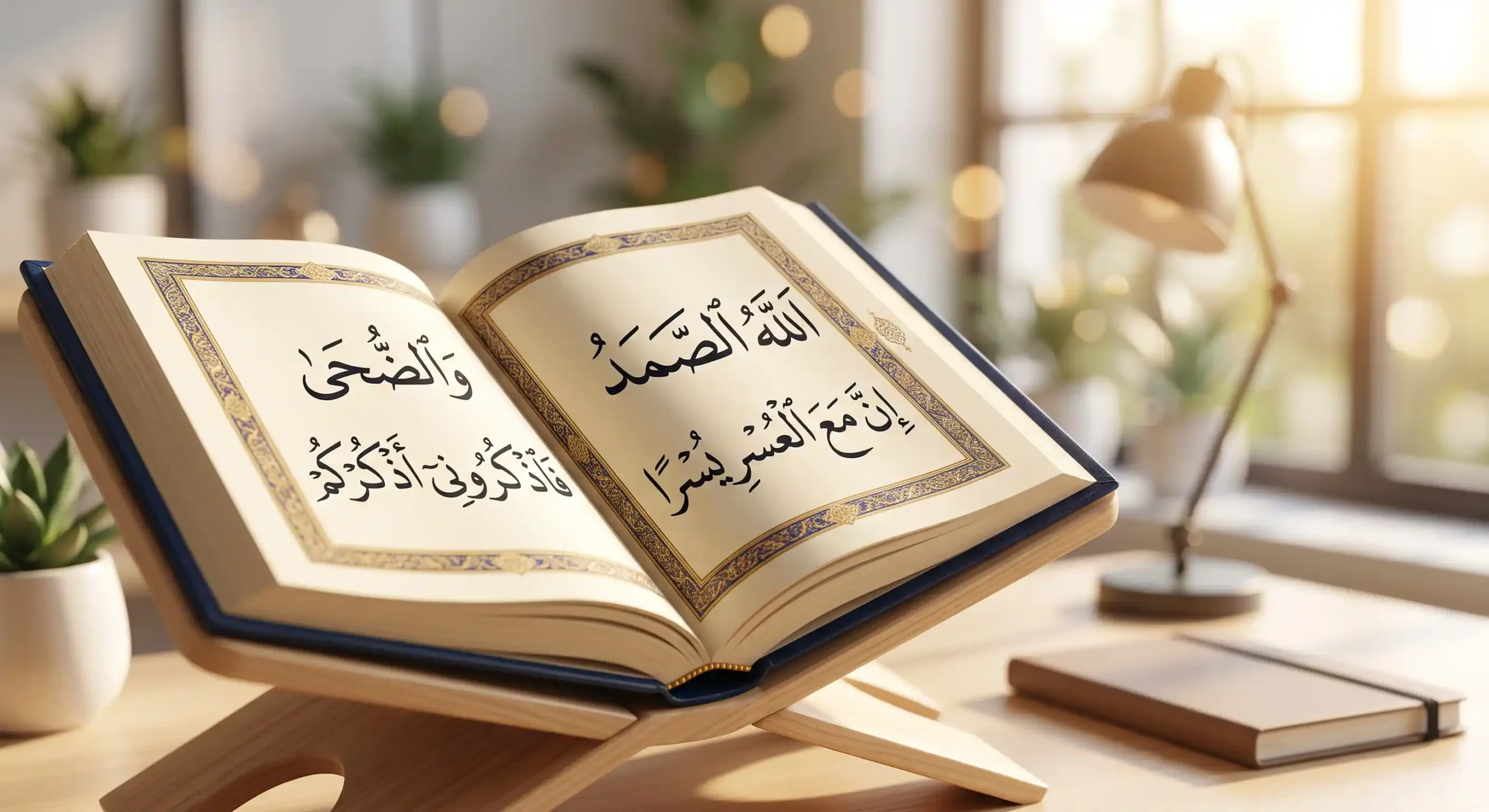
- Arabic Text: اللَّهُ الصَّمَدُ
- Transliteration: Allahu Samad
- English Translation: Allah, the Eternal Refuge.
- Urdu Translation: اللہ بے نیاز ہے۔
- Hindi Translation: अल्लाह बेनियाज़ है।
When a panic attack hits, your mind searches for control. This verse is the ultimate reset button. It reminds you that you do not need to carry the weight of the world on your shoulders. You have an eternal refuge. Repeating this verse is a highly recommended dua for anxiety and depression because it shifts your reliance from your own limited power directly to the Creator.
To maximize this benefit, read our full breakdown of Surah Ikhlas with English transliteration and make it a core part of your daily prayers.
Wa Duha: Fighting Burnout with Divine Light
Direct Answer: “Wa Duha” (By the morning brightness) is the opening oath of Surah Ad-Duha (Quran 93:1). Revealed during a time when the Prophet Muhammad (PBUH) felt abandoned, this short verse is the ultimate psychological cure for spiritual burnout and depressive thoughts.
- Arabic Text: وَالضُّحَى
- Transliteration: Wad-duha
- English Translation: By the morning brightness.
- Urdu Translation: قسم ہے دن کی روشنی کی۔
- Hindi Translation: क़सम है दिन की रौशनी की।
This verse was revealed to the Prophet (PBUH) after a long period where he received no revelation. He felt intense sadness, assuming Allah was displeased with him. Sound familiar? We all face moments where we feel our Duas are being ignored.
Swearing by the morning light, Allah reminds us that dark times are temporary. Using Surah Ad-Duha as a daily recitation acts as a psychological sunrise. It is a cornerstone strategy for overcoming modern anxiety because it forces you to acknowledge hope before despair.
Inna Ma’al Usri Yusra: The Promise of Immediate Relief
Direct Answer: “Inna ma’al usri yusra” (Indeed, with hardship will be ease) is verse 94:6 of the Quran. This short ayat guarantees that relief is attached directly to the struggle itself, offering immense psychological comfort and emotional endurance during difficult times.
- Arabic Text: إِنَّ مَعَ الْعُسْرِ يُسْرًا
- Transliteration: Inna ma’al ‘usri yusra
- English Translation: Indeed, with hardship [will be] ease.
- Urdu Translation: بیشک مشکل کے ساتھ آسانی ہے۔
- Hindi Translation: बेशक मुश्किल के साथ आसानी है।
Look closely at the Arabic phrasing. Allah does not say ease comes after hardship. He says ease comes with hardship. They are paired together. Even in your darkest financial crisis or medical emergency, tiny mercies are happening simultaneously. Reminding yourself of the concept of fa inna ma’al usri yusra completely changes how you process trauma.
Fadhkuruni Adhkurkum: The Ultimate Spiritual Habit Loop
Direct Answer: “Fadhkuruni adhkurkum” means “So remember Me; I will remember you” (Quran 2:152). It is a foundational short verse that establishes a direct, two-way relationship with Allah, making it ideal for daily mindfulness and protection.
- Arabic Text: فَاذْكُرُونِي أَذْكُرْكُمْ
- Transliteration: Fadhkurunee adhkurkum
- English Translation: So remember Me; I will remember you.
- Urdu Translation: پس تم مجھے یاد کرو، میں تمہیں یاد رکھوں گا۔
- Hindi Translation: तो तुम मुझे याद करो, मैं तुम्हें याद रखूँगा।
This is the essence of a micro-transformation. You give a little, and Allah gives infinitely more. Repeating Faz kuruni az kurkum while driving, cooking, or walking to class builds a continuous line of communication with God. It perfectly complements your morning and evening Azkar, turning dead time into worship time.
Quick Reference: Short Verses for Daily Life
Here is a simple breakdown of how to integrate these verses into your routine:
| Short Ayat | Quran Reference | Primary Benefit | Ideal Time to Recite |
| Allahu Samad | 112:2 | Instant anxiety relief | During panic or deep stress |
| Wa Duha | 93:1 | Fighting depression/sadness | Early morning / Fajr |
| Inna ma’al usri yusra | 94:6 | Endurance during hardship | When feeling overwhelmed |
| Fadhkuruni adhkurkum | 2:152 | Building spiritual habits | Commuting / Walking |
(People Also Ask)
The shortest verse by word count in the Quran is “Mudh-hammatan” (مُدْهَامَّتَانِ) found in Surah Ar-Rahman (55:64). It translates to “Dark green [in color],” describing the lush, vibrant gardens of Paradise.
The fastest way to memorize is through the “Spiritual Habit Loop.” Pick just one short phrase. Read it in Arabic while looking at the transliteration. Listen to an audio recording of a Qari three times. Then, recite it exclusively in your daily prayers for a full week before moving to a new verse.
Yes. You can recite Quran from memory at any time, even without Wudu (ablution), as long as you are not in a state of major ritual impurity (Janabah). This makes short verses the perfect tool for daily Dhikr (remembrance).
Take the Next Step:
Now that you have these powerful verses memorized, the next logical step is learning exactly how to ask Allah for what you want. Read our complete, step-by-step guide on how to make dua to ensure your prayers are always answered.
