![Overhead photograph of handcrafted felt text calligraphy art. Features multiple nested gold wire frames with felt flowers (white and pink roses) and a central purple bow at the top. The art consists of three lavender felt plaques with gold trim. Top plaque has Arabic calligraphy 'يَا مُفَتِّحَ الْأَبْوَابِ' (Ya Mufattih al-Abwab). Middle plaque has the Urdu translation 'اے دروازوں کو کھولنے والے۔'. Bottom left plaque says '[Reference: Al-Fattah]' in blue text. Bottom right plaque has the attribution 'currentislam' in black script.](https://currentislam.com/wp-content/uploads/2026/06/ya-mufattih-al-abwab-dua-calligraphy-felt-art-islamic-home-decor-currentislam.webp)
Have you ever felt so overwhelmed by a sudden crisis that your mind simply freezes? In moments of severe emotional distress, financial panic, or personal loss, the walls can feel like they are closing in. Modern life constantly bombards us with cognitive overload, leaving us paralyzed when hardship actually strikes. But Islamic tradition offers a profound mechanism to break this paralysis. A authentic mushkil waqt ki dua (prayer for difficult times) is not merely a few words to whisper into the wind; it is a strategic, spiritual habit loop designed to instantly ground your mind, eliminate the feeling of helplessness, and transfer your burdens to the Creator.
Here is why this matters: the words we speak when we are terrified physically rewire how our brain processes fear. Let’s understand the real meaning behind the most powerful prayers for hardship and how to apply them to your daily life.
What is the Most Powerful Mushkil Waqt Ki Dua?
The most powerful dua for difficult times is Ayat-e-Kareema, the prayer of Prophet Yunus (peace be upon him). Reciting this specific supplication acknowledges God’s absolute power, validates His perfection, and takes personal accountability, which psychologically interrupts panic and invites immediate divine mercy.
The Prayer of Prophet Yunus (Ayat-e-Kareema)
When Prophet Yunus was swallowed by the massive whale, he found himself trapped in three layers of absolute darkness: the darkness of the night, the darkness of the deep ocean, and the darkness of the whale’s stomach. This mirrors the compounding anxiety, depression, and isolation of modern crises.
Arabic:
لَا إِلَٰهَ إِلَّا أَنْتَ سُبْحَانَكَ إِنِّي كُنْتُ مِنَ الظَّالِمِينَ
Transliteration: La ilaha illa anta subhanaka inni kuntu minaz-zalimin
English Translation: “There is no deity except You; exalted are You. Indeed, I have been of the wrongdoers.” (Quran 21:87)
Urdu Translation:
تیرے سوا کوئی معبود نہیں، تیری ذات پاک ہے، بے شک میں ہی زیادتی کرنے والوں میں سے ہوں۔
Scholarly Depth and Modern Relevance
Classical scholars of tafseer (Quranic exegesis), such as Ibn al-Qayyim, note that this dua is a masterpiece of spiritual architecture. Notice that Prophet Yunus does not actually ask to be rescued. Instead, he focuses on three things:
- Tawheed (Oneness): Reminding himself that only Allah is in control.
- Tanzih (Purity): Declaring that Allah is free from injustice; the hardship is not an act of divine cruelty.
- Istighfar (Accountability): Admitting his own flaws.
Psychologically, claiming victimhood keeps you stuck in helplessness. By taking ownership, you shift from a passive victim to an active participant in your spiritual rescue. This is the cornerstone of understanding true Tawakkul in difficult times, as it shifts your focus from the massive problem to the infinitely capable Problem-Solver.
Surviving Panic with Prophetic Routine
The spiritual habit loop involves replacing the immediate trigger of anxiety with a prophetic recitation, which then yields the reward of divine tranquility. By conditioning yourself to recite specific words of reliance the second fear hits, you bypass mental paralysis and invite active divine intervention.
The Dua for Immediate Overwhelm
Prophet Muhammad (peace be upon him) taught a specific phrase to his companions whenever matters became overwhelming or deeply stressful.
Arabic:
يَا حَيُّ يَا قَيُّومُ بِرَحْمَتِكَ أَسْتَغِيثُ
Transliteration: Ya Hayyu Ya Qayyum, bi-rahmatika astagheeth
English Translation: “O Ever-Living One, O Sustainer of all, by Your mercy I call on You for help.” (Sunan at-Tirmidhi)
Urdu Translation:
اے زندہ اور قائم رکھنے والے، میں تیری رحمت کے واسطے سے فریاد کرتا ہوں۔
Creating Your Anxiety Anchor
Modern behavioral psychology often refers to “habit loops”—a cue, a routine, and a reward. In the context of the Sunnah, your cue is the sudden spike in anxiety, the unexpected bill, or the frightening medical diagnosis. Your routine must become the immediate, almost involuntary recitation of “Ya Hayyu Ya Qayyum”.
The words chosen here are highly intentional. When you are in a crisis, your world feels like it is falling apart. By calling upon Al-Hayy (The Ever-Living who never dies) and Al-Qayyum (The Sustainer who holds the universe together), you are tethering your fragile reality to the only Entity that does not break. The reward is Sakinah—a profound, divinely granted calmness that stabilizes your heart so you can figure out your next physical steps. Integrating this into your daily sunnah protection prayers ensures your mind is fortified before the crisis even begins.
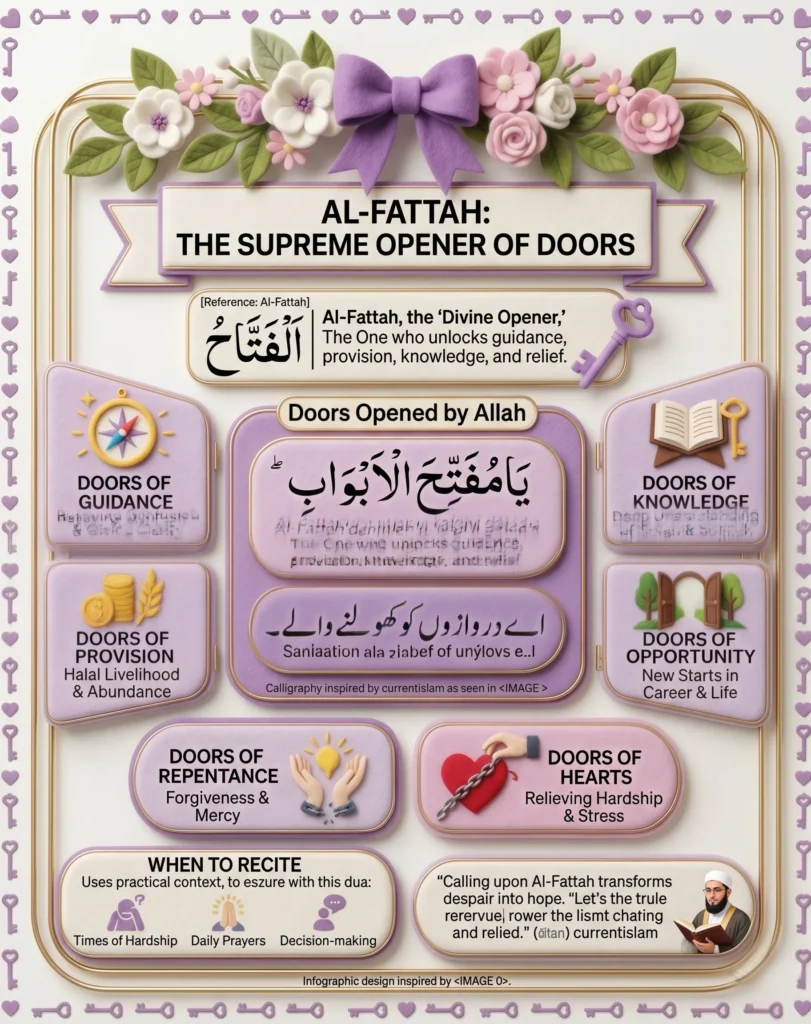
Ya Mufattihal Abwab Dua: Opening Closed Doors in Modern Life
The invocation “Ya Mufattih al-Abwab” translates to “O Opener of Doors.” While it is deeply rooted in Islamic culture as a powerful supplication for overcoming dead ends, it is essential to understand it as an invocation of Allah’s attributes rather than a strictly recorded Hadith.
Arabic:
يَا مُفَتِّحَ الْأَبْوَابِ
Transliteration: Ya Mufattihal Abwab
English Translation: “O Opener of Doors.”
Urdu Translation:
اے دروازوں کو کھولنے والے۔
The Cultural and Theological Context
When seeking a job, dealing with a visa rejection, or facing a situation where human avenues have entirely shut down, Muslims have historically turned to this phrase. This becomes important when you look at how it connects to the confirmed name of Allah, Al-Fattah (The Supreme Opener, The Judge).
Calling upon Al-Fattah to open closed doors is entirely valid and highly encouraged in Islamic theology. The name implies that Allah possesses the key to every locked situation in your life. If you feel that your career, marriage prospects, or health solutions are behind a locked iron gate, repeating this phrase serves as a beautiful, hopeful plea for divine intervention.
Overcoming Financial and Structural Hardships
For enduring financial difficulties and structural life roadblocks, the Quran promises that maintaining God-consciousness (Taqwa) is the prerequisite for divine relief. Reciting verses of reliance specifically activates God’s promise to provide from unimaginable sources.
The Guarantee of a Way Out (Surah At-Talaq)
When hardship is chronic—such as crushing debt or long-term unemployment—the emotional toll requires a different kind of spiritual anchor.
Arabic:
وَمَن يَتَّقِ اللَّهَ يَجْعَل لَّهُ مَخْرَجًا وَيَرْزُقْهُ مِنْ حَيْثُ لَا يَحْتَسِبُ
Transliteration: Wa may-yattaqillaha yaj’al lahu makhraja. Wa yarzuqhu min haythu la yahtasib.
English Translation: “And whoever fears Allah, He will make for him a way out, and will provide for him from where he does not expect.” (Quran 65:2-3)
Urdu Translation:
اور جو کوئی اللہ سے ڈرتا ہے، اللہ اس کے لیے نکلنے کا راستہ بنا دیتا ہے، اور اسے وہاں سے رزق دیتا ہے جہاں سے اسے گمان بھی نہیں ہوتا۔
The Mechanism of Unexpected Provision
This verse contains a radical promise. It tells us that the solution to our problem will likely not come from the logical avenues we are obsessing over. We often calculate our resources on a limited human spreadsheet: who we know, what we earn, what our options are. This verse asks us to stop obsessing over the “how” and start focusing on our character (Taqwa). Ensure your income is halal, ensure your treatment of others is just, and trust that the Sustainer manages the logistics of your rescue.
How to Recite These Duas: A Wazifa Action Plan
To effectively practice a mushkil waqt ki dua, consistency matters more than sheer volume. Recite Ayat-e-Kareema daily, incorporate calls for mercy during your prostrations (sujud), and wake up for the night prayer to ask when divine relief is closest to the earth.
Now let’s connect this to daily life. A beautifully worded prayer only works if your heart is actually engaged. Here is how to structure your spiritual habits during a tough time:
- The Sujud Anchor: The closest a believer is to Allah is in prostration. While in sujud during your obligatory or voluntary prayers, quietly whisper Ya Hayyu Ya Qayyum bi-rahmatika astagheeth.
- The Commute Dhikr: Replace mindless scrolling or radio listening during your commute with the silent repetition of Ayat-e-Kareema (La ilaha illa anta…). Do not just count beads; visualize the darkness of your specific “whale” and visualize God’s light piercing it.
- The Pre-Dawn Leverage: The last third of the night is when the doors of heaven are widest. Praying Tahajjud for impossible requests is the ultimate life-hack of the believers. Wake up just 20 minutes before Fajr, pray two units, and ask Ya Mufattihal Abwab to open the doors that have caused you so much grief.
People Also Ask
The best dua for hard times is Ayat-e-Kareema (La ilaha illa anta subhanaka inni kuntu minaz-zalimin), followed by the prophetic supplication for distress: Ya Hayyu Ya Qayyum bi-rahmatika astagheeth. Both shift your mindset from panic to profound reliance on Allah.
While cultural traditions sometimes suggest reciting it 125,000 times (Khatam-e-Yunus), the Sunnah does not mandate a specific numerical count for this dua. Sincerity, tears, and a present heart while reciting it 10 times are more powerful than reciting it 1,000 times absentmindedly.
When feeling utterly helpless, recite Hasbunallahu wa ni’mal wakeel (“Sufficient for us is Allah, and He is the best Disposer of affairs”). This phrase psychologically transfers the burden of the crisis off your shoulders and hands the management of the outcome entirely to God.
Ya Mufattihal Abwab (O Opener of Doors) is not a direct quotation from a verified Hadith, but rather a deeply respected cultural invocation. It beautifully calls upon Allah by His established Quranic attribute, Al-Fattah (The Opener).
Download Your Action Plan
Knowing the words is only the first step; implementing them consistently when your mind is racing is the real challenge. To help you build an unshakable spiritual habit loop, we have created a free, highly visual resource.
📥 Download: The 7-Day Crisis Relief Wazifa Guide (PDF & Infographic)
Keep this high-resolution guide on your phone’s lock screen or print it for your prayer mat. It outlines exactly what to say, when to say it, and how to conceptually reframe your anxiety into empowering faith every single morning.

3 thoughts on “Mushkil waqt ki dua — Ya mufattihal abwab dua”