
Waking up feeling emotionally drained, isolated, or stressed about finding a righteous spouse is a heavy burden. We live in a hyper-connected society, yet genuine affection and pure intentions are rare. Scrolling through curated lives online often amplifies this loneliness, leaving you to wonder where true, unconditional love exists.
The timeless spiritual remedy lies in invoking Al-Wadud. By integrating the precise dhikr of “Ya Wadudu” into your daily routine, you bypass worldly validation and connect directly to The Source of Love. This spiritual habit loop is the ultimate antidote for a restless heart.
What is the Meaning of Ya Wadudu?
The best meaning of Ya Wadudu is “O Most Loving” or “The Affectionate.” It is an invocation of Al-Wadud, one of the 99 Names of Allah Asma-ul-Husna. It describes the Creator who actively demonstrates His love and places pure affection between the hearts of His creation.
To understand the semantic depth of this name, we must look at the Arabic root. While Hubb refers to an internal feeling of love, Wudd is love expressed through action. Allah does not just love His creation silently; He actively bestows blessings, mercy, and provision upon us.
- Meaning in Urdu: اے سب سے زیادہ محبت کرنے والے
- (Ae Sab se Ziada Mohabbat Karne Wale)
- Meaning in Hindi: ऐ सबसे ज़्यादा प्यार करने वाले
- (Ae Sabse Zyada Pyaar Karne Wale)
The Quranic Blueprint of Al-Wadud
Allah mentions Al-Wadud twice in the Quran, specifically in Surah Hud and Surah Al-Buruj. In both instances, this name is paired with His Mercy (Ar-Raheem) or His Forgiveness (Al-Ghafoor) to prove that divine love is continuous, forgiving, and transformative.
Let’s break down the exact meaning of these verses. When humans forgive, they often harbor resentment. When Allah forgives, He restores you completely to a state of being loved.
Surah Hud (11:90)
Arabic Text:
وَاسْتَغْفِرُوا رَبَّكُمْ ثُمَّ تُوبُوا إِلَيْهِ ۚ إِنَّ رَبِّي رَحِيمٌ وَدُودٌ
Transliteration: Wastaghfiruu rabbakum thumma tuubuu ilayh; inna rabbii rahiimun waduud.
English Translation: “And ask forgiveness of your Lord and then repent to Him. Indeed, my Lord is Merciful and Affectionate.”
Urdu Translation:
اور اپنے رب سے معافی مانگو پھر اس کی طرف توبہ کرو۔ بیشک میرا رب نہایت مہربان، بہت محبت کرنے والا ہے۔
Hindi Translation: और अपने रब से माफ़ी मांगो फिर उसकी तरफ तौबा करो। बेशक मेरा रब निहायत मेहरबान, बहुत प्यार करने वाला है।
Surah Al-Buruj (85:14)
Arabic Text:
وَهُوَ الْغَفُورُ الْوَدُودُ
Transliteration: Wa huwal ghafuurul waduud.
English Translation: “And He is the Forgiving, the Affectionate.”
Urdu Translation:
اور وہ بہت بخشنے والا، بہت محبت کرنے والا ہے۔
Hindi Translation: और वह बहुत बख़्शने वाला, बहुत प्यार करने वाला है।
The Sunnah of Divine Love
How does this translate to our daily lives? The Prophet Muhammad (PBUH) explained the cascading effect of Allah’s love in a famous Hadith. When you consistently practice the most powerful duas for forgiveness and build a relationship with Al-Wadud, that love manifests in the physical world.
Sahih al-Bukhari (3209)
Arabic Text:
إِذَا أَحَبَّ اللَّهُ عَبْدًا نَادَى جِبْرِيلَ إِنَّ اللَّهَ يُحِبُّ فُلاَنًا، فَأَحِبَّهُ
Transliteration: Idha ahabballahu abdan naada Jibriila innallaha yuhibbu fulaanan, fa’ahibbah.
English Translation: The Prophet (PBUH) said, “If Allah loves a person, He calls Jibril, saying, ‘Allah loves so and so, O Jibril love him.'”
Urdu Translation:
رسول اللہ ﷺ نے فرمایا: جب اللہ کسی بندے سے محبت کرتا ہے تو جبریل کو آواز دیتا ہے کہ اللہ فلاں سے محبت کرتا ہے، تو بھی اس سے محبت کر۔
Hindi Translation: रसूल अल्लाह ﷺ ने फरमाया: जब अल्लाह किसी बंदे से प्यार करता है तो जिब्रील को पुकारता है कि अल्लाह फलां से प्यार करता है, तू भी उससे प्यार कर।
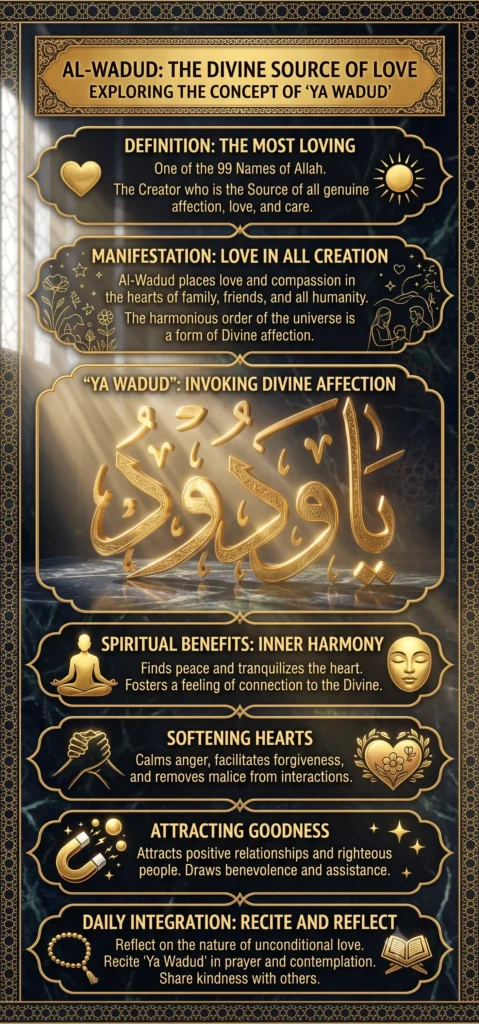
Ya Wadudu Benefits and the Spiritual Habit Loop
Reciting Ya Wadudu daily softens hardened hearts, resolves marital friction, attracts righteous companionship, and acts as a spiritual anchor. It is highly effective for inner peace when combined with a specific dua for anxiety and depression.
Here is why this matters for your daily routine. We often seek external validation to cure internal voids. By initiating a “Ya Wadudu” wazifa, you rewire your spiritual habit loop to rely entirely on divine affection.
- Restoring Broken Relationships: It removes malice and coldness between family members or spouses.
- Attracting a Righteous Spouse: It opens doors for pure, Halal companionship.
- Curing Emotional Distress: It functions as a core component of any Islamic guide to overcoming modern anxiety, grounding you in the certainty of God’s love.
- Increasing Charisma (Noor): Frequent reciters are often granted a natural respect and affection from people in their community.
The Wazifa: How Many Times to Recite Ya Wadudu?
The optimal way to perform the Ya Wadudu wazifa is to recite it 100 times for daily emotional stability, 313 times to resolve specific marital conflicts, or 1000 times after Isha prayer when seeking a dua for love marriage.
Generations of scholars have recommended specific counts based on spiritual experiences and the numerical values (Abjad) of Arabic letters.
| Recitation Count | Best Time to Perform | Primary Spiritual Benefit |
| 100 Times | After Fajr Prayer | General harmony, daily peace, and protecting the home from arguments. |
| 313 Times | After Asr Prayer | Resolving severe conflicts, removing misunderstandings, and restoring broken trust. |
| 1000 Times | After Isha / Tahajjud | Seeking a righteous spouse, manifesting a Halal love marriage, and deep spiritual healing. |
Practical Implementation for Marriage
If you are facing severe turbulence in your marriage, approach this systematically. Perform a fresh Wudu. Pray two Rakats of Dua e Hajat (the prayer of need). Sit quietly on your prayer mat, recite Durood Shareef 11 times, recite “Ya Wadudu” 313 times, and close with Durood Shareef 11 times. You can then gently blow on water or a sweet food item and share it with your spouse. This is a trusted, classical method for nurturing mutual affection.
For issues requiring intervention on behalf of others, you might also consider the etiquette of Dua e Tawassul, asking Allah by His beautiful names to bring harmony to your household.
People Also Ask:
Yes, anyone can recite Ya Wadudu without specific permission (Ijazah). Calling upon the 99 Names of Allah is a highly encouraged Sunnah for all Muslims seeking closeness to the Creator.
Reciting Ya Wadudu 1000 times daily, especially after Isha or Tahajjud, acts as a powerful spiritual magnet for Halal love. It is predominantly used by those seeking immediate marriage or looking to mend a deeply fractured relationship.
Yes. You can make dua for a specific person while reciting Ya Wadudu, provided your intention is pure, Halal (such as a spouse or a prospective spouse in a permissible manner), and you are asking Allah to place righteous affection between you.
Next Steps for Your Spiritual Journey:
Understanding the divine nature of love is just the first step in building a resilient, faith-based relationship. To master the Quranic blueprint for marriage and mutual respect, read our complete breakdown on the Wa Khalaqnakum Azwaja meaning.
